
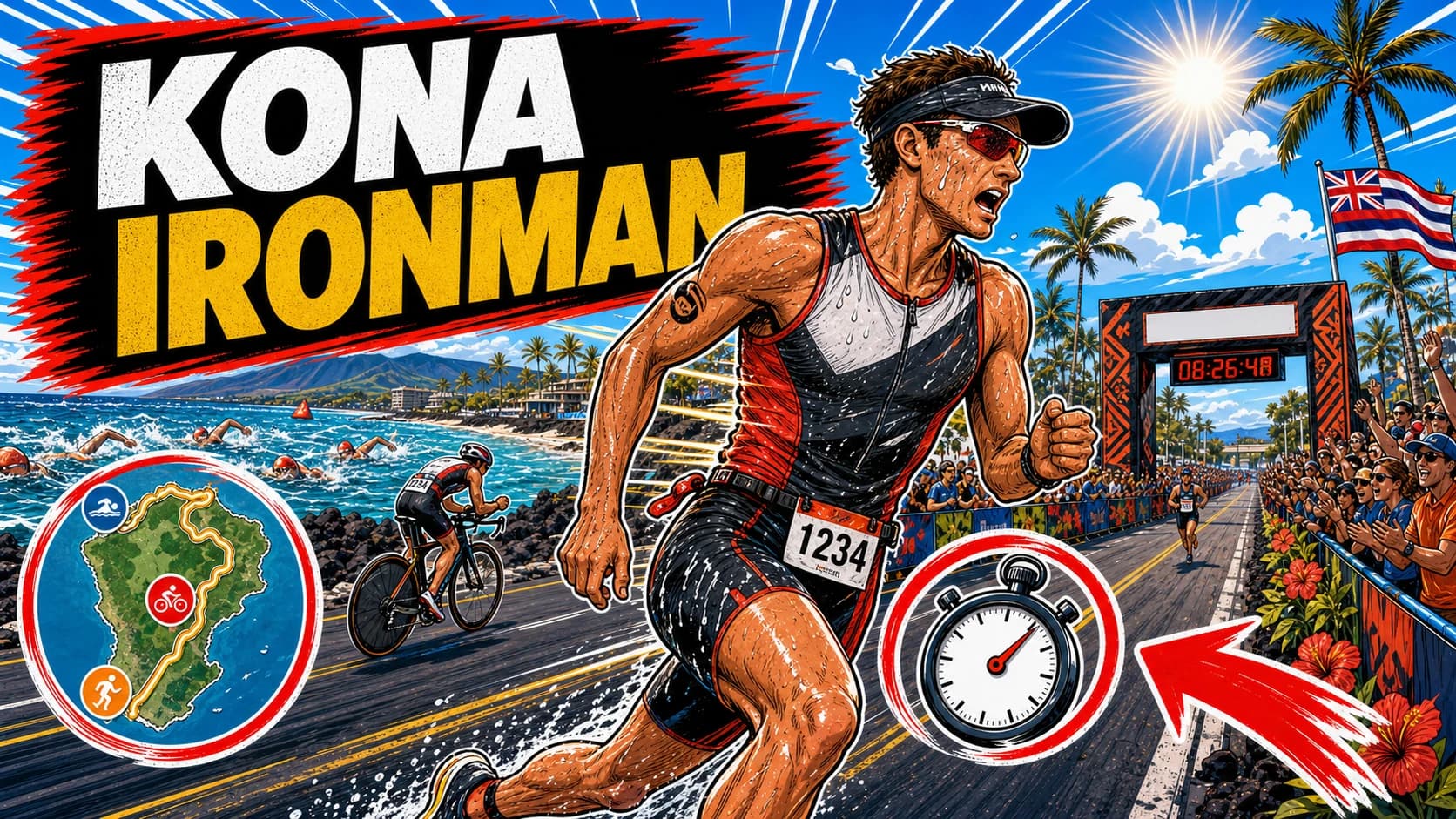
IRONMAN World Championship Kona 2026: complete guide
Confirmed guide to the 10 October 2026 IRONMAN World Championship in Kona: qualification, course, race-week limits, travel, training and logistics.
By Ramon Curto · Updated 12 July 2026
The 2026 IRONMAN World Championship takes place in Kailua-Kona, Hawaiʻi, on Saturday 10 October 2026. For the first time since 2019, women and men will race together on one day in Kona. Entry is by qualification only, and IRONMAN expects nearly 3,000 athletes.
The full-distance course combines a 2.4-mile / 3.8 km ocean swim in Kailua Bay, a 112-mile / 180.2 km bike to Hawi and back, and a 26.2-mile / 42.2 km run through Kona and the Natural Energy Laboratory Hawaiʻi Authority area. Those are confirmed organizer facts. Exact start waves, check-in hours, aid-station products, cutoffs and other race-week operations are not copied from 2025: IRONMAN says the 2026 information will be published closer to the event.
This guide is for qualified athletes and supporters who need a reliable planning framework. It does not promise a finishing time, prescribe one power target for every athlete or turn historical weather into a forecast. Open the official Kona race page and verify every operational detail in the final athlete guide.
| Item | Confirmed information |
|---|---|
| Date | Saturday 10 October 2026 |
| Host | Kailua-Kona, Island of Hawaiʻi, United States |
| Format | One race day with women and men together |
| Access | Qualification only |
| Expected field | Nearly 3,000 athletes |
| Swim | 2.4 miles / 3.8 km, ocean, Kailua Bay |
| Bike | 112 miles / 180.2 km, Kailua-Kona to Hawi and back |
| Run | 26.2 miles / 42.2 km, including Aliʻi Drive, Queen Kaʻahumanu Highway and NELHA |
| Total | 140.6 miles / 226 km |
| 2026 race-week guide | Not yet published when this article was checked |
The official race page is the authority if any of these details changes. A map is a general representation, and IRONMAN explicitly warns that lane layouts, counterflows and traffic control may differ from the illustration.
Recent World Championship editions split locations or race days by gender. In 2026, Kona becomes the exclusive host again and returns to a single-day format with women and men racing together. IRONMAN announced the change with Hawaiʻi state and local officials and described it as a reimagined event intended to balance competition, coverage and community constraints.
This matters for planning. Advice written for a women-only 2025 Kona week or a men’s World Championship in Nice is not a 2026 schedule. The combined field may affect wave planning, transition flow, road management and support logistics, but those details must come from the 2026 athlete guide rather than speculation.
The race is not open entry. Athletes must earn and accept a qualifying slot through the applicable IRONMAN process. The 2026 cycle introduced a performance-based age-group system using the Kona Standard, automatic age-group-winner slots and a performance pool based on age-graded results.
Qualification rules have also been updated during the cycle. IRONMAN’s December 2025 update changed how women’s performances are benchmarked and discussed slot acceptance and roll-down behaviour. Do not rely on a static table copied into a blog: use the current 2026 qualification update, your qualifying race communication and the official slot-acceptance instructions.
A slot is tied to the specific World Championship for which it was earned. The official FAQ says it cannot be deferred to Kona in another year. Confirm payment deadline, identification, federation requirements and any on-site slot ceremony before competing at a qualifier.
The official 2026 course page describes a clockwise out-and-back swim in Kailua Bay, starting and finishing by Kailua Pier. The published distance is 2.4 miles / 3.8 km. Ocean conditions can include small swells, but race-day current, water temperature and visibility cannot be guaranteed months ahead.
Train for open-water navigation, contact and a non-pool start. Use the final map to learn buoy order and start procedure. Wetsuit rules depend on the measured water temperature and the applicable competition rules; do not decide equipment from a historical average.
Supporters should use designated viewing areas and follow local access instructions. Kailua Pier and the surrounding waterfront are operational race spaces, not ordinary public access during the event.
The 112-mile / 180.2 km bike travels from Kailua-Kona to the Hawi turnaround and returns along the Queen Kaʻahumanu Highway. IRONMAN describes rolling terrain, exposed volcanic landscapes, a climb toward Hawi and the possibility of strong crosswinds.
That description supports practical preparation: sustained aerodynamic riding, controlled handling in variable wind, climbing without surging, hydration in exposed conditions and the ability to keep making safe decisions late in a long ride. It does not support a guaranteed wind speed at a particular kilometre or one wheel-depth recommendation for everyone.
Use the official 2026 GPX and map when preparing. Equipment must comply with current IRONMAN competition rules. Choose wheels and position based on your handling, expected conditions and professional advice, not a dramatic anecdote from another edition.
The marathon is 26.2 miles / 42.2 km. The official description sends athletes along Aliʻi Drive, up Palani Road to Queen Kaʻahumanu Highway, into the HOST Park at the Natural Energy Laboratory Hawaiʻi Authority, and back toward the Kona finish.
The course is described as rolling with intermittent steep sections. Prepare to regulate effort after a full swim and bike, drink while moving and adjust to conditions. Avoid importing exact kilometre-by-kilometre pacing from an older map: the final athlete guide, course signage and officials define the race.
Heat exposure is possible, but a July article cannot forecast 10 October. Build an evidence-based acclimation plan with a qualified coach or clinician where appropriate, and modify it if illness, travel fatigue or unsafe conditions intervene.
IRONMAN’s race-week page currently says that 2026 information will be available closer to the event and displays 2025 material in the meantime. Therefore this guide does not publish 2025 check-in hours, bag procedures or briefing times as if they apply in 2026.
Before travel, download the final athlete guide and confirm:
- athlete check-in dates and the no-late-check-in rule;
- briefing format and mandatory attendance, if any;
- bike and gear-bag check-in windows;
- wave or rolling-start assignments;
- intermediate and final cutoffs;
- aid-station locations and products;
- road closures, parking and supporter access;
- bike checkout and awards schedule.
Save offline copies after the final update. Race-week instructions can change for safety, weather or traffic management.
Kailua-Kona is on the west side of the Island of Hawaiʻi. Most long-haul athletes compare flights to Ellison Onizuka Kona International Airport at Keāhole with connections through Honolulu. Check airline bicycle rules, oversize fees, connection time and whether ground transport accepts a bike case.
Accommodation demand around the World Championship is exceptional. Compare cancellation terms, kitchen access, bicycle storage and the actual route to check-in and transition. A property marketed as “Kona” may still require a long drive. Do not assume race-day parking or ordinary road access.
Arrive with enough time to rebuild and test the bicycle, resolve damage and recover from travel. Follow IRONMAN’s local training-safety notices; the course page currently includes a warning against riding south of Kona town in the identified area.
There is no universal 40-week Kona plan. A qualified athlete’s starting fitness, injury history, climate, available terrain and qualifying-race recovery all matter. The useful common priorities are full-distance durability, open-water confidence, stable bike handling, fueling tolerance and running under accumulated fatigue.
Specificity should increase without turning every session into a simulation. Practise the equipment and nutrition you plan to use. Include recovery after the qualifying race. If using heat acclimation, make it progressive and supervised when medical risk is relevant. More heat is not automatically better preparation.
The final weeks should protect health and logistics. A last-minute fitness gain is rarely worth arriving injured, sleep-deprived or with an untested bicycle position.
Build targets from recent training and testing, not from professional splits or a generic table. Define effort ceilings for the swim start and early bike, a fueling range already tolerated in training, and objective signs that require slowing down or seeking medical help.
Conditions can change across the island and through the day. Treat wind, heat and humidity as variables to respond to, not proof that a fixed time penalty will occur. Obey officials and current rules even if they conflict with an earlier plan.
Finishing safely is more important than defending a predicted split. A World Championship qualification does not remove the risk of heat illness, dehydration, collision or overuse injury.
It is scheduled for Saturday 10 October 2026 in Kailua-Kona, Hawaiʻi. IRONMAN confirms that women and men will race together on one day. Check the official race page and final athlete guide for operational updates.
No. The event is qualification only. Athletes must earn and accept a slot through the applicable IRONMAN qualification process. Rules, roll-downs and deadlines belong to the qualifying event and current championship guidance, not a general blog summary.
The organizer publishes a 2.4-mile / 3.8 km swim, 112-mile / 180.2 km bike and 26.2-mile / 42.2 km run, totalling 140.6 miles / 226 km. Use final maps for exact operational routing.
Not yet on the race-week page when checked on 12 July. IRONMAN explicitly says 2026 information will appear closer to the event and currently shows 2025 material. Do not treat those older times as confirmed.
Kona can be hot, humid and windy, but historical ranges are not a forecast. Review the actual race-week forecast, alerts and organizer guidance. Prepare progressively for plausible conditions and adjust pacing, hydration and safety decisions to what occurs.
No. SportPlan helps athletes discover and save events. IRONMAN and each qualifying race control slots, acceptance, payment, rules and race-week operations. If this guide conflicts with official communication, follow the organizer and report the discrepancy for correction.
- IRONMAN World Championship Kona race page.
- Official 2026 Kona course page.
- Official announcement of the single-day 2026 return.
- 2026 qualification update.
- Kona race-week information status.
- Kona official FAQ.
Facts were checked on 12 July 2026. We will update the guide when IRONMAN releases the 2026 athlete guide or materially changes the race, course or qualification information.
Keep planning
Use SportPlan to compare dates, save target events, and build a season that fits your weekends instead of another unstructured list.