30 min læsningrunningmaraton
Marine Corps Marathon 2026 Complete Guide — Course, Monuments, "The People's Marathon" and How to Train For It
Marine Corps Marathon 2026 Complete Guide
Marine Corps Marathon 2026 Complete Guide
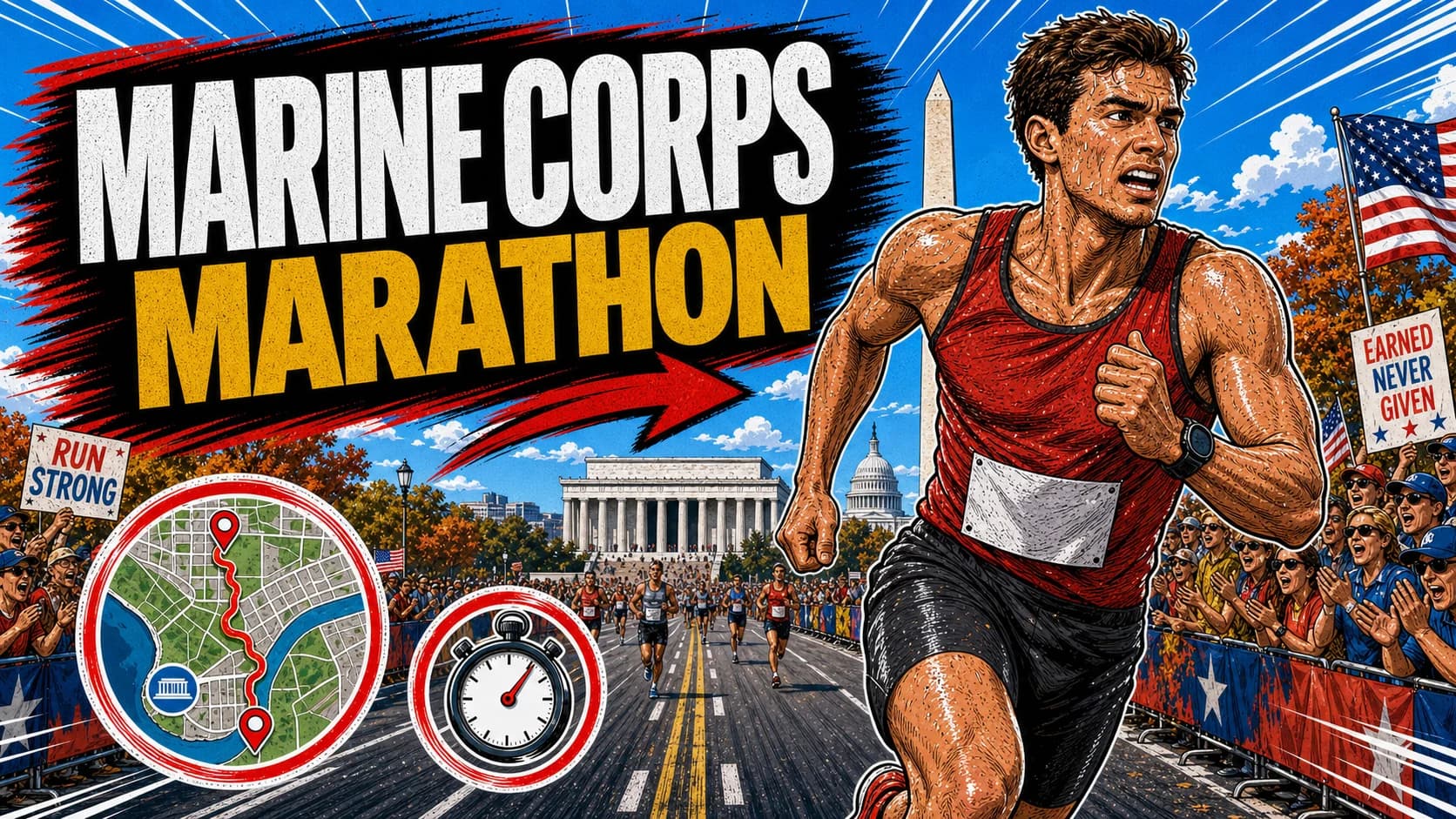
On Sunday, October 25, 2026 Arlington and Washington DC celebrate the 51st edition of the Marine Corps Marathon — known worldwide as "The People's Marathon" because it awards no prize money and is organized entirely by active-duty United States Marines, who volunteer at every aid station, every mile marker, and personally place the finisher medal around your neck. The start at Route 110 / Arlington National Cemetery, the crossing of Key Bridge into Georgetown, the miles between the Lincoln Memorial, Reflecting Pool, Washington Monument, U.S. Capitol and Smithsonian museums, the 14th Street Bridge cutoff at mile 20, and the final climb up "the Hill" to the finish under the raised flag at the Marine Corps War Memorial (Iwo Jima Memorial) make it one of the most symbolic marathons on the international calendar. This guide covers what the official site doesn't quite spell out: how to enter the lottery, how to handle the bridge cutoff, what to do at the Healthy Heart Expo at National Harbor, and how to manage the dual breaking points (the bridge and the final hill) with already-cooked legs.
| Item | Info |
|---|---|
| Date | Sunday, October 25, 2026 (last Sunday of October) |
| Edition | 51st (since 1976, Bicentennial inaugural year) |
| Distance | 42.195 km (26.2 mi / marathon) · companion 10K same morning |
| Profile | ~115 m elevation gain · flat except final climb ("the Hill") |
| Start | Route 110 / Arlington National Cemetery (Pentagon vicinity) |
| Finish | Marine Corps War Memorial (Iwo Jima Memorial), Arlington (VA) |
| Start time | 07:55 ceremony · 08:00 cannon |
| Organizer | U.S. Marine Corps (active-duty Marines) |
| Registration | marinemarathon.com — lottery + charity |
The Marine Corps Marathon is the most symbolic American marathon that awards no prize money: organized entirely by active-duty U.S. Marines since 1976, it runs through the major monuments of Washington DC and finishes under the raised flag at the Marine Corps War Memorial (Iwo Jima Memorial), where an active-duty Marine places the medal around your neck and salutes. It draws ~30,000 runners, attracts participants from 60+ countries, and is held every year on the last Sunday of October, with a companion 10K race the same morning. It's not a fast marathon nor does it try to be — its value lies in the tribute, not the clock.
Start at Route 110 / Arlington with thousands of runners in front of the Pentagon at sunrise, or finish under the raised flag at the Iwo Jima Memorial with a Marine handing over the medal.
What sets MCM apart from other international marathons:
The Marine Corps Marathon course is a circular 42.195 km (26.2 mi) layout that starts on Route 110 (Arlington, VA), crosses Key Bridge into Washington DC, runs through Georgetown, Rock Creek Park, the National Mall and the monumental heart of the capital, returns via the 14th Street Bridge to Crystal City, and finishes with a final climb ("the Hill") to the Marine Corps War Memorial (Iwo Jima Memorial). The profile is deceptive: ~115 m total elevation gain, almost all of it concentrated in the last 5 km — a cruel finish that destroys legs already cooked by the distance. Strava: MCM Final Hill (mile 24–25.5).
Official map of the circular Arlington–DC–Arlington course, ideally with elevation profile visible showing the final climb between mile 23 and mile 25.5.
Key segments:
MCM has two breaking points, not one. This sets it apart from Boston (Heartbreak Hill at mile 20) or NYC (1st Avenue at mile 17):
The Marine Corps Marathon was born in 1976 as a tribute from the Marine Corps to everyday runners during America's Bicentennial year. Its founding philosophy — "The People's Marathon" — is to award no prize money so that the focus stays on the collective experience, not on competition. It's the only major American marathon organized entirely by active-duty members of the armed forces, with more than 2,500 Marines volunteering on race morning. More than 1 million finishers have completed the race over its 50 previous editions.
Finish under the raised flag at the Iwo Jima Memorial — iconic moment that defines the race. Or archival image of the inaugural 1976 edition with the pioneer Marines.
Race and roll-of-honor data:
| Item | Value |
|---|---|
| First edition | 1976 (Bicentennial) |
| Editions held | 50 (through 2025) |
| Historic men's record | 2:14:01 — Jeffrey Scuffins (USA, 1987) |
| Modern men's record | 2:14:55 — Jeffrey Eggleston (USA, 2014) |
| Women's record | 2:31:23 — Olesya Nurgalieva (RUS, 2007) |
| Recent participants | ~30,000 starters · ~28,000 finishers |
| Countries represented | 60+ |
| Status | "The People's Marathon" · no prize money |
Data verified against the public archive of Marine Corps Marathon (Wikipedia EN).
Marine Corps Marathon registration runs through a lottery system since 2014. The lottery opens late March / early April of the edition year (March–April 2026 for MCM 2026), runs ~10 days, and the drawing is held in early May. Acceptance hovers around 50 % (~80,000 applicants for ~30,000 spots). Entry costs $190–230 USD depending on date. If you don't get in via lottery, charity bibs (MCM-approved organizations) are the alternative with a fundraising commitment of $5,000–10,000 USD.
Athletes at the Healthy Heart Expo at the Gaylord National Resort picking up bibs — atmosphere of the expo prelude.
| Item | Approx. cost |
|---|---|
| Lottery bib | $190–230 USD |
| Charity bib | $5,000–10,000 USD fundraising |
| Flight Madrid–Washington (DCA/IAD) | €600–900 |
| Hotel 4 nights Arlington/DC (4*) | €700–1,200 |
| ESTA visa USA | $21 USD (~€20) |
| Realistic total budget (lottery) | ~€1,700–2,500 |
| Realistic total budget (charity) | ~€6,300–11,500 + fundraising |
Washington DC has three airports, but the closest and most convenient for MCM is Reagan National (DCA) — only 5 km from the start, with a direct Metro Blue/Yellow connection. Dulles (IAD) is 35 km away (Metro Silver) and BWI Baltimore is 50 km (MARC train + Metro). Race morning, Metro Blue/Yellow to Pentagon station + 10-minute walk to the start is the optimal option — driving is NOT recommended: extensive traffic closures, saturated parking, and an Uber at 06:30 runs $30–50.
Runners exiting Pentagon Metro station at sunrise, walking toward Route 110 — the typical race-morning pattern.
| Airport | Distance | Time to center | Metro connection |
|---|---|---|---|
| Reagan National (DCA) | 5 km | 15 min | Yes — Blue/Yellow direct |
| Washington Dulles (IAD) | 35 km | 60 min | Yes — Silver line |
| BWI Baltimore | 50 km | 90 min | MARC train + Metro |
Recommendation: fly to DCA if you find a reasonable fare. Cost difference vs IAD/BWI is usually $50–100, but you save 1–2 h of transfer and $30–60 of Uber.
For Marine Corps Marathon the critical neighborhood is Crystal City or Pentagon City (Arlington, VA) — they're 1–2 km from the start and finish, with free shuttles offered by some hotels. Downtown DC is a good option if you want tourist atmosphere and to be in the middle of the course. National Harbor (MD) is where the Friday/Saturday expo lives but it's far from the start. Book 3+ months in advance — the last weekend of October is popular in DC.
| Hotel | Cat. | $/night* | To start | Runner highlight |
|---|---|---|---|---|
| Crystal Gateway Marriott | 4* | 220–340 USD | 1.5 km · 18 min | Free shuttle to Route 110 |
| Hyatt Regency Crystal City | 4* | 200–320 USD | 1.2 km · 15 min | Internal Metro connection |
| Westin Crystal City | 4* | 230–350 USD | 1.8 km · 22 min | Spa + runner massage |
| Holiday Inn Arlington Ballston | 3* | 160–240 USD | 4 km · Metro Orange | Comfortable mid-range |
| Doubletree Crystal City | 3* | 180–260 USD | 1.5 km · 18 min | Welcome cookies |
| Hotel | Cat. | $/night* | To start | Runner highlight |
|---|---|---|---|---|
| Marriott Marquis Washington DC | 5* | 350–550 USD | Metro · 35 min | Adjacent to Convention Center |
| Capital Hilton | 4* | 280–420 USD | Metro · 30 min | Historic, central |
| JW Marriott Washington DC | 5* | 380–580 USD | Metro · 30 min | Pennsylvania Ave, luxury |
| Conrad Washington | 5* | 400–600 USD | Metro · 35 min | Premium boutique |
| Hampton Inn Convention Center | 3* | 180–280 USD | Metro · 35 min | Mid-range central |
| Hotel | Cat. | $/night* | To expo | Runner highlight |
|---|---|---|---|---|
| Gaylord National Resort | 5* | 280–420 USD | 0 km · in-house | Expo is in the hotel |
| MGM National Harbor | 5* | 250–380 USD | 1 km · 12 min | Casino + spa |
| Hyatt Regency Alexandria | 4* | 180–280 USD | 8 km · 15 min car | Old Town setting |
*Indicative rates last weekend of October. Book with flexible cancellation policies if your lottery is uncertain.
The weather in Washington DC on the last Sunday of October is one of the most favorable on the American marathon calendar. Historical average is start temperature 5–10 °C (41–50 °F), finish max 13–18 °C (55–64 °F), with frequent clear sky and occasional crisp wind. The October foliage is at peak — the trees of the National Mall and Rock Creek Park offer a spectacular fall backdrop. 7 of the last 10 editions have run without significant rain.
Runners mid-course mile 9–15 with autumn-colored trees and monuments in the background — the aesthetic pattern of MCM.
Plan by forecast:
The foliage factor. If you get a clear day, miles 9–15 (National Mall) and miles 2.5–9 (Georgetown + Rock Creek Park) are among the most beautiful on the world marathon calendar. Bring your phone strapped to your arm for photos at mile 11 (Reflecting Pool) and mile 24 (Arlington Cemetery view).
The recommended plan for Marine Corps Marathon combines two specifics: managing conservative pace through the first 16 miles to secure the 14th Street Bridge cutoff and stacking hill repeats to survive "the Hill" at mile 23–25.5. Most non-debutant runners underestimate the second point — ~80 m of elevation gain in 2.5 miles sounds like nothing, but arriving with cooked legs turns the climb into a heavy walk.
Runner doing hill repeats at sunset — the key workout to prepare for "the Hill" final stretch of MCM.
| Goal | Avg pace | Peak weekly volume | Peak long run |
|---|---|---|---|
| 3h00 | 4:16 min/km · 6:52 min/mi | 90–110 km · 56–68 mi | 32–36 km · 20–22 mi |
| 3h30 | 4:58 min/km · 8:01 min/mi | 70–85 km · 43–53 mi | 32–35 km · 20–22 mi |
| 4h00 | 5:41 min/km · 9:09 min/mi | 55–70 km · 34–43 mi | 30–32 km · 19–20 mi |
| 4h30 | 6:24 min/km · 10:18 min/mi | 45–55 km · 28–34 mi | 28–30 km · 17–19 mi |
| Finish | 7:00–7:30 | 35–45 km · 22–28 mi | 25–28 km · 16–17 mi |
Three workouts that are gold for MCM:
Your recent 10K predicts your MCM marathon (factoring elevation + final climb):
| Recent 10K | Realistic MCM marathon target |
|---|---|
| 38 min | sub-3:00 (with specific prep) |
| 42 min | 3:10–3:20 |
| 45 min | 3:25–3:35 |
| 48 min | 3:40–3:55 |
| 52 min | 4:00–4:15 |
| 55 min | 4:20–4:40 |
| 60 min | 4:45–5:10 |
| 65 min | 5:15–5:45 |
Approximate prediction. Add 5–10 min over your theoretical equivalent (Daniels, Riegel) due to the final climb at mile 23–25.5.
Your race plan starts with an average pace and goal splits in hand. Change your goal time (sub-3:30, 4:00, 4:30…) and the table updates instantly with the required pace (min/km and min/mi) and accumulated times at each checkpoint:
| Punto | Tiempo acumulado | Parcial |
|---|---|---|
| 5 km | 28:26 | 28:26 |
| 10 km | 56:53 | 28:26 |
| 15 km | 1:25:19 | 28:26 |
| Media (21,1 km) | 2:00:00 | 34:41 |
| 30 km | 2:50:38 | 50:38 |
| Meta | 4:00:00 | 1:09:22 |
Splits asumen ritmo constante. En carreras con desnivel real (Marine Corps Marathon) — banca 5–8 s/km en bajadas y pierde el mismo margen en subidas; el ritmo medio se mantiene.
The MCM race plan must manage three traps: the first quarter (don't accelerate with the emotion of starting in front of the Pentagon), the 14th Street Bridge cutoff (tactical patience, conservative bank) and "the Hill" final (effort, not pace). The classic mistake is to attack miles 9–15 of the National Mall on the emotional high of the monuments — and arrive at the bridge with no margin, at the climb empty.
| Goal | Goal splits | MCM-specific tactical note |
|---|---|---|
| sub-2:45 | 3:54 min/km · 6:17 min/mi | Conservative first 10K (no more than +5 sec/km below goal). Secure bridge with 25-min margin. "The Hill" by effort: 4:10–4:20. Close at pace. |
| sub-3:00 | 4:16 min/km · 6:52 min/mi | Cross half in 1:30:30. Secure bridge by 2:14. "The Hill" at 4:35–4:50. Recover at the end. |
| sub-3:15 | 4:37 min/km · 7:26 min/mi | Cross half in 1:38. Bridge by 2:25. "The Hill" without panic — attack by effort. |
| sub-3:30 | 4:58 min/km · 8:01 min/mi | No rush mile 0–6 (first 10K). Cross half in 1:45:30. Walk 15 sec at aid stations mile 16 and mile 20. "The Hill" at 5:30–5:50. |
| sub-4:00 | 5:41 min/km · 9:09 min/mi | Conservative pace 5:50–6:00 mile 0–6. Cross half in 2:00. Secure bridge at 3:00. "The Hill" at 6:20–6:40. |
| sub-4:30 | 6:24 min/km · 10:18 min/mi | Cross half in 2:15. Secure bridge at 3:25 (35-min margin). "The Hill" walking uphills if needed. |
| sub-5:00 | 7:06 min/km · 11:25 min/mi | Cross half in 2:30. Secure bridge at 3:50 (10-min margin). Critical not to lose pace mile 16–19. "The Hill" walking. |
| Finish | 7:30+ | The cutoff is 6 h at the bridge. Push hard first 16 miles then enjoy. |
The MCM nutrition strategy pivots on 60–100 g carbs per hour, with 5–8 gels distributed every 25–30 min from mile 5. Carb load the 3 days before: 8–10 g/kg/day. Saturday dinner light (white pasta, grilled chicken, fruit — DC restaurants offer pasta-load options on the last weekend of October). At MCM sodium matters more than at many European marathons — DC's dry October air can cause silent dehydration even with cool temperatures.
| Goal | Carbs/hour | Gels | When |
|---|---|---|---|
| 4h30 | 45–55 g/h | 5 | mile 5, 10, 14, 19, 23 |
| 4h00 | 55–70 g/h | 5–6 | mile 5, 9, 13, 16, 20, 23 |
| 3h30 | 60–75 g/h | 6 | mile 4, 8, 11, 15, 19, 23 |
| 3h00 | 75–90 g/h | 7 | mile 3, every 3 mi through mile 22 |
Official aid stations: MCM has 17+ aid stations along the course with water + Powerade. Official gels (GU) at specific stations (mile 7.5, 15, 20). Carry 2–3 personal gels for safety — official ones may not be your usual brand.
The best shoes for Marine Corps Marathon are mixed-carbon plate (Nike Vaporfly, Adidas Adios Pro, ASICS Metaspeed Sky) — the course is predominantly flat through mile 23, after which the climb requires more protection. For non-elite runners, a plate with good protection + hybrid daily-trainer works better than ultralight options like Alphafly.
| Goal | Category | Common models |
|---|---|---|
| ≤2h45 | Elite carbon plate | Nike Alphafly 3 · adidas Adios Pro Evo · ASICS Metaspeed Edge |
| 2h45–3h30 | Mixed carbon plate | Nike Vaporfly 4 · Saucony Endorphin Elite · Hoka Rocket X 2 |
| 3h30–4h00 | Super-trainer or carbon | Saucony Endorphin Speed · Hoka Mach X · ASICS Magic Speed |
| 4h00+ | Protective daily trainer | Nike Pegasus · ASICS Cumulus · Brooks Ghost |
Gear laid out: singlet, shorts, throwaway warm layer, cap, gels, sunglasses — the typical MCM October kit.
MCM-specific gear:
The Marine Corps Marathon lottery opens late March / early April of the edition year, runs ~10 days, and the drawing is in early May. Acceptance is around 50 % (~80,000 applicants for ~30,000 spots). Cost is $190–230 USD and you're charged only if selected. Active-duty military have guaranteed entry.
The 14th Street Bridge is at mile 20 of the course. To cross it you must arrive within ~6 hours from the start cannon (avg pace ~14:24 min/mile). If you don't make it in time, Marines load you on the "Sweep Vehicle" and the marathon ends. It's the most famous cutoff on the American marathon calendar.
More than 2,500 active-duty Marines volunteer race morning. Every aid station, every mile marker, every traffic crossing, every finish-line zone is staffed by a Marine. At the finish, an active-duty Marine places the medal around your neck and salutes — iconic moment. The entire organization is run by the U.S. Marine Corps; not a private contractor.
Yes, fully. MCM accepts runners of any nationality. You need an ESTA visa ($21 USD, valid 2 years) for EU/UK/AU passports. Pick up bib Friday/Saturday at the Healthy Heart Expo at the Gaylord National Resort with passport. 60+ countries represented each edition.
MCM doesn't require qualifying. It's a lottery: you apply, ~50 % chance of getting in. If you don't get in via lottery, there's a charity bib route ($5,000–10,000 fundraising) with approved organizations (Semper Fi & America's Fund, Wounded Warrior Project). No qualifier times.
Boston requires BQ qualifying (time-based qualifying) and attracts runners chasing personal bests. MCM is lottery (~50 % acceptance) and is "The People's Marathon" — no prize money, organized by Marines, focus on experience. Boston is elite prestige; MCM is collective tribute. For your first American marathon, MCM is more accessible.
NYC is lottery, 50,000 runners, lots of atmosphere, hilly course (Verrazzano + 1st Ave + Central Park). Chicago is lottery, flat and fast, ideal for PB. LA is March, point-to-point, gentle course. Twin Cities is October like MCM, flat-ish. MCM is the only one with Marines, monuments and no prize money — the most symbolic.
The official cutoff is 6 h at the 14th Street Bridge (mile 20). After the bridge you can finish at your own pace, though aid stations close progressively. In practice, 6:30–7:00 h is the reasonable limit to cross the Iwo Jima Memorial finish with the team still operational.
No. Pickup is at the Healthy Heart Expo at the Gaylord National Resort & Convention Center, National Harbor (MD), on Friday and Saturday before. No Sunday pickup. You need passport/photo ID + email confirmation.
Yes. The MCM10K runs the same morning of October 25, 2026, starting shortly after the marathon. Course through Crystal City + 14th Street Bridge + part of the National Mall. Separate registration (also lottery), ~$60 USD. Good option if you're traveling with partner/family who doesn't want a full marathon.
The Marine Corps Marathon is the most symbolic and accessible of the major American marathons, but not the fastest or the most prestigious. This table compares the five majors to help you decide:
| Race | Month | Elevation | Best for | Entry |
|---|---|---|---|---|
| MCM (this guide) | October | ~115 m + final climb | Experience · monuments · tribute | Lottery (~50 %) or charity |
| Boston Marathon | April | ~140 m descent + 4 hills | Prestige · BQ runners | BQ qualifying or charity |
| NYC Marathon | November | ~250 m | Atmosphere · 50,000 runners | Lottery + 9+1 + charity |
| Chicago Marathon | October | <30 m | Flat PB · cool weather | Lottery |
| LA Marathon | March | Rolling point-to-point | City + coast | Open registration |
| Twin Cities Marathon | October | <50 m | Flat, family vibe | Lottery |
Did this guide help? If you're running MCM 2026, save the event on SportPlan to receive lottery-opening alerts, charity deadlines and, after, log your result.
Fortsæt med at planlægge
Brug SportPlan til at sammenligne datoer, gemme målbegivenheder og bygge en sæson, der passer til dine weekender i stedet for endnu en ustruktureret liste.