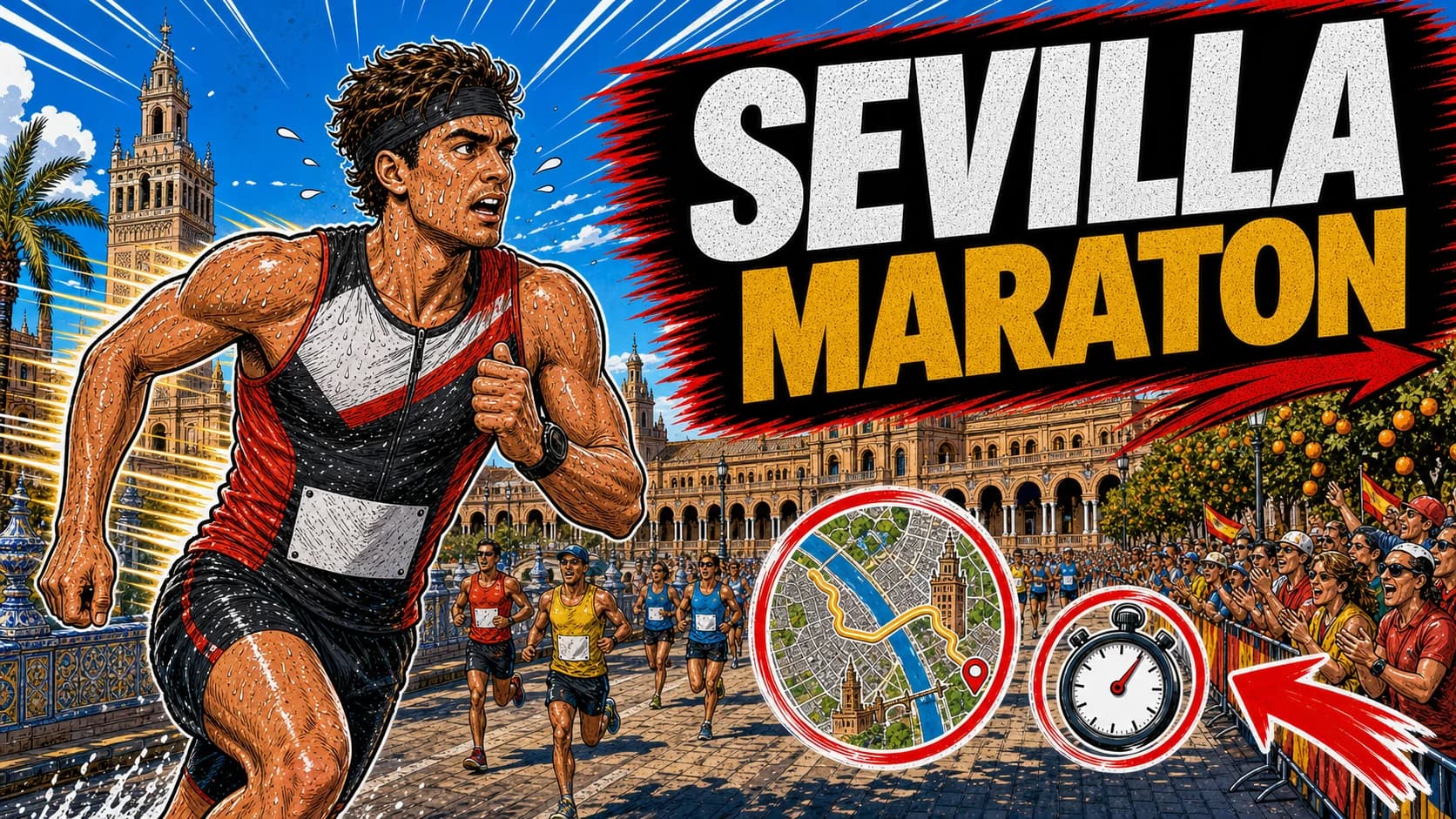
On February 21, 2027 Seville hosts Spain's second-fastest marathon after Valencia. Essentially flat course (<50 m total elevation gain), World Athletics Platinum Label since 2024, ~14,000 finishers, ideal Andalusian winter weather (8–15 °C, low humidity) and a route past the Cathedral, the Giralda, the Royal Alcázar, Plaza de España and Triana. This guide covers what the official site does not fully explain: why Seville is the best PB alternative to Valencia, what the course actually feels like, where the race breaks (kilometers 30–37 returning through Triana), and how to plan logistics for a weekend in the Andalusian capital.
Why Seville is Spain's second-fastest PB course, what kind of runner fits it, and when to pick something else.
The Zurich Seville Marathon is Spain's second-fastest marathon and one of Europe's most reliable PB courses. Organized by IMD Sevilla (the city's Sports Department) together with Zurich Insurance as title sponsor since 2017, the race has been built into a flat-course PB machine since 1985. The route starts at the Estadio Olímpico de la Cartuja, crosses the Puente del Alamillo, traverses the historic centre passing the Cathedral, the Giralda, the Royal Alcázar, Plaza de España and Parque de María Luisa, heads south along Avenida de la Palmera, returns through Triana crossing the Puente de Triana, and ends back at the stadium. Since 2024 it holds World Athletics Platinum Label, the highest tier in the international calendar — together with Valencia, the only two Spanish races at this level.
📷 Photo pending · About-the-race header
Lead pack passing the Giralda at km 12 — the postcard image of the Seville Marathon.
Seville is the best alternative to Valencia. If Valencia is sea-level course in December, Seville is near-flat course in February with monuments. What you give up in altitude (Seville sits at ~10 m, still effectively sea level) you gain in weather — February in Seville is one of Europe's best marathon weather profiles: 5–8 °C at the start, 12–18 °C at the finish, low humidity, typical sunshine. The average amateur runner trims 2–4 minutes off their previous best when switching from a hilly marathon (Madrid, Bilbao, Donostia) to Seville. And the finish rate exceeds 97% — one of the highest in Europe, thanks to the combination of flat course + mild weather + polished organization.
If you ran a recent sub-3:30 on rolling terrain: target 3:23–3:27 here. Flat course + ideal climate give you back 2–4 minutes.
If you come from half marathons and are debuting at the marathon distance: Seville is an excellent choice — flat profile, mild temperature and ~97% finish rate support first-timers.
If your goal is sub-3h, sub-2:45, sub-2:30: it is the best February option and Spain's second alternative after Valencia.
If you want a mega-event with massive crowds:Berlin, London or NYC play in another league. Seville sits around 14,000 finishers — more intimate.
If tourism tempts you: the route passes Seville's top monuments. A weekend of race + tapas + Alcázar is one of the calendar's best sports getaways.
A flat route linking Estadio Cartuja with the historic centre and Triana — where the race breaks and how to manage it.
The Seville Marathon course is a loop that starts and finishes at the Estadio Olímpico de la Cartuja (north Seville), passes every iconic monument in the historic centre, and returns. The profile is dead flat: <50 m total elevation gain, no significant ramp anywhere on the course. The only "climb" of the route is the Puente del Alamillo ramp at km 1 — irrelevant for the clock.
📷 Photo pending · Course map
Schematic map with key points: start at Cartuja, Cathedral km 12, Plaza de España km 17, Triana return km 32, finish at Cartuja km 42.
Km 0–3 — Start at Estadio Cartuja → Puente del Alamillo: you exit the stadium heading south and cross the Guadalquivir River via the Puente del Alamillo (Calatrava). Only "ramp" of the route. Resist the urge to start fast.
Km 3–10 — North into the historic centre: wide avenues, smooth asphalt, comfortable pace. Keep heart rate under control.
Km 10–18 — Monumental centre: you pass the Cathedral, the Giralda, the Alcázar, Plaza de España and Parque de María Luisa. The most beautiful stretch of the route. Do not speed up because of the visual rush — classic mistake.
Km 18–28 — South along Avenida de la Palmera: long straight avenue heading south. Pace shakeout zone. Lock target pace.
Km 28–35 — Return through Triana: you cross the river back via the south, run through the Triana neighborhood and re-cross via the Puente de Triana. This is where the race breaks for most runners.
Km 35–42 — Final approach to Cartuja: north back to the stadium. If you have managed effort, the final 7 km feel manageable. If not, you pay for the centre overpacing.
From the first edition in 1985 to the 2024 Platinum Label — how Seville became Spain's #2 PB course.
The Seville Marathon was born in 1985 as a popular race in the Andalusian calendar. For two decades it stayed a mid-scale regional event. The qualitative leap came in 2017 with Zurich Insurance entering as title sponsor — since then, Zurich Maratón de Sevilla. Investment in organization, certified course, professional pacers and African elite attraction earned the race Bronze Label (2018), Silver Label (2020), Gold Label (2022) and finally Platinum Label in 2024 — World Athletics' highest tier, shared with Valencia as the only Spanish race at that level.
Course records were substantially updated in the 2024 edition. For definitive figures consult the official archive at zurichmaratonsevilla.es — absolute men's times hover around ~2:03 and women's around ~2:23, placing Seville among the world's fastest marathons in elite category.
📷 Photo pending · Elite finish
Archive image from a recent edition — finish at Estadio Olímpico de la Cartuja with Platinum Label podium.
February in Seville is one of Europe's best marathon weather profiles — what to expect and what to wear.
Variable
Start 8:30
Finish 11:00–12:30
Temperature
5–8 °C
12–18 °C
Humidity
65–80%
45–60%
Wind
Light (Guadalquivir)
Light-moderate
Rain (last 10 years)
2 editions with light rain
—
Sun
Typical from km 8
Full sun
February in Seville is one of the European calendar's most favorable climates for a marathon. The combination of cool start (5–8 °C) gradually rising to mild finish (12–18 °C), low humidity and consistent sunshine puts the race in the world's top "weather profiles". Compare with Berlin (September, ~12–18 °C but high humidity), Valencia (December, 8–14 °C, also ideal) or Boston (April, unpredictable).
Enter your goal time and get splits and average pace for the Seville course.
🎯 Calculadora de ritmo y splitsEscribe tu tiempo objetivo para Zurich Maratón de Sevilla
Ritmo medio requerido4:59 min/km
Equivalente en millas8:01 min/mi
Punto
Tiempo acumulado
Parcial
5 km
24:53
24:53
10 km
49:46
24:53
15 km
1:14:39
24:53
Media (21,1 km)
1:45:00
30:21
30 km
2:29:18
44:18
Meta
3:30:00
1:00:42
Splits asumen ritmo constante. En carreras con desnivel real (Zurich Maratón de Sevilla) — banca 5–8 s/km en bajadas y pierde el mismo margen en subidas; el ritmo medio se mantiene.
Universal rules across profiles — splits, early conservation, monumental-centre management.
Moderate negative split: target first half 30–60 s slower than the second. Flat course allows it.
Conserve first 15 km: Seville's trap is speeding up in the monumental centre due to the visual high of the Cathedral, the Giralda and the Alcázar. Every second banked at km 12 you pay back multiplied at km 35.
Triana return is where you break: if you reach km 28 with legs, you decide the race. If you arrive empty, the next 14 km feel long.
Final stretch: the last 2 km return to Estadio Cartuja with a slight downhill into the finish — save fuel for the final 800 m.
Seville in February starts at 5–8 °C — a black coffee 60–90 min before helps wake up and oxidize fat. Take coffee at the hotel, not at the start-line bar (huge queue).
Shoes, clothing, accessories — what to bring and what to skip.
Shoes: carbon-plated if going sub-3:30 (Nike Vaporfly/Alphafly, Adidas Adios Pro, ASICS Metaspeed Sky). For finishers, your usual long-run shoe — do not break in anything new.
Socks: technical, tested in at least one long run. Anti-chafe Vaseline on toes.
Top: short-sleeve technical. The official bib shirt do not break in — test beforehand.
Bottoms: shorts with pockets for 4–6 gels.
GPS watch: yes, but do not obsess over per-km pace — Seville has GPS-loss zones (bridges, tall centre buildings).
Gel belt: optional if your shorts have enough pocket capacity.
Yes. Course with <50 m total elevation gain, ~10 m above sea level and World Athletics Platinum Label since 2024. The only faster Spanish race is Valencia (December).
Start 5–8 °C, finish 12–18 °C, low humidity, typical sunshine. 8 of the last 10 editions had ideal conditions. One of the European calendar's best marathon weather profiles.
Kilometers 30–37, on the Triana return toward Estadio Cartuja. Breaking is not from terrain (all flat) — it is from overpacing in the monumental centre or under-fueling. Solution: gel every 25 min from km 6.
This guide is updated each edition. Last review: 2026-05-08. If you spot stale data, reach out via SportPlan.
Fortsæt med at planlægge
Brug SportPlan til at sammenligne datoer, gemme målbegivenheder og bygge en sæson, der passer til dine weekender i stedet for endnu en ustruktureret liste.