24 Min. Lesezeitrunningmaraton
Boston Marathon 2027 Complete Guide — Course, BQ, Heartbreak Hill and How to Train For It
📖 14 min read 📝 3,000 words 🎯 Skim friendly
Boston Marathon 2027 Complete Guide
By · Updated 2026-05-06
📖 14 min read 📝 3,000 words 🎯 Skim friendly
By · Updated 2026-05-06
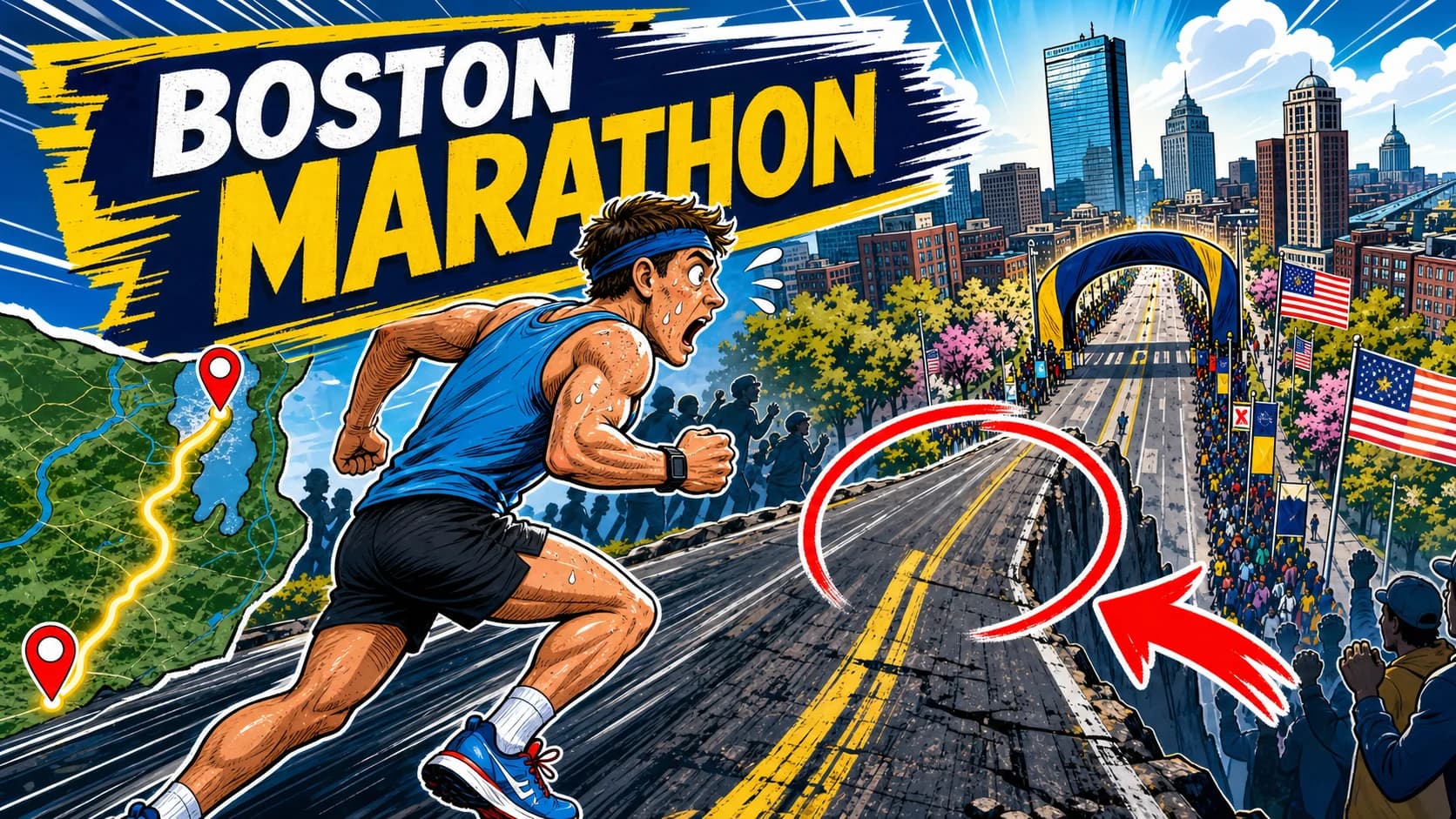
On Monday, April 19, 2027 (Patriots' Day) Boston runs its 131st edition — the world's oldest annually held marathon since 1897 and the holy grail for any runner chasing a BQ (Boston Qualifier). Point-to-point from Hopkinton to Boylston Street, with the four Newton Hills and Heartbreak Hill at mile 20, Boston isn't the fastest marathon on the international calendar but it's the most symbolic. This guide covers what the BAA's official site doesn't quite spell out: how to get in (qualifying times or charity), how to manage the net descent + the hill repeats before mile 20, what to do in Hopkinton during the two hours before your wave, and how to run the final stretch down Beacon Street to "right on Hereford, left on Boylston" without falling apart.
| Item | Info |
|---|---|
| Date | Monday, April 19, 2027 (Patriots' Day) |
| Distance | 42.195 km (26.2 mi / marathon) |
| Profile | Point-to-point · ~140 m net descent · 4 Newton Hills + Heartbreak Hill |
| Start | Hopkinton (Massachusetts) |
| Finish | Boylston Street, Boston |
| Start time | Waves from 09:30 (elite at 09:32) |
| Organizer | Boston Athletic Association (BAA) |
| Registration | baa.org — BQ qualifying or charity bib |
The Boston Marathon is the world's oldest annual marathon (since 1897), one of the six World Marathon Majors, and the only one of the six that requires a qualifying time (BQ) to enter (except via charity). It draws ~30,000 runners, attracts participants from 80+ countries, and is held every year on Patriots' Day (the third Monday in April), a Massachusetts state holiday. It's not the fastest marathon on the international calendar — the net descent and Newton Hills make it demanding — but it is the most symbolic in global road running.
Hopkinton start at sunrise with thousands of runners waiting in the Athletes' Village, or the podium on Boylston Street with the classic finish line.
What sets Boston apart from other World Marathon Majors:
The Boston Marathon course is a point-to-point 26.2-mile route that starts in Hopkinton (Massachusetts) and finishes on Boylston Street (Boston). The profile is deceptive: it has a net descent of ~140 m from Hopkinton to Boston, but the first stretch is downhill (which trashes quads), the middle is rolling, and the four Newton Hills (mile 16–21) culminate in Heartbreak Hill — the most famous climb in road running. The "right on Hereford, left on Boylston" from mile 25.8 to 26.2 is the most iconic finish stretch on the international calendar.
Official point-to-point Hopkinton–Boston course map, ideally with elevation profile visible showing the early descent + Newton Hills.
Key segments:
The four climbs add ~70 m of vertical gain in less than 5 miles. Exact breakdown:
The Boston Marathon has been run since 1897, making it the world's oldest annual marathon. It was the first marathon open to mass participation (1,900 runners by 1900 vs. today's 30,000) and the first to officially accept women (1972). The men's course record (2:01:50, John Korir, 2026) is comparable to Berlin's records but on a tougher profile. The Boston Athletic Association (BAA) has kept the Patriots' Day format since the very first edition.
Most recent winner crossing the finish line on Boylston Street — the iconic image that anchors the past-winners section.
Past-winner and event facts (recent editions):
| Item | Value |
|---|---|
| First edition | 1897 |
| Editions held | 130 (through 2026) |
| Men's record | 2:01:50 (John Korir, KEN, 2026) |
| Women's record | 2:17:22 (Sharon Lokedi, KEN, 2025) |
| Recent participants | ~30,000 |
| Countries represented | 80+ |
| Status | World Marathon Majors |
Verified winners and times:
| Year | 🥇 Men | Country | Time | 🥇 Women | Country | Time |
|---|---|---|---|---|---|---|
| 2026 | John Korir | 🇰🇪 KEN | 2:01:50 | Sharon Lokedi | 🇰🇪 KEN | 2:18:51 |
| 2025 | John Korir | 🇰🇪 KEN | 2:04:45 | Sharon Lokedi | 🇰🇪 KEN | 2:17:22 |
| 2024 | Sisay Lemma | 🇪🇹 ETH | 2:06:17 | Hellen Obiri | 🇰🇪 KEN | 2:22:37 |
| 2023 | Evans Chebet | 🇰🇪 KEN | 2:05:54 | Hellen Obiri | 🇰🇪 KEN | 2:21:38 |
| 2022 | Evans Chebet | 🇰🇪 KEN | 2:06:51 | Peres Jepchirchir | 🇰🇪 KEN | 2:21:01 |
Data verified against the public archive at List of winners of the Boston Marathon (Wikipedia).
Boston Marathon registration doesn't work like other marathons. There's no early-bird and no first-come — you need to have run a certified marathon under the BQ qualifier time for your age group within the 18 months prior to the edition. Registration opens in September of the previous year (Sept 2026 for Boston 2027), runs ~10 days, and the BAA accepts the runners with the largest margin under their BQ.
Athletes in the Hopkinton Athletes' Village waiting for their wave — the iconic Boston prelude image.
Qualifier times by age group and gender:
| Age | Men | Women |
|---|---|---|
| 18–34 | sub-3:00:00 | sub-3:30:00 |
| 35–39 | sub-3:05:00 | sub-3:35:00 |
| 40–44 | sub-3:10:00 | sub-3:40:00 |
| 45–49 | sub-3:20:00 | sub-3:50:00 |
| 50–54 | sub-3:25:00 | sub-3:55:00 |
| 55–59 | sub-3:35:00 | sub-4:05:00 |
| 60–64 | sub-3:50:00 | sub-4:20:00 |
| 65–69 | sub-4:05:00 | sub-4:35:00 |
| 70+ | sub-4:20:00 | sub-4:50:00 |
Times published by the BAA. Always confirm the official version in force for your edition at baa.org.
Important: hitting the BQ time doesn't guarantee a spot. In recent years, the BAA has had to turn away runners with a BQ and accept only those 5–7 minutes under the qualifier time. Aim for 5+ minutes of margin under your BQ if you want certainty.
If you don't have a BQ, the official BAA charities (~80 organizations, including Dana-Farber, American Liver Foundation, Massachusetts General Hospital) offer bibs in exchange for a fundraising commitment:
Charity registration opens in the fall/winter before the edition and usually fills within weeks. If you're going charity, register in September of the previous year.
| Item | Approx. cost |
|---|---|
| BQ bib | $250 USD (~€230) |
| Charity bib | $250 USD + fundraising ($5,000–15,000) |
| Round-trip flight Madrid–Boston | €600–900 |
| 4-night Boston hotel (4*) | €800–1,500 (Patriots' Day weekend = peak) |
| Realistic total budget (BQ) | ~€1,800–2,700 |
| Realistic total budget (charity) | ~€6,500–15,000 + fundraising |
The usual way to reach Boston from Spain is a direct flight to Boston Logan (BOS) from Madrid (Iberia / American Airlines, ~7 h). Once in Boston, stay in the city (not in Hopkinton — it's a town of 18,000 with no runner infrastructure) and on race morning take the official BAA bus from Boston Common to Hopkinton (28 miles, ~1 h).
The classic finish line on Boylston Street, with the spectator grandstand and the official clock visible.
Race-morning logistics:
No private cars allowed into Hopkinton on race day. The official bus is mandatory.
For Boston Marathon the critical neighborhood is Back Bay (near the finish on Boylston Street) or Downtown / Beacon Hill (near Boston Common, where the bus to Hopkinton departs). Cambridge offers lower rates and a quick subway connection (Red Line) to downtown. Book 6+ months in advance — Patriots' Day weekend sells the city out.
| Hotel | Cat. | $/night* | To finish | Runner edge |
|---|---|---|---|---|
| Lenox Hotel | 4* | $350–500 | 0.3 mi · 6 min | 200 m from the finish line |
| Westin Copley Place | 4* | $300–450 | 0.2 mi · 4 min | Right by Copley Square |
| Mandarin Oriental Boston | 5* | $600–900 | 0.25 mi · 5 min | Bathtub, luxury, strong AC |
| Marriott Copley Place | 4* | $280–420 | 0.2 mi · 4 min | Internal connection to Prudential Center |
| Boston Park Plaza | 4* | $220–340 | 0.5 mi · 10 min | Historic, mid-upper tier |
| Hotel | Cat. | $/night* | To Boston Common | Runner edge |
|---|---|---|---|---|
| The Liberty Hotel | 4* | $350–500 | 0.3 mi · 6 min | Boutique in former jail |
| Omni Parker House | 4* | $240–360 | 0.2 mi · 4 min | Historic (1855), central |
| The Bostonian Boston | 4* | $220–320 | 0.3 mi · 7 min | Quiet, by the market |
| Club Quarters Hotel Boston | 3* | $180–280 | 0.25 mi · 5 min | Mid-range, runner-friendly |
*Rates indicative for Patriots' Day weekend (peak). Cambridge standard rates $150–250/night.
Boston weather in the third week of April is the most unpredictable of the World Marathon Majors. The historical Patriots' Day average is start temp 8–12 °C (46–54 °F), finish high 14–18 °C (57–64 °F), but the swings are brutal: 2018 was 5 °C with freezing rain and a headwind (extreme conditions racing), while 2012 was 27 °C with sun (DNF record from heat). Year-to-year swings can be 20 °C.
Runners mid-race with New England trees in bloom in the background — Boston's signature aesthetic.
Plan by forecast:
The "headwind" factor is real. The course goes west to east; the prevailing wind in April is from the west. If the forecast shows >25 km/h (15 mph) from the west, pace gets tougher.
The recommended Boston plan combines two specifics: training your quads for the early downhill and stacking hill repeats to survive the Newton Hills. Most runners underestimate the first point — the steep early descent trashes quads if you haven't done at least 4 long runs with a downhill profile in your buildup.
| Goal | Avg. pace | Peak weekly volume | Peak long run |
|---|---|---|---|
| 3:00 | 4:16 min/km (6:52 min/mi) | 90–110 km (56–68 mi) | 32–36 km (20–22 mi) |
| 3:30 | 4:58 min/km (8:00 min/mi) | 70–85 km (43–53 mi) | 32–35 km (20–22 mi) |
| 4:00 | 5:41 min/km (9:09 min/mi) | 55–70 km (34–43 mi) | 30–32 km (19–20 mi) |
| 4:30 | 6:24 min/km (10:18 min/mi) | 45–55 km (28–34 mi) | 28–30 km (17–19 mi) |
Three sessions worth gold for Boston:
Your race plan starts with an average pace and target splits in hand. Change your goal time (sub-3:00, 3:30, 4:00…) and the table updates instantly with the required pace (min/km and min/mi) and cumulative times at each checkpoint:
| Punto | Tiempo acumulado | Parcial |
|---|---|---|
| 5 km | 21:20 | 21:20 |
| 10 km | 42:40 | 21:20 |
| 15 km | 1:03:59 | 21:20 |
| Media (21,1 km) | 1:30:00 | 26:01 |
| 30 km | 2:07:59 | 37:59 |
| Meta | 3:00:00 | 52:01 |
Splits asumen ritmo constante. En carreras con desnivel real (Boston Marathon) — banca 5–8 s/km en bajadas y pierde el mismo margen en subidas; el ritmo medio se mantiene.
The Boston race plan needs to manage three traps: the early descent (don't trash your quads), the rolling middle (don't speed up too much), and the Newton Hills (patience until Heartbreak Hill). The classic European-runner mistake is to attack the early-mile descent because "it feels great" — and arrive at mile 16 with quads pulverized just as the climbs begin.
| Goal | Target splits | Boston-specific tactical note |
|---|---|---|
| sub-2:45 | 3:54 min/km | Mile 0–4 descent conservative (no more than +5 s/km under target). Hill repeats mile 16–21 by effort, not pace. Attack mile 22 if you arrive with legs. |
| sub-3:00 | 4:16 min/km | Cross half in 1:30:30. Hold Newton Hills even if pace slips to 4:25–4:35. Recover mile 21–25. |
| sub-3:30 | 4:58 min/km | No rush mile 0–6 (descent). Cross half in 1:45:30. Walk 15 s at aid stations mile 16 and 19. |
| sub-4:00 | 5:41 min/km | Descent at 5:50–6:00 (don't speed up). Newton Hills at 6:10–6:20. Close strong in last 6 miles. |
| Finish Boston | 7:00–7:30 | Enjoy the Wellesley scream tunnel, the Newton Hills, Boylston Street. Race of a lifetime. |
The nutrition strategy for Boston pivots on 60–100 g of carbs per hour, with 5–8 gels spaced every 25–30 min from mile 5 onward. Carb loading the 3 days before: 8–10 g/kg/day. Saturday dinner light (white pasta, grilled chicken, fruit). In Boston sodium matters more than in other marathons — New England's dry air can cause silent dehydration even in cold conditions.
| Goal | Carbs/hour | Gels | When |
|---|---|---|---|
| 4:00 | 45–60 g/h | 5 | mi 5, 10, 14, 19, 22 |
| 3:30 | 60–75 g/h | 6 | mi 4, 7.5, 11, 15, 19, 22 |
| 3:00 | 75–90 g/h | 7 | mi 3, every 3 mi until mile 22 |
The best Boston shoes are protective carbon-plate models (Nike Vaporfly 4, Adidas Adios Pro, ASICS Metaspeed Sky) — the descent + climb combo punishes ultralight options like the Alphafly. For non-elite runners, a plate with solid quad protection is critical.
| Goal | Category | Common models |
|---|---|---|
| ≤2:45 | Protective carbon plate | Nike Vaporfly 4 · adidas Adios Pro Evo · ASICS Metaspeed Sky |
| 2:45–3:30 | Protective carbon plate | Saucony Endorphin Elite · Hoka Rocket X 2 · Nike Vaporfly 4 |
| 3:30–4:00 | Super-trainer or carbon | Saucony Endorphin Speed · Hoka Mach X · ASICS Magic Speed |
| 4:00+ | Protective daily trainer | Nike Pegasus · ASICS Cumulus · Brooks Ghost |
Boston-specific kit:
In recent years the BAA has had to turn away runners with an exact BQ and accept only those 5–7 minutes under. Aim for 5+ minutes of margin under your BQ time if you want certainty. If your margin is <2 min, there's a real risk of being rejected.
The official BAA charities (~80 organizations) offer bibs in exchange for a fundraising commitment of $5,000–15,000. You sign up in September/October of the previous year, get assigned a charity, and have until March to fundraise. It's the only non-qualifying route.
Boston has no strict official cutoff, but the Hopkinton bus arrives late for very slow runners and aid stations close at local noon + 6 hours (around 17:00–18:00). In practice, 6 h is the reasonable limit.
Arrive 3–5 days early. The time difference is 6 h (Spain → Boston). The first 2 days you'll feel morning fatigue — don't do a long run. Day 3: easy 30-min shakeout to wake up the legs. Day 4: rest or walk. Day 5: marathon.
The steep descent trashes quads because they work eccentrically (braking your weight). If you haven't trained long runs with downhill, you arrive at mile 16 with quads pulverized — and that's when the Newton Hills begin. The mistake is to speed up because "it feels good" on the descent. Stay conservative.
The grade is modest (4%, ~700 m) — comparable to any urban hill. What makes it legendary is where it sits: mile 20, after three previous climbs and with the easy glycogen depleted. If you arrive with fresh legs, it's nothing. If you arrive empty, it's the wall.
No. Bib pickup is at the Hynes Convention Center during the Friday and Saturday before. No bibs are handed out on Monday (race day). You need a passport / photo ID.
Wellesley College students scream for half a mile at mile 13. It's one of Boston's most iconic moments — some runners speed up (a mistake) on the crowd's energy. The smart play is to enjoy it without losing the pacing plan.
For sub-3:30, a protective carbon plate (Vaporfly 4, Adios Pro, Metaspeed Sky). The early descent + climbs punish ultralight options (Alphafly). What matters most: broken in over at least 2 long runs and with fewer than 250–350 km (150–220 mi) of use.
Boston is the oldest, most prestigious and most demanding (Newton Hills). Berlin is the fastest (world records). NYC is the largest (50,000 runners) and biggest atmosphere. Chicago is flat and fast but colder than Berlin. London is the most expensive and emotional. Boston is the only one with BQ qualifying — getting in is the main filter.
The Boston Marathon is the most prestigious of the World Marathon Majors by history and BQ qualifying, but not the fastest. This table compares the big six to help you choose:
| Race | Month | Elevation | Best for | Entry |
|---|---|---|---|---|
| Boston (this guide) | April | ~140 m net descent + 4 hills | Prestige · BQ runners | BQ qualifying or charity |
| Tokyo Marathon | March | <30 m | Pure PB · culture | Lottery |
| London Marathon | April | <50 m | Iconic atmosphere | Lottery + charity |
| Berlin Marathon | September | <30 m | World records · fastest | Lottery |
| Chicago Marathon | October | <30 m | Flat PB · cool weather | Lottery |
| NYC Marathon | November | ~250 m | Atmosphere and experience | Lottery + 9+1 + charity |
Did this guide help? If you're running Boston 2027, save the event on SportPlan to get registration alerts, BQ deadlines, and later log your result.
Weiter planen
Nutze SportPlan, um Termine zu vergleichen, Events zu speichern und eine Saison zu erstellen, die zu deinen Wochenenden passt.