45 Min. Lesezeitrunningmaraton
Schneider Electric Marathon de Paris 2027 Complete Guide — Course, Champs-Élysées and How to Train For It
Schneider Electric Marathon de Paris 2027 Complete Guide
Schneider Electric Marathon de Paris 2027 Complete Guide
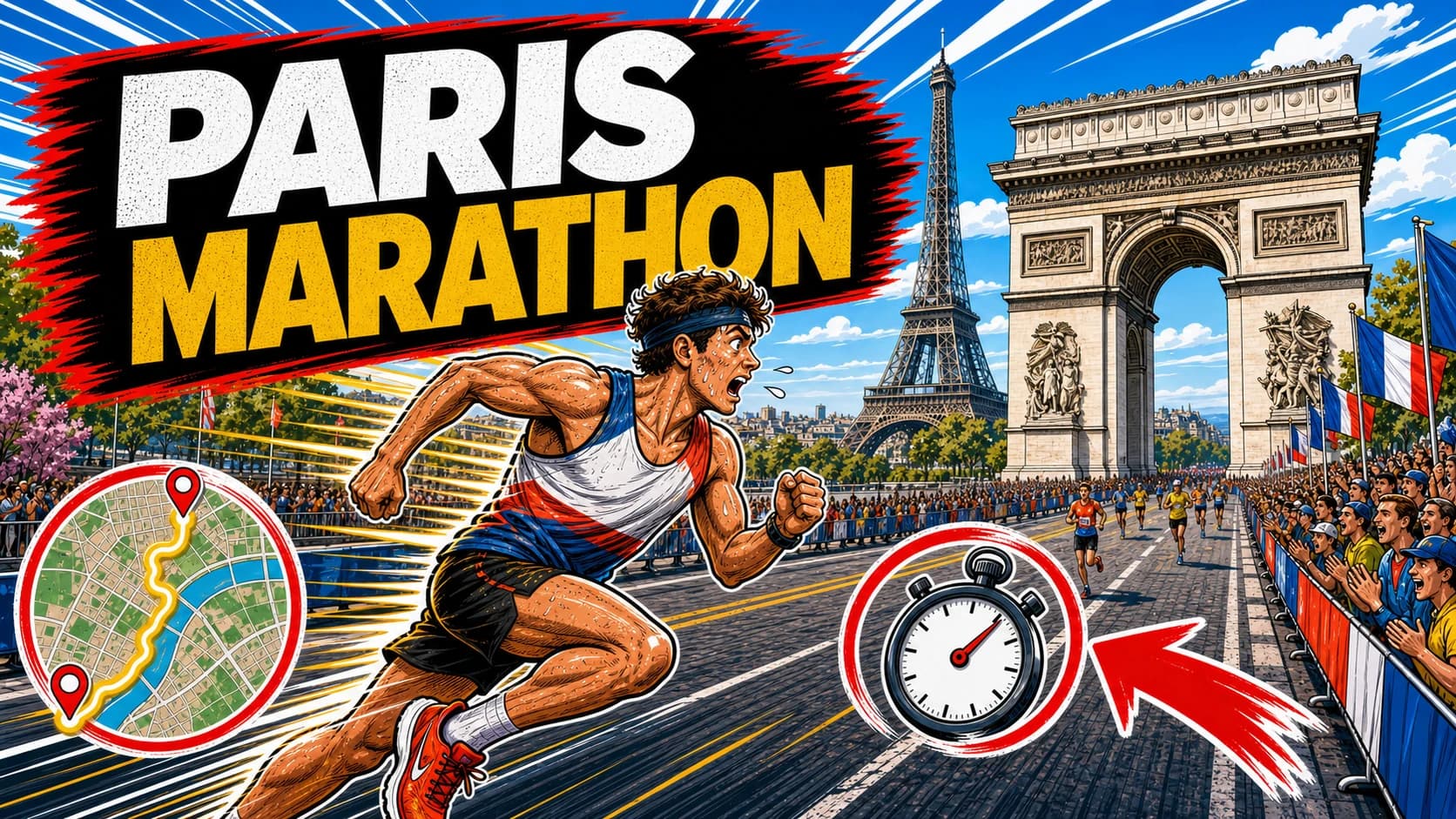
On April 11, 2027 Paris runs continental Europe's biggest marathon: ~57,000 finishers launching as one block from the Champs-Élysées — the most iconic starting line on the calendar — with the Arc de Triomphe at your back and the Place de la Concorde opening up below. ASO organizes it — the same house that runs the Tour de France — so expect French organization at the highest level: spotless signage, gram-perfect aid stations, evacuation plans that don't fail. The course is relatively flat — ~140 m of cumulative elevation — but it's not Berlin: two forests (Vincennes and Boulogne) introduce undulations that punish runners who go out hard. This guide covers what the official site doesn't quite spell out: how the route really runs, where the race breaks, what weather to expect on the second Sunday in April, and how to build the weekend.
| Data | Information |
|---|---|
| Date | Sunday, April 11, 2027 |
| Distance | 42.195 km (marathon) |
| Elevation gain | ~140 m (relatively flat, with undulations) |
| City | Paris (35–80 m elevation) |
| Start | Avenue des Champs-Élysées (between Arc de Triomphe and Concorde) |
| Start time | ~8:00–8:45 in waves (confirm via official communications) |
| Organizer | Amaury Sport Organisation (ASO) — the Tour de France people |
| Title sponsor | Schneider Electric (since 2017) |
| Registration | schneiderelectricparismarathon.com |
The Schneider Electric Marathon de Paris is continental Europe's biggest marathon (~57,000 finishers), organized by Amaury Sport Organisation (ASO) since 2002. The same house that runs the Tour de France, the Vuelta a España, the Dakar and Roland-Garros handles operations: expect French organization at the highest level — flawless signage, aid stations calibrated to the gram, evacuation plans that just work. Schneider Electric has been title sponsor since 2017. The Champs-Élysées start between the Arc de Triomphe and the Place de la Concorde is the most iconic starting line on the European marathon calendar.
Lead pack heading down the Champs-Élysées with the Arc de Triomphe in the background and the Place de la Concorde opening below — the postcard that defines the Paris race.
Paris isn't a mountain marathon and it isn't a flat record-track. It's a fast-but-not-record-fast marathon: a sea-level course (35–80 m elevation), ~140 m of cumulative gain, two forest loops (Bois de Vincennes and Bois de Boulogne) that add undulations, and a technical zone with bends and kilometers between buildings where the GPS can lie. Elite winners come home in 2:04–2:08; a well-prepared amateur can target 3% below their best on a flat marathon like Valencia or Berlin.
The Schneider Electric Marathon de Paris course is a single 42.195 km loop that starts on the Champs-Élysées, drops down to Place de la Concorde, swings east toward Bois de Vincennes (km 5–15), returns to the center past Place de la Bastille and the Hôtel de Ville zone, climbs the Seine quays toward the Tour Eiffel (km 25–28), crosses Trocadéro, swings west into Bois de Boulogne (km 32–37) and finishes on Avenue Foch, 500 m from the Arc de Triomphe. Asphalt almost the whole way, with short stretches of smooth cobblestone in the central bends.
Official 3D map of the full Marathon de Paris course (published by ASO), with the Champs-Élysées start, the two forest loops (Vincennes and Boulogne) and the Avenue Foch finish clearly visible.
The start is arguably the most photogenic on the European calendar: you stand on the Champs-Élysées with the Arc de Triomphe at your back and the Place de la Concorde 1.9 km downhill. The first kilometers drop gently, cross Concorde, hit Rue de Rivoli and swing southeast toward Place de la Bastille. From Bastille the route enters Bois de Vincennes (km 6–8), where you meet the first significant undulation: a gentle 30–40 m climb between the lakes. It's the first silent trap — runners who hit the Champs-Élysées at 4:00 min/km (with the slope helping) drift to 4:15 here without noticing.
Bois de Vincennes km 6–12 — green recovery before the city turns. The forest occupies you from km 5 to km 15 roughly, in a green, shaded section with scattered crowds. It's the course's recovery zone: use it to settle into your pace, drink at the km 5 and km 10 stations, and slot in the first gel. Coming out of the forest (km 15) you return to the center via Avenue Daumesnil, pass Bastille a second time, hit the Seine quays (Rive Droite) and cut across the historic center with views of Notre-Dame in the distance (km 19), Hôtel de Ville (km 20–21) and Île de la Cité.
The km 21–27 stretch is one of the fastest on the course: you run the Seine quays, slightly downhill, and from km 25 the Tour Eiffel km 27 — the postcard motivator appears on your right, first small and then dominating the entire skyline. It's the day's motivational hit — more than one runner confesses that km 27 in front of the Eiffel Tower is where they remember why they signed up. You cross Pont d'Iéna, climb to Trocadéro (km 28 — small 200 m hill, 4–5% gradient) and head west on Avenue de New York.
🚨 Where the race breaks
The Bois de Boulogne spans kilometers 32–37: urban forest, 5–15 m undulations, asphalt in good shape, scattered crowds. It's the last forested zone and the marathon's last chance to punish anyone who went out hard. You exit the forest via Porte Dauphine, hit Avenue Foch (~1.5 km straight, slight downhill) and have the finish 500 m from the Arc de Triomphe.
Course data for Strava / Garmin: ASO publishes the official GPX and the detailed roadbook on their site a few weeks ahead. The Strava segment "Bois de Boulogne East-West" replicates the exact km 32–37 profile and is ideal for calibrating the last hour of your long run.
The Marathon de Paris has been run since 1976, making it one of Europe's longest-running marathons (alongside Berlin, 1974, and London, 1981). The modern format and the explosive growth past 50,000 finishers arrive in 2002, when Amaury Sport Organisation (the Tour de France house) takes over operations. Schneider Electric has been title sponsor since 2017, giving the race its official name: Schneider Electric Marathon de Paris.
Most recent men's or women's winner crossing the line on Avenue Foch — iconic image anchoring the roll of honour section.
Race and roll of honour data (recent editions):
| Data | Value |
|---|---|
| First edition | 1976 |
| ASO takes over | 2002 |
| Schneider Electric sponsor | since 2017 |
| Current distances | Marathon (only) |
| Finishers (recent editions) | ~57,000 |
| Countries represented | 145+ |
| Men's elite record | 2:04:21 (Elisha Rotich, KEN, 2021) |
| Women's elite record | 2:18:33 (Shure Demise, ETH, 2026) |
Verified winners and times for the 5 most recent editions:
| Year | 🥇 Men | Country | Time | 🥇 Women | Country | Time |
|---|---|---|---|---|---|---|
| 2025 | Benard Biwott | 🇰🇪 KEN | 2:05:25 | Bedatu Hirpa | 🇪🇹 ETH | 2:20:45 |
| 2024 | Mulugeta Uma | 🇪🇹 ETH | 2:05:33 | Mestawot Fikir | 🇪🇹 ETH | 2:20:45 |
| 2023 | Gizealew Ayana | 🇪🇹 ETH | 2:07:15 | Helah Kiprop | 🇰🇪 KEN | 2:23:19 |
| 2022 | Deso Gelmisa | 🇪🇹 ETH | 2:05:07 | Judith Korir | 🇰🇪 KEN | 2:19:48 |
| 2021 | Elisha Rotich | 🇰🇪 KEN | 2:04:21 | Tigist Memuye | 🇪🇹 ETH | 2:26:11 |
Data verified against the public archive at Paris Marathon (Wikipedia EN). The 2021 edition was run in October due to COVID; the rest of the recent editions in April.
Registration for the Schneider Electric Marathon de Paris 2027 opens in September 2026 and runs as first-come-first-served with no lottery. The marathon sells out every year between 24 and 48 hours of opening — the ~80,000 bibs (~57,000 finishers + reserves) fly in less than two days. If you want to run Paris, set an alarm for opening day.
Aerial shot of the massive field heading down the Champs-Élysées in the early kilometers — perfect for reinforcing the "57,000 bibs that fly in 48 hours" message.
Reference from the 2026 edition at close:
Three entry channels that stay open when the site reads "complet":
ASO uses a tiered pricing system — the bib gets more expensive each time a tier closes, but in Paris tiers close in hours, not months. If you can afford it and you know you're racing, register in the first opening tier: the saving versus the last spots (when they're still around) is €30–50 per bib.
| Tier | Approx. open | Approx. close | Marathon |
|---|---|---|---|
| 🟢 Early-bird (opening) | Sept 2026 (alarm) | Sept 2026 (24–36 h) | €120–135 |
| 🟡 Standard | Sept-Oct 2026 | Oct-Nov 2026 | €150–165 |
| 🔴 Last spots | Nov-Dec 2026 | until sold out | €170–185 |
| 🟣 Charity | open year-round | until January 2027 | €500–1,000+ |
Indicative prices based on the 2026 edition structure. Always confirm on the official registration site — amounts and tiers are updated there.
| Included in the price | NOT included (optional extras) |
|---|---|
| ✅ Bib with timing chip | ❌ Official professional photo (~€20–30) |
| ✅ Finisher technical shirt | ❌ Saturday pasta party (€20–30 extra) |
| ✅ Finisher medal | ❌ Premium baggage service |
| ✅ On-course aid stations (liquids every 5 km, solids at 4 points) | ❌ Cancellation insurance (~€15) |
| ✅ Post-finish bag (fruit, bars, isotonic) | ❌ VIP transfer / premium changing rooms |
| ✅ Digital diploma with certified time | |
| ✅ Salón du Running access |
Things to factor in beyond the bib price:
Family members and runners at the Salón du Running (Paris Expo Porte de Versailles), with stands or the bib pickup counter visible.
Bib pickup happens at the Salón du Running, normally held the 3–4 days before the race (Thursday, Friday, Saturday) at Paris Expo Porte de Versailles (southwest Paris). No race-day pickup: you must collect in person before the expo closes Saturday, historically around 18:00.
You'll need:
Family and friends can pick up for you with signed authorization and a copy of your ID + a copy of the medical certificate. The race kit normally includes the finisher technical shirt, the chip-timed bib, a bag tag and the official roadbook. Finisher medals are handed out in the post-finish zone after crossing on Avenue Foch.
The most practical way to get to the Marathon de Paris start is by Métro or RER: the Charles-de-Gaulle Étoile (lines 1, 2, 6 + RER A), George V (line 1) and Franklin D. Roosevelt (lines 1 and 9) stations are 200–600 m from the Champs-Élysées start zone. The Métro starts running at 05:30 on Sundays. For finishers on Avenue Foch, the closest stations are Porte Dauphine (line 2) and Argentine (line 1).
Charles-de-Gaulle Étoile Métro entrance or aerial view of the Arc de Triomphe with the Champs-Élysées in the background — visual anchor for the first-time visitor to Paris.
Paris has one of the densest public transport networks in the world: 16 Métro lines, 5 RER lines (express commuter rail), trams, buses. Race morning the Métro starts at 05:30 on Sundays. Plan to be in your wave 45–60 minutes before the gun: the marathon launches in 4–6 staggered waves from 8:00, and porta-potty queues blow up in the last 30 minutes.
For the Salón du Running at Paris Expo Porte de Versailles, the nearest Métro stations are Porte de Versailles (line 12) and Balard (line 8). From the center it's about 25 minutes door to door.
Arriving from the airport:
Driving is not recommended. The Champs-Élysées and the entire central area are closed from early morning into the afternoon. Paris has Crit'Air, a low-emission zone (ZFE) restricting older vehicles in the entire center. If you do drive, park at a Park & Ride on the periphery (RER stations) and switch to public transport.
For a marathon runner in Paris, staying within 20 minutes' walk of the start or the finish isn't luxury: it's logistics. The marathon spits you out around 11:00–13:30 depending on goal — you walk back to the hotel sweating, hungry, with cramps building. Walking 5 minutes to your wave versus catching the Métro at 7:30 with a transfer can be worth 1–2 minutes on the clock and twice that in mental stress.
Wide shot of Champs-Élysées or le Marais showing hotel density and proximity to the start or finish zone.
| Hotel | Cat. | €/night* | To start | Runner edge |
|---|---|---|---|---|
| Hyatt Regency Paris Étoile | 4* | €280–420 | 1.2 km · 15 min | Early breakfast for groups |
| Marriott Champs-Élysées | 5* | €450–650 | 600 m · 8 min | Bathtub, strong A/C, late check-out |
| Hôtel Splendide Étoile | 4* | €240–380 | 800 m · 10 min | Discreet boutique near Étoile |
| Le Bristol Paris | 5* palace | €1,200–2,000 | 1.4 km · 17 min | Absolute luxury, perfect for celebrating |
| Hôtel Plaza Athénée | 5* palace | €1,400–2,500 | 1.5 km · 18 min | Iconic, bathtub, runner-suite if you ask |
| Hotel | Cat. | €/night* | To start | Runner edge |
|---|---|---|---|---|
| Pavillon de la Reine | 5* boutique | €380–550 | 4.2 km · Métro | Bathtub, inner garden, guaranteed quiet |
| Hôtel des Grands Boulevards | 4* boutique | €220–340 | 3.5 km · Métro | Modern, A/C, in-house dinner restaurant |
| Hotel Saint-Paul Le Marais | 4* | €180–260 | 3.8 km · Métro | Discreet, quiet high floor |
| Hôtel Caron de Beaumarchais | 3* | €150–220 | 4.0 km · Métro | Family-run, mid-range, central |
| Cour des Vosges | 5* boutique | €450–700 | 4.5 km · Métro | Discreet luxury, perfect for celebrating |
| Hotel | Cat. | €/night* | To start | Runner edge |
|---|---|---|---|---|
| Shangri-La Paris | 5* palace | €900–1,500 | 2.2 km · Métro | Eiffel Tower views, bathtub, strong A/C |
| The Peninsula Paris | 5* palace | €800–1,300 | 1.8 km · 22 min | Absolute luxury, bathtub, generous late check-out |
| Saint James Albany | 5* | €400–600 | 1.8 km · Métro | Discreet, quiet, private garden |
| Hôtel Keppler | 4* boutique | €200–320 | 1.5 km · 18 min | Mid-range boutique, very close to finish |
| Le Rond Point d'Auteuil | 3* | €120–180 | 2.5 km · Métro | Affordable for the 16e, close to Bois de Boulogne |
*Indicative race weekend rate (second Sunday in April). Varies with booking lead time, availability and current promotions. Paris in April is mid-high season — book 4–6 months out.
Paris weather on the second Sunday of April averages 6 °C low and 15 °C high with variable conditions: 50% chance of sunny, 30% overcast, 20% light rain, based on historical data from Météo-France. Wind is the most unpredictable variable: it can swing from dead calm to 25 km/h from the west.
Finishers from a recent edition with their medals on a partly cloudy day — the typical pattern of the second Sunday of April in Paris.
The variable to watch is the wind, not the heat. For the marathon, temperature is almost always optimal (6–15 °C, standard European conditions), but the west wind — frequent in April — hits head-on in the km 30–37 stretch (Trocadéro → Bois de Boulogne → Avenue Foch). An 8:30 start leaves you in near-ideal conditions for the first 4 hours; extreme heat is exceptional in Paris in April.
Plan by forecast:
Paris isn't Madrid, isn't Valencia, isn't Rome. Heat is almost never the problem in April; the wind can be. Watch the wind forecast (not just the temperature) in the 48 hours before.
The recommended plan to prepare the Schneider Electric Marathon de Paris is a 16-week block with peak volume in weeks 11–13 (between 50 km and 130+ km weekly depending on goal), one weekly long run and a three-week taper. The key for Paris: train on mostly flat terrain with gentle undulations, do at least two long runs with race-pace blocks after 25 km accumulated (to simulate km 32 of Bois de Boulogne) and slot in headwind work in the last 6 weeks.
Runner crossing the line on Avenue Foch or training on flat weekend terrain — aspirational image anchoring the 16-week plan.
Treat Paris as a marathon with a low elevation budget (~140 m) but with two forest loops and high probability of west wind. Pick your goal and use the table — these are peak volumes (weeks 11–13), not block averages.
| Goal | Average pace | Peak weekly vol | Peak long run |
|---|---|---|---|
| 5h00 | 7:06 min/km | 35–45 km | 25–28 km |
| 4h30 | 6:24 min/km | 45–55 km | 28–30 km |
| 4h00 | 5:41 min/km | 55–70 km | 30–32 km |
| 3h30 | 4:58 min/km | 70–85 km | 32–35 km |
| 3h00 | 4:16 min/km | 90–110 km | 32–36 km |
| ≤2h45 | 3:54 min/km | 110–130+ km | 32–38 km |
How to read the table and build the cycle:
Three sessions worth gold for Paris:
The taper is three weeks, not two. Week 14 at 80%, week 15 at 60%, week 16 at 40% holding race pace in short pickups. The last two long runs (in weeks 11 and 12) are the ones that fill the tank.
Don't know what realistic target time you have for Paris? Cross your best recent half-marathon with the "Paris marathon" factor (which discounts the forest loops and the central bends):
| Your best recent half | Flat equivalent (marathon) | Realistic Paris |
|---|---|---|
| 1:25 | sub-3:00 flat | 3:01–3:05 |
| 1:35 | sub-3:20 flat | 3:21–3:28 |
| 1:45 | sub-3:42 flat | 3:43–3:52 |
| 1:55 | sub-4:05 flat | 4:08–4:18 |
| 2:05 | sub-4:25 flat | 4:28–4:40 |
| 2:15 | sub-4:48 flat | 4:50–5:02 |
How to read this: the "flat" column is the Riegel conversion without adjustments (your half × ~2.11). Paris loses just 1–3% versus pure flat — significantly less than Madrid or Boston. If you've done long runs with race-pace blocks and your form holds, target the low end of the range. If your last hour falls apart or there's strong wind on race day, the high end.
Once you have your target time, this calculator gives you the required average pace (in min/km and min/mi) and the cumulative splits at 5K, 10K, 15K, half marathon, 30K and finish. Change the target time in the field below and the table updates instantly:
| Punto | Tiempo acumulado | Parcial |
|---|---|---|
| 5 km | 21:20 | 21:20 |
| 10 km | 42:40 | 21:20 |
| 15 km | 1:03:59 | 21:20 |
| Media (21,1 km) | 1:30:00 | 26:01 |
| 30 km | 2:07:59 | 37:59 |
| Meta | 3:00:00 | 52:01 |
Splits asumen ritmo constante. En carreras con desnivel real (Marathon de Paris) — banca 5–8 s/km en bajadas y pierde el mismo margen en subidas; el ritmo medio se mantiene.
The calculator above gives you the pace. But a real race plan answers more questions: with what strategy do I start on the Champs-Élysées? How many gels do I carry? When do I take the caffeine? What do I do if at km 21 I'm 30 seconds above target?
Configure your goal, strategy and fueling plan. The planner generates a personalized plan by segment (with paces, HR zones, mental cues and minute-by-minute fueling), a race-morning checklist, and a Plan B for the unexpected. Download as PDF to take with you on race day.
PDF A4, optimizado para imprimir y llevar el día de carrera.
You arrive at the wave on the Champs-Élysées. You've done the 16-week plan. What separates good training from a good time is what you do over the next 3–5 hours.
The Paris race plan has three Paris-specific keys: (1) ultra-controlled start on the Champs-Élysées — the slope helping + the crowd density + the postcard adrenaline tempt you to let go and hit km 1 in 3:50 when you're shooting for sub-3:00; (2) settled and well-hydrated pace in Bois de Vincennes (km 5–15), using the shade and scattered crowds to slot in gels comfortably; (3) push or hold in the km 30–33 tunnel leaving Bois de Boulogne, the moment where the marathon is decided.
| Goal | Target splits | Paris-specific tactical note |
|---|---|---|
| sub-2:45 | 3:54 min/km | Brake on the Champs-Élysées: km 1 in 3:58 (not 3:50). Hold by feel in Bois de Vincennes; attack km 22–27 (Tour Eiffel, slight downhill). If headwind in km 30–35, lose 5–8 sec/km, recover on Avenue Foch. |
| sub-3:00 | 4:16 min/km | Cross half at 1:30:30. Bois de Vincennes at settled pace. Hold km 30–33 leaving Boulogne; attack km 38 on Avenue Foch if you arrive with legs. |
| sub-3:30 | 4:58 min/km | No rush km 1–5 (Champs-Élysées + Concorde). Cross half at 1:45:30. Drink at every aid station. Walk 15 sec at the km 30 station. |
| sub-4:00 | 5:41 min/km | The classic mistake is to start at 5:30 caught up in the Champs-Élysées crowd surge. Hold 5:45 the first 10 km. Walk 20 sec at every aid station from km 25. |
| sub-4:30 | 6:24 min/km | Very even splits: 6:20–6:30 throughout. Walk-run strategy from km 30 if you need it. Bois de Boulogne with short walks every 4 km. |
| sub-5:00 | 7:06 min/km | Walk-run plan B from km 1: 8 run / 1 walk. Gives you margin to finish in shape, enjoy the Tour Eiffel postcard and cross all of Avenue Foch. |
| Finish | 7:00–7:30 | No watch. Enjoy the Champs-Élysées, the Bois de Vincennes shade, the Tour Eiffel at km 27 and the arrival on Avenue Foch. |
It's where the marathon is decided. Three anchors:
The nutrition strategy for a marathon pivots on 60–100 g of carbs per hour depending on goal, with 5–8 gels spaced every 25–30 minutes from km 8. Carb loading the 3 days before should be 8–10 g/kg/day, and Saturday dinner light and familiar. Paris has a quirk: the Saturday food temptation is high — traditional bistros, markets, croissants, wine, cheese. It's not the night to discover French cuisine.
Volunteer at a Marathon de Paris aid station handing out isotonic drink.
Saturday dinner is light, familiar and early (eat before 21:00). In Paris you're lucky — any traditional bistro offers carbonara pasta or pesto tagliatelles, roast chicken with potatoes, country bread, fruit — all carbs without risk. Order pasta without heavy cream and chicken grilled. No exotic plats du jour, no shellfish, no strong cheese. Saturday is for hoarding fuel, not for discovering French cuisine.
Saturday afternoon chocolat chaud is a Parisian tradition that does fit: it's basically hot milk with chocolate, fast carbs + fats + a touch of caffeine. Taken at 17:00–18:00 with a croissant, it's perfect as a pre-dinner snack. Don't experiment with éclairs or mille-feuilles — those are for the Monday after.
Race-morning breakfast depends on whether you wake up hungry. The safe play: toast with honey/jam + banana + coffee (if you take it habitually). 80–100 g of carbs, eaten 3 hours before the gun. If your stomach shuts down with nerves, swap for a sports drink with 80 g of carbs. The hotel croissant waits until after the finish — it's 50% fat, doesn't work as pre-marathon breakfast.
What the organization provides on course:
Carb plan by goal:
| Goal | Carbs / hour | Gels to carry | When to take them |
|---|---|---|---|
| 5h00 | 30–45 g/h | 3–4 gels | km 8, km 18, km 28, km 36 |
| 4h00 | 45–60 g/h | 5 gels | km 8, km 16, km 22, km 30, km 36 |
| 3h30 | 60–75 g/h | 6 gels | km 6, km 12, km 18, km 24, km 30, km 36 |
| 3h00 | 75–90 g/h | 7 gels + flask | km 5, every 5 km until km 35 |
| ≤2h45 | 90–100 g/h | 8 gels + flask | km 4, every 4–5 km |
Three mistakes you see every year at the Paris marathon:
Hydration and sodium by wind (not by heat):
Post-finish recovery — the first hour counts more than at the half:
The best shoes for the Schneider Electric Marathon de Paris are carbon-plate race for sub-3:30, carbon-plate or super-trainer between 3:30–4:00 (Saucony Endorphin Speed, Hoka Mach X), and a protective daily trainer for over 4:00 (Nike Pegasus, ASICS Cumulus, Brooks Ghost). What's critical isn't the brand but that they're already broken in and don't exceed 250–350 km of use. Paris, being flat with bends, rewards the lightest model that survives 42 km without trashing the quads.
Tight shot of race shoes on the Champs-Élysées start line — multiple brands visible.
Unlike Madrid or Boston (with elevation), in Paris the bends and turns factor weighs as much as weight. An ultralight carbon plate can save you 4% of energy but leaves the quads trashed from km 30 if you don't manage your foot strike on the technical bends in the center. For non-elite runners, a plate with good protection (Vaporfly 4, Adios Pro Evo, Metaspeed Sky) or a protective super-trainer beats the lightest option.
Recommendations by goal:
| Goal | Category | Common models |
|---|---|---|
| ≤2h45 | Light "race" carbon plate | Nike Alphafly 3 · adidas Adios Pro Evo · ASICS Metaspeed Sky · Saucony Endorphin Elite |
| 2h45–3h30 | Protective carbon plate | Nike Vaporfly 4 · adidas Adios Pro 4 · ASICS Metaspeed Sky · Saucony Endorphin Pro |
| 3h30–4h00 | Carbon plate or super-trainer | Saucony Endorphin Speed · Hoka Mach X · Puma Deviate Nitro Elite · ASICS Magic Speed |
| 4h00+ | Protective daily trainer | Nike Pegasus · ASICS Cumulus / Nimbus · Brooks Ghost · Hoka Clifton |
Check this before leaving the house:
Three real options: (1) General opening in September 2026 with an alarm — bibs fly in 24–48 hours, you have to be online at the exact moment; (2) Time qualifier: if you have a certified mark below a target time (typically sub-3:00 men / sub-3:30 women in senior categories), you have a guaranteed entry path that opens weeks before the public; (3) Charity bib: minimum donation €500–1,000+ through partner charities. No official lottery — Paris doesn't work like Berlin, NYC or Tokyo on this front.
Yes, it's mandatory. Unlike many international marathons, French law requires a medical certificate signed by a doctor (in French or English) certifying no contraindication for participating in athletics competition events, or a current French federation athletics license (FFA). Without one of the two, no bib is issued. The official template is downloadable from the registration site.
About 140 m of cumulative gain over 42.195 km, spread across gentle undulations in Bois de Vincennes (km 5–15), a small Trocadéro climb (km 28, 200 m at 4–5%) and Bois de Boulogne undulations (km 32–37). It's a relatively flat marathon — significantly faster than Madrid (~600 m) or Boston (~140 m with a more demanding profile), but slightly slower than Berlin (<50 m) or Valencia (<50 m) due to the bends and the forest loops. Take it as 42 km of undulating road with two forest sections, not as pure flat asphalt.
Recent editions close the marathon at 5 hours 40 minutes from the last wave, equivalent to about 8:00 min/km. Walking is allowed; the course has staggered partial closures (streets reopen to traffic after the last runner in each zone passes). If you're aiming for finish-without-time-limit, ask the organizer first — some editions allow running up to 6 h on the sidewalk with a "marche / walk" bib.
No. Pickup is restricted to the Salón du Running Thursday through Saturday at Paris Expo Porte de Versailles. No bibs are issued the day of the race under any circumstances, so plan your arrival to allow at least one expo visit. If you arrive Saturday, do it before 16:00 — the queue grows exponentially in the last hour.
There's a baggage area at the Champs-Élysées start, organized by bib number in temporary marquees. Tag your bag with the printed sticker that comes in the kit, drop it 30–45 minutes before the start and pick it up in the same area at the finish (the baggage zone moves near the Avenue Foch finish). There's staff but no ID check, so don't pack valuables.
Yes, headphones are allowed at the Marathon de Paris. That said, the urban entertainment on the route is exceptional — bands every 3–5 km, massive crowds on the Champs-Élysées, on the Seine quays and on Avenue Foch — so many runners prefer running without headphones. The most solitary section (Bois de Vincennes interior, km 8–13) does benefit from music if it helps you hold focus.
Paris in April has a high probability (~60%) of west wind. Average historical speed is 10–18 km/h, with peak days at 25–30 km/h. The course has tailwind sections (km 5–15 heading east), neutral (center, Seine quays) and headwind (km 30–37, exiting Bois de Boulogne to the west). A 20 km/h headwind for 5 km costs between 20–40 seconds off the target pace in that section. Simple rule: if the forecast shows west wind >15 km/h, save 3–5 sec/km in km 1–25 and bank fuel for the km 30–35 tunnel.
For sub-3:30, a protective carbon plate (Nike Vaporfly, adidas Adios Pro, ASICS Metaspeed Sky). For 3:30–4:00, a carbon plate or super-trainer (Saucony Endorphin Speed, Hoka Mach X). For over 4:00, a protective daily trainer (Nike Pegasus, ASICS Cumulus, Brooks Ghost). The most important thing isn't the brand but that they're already broken in and not over 250–350 km of use. Paris, being flat with bends, rewards the lightest model that survives 42 km without trashing the quads.
Paris is continental Europe's biggest marathon and the best "first Major-style" for European runners. Berlin is flat and fast (world record), but you only get in via lottery. London is a World Marathon Major with top atmosphere, also lottery. Madrid is 600 m of elevation — 5–10 minutes slower. Valencia is flat and fast, the best PB option in Spanish. Boston has a qualifying-time cutoff and more cumulative elevation. NYC is a World Marathon Major with elevation and brutal lottery (3% acceptance). Tokyo lottery 5%, flat and fast but expensive and far. Chicago flat, fast, lottery 30%. Paris is the only big European marathon without a lottery that still offers Major-level organization.
Yes, if you go in without an aggressive time goal. The atmosphere, the ASO operation, the aid stations every 5 km, the Champs-Élysées postcard and the Tour Eiffel view make the experience memorable. Yes also if your goal is an honest clock — the course doesn't punish significantly. No, if your goal is an absolute sub-2:30 PB — Berlin or Valencia are significantly faster. If it's your first marathon and you want a time, Paris is a good option as long as you accept that the west wind and the forest loops can cost you 1–3% over pure potential.
The Schneider Electric Marathon de Paris is the best World Marathon Majors-style experience without entering a lottery, but not the fastest on the calendar. If you want a pure PB, Berlin or Valencia are significantly faster; if you want atmosphere with massive crowds and historic prestige, Paris is continental Europe's best bet.
All are marathon (42.195 km), so the choice depends on month, lottery, elevation and what you're looking for:
| Race | Month | Elevation | Access | Best for | Atmosphere |
|---|---|---|---|---|---|
| Schneider Paris (this guide) | April | ~140 m | First-come-first-served | Major-style without lottery · atmosphere · experience | ⭐⭐⭐⭐⭐ |
| London (TCS) | April | ~50 m | Lottery (~5%) | World Marathon Major · atmosphere | ⭐⭐⭐⭐⭐ |
| Berlin (BMW) | September | <50 m | Lottery (~25%) | PB · world record | ⭐⭐⭐⭐⭐ |
| EDP Madrid | April | ~600 m | Open | Atmosphere · experience (Spain) | ⭐⭐⭐⭐⭐ |
| Valencia | December | <50 m | Open | Pure PB (Spain) | ⭐⭐⭐⭐ |
| Boston | April | ~140 m | Qualifying time | Tradition · prestige | ⭐⭐⭐⭐⭐ |
| New York City (TCS) | November | ~250 m | Lottery (~3%) | Major · 5 boroughs | ⭐⭐⭐⭐⭐ |
| Tokyo | March | <50 m | Lottery (~5%) | Major · flat | ⭐⭐⭐⭐⭐ |
| Chicago (Bank of America) | October | <50 m | Lottery (~30%) | Major · flat · fast | ⭐⭐⭐⭐⭐ |
Lottery acceptance and elevation data indicative based on recent editions (2023–2025). Always confirm on each race's official site.
Did this guide help? If you're running Paris 2027, save the event in SportPlan for registration alerts, Salón du Running reminders and, after, to log your result.
Weiter planen
Nutze SportPlan, um Termine zu vergleichen, Events zu speichern und eine Saison zu erstellen, die zu deinen Wochenenden passt.