
How to Choose and Prepare for Your First Half Marathon
Choose a race that fits, build purposeful training, work out paces and cutoffs, rehearse your fuelling, and arrive with a race plan you trust.
Somewhere between an ordinary Sunday run and the next race you spot, the thought arrives: could I run a half marathon?
Then come the better questions. How much training will fit your week? What happens after kilometre 15? And how do you reach the start feeling prepared rather than hoping for the best?
Confidence comes from decisions you have already rehearsed. This guide walks you through them, from choosing the event to making sense of the finish.
If you already run regularly and are considering your first half, start here. Your starting point, weekly time and chosen course will shape the preparation.
Read from the beginning, or use the contents to jump to the decision in front of you.

Race-day confidence starts here: ordinary runs, patient effort, and a plan you can repeat.
The official half-marathon distance is 21.0975 km: usually displayed as 21.1 km or 13.1 miles. That tells you how far you will go. The course tells you what the day will ask of you.
A flat road race with frequent water and manageable conditions may fit your preparation better than a hilly trail event. Large city races add crowds, turns and travel; smaller events may offer simpler logistics but fewer aid stations. Check each event rather than assuming size means easier.
Keep two or three candidates open and compare the details that will change your day:
| Check | The question to answer before entering |
|---|---|
| Course and surface | Does the terrain match what you can rehearse? Where are the climbs? |
| Cutoffs | Is there room for your moving pace and stops? Are there intermediate closures? |
| Start and travel | Can you collect the bib and reach your start pen without rushing? |
| Aid stations | Where are they, what do they offer, and what must you carry? |
| Total cost | What do entry, transport, accommodation and the journey home add up to? |
The answers should come from the current organiser instructions. A familiar race name does not guarantee an unchanged course or schedule.
The right first race is the one whose demands you can name. “It is only 21 km” is not a course assessment. “It has 180 metres of climbing, a 3-hour cutoff, water at kilometres 5, 10, 15 and 18, and a start 40 minutes from my accommodation” is one.
These are imagined examples; the useful part is the decision.
Elena: match the terrain. She runs mainly on flat paths and is considering a race with 250 metres of climbing. Can she rehearse similar hills and recover well, or would the flatter event fit her preparation better?
Marcus: leave room for delays. His expected moving time leaves almost nothing under a 2:45 cutoff. He chooses a race with more generous time limits, rather than relying on a perfect day.
The right choice is made before the entry fee is spent.
Look for a repeatable routine, not one impressive outing. Several recent weeks of manageable running tell you more than a single exhausting long run.
You do not need to run 21 km today. You need a starting workload you can recover from, and room to progress.
Use this readiness conversation with yourself:
- Can I run three times in a normal week, or reliably protect two runs plus a longer outing?
- Can I finish my current long run and feel broadly recovered within the next day or two?
- Can I increase time on feet without changing every other variable at once?
- Do I have a way to replace a run when pain changes my stride, rather than trying to prove toughness?
- Can I give the training block a stable slot for sleep, food, and easy movement?
If the answers are mostly yes, compare your current week with the opening week of a plan.
For example, Cancer Research UK’s beginner half-marathon plan starts with two 30-minute easy runs and a 40-minute longer outing with walk breaks. Its 12 weeks describe that plan, not a promise that everyone will be ready in three months.
If the opening week already feels like a big leap, choose a different starting point or a later event.
If pain changes your stride, stop running. The NHS advises getting persistent running pain checked by a GP or physiotherapist; a missed session is easier to absorb than a small problem made larger by trying to prove toughness.
A useful week has jobs. The exact days can move around work, family, weather, and fatigue.
- Easy running: build a routine while leaving energy for the next outing.
- The long run: extend time on feet and rehearse clothing, fuelling and patience.
- Faster work: practise controlled effort when your existing training supports it.
- Strength and recovery: account for gym work too, and leave space between demanding days.
Place the long run where you have time to prepare and recover. Fit the easy runs around it, rather than squeezing every demanding session into the weekend.
A faster session should help your running, not leave you unable to complete the next important outing. If four running days leave you struggling, reconsider the load. If faster work depletes the long run, review its place in the plan.
A useful schedule is one you can repeat.
For example, a runner might lengthen an outing while keeping the pace and terrain familiar. Another might hold the duration steady while introducing gentle hills. The appropriate change depends on what they already tolerate.
Follow the easier weeks and final reduction in your chosen plan. A last-minute long run to “prove” your fitness can leave you tired just when you want to feel ready.
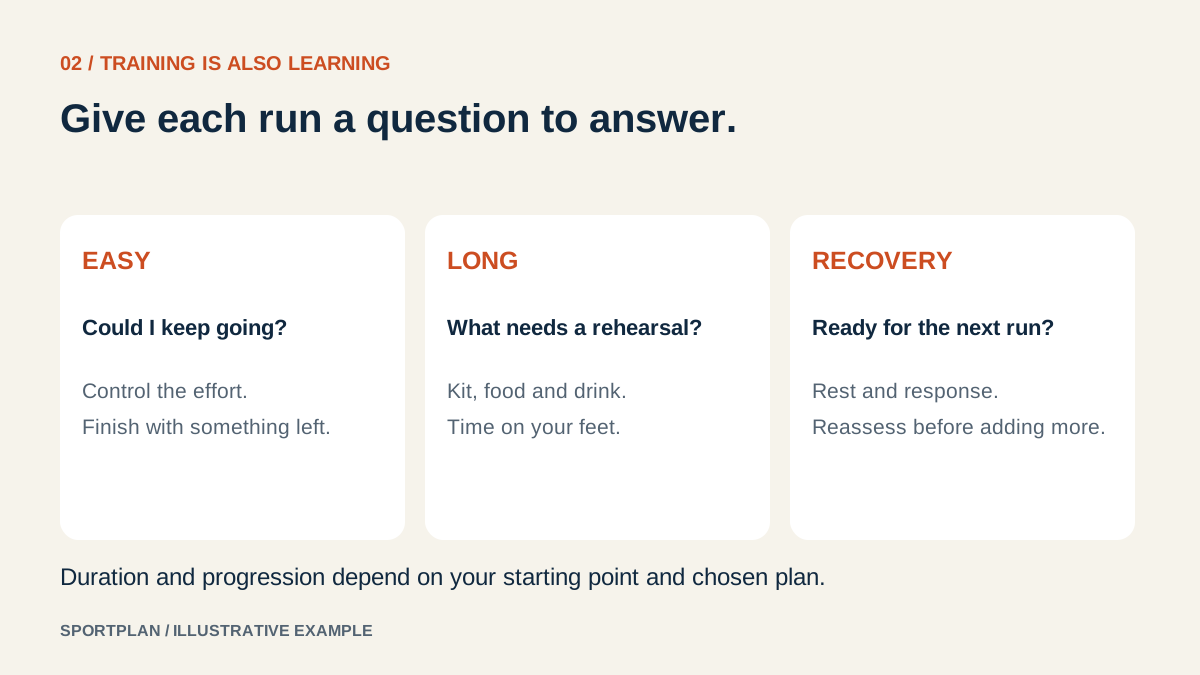
Judge a session by the job it does, not by how impressive it looks on your watch.
Your longest training run does not have to equal the race distance. Follow the logic of a plan that fits your starting point and recovery.
The purpose is to build endurance and confidence in your routine. An exhausting distance test is not automatically better preparation.
Before your next suitable long run, choose one thing to rehearse:
- Wear the complete outfit, with the pockets loaded.
- Test a breakfast and start time that could work on race morning.
- Practise reaching your food or drinking while moving.
- Include familiar terrain that resembles the event.
Make a note afterwards. What would you keep? What needs changing?
Keep a short rehearsal notebook. You are looking for details you can act on:
| Record | What it helps you decide |
|---|---|
| Time, route, weather and effort | Whether two similar-looking runs were actually comparable. |
| Food, drink and timing | What you tolerated and can practise again. |
| Clothing and loaded pockets | What rubbed, bounced, or was difficult to reach. |
| How you felt afterwards | Whether the next planned session still makes sense. |
“Gel at 45 minutes caused no stomach issue; new socks rubbed left heel” is more useful than an average pace without context. Fix one problem on the next outing. A long run that teaches you where to carry your phone has done more than add kilometres.
Imagine a race with a 3:00 cutoff. The average allowance is about 8:32/km, including stops. If you expect to spend five minutes stopped, the remaining moving time is 175 minutes: about 8:18/km.
That calculation does not tell you what pace you can sustain. It helps you decide whether the event leaves enough room for your strategy.
Cutoff math is a logistics tool. Your goal is to understand the constraint early enough to choose the event, pace conservatively, and know when a shorter race would be wiser.
A tighter example makes the trade-off visible: at 7:00/km, 21.0975 km takes 2:27:41. Against a 2:30 cutoff, that leaves just 2 minutes 19 seconds for all delays, assuming the same start clock. A comfortable training pace can still be an uncomfortable event choice.
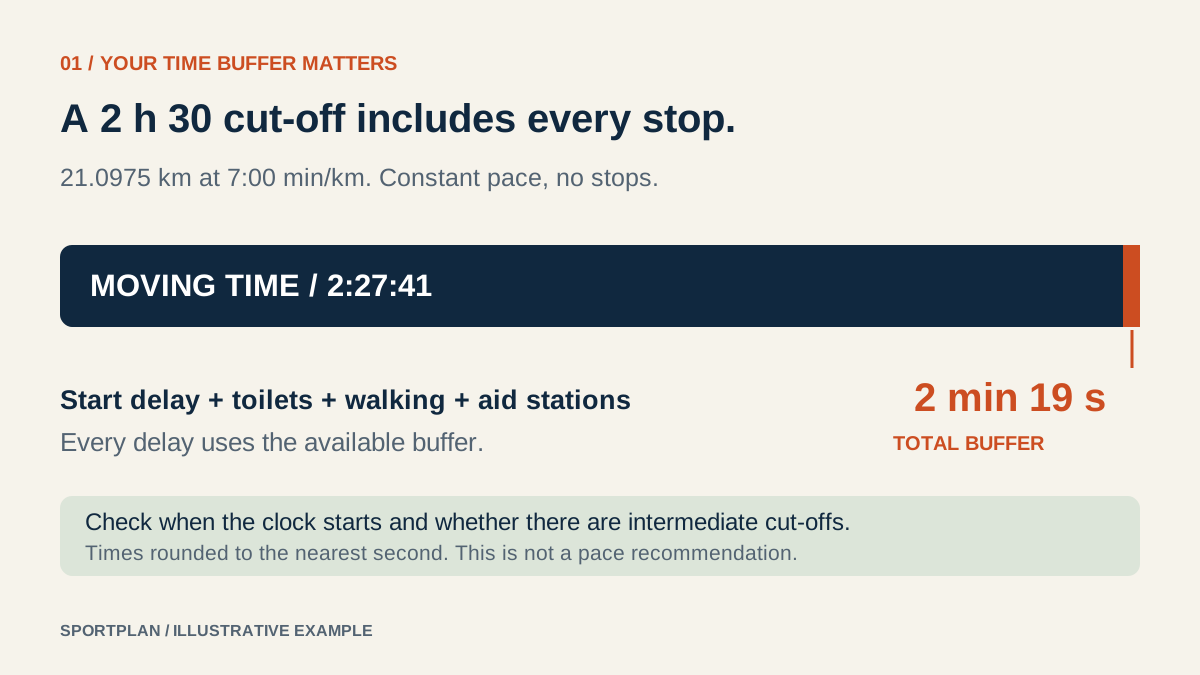
The orange sliver is all the spare time. Check whether the cutoff starts with the gun or when you cross the line.
The pace calculator can translate a target finish into checkpoints. A hypothetical 2:20:00 goal over 21.0975 km is 140 minutes divided by 21.0975, or about 6:38 per kilometre. A 2:30:00 goal is about 7:07 per kilometre. On a perfectly even course with no congestion, those averages are useful. They are not commands to stare at every kilometre marker.
Make the opening deliberately calm. Let faster runners pass; settle before you ask more of yourself.
On a hill, hold a controlled effort and accept the slower split. If a reference pace of 6:38/km becomes 7:10 uphill, ask how your breathing and form feel. Trying to reclaim every second downhill can turn a manageable section into an unnecessary gamble.
Use three pace bands in your plan:
- Easy or protected pace for the opening and for any section where heat, hills, or congestion raises effort.
- Target rhythm for the stable middle kilometres when breathing is controlled and you could answer briefly.
- Decision pace for the final 3–5 km, used only if you still have good form, fuel, and a clear head.
If a goal time depends on perfect splits, it is probably too aggressive for a first attempt. Choose a primary effort goal, a sensible time range, and a fallback such as “run the first 15 km calmly, then reassess.”
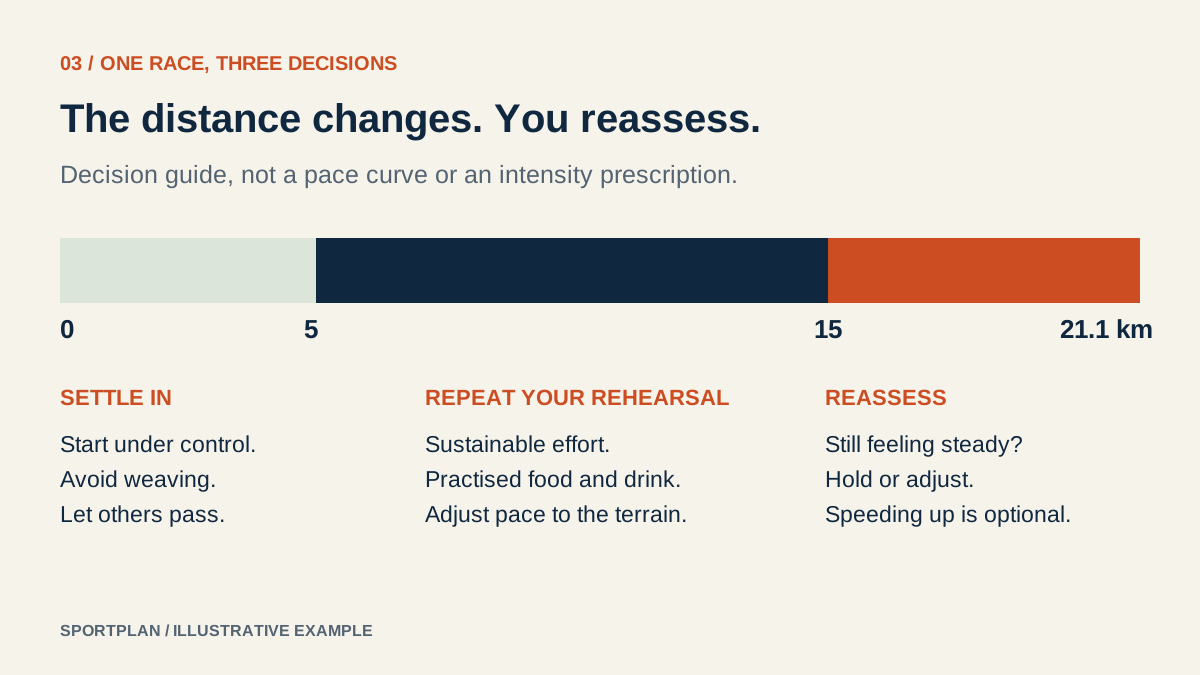
Give each part of the race one job. The final decision depends on how you feel, not on a promise made at the start.
Fuelling is a skill to practise, not an emergency purchase at the expo. For exercise lasting more than an hour, the British Heart Foundation gives a general guide of 30–60 grams of carbohydrate per hour. Treat that as a range to test in training, not as a target you must force.
Suppose a runner has practised 40 g of carbohydrate per hour and expects to finish in 2 h 20. That is roughly 93 g across the whole effort. This is an example calculation, not a suggested intake for everyone.
| In this example | Carbohydrate |
|---|---|
| Three products labelled 25 g each | 75 g |
| Amount still needed to reach about 93 g | About 18 g |
A drink or another food could supply the remainder, provided the runner has checked its label and practised it. Count what the product contains; do not assume every gel or every cup is equivalent.
Practise your chosen products during suitable training runs. Avoid changing breakfast, gels and drinks all at once: you want to know what agrees with you.
Allow your pre-event meal time to digest, and rehearse its timing. A breakfast that works for a friend may not work for you.
Eat normally in the days before. You do not need an exotic loading ritual for a half marathon. Arrive hydrated, but do not force excessive water immediately before the start. Check the weather and the organiser's drink stations, and carry what the course requires.
- Ready to wear: bib, pins, shoes, socks and tested clothing.
- Ready to carry: practised food, watch and any required kit.
- Ready to travel: transport, bag-drop deadline, start pen and journey home.
- Ready for the conditions: the forecast and the organiser’s latest instructions.
Work backwards from the time your pen closes. Add bag drop, toilets, the walk from transport and room for queues. A calm arrival is part of the plan.
At the start, stand in the correct pace area. Let faster runners pass rather than weaving around them. Keep the opening effort boring. Follow the drink and fuelling strategy you rehearsed, adapting to the actual stations and conditions. Walking briefly through an aid station can be sensible if it keeps you calm and lets you take what you need without spilling everything.
| If the day changes | Your next decision |
|---|---|
| It is hotter than expected | Ease off early, reconsider the time goal and follow organiser guidance. |
| Your stomach reacts | Avoid forcing the plan; ask race medical staff for help if symptoms concern you. |
| Clothing or a shoe starts rubbing | Address it at the first safe opportunity. |
| Pain changes your stride | Stop and ask the event medical team for help. |
| Crowds or a wrong turn cost time | Return to controlled effort instead of chasing the lost seconds. |
A fallback is easier to use when you chose it before the adrenaline arrived.
The best race plan includes permission to change the goal. A finish with steady effort, a walk-run pattern, or an early stop because something is wrong can be a successful training decision. Your next half marathon will benefit from accurate information more than from a heroic story that hides a preventable problem.
Give yourself time to walk gently, collect your belongings, eat, drink and change out of wet clothing. Arrange a straightforward journey home.
If you feel dizzy, unusually breathless or unwell, ask the event medical team for help. Seek urgent help for severe symptoms.
Leave the next day flexible. Rest or easy movement may suit you better than another demanding session.
As you recover, notice your sleep, soreness, mood and how ordinary movement feels. Return gradually; the calendar alone cannot tell you when you are ready.
Your first half marathon is not an exam that decides whether you are a runner. It is a long, specific experiment. Choose an event whose demands you understand, train the systems that will carry you, rehearse the details, and leave enough judgment for the final kilometres. That is how a committed amateur turns 21.0975 kilometres into useful experience.
- World Athletics — Half Marathon: official distance of 21.0975 km / 13.1094 miles.
- Cancer Research UK — Training for a half marathon and its beginner plan PDF: official beginner and intermediate plan reference; the beginner PDF uses progressive run/walk sessions and is not reproduced here.
- British Heart Foundation — Carbohydrates and exercise: practical 30–60 g carbohydrate-per-hour guide and sports-drink context.
- British Heart Foundation — What should I eat before a marathon or sporting event?: timing and digestion guidance for pre-event food and fuelling during events over an hour.
- NHS — Knee pain and other running injuries: stop running with pain and seek GP or physiotherapy advice when pain persists or is severe.
Keep planning
Use SportPlan to compare dates, save target events, and build a season that fits your weekends instead of another unstructured list.