
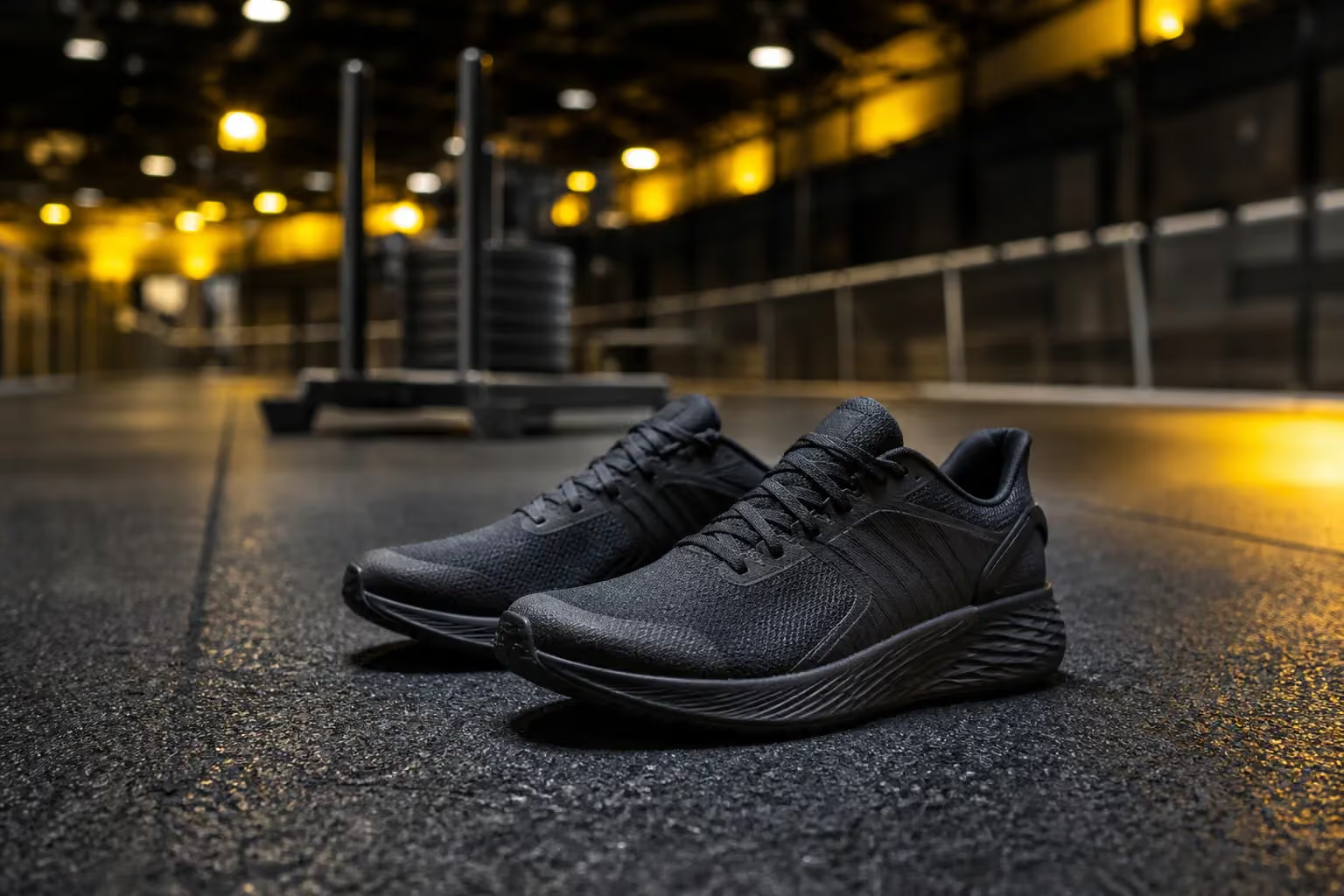
The best HYROX shoes of 2026: grip, stability and 8 km of running
Eight HYROX shoes compared for grip, stability, cushioning and speed, with verified specs, European prices and picks for every athlete.
By Ramon Curto · Updated 4 August 2026
A conventional running shoe can be quick and comfortable yet fail when the sled gets heavy: exposed foam, smooth rubber and a narrow, soft platform waste force or slip on turf. A pure gym shoe solves that contact problem but usually feels heavy, firm and flat over eight separate 1 km runs. HYROX therefore rewards a compromise rather than the most extreme shoe from either category.
Our three-model shortlist is simple. The Saucony Endorphin Pro 5 is the best overall balance of speed, grip and unusually good stability for a plated racer. The PUMA x HYROX Velocity NITRO 4 is the value choice and the safer answer for a first race. Fast runners chasing a sub-70-minute result can exploit the lighter, more aggressive PUMA x HYROX Deviate NITRO Elite 4, provided they already control plated shoes under load.
| Category | Model | Weight | Sled grip | Price | Best for |
|---|---|---|---|---|---|
| Best overall | Saucony Endorphin Pro 5 | 206 g | High | €270 | Most racers wanting one fast compromise |
| Best value | PUMA x HYROX Velocity NITRO 4 | 245 g* | Very high | €130 | Training and racing on one budget |
| Fast athletes | PUMA x HYROX Deviate NITRO Elite 4 | 194 g | Very high | €250 | Sub-70 athletes with sound station technique |
| Best sled grip | HOKA Mach 7 | 232 g | Very high | €160 | Slippery floors and runners avoiding a plate |
| Best stability | ASICS GT-2000 14 | 270 g | High | €160 | Strong athletes, support needs and doubles |
| Best for beginners | Nike Pegasus 42 | 300 g | High | €139.99 | A first HYROX and regular road training |
| Best hybrid | Reebok Nano X5 | 340 g* | Medium | €140 | Daily gym work plus occasional HYROX |
| Best cushioning | Saucony Endorphin Speed 5 | 238 g | High | €200 | Protecting the legs across all eight runs |
This is an editorial selection, not a claim that one shoe fits every foot. We checked official specifications, Spanish or European list prices and product availability on 4 August 2026, then contrasted those claims with published independent laboratory reviews. The asterisk in the table marks weights reported by independent reviewers because the Spanish product page did not publish a comparable men's weight.
We scored the practical demands station by station: rubber coverage and friction for the sled, platform width and foam compression for loaded lunges and carries, lockdown for changes of direction, forefoot flex for burpees, heel fit in the rower and enough impact protection for 8 km. No ranking is based on personal race testing, gifted-product impressions or an elite result treated as proof. Independent reviewers can measure traction and stability; your venue surface, body mass, pace and fit still decide the final answer.
HYROX alternates eight 1 km runs with the SkiErg, sled push, sled pull, burpee broad jumps, row, farmers carry, sandbag lunges and wall balls. The shoe repeatedly switches from forward running to force transfer, deep flexion and fatigue-sensitive control.
| Station | What it punishes | What to look for |
|---|---|---|
| Eight 1 km runs | Excess weight, dead foam and harsh impact | Responsive cushioning, secure fit and sensible mass |
| Sled push and pull | Smooth rubber, exposed foam and heel slip | Tacky forefoot rubber, broad contact and lockdown |
| Burpee broad jumps | Rigid forefoot and unstable landings | Controlled flex, grip and a predictable platform |
| Row and SkiErg | Bulky heel, loose upper and wasted movement | Heel-cup compatibility and firm midfoot hold |
| Farmers carry | Soft foam and lateral wobble | Moderate stack and a wide, contained base |
| Sandbag lunges | Tall geometry and poor side-to-side control | Stable edges, secure heel and usable forefoot flex |
| Wall balls | Fatigue, pronation drift and unstable squatting | Lockdown, lateral support and an appropriate drop |
Grip is not only an outsole brand name. Coverage under the ball of the foot, rubber texture, floor contamination and the direction of force all matter. Stability is also more than firmness: a broad base can tame a lively foam, while a narrow high stack can turn a fast running shoe into work at every lunge. Finally, lockdown deserves equal attention. If the heel lifts while the athlete drives the sled, good rubber cannot transmit force cleanly.
Prices below are official Spanish or verified European list prices observed on the check date; sale colours, sizes and stock can change. Men's weights and manufacturer drops are used where the brand publishes them, with independent measurements identified when necessary.
The Endorphin Pro 5 is the rare carbon racer that does not demand an all-or-nothing trade. Saucony lists 206 g for men, an 8 mm drop and a 39.5/31.5 mm stack, with a dual PWRRUN HG/PWRRUN PB midsole and a redesigned carbon chassis. The official Spanish price checked was €270. Its PWRTRAC outsole adds more useful rubber than many exposed-foam super shoes, and independent laboratory work rated its ride notably stable for this class.
That combination suits athletes who still spend a large share of the race running but cannot afford a nervous platform at wall balls or sandbag lunges. The plate and tall stack remain less forgiving than a daily trainer during burpees, tight corners and heavy carries; practise those transitions before racing. It is our overall pick, not the automatic pick for every beginner or every heavier athlete. Choose it when pace matters, plated shoes already feel natural and one premium pair must cover the whole event.
Official page: Saucony Endorphin Pro 5 specifications and price · Independent review: RunRepeat Endorphin Pro 5 laboratory review
At €130 on PUMA Spain when checked, the HYROX Velocity NITRO 4 costs half as much as several plated racers and addresses the right failure point: traction. PUMAGRIP covers the outsole, while the nitrogen-infused NITRO foam and 10 mm official drop keep the ride familiar for daily road runners. PUMA does not publish a comparable men's weight on the Spanish page; the 2026 HYROX comparison from HyroxDataLab lists 245 g.
There is no plate, so the shoe gives up some propulsion at sub-elite running speeds. In return it bends more naturally for burpees, feels less precarious during carries and can take regular training without reserving a fragile super shoe for race day. Independent testing of the standard Velocity NITRO 4 found outstanding PumaGrip traction and strong energy return for its price, although the forefoot fit can feel narrow. It is the most rational purchase for athletes who want one pair for intervals, compromised running, sled sessions and the race itself.
Official page: PUMA x HYROX Velocity NITRO 4 product page · Independent review: RunRepeat Velocity NITRO 4 laboratory review
The Deviate NITRO Elite 4 is the sharpest HYROX-specific option in this list. PUMA publishes 194 g in EU 42, an 8 mm drop and a 40/32 mm stack, with NITROFOAM Elite, a carbon PWRPLATE and a modified PUMAGRIP outsole. The Spanish official price was €250. That specification is attractive when eight quick kilometres represent a decisive part of a sub-70 attempt.
Speed is also the condition for recommending it. A tall, plated racer returns more value to an athlete who can hold fast 1 km splits and already controls lunges, turns and wall balls under fatigue. It can be a liability for a first-timer who gains seconds running but loses them finding balance or bending through burpees. The outsole is far more relevant to HYROX than the smooth rubber of many marathon shoes, yet carbon does not cancel the need for sled practice on the exact pair. Use it as a race tool, not as a shortcut to elite technique.
Official page: PUMA x HYROX Deviate NITRO Elite 4 specifications and price · Independent review: HyroxDataLab 2026 HYROX shoe review
RunRepeat's 2026 HYROX guide selected the Mach 7 for traction, and its standalone test confirms why the outsole matters: sticky rubber at the forefoot is paired with tougher Durabrasion rubber at the heel. HOKA lists 232 g for men and a 5 mm drop; the verified European launch price was €160. The supercritically foamed EVA keeps it light and responsive without a plate.
A lower drop and relatively grounded, predictable ride make force transfer easier than in a soft, towering super shoe. That helps on sled carpet and during broad-jump landings, while the modest mass still works for all eight runs. The caution is adaptation: athletes used to 10 mm trainers may load calves and ankles differently, and grip measured on one surface cannot promise the same result on dusty concrete or wet rubber. Pick the Mach 7 when forefoot bite is the priority and a natural, plateless ride suits your mechanics.
Official page: HOKA Mach 7 official product page · Independent review: RunRepeat Mach 7 laboratory review
The GT-2000 14 is the control-first option. ASICS Spain lists 270 g, an 8 mm drop and a €160 price, with the 3D Guidance System, PureGEL and FF BLAST MAX foam. Independent testing gave it an excellent stability score and praised the durable outsole. Unlike a rigid lifting shoe, it still has enough cushioning for continuous road training and all eight HYROX run segments.
That makes it useful for heavier or strength-dominant athletes who compress soft superfoams, runners who want guidance, and doubles competitors who need a trustworthy platform while sharing loaded work. Doubles still requires both partners to run every kilometre, so a pure gym shoe remains the wrong extreme. The trade-offs are weight, a less explosive ride and a tapered toe box that can restrict wider feet. Choose the GT-2000 14 when lateral confidence and repeatable mechanics matter more than the last seconds of running pace.
Official page: ASICS GT-2000 14 specifications and price · Independent review: RunRepeat GT-2000 14 laboratory review
The Pegasus 42 is the low-risk starting point: familiar geometry, broad availability and a durable outsole rather than an aggressive race setup. Nike Spain lists 300 g in men's EU 44, a 10 mm drop and €139.99, with ReactX foam, a full-length Air Zoom unit and high-abrasion rubber. The updated last also creates more forefoot and toe room than version 41.
Its strength is predictability. A beginner can use it for easy runs, intervals and compromised sessions, learn what slips or feels unstable, then decide whether a specialist pair is justified. Independent testing found substantially improved traction over its predecessor and a secure heel, but only modest energy return and more weight than modern tempo shoes. It will not turn the running splits into a strength, nor does it match PumaGrip on every surface. It is the recommendation for finishing a first HYROX comfortably and collecting useful experience without paying a carbon premium.
Official page: Nike Pegasus 42 specifications and price · Independent review: RunRepeat Pegasus 42 laboratory review
The Nano X5 starts from the gym and stretches toward HYROX. Reebok's Spanish range lists it at €140 and uses a Lift and Run plate, full-foot base and flexible zones for loaded work, HIIT and plyometrics. The manufacturer page does not publish directly comparable weight and drop figures; RunRepeat measured 340 g and 8.1 mm. Its firm heel, containment and durability are much more reassuring under barbells and carries than a soft road racer.
The compromise appears across 8 km. It is heavy, less energetic and, in independent wet-concrete testing, less grippy than the best road-rubber options. It therefore suits athletes who genuinely want one shoe for regular strength sessions, treadmill intervals, burpees and occasional HYROX preparation—not runners trying to maximise race pace. Test it on sled turf before committing, because a stable gym platform does not automatically equal top sled friction. For a relay athlete running only two kilometres and handling strength-led stations, the gym-first bias can make more sense.
Official page: Reebok Nano X5 official product page · Independent review: RunRepeat Nano X5 laboratory review
The Endorphin Speed 5 protects tired legs without moving all the way to a rigid carbon racer. Saucony lists 238 g for men, 213 g for women, an 8 mm drop and a €200 list price. PWRRUN PB foam provides high energy return, while the curved nylon chassis preserves more forefoot flex than carbon and the outsole has increased heel-rubber coverage.
This is the pick for athletes whose form deteriorates on runs five to eight and who want a responsive cushion that remains usable for daily tempo work. The smooth SPEEDROLL transition helps when cadence fades, and independent testing rated both energy return and traction highly. It is still a relatively tall, bouncy road shoe, so strength-dominant racers must confirm lateral control during lunges and wall balls. It also costs more than the Velocity. Choose it when accumulated impact, not maximal sled load or the lowest price, is the limiting factor.
Official page: Saucony Endorphin Speed 5 specifications and price · Independent review: RunRepeat Endorphin Speed 5 laboratory review
Carbon plate or no plate? A plate can improve running economy and make each 1 km segment feel smoother, but HYROX is not a road 10K. Carbon increases longitudinal stiffness, can reduce useful forefoot flex and often comes with taller, softer geometry. It makes most sense when the athlete already runs quickly, has rehearsed the sled and stays controlled under load. A nylon plate or plateless trainer is more forgiving for most first-timers.
Drop and stack. An 8–10 mm drop is familiar to many road runners and can help athletes with limited ankle mobility reach wall-ball depth, but it also shifts load and should not be chosen by rule. A 5 mm shoe may feel more planted yet asks more of the calf and ankle. Moderate stack gives enough impact protection without disconnecting the foot from the floor. Fit and adaptation outrank any universal number.
Outsole compounds. Look for rubber under the forefoot, not just the heel, because sled force is applied through the front of the shoe. PUMAGRIP, PWRTRAC and sticky-rubber formulations are useful signals, but compound name alone is insufficient: coverage, texture, dust, sweat and venue flooring change friction. Do a heavy push and pull on comparable turf before race day.
When a carbon racer makes sense. A fast athlete chasing sub-70 can gain more from a light plated model because running occupies a large, improvable share of the total. The same shoe can cost a novice time through instability, awkward burpees or poor rower fit. Carbon is a performance choice after technique, not an entry requirement.
One shoe or two. One versatile pair is economical and keeps training specific: the Velocity, Pegasus or Speed can cover ordinary runs and compromised sessions. A two-pair rotation lets a durable trainer absorb mileage while a lighter race shoe stays fresh. Doubles does not remove the 8 km—both partners run every lap—so stability cannot come at the cost of runnability. In relay, each athlete runs only two kilometres and completes two stations; a gym-forward shoe can be logical for a strength-heavy assignment, provided it still handles those fast runs.
Footwear only works inside a complete race plan. Use our HYROX Madrid guide to organise arrival and event logistics, compare it with HYROX London ExCeL, and build realistic splits with the HYROX time calculator.
Venue floors differ. Sled lanes use purpose-built turf, while runs and transition areas may include concrete, rubber or other indoor surfaces. Carpet condition, dust and moisture also change through the day. Grip matters most on a slick floor, so an outsole that felt secure outdoors is not automatically secure in the arena. Rehearse lacing, corners, burpees, lunges and at least one race-load sled session in the exact pair.
Yes, if they have secure lockdown, enough forefoot rubber and a stable platform. Many daily trainers work better than pure gym shoes because HYROX includes 8 km of running. Avoid assuming that any road shoe is suitable: exposed foam, smooth outsoles and very soft high stacks can slip or wobble at stations.
It is optional. Carbon can reward fast, efficient runners, but stiffness and tall foam may hinder burpees, lunges and loaded stability. Test sled grip and station control before choosing it. Most first-timers are better served by a grippy daily or tempo trainer.
Elite fields include several light plated racers, and PUMA's official partnership makes its HYROX models especially visible. There is no complete public shoe census proving one universal elite choice. Sponsored use and podium appearances are evidence of use, not proof that the same shoe is best for every athlete.
Yes, with a compromise. The Reebok Nano X5 favours lifting and gym durability but is slower over 8 km; the PUMA Velocity NITRO 4 favours running while remaining station-capable. Heavy Olympic lifting and fast HYROX racing still pull footwear in opposite directions.
Start with the size that works in your current running shoe, then check the specific model because lasts differ. The heel and midfoot must not move during sled work, while the toes need space under swelling and downhill pressure from lunges. Do not size down merely to create lockdown; use the eyelets and lacing first.
The €130–€160 range already includes capable options such as the Velocity, Pegasus, Mach and GT-2000. Spending €250–€270 buys lower mass, premium foam and carbon, not guaranteed minutes. A first-timer should fund training and entry costs before a marginal race-day upgrade.
Complete at least three or four sessions in it, including intervals, burpee broad jumps, loaded lunges, rowing and a race-load sled push and pull on similar turf. Check heel lift, toe pressure, lateral wobble and grip when the floor is dusty or damp. Never debut a new pair in the arena.
We separate official specifications and prices from independent testing. Product colours, sale prices and stock can change; the list price and page contents below were checked on 4 August 2026. Sources by pick:
- Saucony Endorphin Pro 5: official product page · independent review.
- PUMA x HYROX Velocity NITRO 4: official product page · independent review.
- PUMA x HYROX Deviate NITRO Elite 4: official product page · independent review.
- HOKA Mach 7: official product page · independent review.
- ASICS GT-2000 14: official product page · independent review.
- Nike Pegasus 42: official product page · independent review.
- Reebok Nano X5: official product page · independent review.
- Saucony Endorphin Speed 5: official product page · independent review.
- RunRepeat's HYROX testing method and 2026 selection.
SportPlan will review this guide quarterly during the HYROX season, and sooner when a listed model is replaced, an official specification changes or meaningful independent traction data appears. Rankings will not be changed because of a single sponsored result or an unverified launch rumour.
Keep planning
Use SportPlan to compare dates, save target events, and build a season that fits your weekends instead of another unstructured list.