
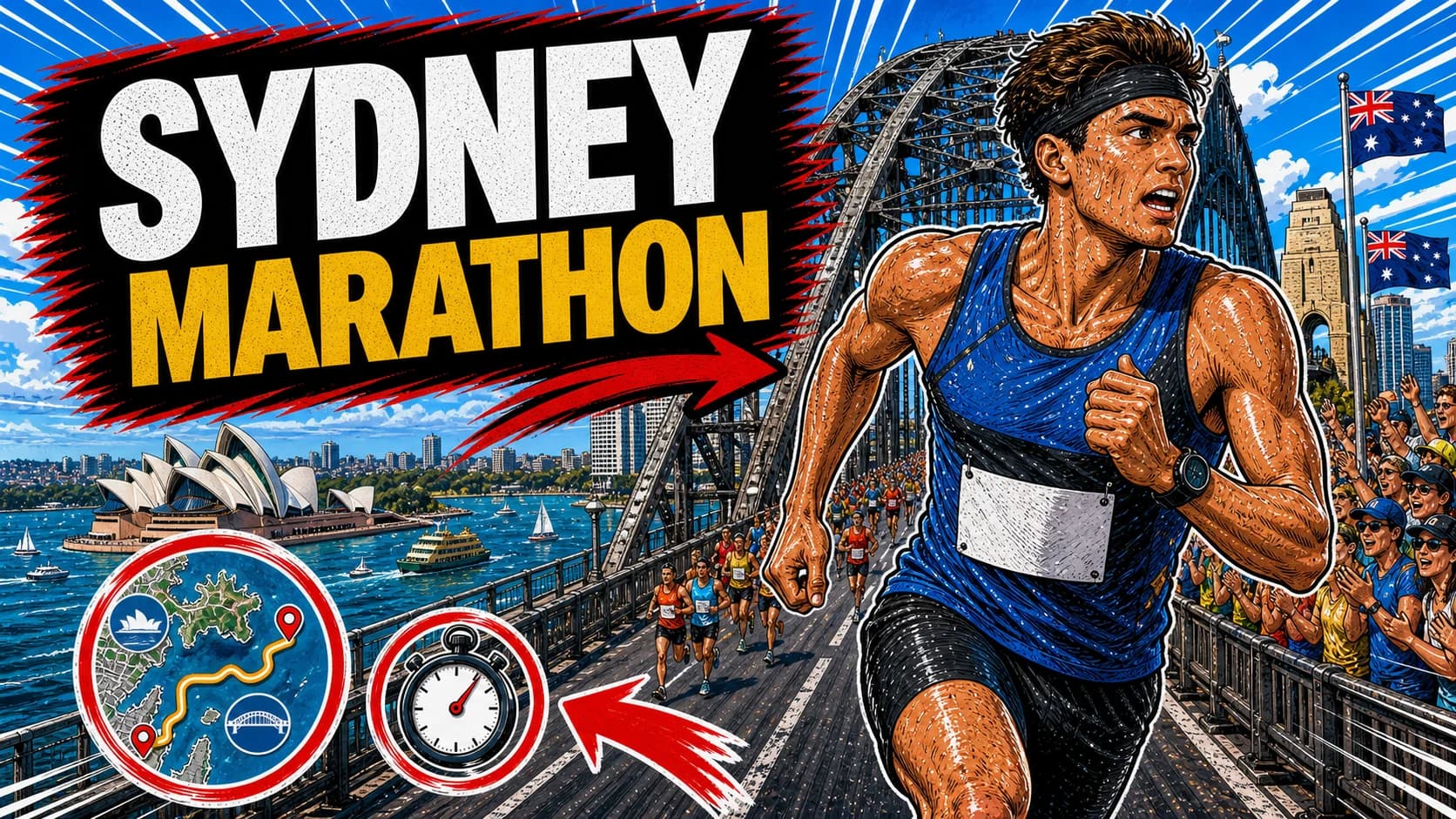
TCS Sydney Marathon 2027 Complete Guide — New Abbott World Marathon Major, Harbour Bridge, Opera House and How to Train For It
Everything you need to run the 2027 TCS Sydney Marathon: the seventh and newest Abbott World Marathon Major (added in 2025), point-to-point course crossing the Harbour Bridge with finish at the Opera House, ~265 m of...
By Ramon Curto · Updated 2026-05-08
On Sunday, August 29, 2027 Sydney holds its marathon — the seventh and newest Abbott World Marathon Major, added to the historic circuit in September 2025 to complete the original six (Boston / London / Berlin / Tokyo / Chicago / NYC). Point-to-point from Milsons Point across the iconic Sydney Harbour Bridge and finishing at the Sydney Opera House Forecourt, with ~265 m of rolling elevation and cool late-winter Australian weather, this isn't the fastest marathon on the international calendar — but it's one of the most spectacular and, in terms of race-day conditions, one of the best of the seven WMMs. This guide covers what the official site doesn't quite spell out: how to get in (Good for Age qualifying, lottery, or tour operator), how to manage the rolling Centennial Park section between km 17–24 without blowing up, what to do about jet lag from Europe, and how to run the bridge-dive opening without burning your race in the first 5 km.
📑 Table of contents
| Item | Information |
|---|---|
| Date | Sunday August 29, 2027 |
| Distance | 42.195 km (marathon) |
| Other distances | Sydney Marathon Half (21.1 km) · Bridge Run (10K) · Family 3.5K |
| Elevation gain | ~265 m (rolling, not flat) |
| City | Sydney, New South Wales, Australia |
| Start | North Sydney (Bradfield Park / Milsons Point) |
| Finish | Sydney Opera House Forecourt |
| Start time | ~06:50 AEST (confirm with official communication) |
| Organizer | Pont3 + Athletics NSW |
| Category | World Athletics Platinum Label + Abbott WMM (since 2025) |
| Participants | ~35,000 (record after WMM induction) |
| Registration | sydneymarathon.com |
The TCS Sydney Marathon presented by ASICS is the seventh and newest Abbott World Marathon Major, added to the historic circuit in September 2025. Organized by Pont3 and Athletics NSW, it runs on the last Sunday of August and brings together ~35,000 runners on a point-to-point course that combines the Sydney Harbour Bridge crossing with a finish on the Sydney Opera House Forecourt. It holds World Athletics Platinum Label since 2024 — the highest category on the international calendar.
Sydney is the perfect opposite of Berlin or Valencia: where those are flat record-breaking tracks, Sydney is landscape, rolling hills, and experience. The descent off the bridge gives you the first 3 km on a plate, but the central rolling section through Centennial Park and the eastern suburbs (km 17–24) has hills that punish runners who went out too hard. What you lose in flat tarmac you gain in scenery: the dawn bridge crossing and the finish at the Opera House are two of the most recognizable images in road running worldwide.
- If you're chasing the Six Stars (now Seven Stars): Sydney is mandatory to complete the circuit. It fits perfectly as your second or third Major.
- If you've run Boston or NYC and you can climb: Sydney is similar in difficulty (NYC has 250 m, Sydney 265 m). Your time here will be comparable to your NYC time.
- If you're chasing your marathon PB: not Sydney. The hills + warming temperature between km 25 and the finish cost you 3–6 minutes vs. a flat European track.
- If you've never flown to Australia: plan 3–5 days of jet-lag adjustment (CET is 8–10 hours behind AEST). Land Wednesday before at the latest if coming from Europe.
- If you want the WMM atmosphere without the impossible Tokyo lottery: Sydney is still the most accessible WMM via Good for Age qualifying — qualifier times similar to Boston but without the cutoff below the official time.
The TCS Sydney Marathon course is a single point-to-point 42.195 km route from Milsons Point (North Sydney) to the Sydney Opera House Forecourt, with ~265 m of total positive elevation gain. It starts next to the north pylon of the Sydney Harbour Bridge, crosses the entire 8-lane span (closed to traffic — the only day of the year this happens), runs through the central CBD and Royal Botanic Garden, heads south-east toward Centennial Park and the eastern suburbs, returns through Surry Hills, and finishes at the Opera House Forecourt.
The first 3 km cross the Harbour Bridge with a gentle descent toward central Sydney — view of the Opera House on your right at the precise moment of sunrise. Km 3 to 10 take you through the CBD, Macquarie Street, the Royal Botanic Garden and the Hyde Park area, with massive crowd support.
From km 10 onward the course heads south-east, crossing Surry Hills toward Centennial Park and Heffron Park — the out-and-back that defines the real difficulty of the race. Here are the hills. Km 17 to 24 is a sequence of repeated rollers (4–6 % grade, 200–400 m each) that the runner who went out fast off the bridge wasn't expecting.
The final third (km 25–35) descends through Surry Hills and Eastern Suburbs back toward the harbour, and the last 7 km drop down through The Domain to the final sprint along Macquarie Street and the finish ramp at the Sydney Opera House Forecourt. The finish crosses the forecourt with the harbour water on your right and the Opera House facade on your left — three visually unforgettable minutes after the toughest of your day.
Strava data: popular segments are "Sydney Harbour Bridge Marathon Crossing" (km 1–3, bridge descent) and "Centennial Park Loop" (km 18–24, the climbing section). The official GPX is published a few weeks before the race.
The Sydney Marathon was first run as part of the Sydney 2000 Olympic Games and became annual in 2001. For two decades it was a solid but secondary international race — until in September 2025 the Abbott World Marathon Majors announced its addition to the circuit as the seventh Major, completing the historic six and being the first new addition since the circuit was created in 2006. The 2025 edition broke the entry record (~35,000) and 2026 confirmed the new scale. 2027 will be edition 27 of the race.
Race data and palmarés (recent editions):
| Item | Value |
|---|---|
| First edition | 2000 (Olympics) |
| Annual edition since | 2001 |
| World Athletics category | Platinum Label (since 2024) |
| Abbott World Marathon Major | Since September 2025 (seventh Major) |
| Current distances | Marathon · Half Marathon · Bridge Run 10K · Family 3.5K |
| Participants 2025 (record) | ~35,000 entries |
| Countries represented | 80+ |
| Men's course record | 2:06:18 (Brimin Kipkorir, KEN, 2024) |
| Women's course record | 2:21:41 (Workenesh Edesa, ETH, 2024) |
Recent winners are published in the official Sydney Marathon archive and on Wikipedia: Sydney Marathon. Brimin Kipkorir's course record (2:06:18 in 2024) marked the start of the Platinum Label / WMM era and remains the international elite reference.
TCS Sydney Marathon 2027 entry has four routes: Good for Age qualifying (qualifier times by age/gender — opens September 2026), general lottery (opens November 2026, drawn February 2027), charity bibs with a fundraising commitment (continuously open), and tour operator entries through accredited operators like Marathon Tours, Travelling Fit, or Apex Sport for international runners. The base marathon fee runs A$220 (early-bird) to A$390 (late), not counting tour-operator packages that reach A$2,000+ with flight + hotel.
Entry routes — comparison:
| Route | Opens | Cost | Probability |
|---|---|---|---|
| 🟢 Good for Age qualifying | Sept 2026 | A$220–280 | High if you have the qualifier time |
| 🟡 General lottery | Nov 2026 (drawn Feb 2027) | A$280–340 | ~30–40 % in WMM era |
| 🟠 Charity bib | Continuous | A$280 + A$5,000+ fundraising commitment | Guaranteed with charity commitment |
| 🔴 Tour operator | Continuous | Package A$2,000–4,000 (incl. flight/hotel) | Guaranteed with package purchase |
Pricing is indicative based on the 2026 edition. Always confirm at the official registration page — fees update there. Official international fee may be higher via licensed operators.
| Included | NOT included (optional extra) |
|---|---|
| ✅ Bib with timing chip | ❌ Official professional photo |
| ✅ TCS / ASICS finisher tech tee | ❌ Saturday pasta party |
| ✅ Finisher medal (seventh Abbott Star) | ❌ Premium gear-check service |
| ✅ On-course aid stations | ❌ Cancellation insurance |
| ✅ Post-finish bag | ❌ Organized expo excursion |
| ✅ Sydney Marathon Festival Expo access |
Refund policy: ~80 % refundable with medical certificate before late June. Entries are non-transferable between runners or to another edition — the organizer has tightened this since the WMM induction due to high demand.
Bib pickup happens at the Sydney Marathon Festival Expo at the International Convention Centre (ICC) Sydney, Darling Harbour, on Friday and Saturday before the race. Race-day pickup is not allowed: collect in person before the Saturday afternoon expo close.
You'll need:
- Registration confirmation (printed or on phone)
- Passport or photo ID
- Australian visa (eVisitor or ETA processed online — essential to enter the country)
Family can collect on your behalf with a signed authorization and a copy of your passport. The kit includes the finisher tech tee, the chipped bib, and the course map. Abbott WMM medals are awarded after crossing the finish line.
The most practical way to reach Sydney is via Sydney Kingsford Smith Airport (SYD), 9 km from CBD, with Train Airport Link direct to Central Station in 13 minutes. From Europe it's ~22 hours with a stop (Dubai, Doha, Singapore, or Hong Kong); from Asia there are direct flights of 7–9 hours. The time zone gap with Madrid/Barcelona/Paris is 8–10 hours ahead depending on European summer time, making it mandatory to arrive 3–5 days early for European runners.
On race day, get to the start by ferry or light rail. Options from CBD:
- Ferry from Circular Quay to Milsons Point (10 minutes) — the option most used by runners. Operates from 05:30. View of the Harbour Bridge from the water as you arrive.
- Light rail / Train to North Sydney from Town Hall or Wynyard Station — faster but less scenic.
- Walking across the bridge (25–30 min from The Rocks / Circular Quay) — only viable if you stay in northern CBD.
Sydney Metro starts running around 05:00. Some recent editions have offered free public transport for runners with bibs — confirm in official communications. Forget about parking near the start — the entire Milsons Point area is closed to traffic from early morning.
For European runners: flight with stop (Emirates Madrid–Dubai–Sydney, Qatar Madrid–Doha–Sydney, Singapore Madrid–Singapore–Sydney) ~22 total hours. Visa required: process the eVisitor (subclass 651) online at immi.homeaffairs.gov.au — free, valid one year, takes 24 h to approve for Spanish, Portuguese, Italian, French, German and other EU passports.
For Asian runners: direct flights from Tokyo (9 h), Hong Kong (9 h), Singapore (8 h), or Bangkok (9 h). Time gap with East Asia is only 1–3 hours, making Sydney especially attractive for Japanese, Korean, and Chinese runners without major jet lag.
Jet-lag adjustment plan from Europe:
- Sunday before (T-7): start advancing your bedtime gradually.
- Wednesday before (T-3): flight from Europe (12+ hours with stop).
- Thursday (T-2): arrive Sydney in the morning, walk / light shakeout in daylight. NO long run.
- Friday (T-1): easy 30 min jog, then to expo for bib pickup and kit.
- Saturday: rest, light walk, carb-loading meal at noon, early dinner.
- Sunday: marathon, wake 03:30, ferry at 05:00.
For a Sydney marathoner, sleeping less than 10 minutes by ferry or walking from the start corral isn't luxury — it's strategy. The marathon drops you at the finish around 11:30–13:00 depending on goal — you head back to the hotel sweaty, hungry, with cramps starting. The difference between sleeping at The Rocks (5 min walk to the Circular Quay ferry on Sunday at 05:30) and a hotel in Sydney Olympic Park 30 min by transport can cost you 1–2 minutes on the clock and double that in mental stress.
- Distance to start: 10–15 minutes by ferry from Circular Quay (~600 m walk to ferry). The most convenient option Sunday at 05:30.
- Pros: unbeatable logistics. Walk to ferry, walk to finish. Opera House (the finish) is 5 min away.
- Cons: more expensive tourist zone. Saturday night can be loud near The Rocks.
- Best for: PB-chasing runners who want to minimize logistics and maximize rest.
| Hotel | Cat. | A$/night* | To start | Runner highlight |
|---|---|---|---|---|
| Park Hyatt Sydney | 5* | 950–1,400 | 5 min ferry + 5 min walk | Bridge view + spa for recovery |
| Sydney Harbour Marriott Hotel | 5* | 380–520 | 5 min ferry | Next to Circular Quay, strong AC |
| Pullman Quay Grand | 5* | 350–480 | 5 min ferry | Frequent late check-out, 24h gym |
| QT Sydney | 5* boutique | 320–460 | 8 min walk + ferry | Boutique, spa with bathtub |
| Pier One Sydney Harbour | 4* | 290–400 | 5 min ferry | Historic hotel next to The Rocks |
- Distance to start: 15–20 minutes by metro or light rail to North Sydney; or 20 min walk + ferry.
- Pros: very close to the ICC Sydney where the Sydney Marathon Festival Expo is held. Top restaurants, moderate tourist atmosphere.
- Cons: further from the start corral than CBD/Rocks. Need a transport plan Sunday at 05:00.
| Hotel | Cat. | A$/night* | To start | Runner highlight |
|---|---|---|---|---|
| Sofitel Sydney Darling Harbour | 5* | 380–520 | 25 min by metro | Next to expo, spa, international luxury |
| Hyatt Regency Sydney | 5* | 320–440 | 25 min by metro | Harbour view, 24h gym |
| Novotel Sydney on Darling Harbour | 4* | 240–340 | 25 min by metro | Solid mid-range, next to expo |
| Ibis Sydney Darling Harbour | 3* | 160–240 | 25 min by metro | Budget, next to expo |
- Distance to start: 5–15 minutes walk — the closest option physically to the corral.
- Pros: walk to the corral in 10 minutes. Quieter residential area than tourist CBD.
- Cons: fewer 5* hotels. Saturday night you have to cross to dine in CBD if you want atmosphere. After finish you have to come back across the harbour.
| Hotel | Cat. | A$/night* | To start | Runner highlight |
|---|---|---|---|---|
| View Sydney | 3* | 180–260 | 5 min walk | Closest to the corral |
| North Sydney Harbourview Hotel | 4* | 220–320 | 8 min walk | Harbour view, mid-range |
| Vibe Hotel North Sydney | 4* | 200–290 | 12 min walk | Modern, strong AC, gym |
*Indicative weekend-of-race rate (last Sunday of August). Varies with booking lead time, growing WMM demand, and exchange rates. WMM induction has lifted prices ~25 % since 2025.
The weather in Sydney on the last Sunday of August averages 8 °C low at start and 17 °C high at finish with sunny or partly cloudy conditions on around 70 % of days, per Bureau of Meteorology data. It's late austral winter, with clear days, moderate westerly wind (10–20 km/h), 50–65 % relative humidity, and zero monsoon. For European or North American runners escaping August/September heat, these are exceptional conditions — comparable to the best of Berlin or Chicago, but with an added marine setting.
Sydney is one of the few WMMs with almost always favorable weather. While Boston can hit you with 28 °C in April or NYC with 5 °C and wind in November, Sydney offers the ideal thermal range for the marathon: cool but not freezing start, progressive rise without thermal stress. Your body enters its optimal aerobic zone between 12–16 °C, and that's exactly what you'll have between km 5 and the finish.
Plan by forecast:
- <8 °C at start + wind >20 km/h: severe austral winter. Throwaway layer to the corral. Short sleeve + arm warmers + gloves for the first 8 km.
- 8–14 °C all day: the perfect conditions. If you don't run your best version here, it's not the temperature.
- 14–20 °C: very good day. Watch dehydration if going sub-3:00 — drink at every aid station from km 5.
- >20 °C: infrequent but happens in atypical years (austral anticyclone). Drop target pace 5 sec/km.
Wind can be a factor on the bridge crossing (km 1–3) if blowing from the west — crosswind. In Centennial Park (km 17–24) buildings and trees damp the effect. Historical wind average is 10–15 km/h, perfectly manageable.
The recommended plan to prepare for the TCS Sydney Marathon is a 16-week block with peak volume in weeks 11–13 (between 50 km and 110+ km weekly depending on goal), progressive long run, specific hill-repeats block between weeks 6 and 11 (essential for the rolling profile), and a 3-week taper. Key for Sydney: train repeated hills — Centennial Park doesn't forgive runners who arrive without 8–10 hill-repeat sessions in their build-up.
Peak weekly volume by goal:
| Goal | Peak volume | Max long run | Sessions/week |
|---|---|---|---|
| Sub-3:00 | 90–110 km | 35 km | 6 |
| Sub-3:30 | 70–90 km | 32 km | 5 |
| Sub-4:00 | 60–75 km | 30 km | 4–5 |
| Sub-4:30 | 50–65 km | 28 km | 4 |
| Finish (5:00+) | 40–55 km | 26 km | 3–4 |
Sydney-specific sessions (weeks 6–11):
- Hill repeats: 8–12 × 400 m at 5K pace up a 4–6 % grade, recovery on descent. Minimum 8 sessions in the block.
- Tempo on rolling profile: 12–16 km at marathon pace in a hilly city park (NOT flat).
- Long run with hills: once a month, 30+ km including 4–5 long climbs to simulate Centennial Park.
- Marathon-pace intervals: 4 × 3 km at goal pace in the middle of long run, weeks 10–11.
Based on your best recent flat marathon (Berlin, Valencia, Sevilla), here's your realistic Sydney time applying the rolling-profile penalty (~4–6 minutes):
| Best on flat | Realistic Sydney time |
|---|---|
| 2:45 flat | 2:48–2:51 |
| 3:00 flat | 3:04–3:07 |
| 3:15 flat | 3:19–3:22 |
| 3:30 flat | 3:35–3:38 |
| 4:00 flat | 4:05–4:09 |
| 4:30 flat | 4:36–4:40 |
Once you have your realistic Sydney goal (factoring in the rolling profile), use the calculator for the splits to hit at each checkpoint:
| Punto | Tiempo acumulado | Parcial |
|---|---|---|
| 5 km | 24:53 | 24:53 |
| 10 km | 49:46 | 24:53 |
| 15 km | 1:14:39 | 24:53 |
| Media (21,1 km) | 1:45:00 | 30:21 |
| 30 km | 2:29:18 | 44:18 |
| Meta | 3:30:00 | 1:00:42 |
Los parciales suponen un ritmo constante y no incluyen paradas. En TCS Sydney Marathon, adapta el esfuerzo al terreno y a las condiciones; no fuerces las bajadas para recuperar segundos.
The Sydney race plan starts at the gun in Milsons Point with the Harbour Bridge descending toward CBD. The first 3 km give pace away: the bridge descent can put you 30–60 seconds ahead of target if you let it. Don't let it. That descent bank is exactly what you'll need — all of it — between km 17 and 24.
| Goal | 5K split | Sydney-specific tactical note |
|---|---|---|
| Sub-2:45 | 19:30 | Bridge descent at 3:48/km max (no faster). Rolling km 17–24 hold 3:55/km — lose 5 sec/km, recover km 25–35. |
| Sub-3:00 | 21:18 | Bridge at 4:08/km. Rolling hold 4:18/km. Final Domain (km 35–42) can drop to 4:10. |
| Sub-3:15 | 23:05 | Bridge at 4:30/km. Rolling 4:42/km. Conservation critical km 10–24. |
| Sub-3:30 | 24:53 | Bridge at 4:52/km. Rolling 5:05/km. Don't chase pace on hills. |
| Sub-4:00 | 28:25 | Bridge at 5:35/km. Rolling 5:48/km. Plan B: walk 30 sec on the toughest climbs. |
| Sub-4:30 | 31:58 | Bridge at 6:18/km. Run-walk on hills km 17–24 is OK. Enjoy the scenery. |
| Sub-5:00 | 35:30 | Bridge at 7:00/km. Planned run-walk from km 25. Focus: finish at Opera House. |
| Finish | — | Comfortable pace. The medal and the Opera House photo are worth any time. |
Race morning: wake 03:30 AEST, coffee + light breakfast at 04:00, leave hotel at 04:30 to catch the 05:00–05:15 ferry. Reach corral at 06:00 (50 min before the 06:50 gun). Old hoodie for the corral — morning temps can drop below 8 °C in August.
Aid stations: every 5 km with water + Maurten (organizer's electrolyte and gel) + banana and bar at some points. Cadence is generous — drink at every one from km 5.
Mental at km 32: after the traditional "wall," the next 10 km are the lowest-elevation section. You go through The Domain and then Macquarie Street toward the Opera House. Crowd support explodes between km 35–40. The last km is the ramp to the Opera House Forecourt — one of the most-photographed finishes in the world.
The TCS Sydney Marathon nutrition strategy is the standard for cool-weather marathons — but adapted to the early start (06:50 AEST) and to jet lag if coming from Europe. Carb loading starts Friday (3 days before), with emphasis on Saturday: 8–10 g/kg body weight spread across 4 meals. Sydney has excellent international cuisine — Italian pasta, Japanese sushi, Cantonese rice in Chinatown — all valid for loading.
Saturday dinner: pasta or rice with lean protein (chicken, fish), cooked vegetables. Avoid raw salad in volume (gas in colon). Dinner by 19:00 AEST at the latest — you're waking at 03:30 the next day.
Sunday breakfast (04:00 AEST): 2:30–3 hours before gun. White bread with honey + banana + espresso coffee (Sydney has elite coffee culture — a flat white before the race works). Avoid full-fat dairy and fiber.
On course: one gel every 25–30 minutes from km 6, last at km 35. Total 5–6 gels = 250–300 g of carbs. Drink water at every aid station (every 5 km), Maurten on alternates.
Sydney-specific hydration: 8 °C start needs less water than Boston or NYC (similar climate). 200–300 ml per aid station is enough. Sodium: 200–300 mg per aid station if you're a salt-marker sweater.
Post-finish recovery (first 60 minutes): banana + protein bar + water + electrolyte. Hotel shower, lunch at 14:00 (protein + carbs + vegetables), short nap. Sunday night is loud in CBD — massive WMM celebration in pubs of The Rocks.
Sydney gear is the standard cool-weather marathon kit — closer to Boston or NYC than Valencia. Start temperature (~8 °C) calls for a corral throwaway layer; finish temperature (~17 °C) means short sleeve + shorts the rest of the way. The differentiator is the rolling profile: protective carbon-plate shoes (not the lightest), well broken in, are the right call.
Sydney-specific gear:
- Corral throwaway layer. 5–10 °C in Milsons Point at 06:00. Old hoodie or plastic poncho you ditch before the start (the organizer collects for donation).
- Light cap or visor. Sydney has strong sun in August if it clears — harbour-water reflection can dazzle from km 25 onward.
- Anti-chafe + nipple plasters. The rolling profile makes up-down movement chafing show up earlier than on flat.
- Gel belt or vest. Carry 5–6 of your own. Aid station gels are solid but not particularly generous — Maurten in stick at km 30 is confirmed; bring your own before that.
- Carbon-plate shoes. Vaporfly Next% 4, Adidas Adios Pro 4, Asics Metaspeed Sky+. NOT Alphafly (heel strike gets punished in Centennial hills). Minimum 200 km broken in across 2 prior long runs.
Is Sydney really a World Marathon Major?
Yes — since September 2025. Sydney is the seventh Abbott World Marathon Major, after Boston, London, Berlin, Tokyo, Chicago, and NYC. It's the first new addition to the circuit since its creation in 2006. Complete Sydney and you earn the Seven Star Medal from Abbott (replacing the historic Six Star).
How does Good for Age qualifying work?
Sydney uses qualifier times by age and gender similar to Boston (2025: ~3:00 men 18–34, ~3:30 women 18–34, scaling up). Your qualifier time must be from a certified marathon in the past 24 months. Registration opens September 2026 — set an alarm. A 3+ minute margin under the qualifier is recommended to guarantee a slot.
How does the lottery work?
The general lottery opens in November 2026 and is drawn in February 2027. Historical probability of being picked is ~30–40 % in post-WMM years (was ~50 % before). Entry costs a small non-refundable fee (~A$30); if drawn, you pay the full registration. If not drawn, charity bib or tour operator are the alternatives.
What visa do I need from Spain / EU?
eVisitor (subclass 651) — free, online at immi.homeaffairs.gov.au, valid one year, takes 24 hours to approve for Spanish, Portuguese, Italian, French, German, and other EU passports. Allows tourism + running the marathon (not paid work, so no elite-athlete visa needed).
How do I manage jet lag from Europe?
Arrive 3–5 days early. Time difference is 8–10 hours (Spain → Sydney) depending on European summer time. First 2 days you'll feel strong morning fatigue — no long run. Day 3: easy 30 min jog to activate legs. Day 4: rest or city walk. Day 5: marathon. 6 days early is optimal if budget allows.
Why is the bridge crossing dangerous for pacing?
The Sydney Harbour Bridge descent (km 1–3) gives away 30–60 seconds vs. target pace if you let it. Adrenaline of crossing the bridge at sunrise + descent + CBD energy compound the effect. The mistake is accelerating because "it feels good" in the first 8 km. Stay conservative: target pace + 5–10 sec/km in the first 10 km.
Is Centennial Park really hard?
Individual climbs are modest (4–6 % grade, 200–400 m each) — comparable to any urban hill. What makes them critical is they're repeated and long in aggregate: km 17 to 24 accumulates ~150 m of extra positive elevation vs. a flat course. Fresh-legged you, no problem. Bridge-blown you, this is where the race is decided.
Can I pick up my bib on race day?
No. Pickup is at ICC Sydney on Friday and Saturday before. No race-day pickup. You need passport + registration confirmation. Family can collect on your behalf with a signed authorization and a copy of your passport.
What shoes are best for Sydney?
For sub-3:30, a protective carbon plate (Vaporfly 4, Adios Pro 4, Metaspeed Sky+). Hills punish ultralight options like Alphafly. Most important: broken in across at least 2 long runs with under 200–300 km of use. Bring a backup pair (daily trainer) in case international travel loses your bag.
How does Sydney compare to Boston, NYC, Berlin, Tokyo?
Sydney is the seventh Major, the newest, and the most outdoor (bridge + Opera House). Boston is the oldest and most prestigious (BQ qualifying). NYC is the largest (50,000) and similar to Sydney in rolling profile (250 m). Berlin is the fastest (world records). Tokyo is the most cultural and operationally cleanest. Sydney has the best weather profile of the seven WMMs.
Sydney is the seventh and newest Abbott WMM, with rolling profile and cool weather. This table compares the seven Majors to help you choose your next one:
| Race | Month | Elevation | Best for | Entry |
|---|---|---|---|---|
| Sydney (this guide) | August | ~265 m rolling | Seventh Star · spectacular setting | Good for Age or lottery |
| Boston Marathon | April | ~140 m descent + 4 hills | Prestige · BQ runners | BQ qualifying or charity |
| Tokyo Marathon | March | <30 m | Pure PB · culture | Lottery |
| London Marathon | April | <50 m | Iconic atmosphere | Lottery + charity |
| Berlin Marathon | September | <30 m | World records · fastest | Lottery |
| Chicago Marathon | October | <30 m | Flat PB · cool weather | Lottery |
| NYC Marathon | November | ~250 m | Atmosphere and experience | Lottery + 9+1 + charity |
Did this guide help? If you're running Sydney 2027, save the event on SportPlan to get registration alerts, Good for Age deadlines, and later log your Seven Star Abbott.
Keep planning
Use SportPlan to compare dates, save target events, and build a season that fits your weekends instead of another unstructured list.