Joan eduki nagusira
SPORTPLAN
DiscoverTribuaBlogCalculators
Sign in
SPORTPLAN

Ekitaldiak aurkitu, denboraldia planifikatu eta emaitzak toki berean gordetzeko modu argiagoa.

DiscoverGuri buruzKontaktuaPribatutasun politika
Email us

© 2026 SportPlan. Eskubide guztiak erreserbatuta.

by Dockia Labs

SPORTPLAN

Ekitaldiak aurkitu, denboraldia planifikatu eta emaitzak toki berean gordetzeko modu argiagoa.

Email us

Product

  • Discover
  • Tribua
  • Blog
  • Calculators

Sports

  • Lasterka
  • Trail Running
  • Triatloia
  • Gravel
  • Errepide Txirrindularitza
  • HYROX
  • OCR / Spartan
  • Igeriketa

Cities

  • Barcelona
  • Madrid
  • Valencia
  • Sevilla
  • Bilbao
  • Málaga
  • Girona
  • Zaragoza

Company

  • Guri buruz
  • Kontaktua
  • Pribatutasun politika
  • Zerbitzu baldintzak
  • Cookie politika

© 2026 SportPlan. Eskubide guztiak erreserbatuta.

by Dockia Labs

DiscoverTribuaSign in
Absa Cape Epic 2026 Complete Guide — The Tour de France of Mountain Biking, 8-Day Pairs Race, South Africa and How to Train For It | SportPlan
Absa Cape Epic 2026 Complete Guide — The Tour de France of Mountain Biking, 8-Day Pairs Race, South Africa and How to Train For It
🌐

Ingelesezko bertsioa erakusten

Gida hau oraindik ez dago zure hizkuntzara itzulita — ingelesezko bertsioa erakusten dizugu. Itzulpenak laster.

23 min irakurketa·mtbmountain-bike

Absa Cape Epic 2026 Complete Guide — The Tour de France of Mountain Biking, 8-Day Pairs Race, South Africa and How to Train For It

📖 19 min read 📝 9,500 words 🎯 Skim friendly

Absa Cape Epic 2026 Complete Guide

Orrialde honetan

Key factsAbout the raceThe courseHistory and palmarèsRegistration and pricingGetting there and logisticsWhere to stayWeather and forecastHow to train — preparation planSplits calculatorPersonalised race planRace planNutritionEquipmentFrequently asked questionsComparison with other stage races and gran fondos

Erlazionatutako artikuluak

By Ramon Curto · Updated 2026-05-08
📖 19 min read 📝 ~9,500 words 🎯 Skim friendly

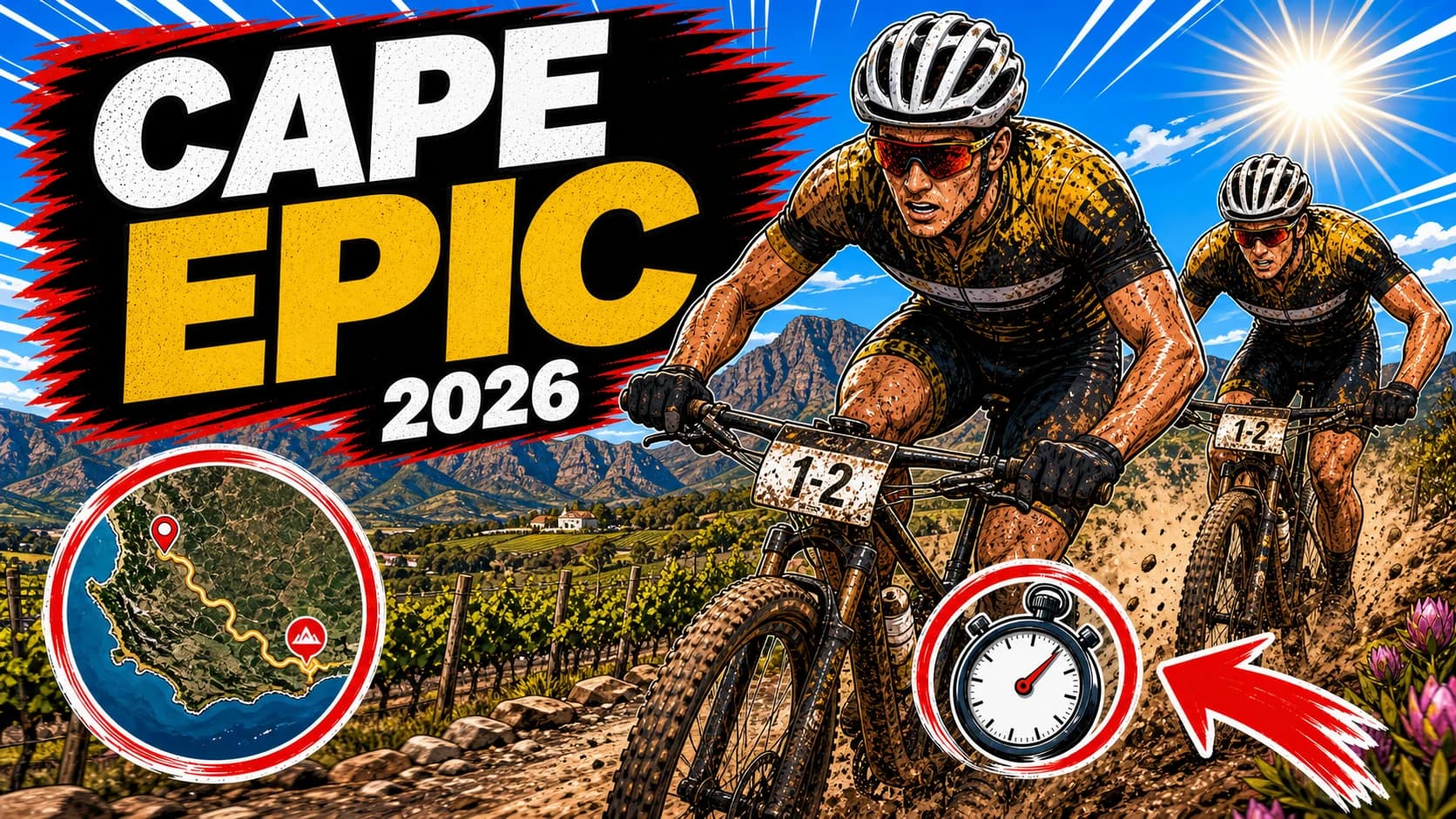
From Sunday March 15 to Sunday March 22, 2026, South Africa's Western Cape hosts what is undisputedly the Tour de France of mountain biking: the Absa Cape Epic. Eight days, prologue plus seven stages, ~600 km, ~16,000 m of elevation, ~1,200 riders divided into 600 teams of two riders who must cross the finish line together within two minutes of each other every single day. It is not a charity ride or a "prestige event by name only" — it is a UCI hors-catégorie stage race with world elite at the front and amateurs who have trained two years to be there. This guide covers what the official site never quite tells you: how the pairs format actually works, where the race breaks, how to train for 8 consecutive days at 8 hours of saddle time, and how to put together the trip from Europe or the Americas.

⚡ Quick verdict
  • One line: the most prestigious mountain bike stage race in the world. The Cape Epic finisher's medal is recognised on any cycling jersey on the planet.
  • Best for: MTB riders with a solid base (3+ years of riding), capacity for 6+ hour rides on a loaded bike, and a reliable partner for 8 consecutive days.
  • Avoid if: you are riding solo (no individuals allowed), you don't have a fit and technically capable partner, or you think you will "just cruise" — even the last finisher team averages 8 h on the bike per day.
  • Key data: 8 days · prologue + 7 stages · ~600 km · ~16,000 m of climbing · ~1,200 riders · 600 teams · ~85 % team finish rate.
  • Registration: lottery opens May 2025 and is drawn September 2025; success rate ~25 %; charity entries ~€12-15K/team if you don't get in.
📑 Table of contents
  1. Key facts
  2. About the race
  3. The course
  4. History and palmarès
  5. Registration and pricing
  6. Getting there and logistics
  7. Where to stay
  8. Weather and forecast
  9. How to train — preparation plan
  10. Splits calculator
  11. Personalised race plan
  12. Race plan
  13. Nutrition
  14. Equipment
  15. Frequently asked questions
  16. Comparison with other stage races and gran fondos

Key facts#

The essentials in one table: dates, pairs format, total distance, elevation and official links.
DataInformation
DatesSunday March 15 to Sunday March 22, 2026 (8 days)
FormatPairs (2 people) — must finish each stage together within <2 min
StructurePrologue (~25 km team time trial) + 7 stages (75-125 km)
Total distance~600 km
Total elevation gain~16,000 m
CategoriesMen's, Women's, Mixed, Masters (40+), Grand Masters (50+)
RegionWestern Cape, South Africa (Stellenbosch, Paarl, Wellington, Worcester, Tulbagh, Ceres)
Prologue startCape Town V&A Waterfront
Final finishCape Town V&A Waterfront (Stage 7)
Participants~1,200 riders · 600 teams · firm cap
OrganiserCape Epic Pty (founded 2004 by Kevin Vermaak)
Registrationcape-epic.com — annual lottery

About the race#

What kind of race Cape Epic actually is, why it is called "the Tour de France of MTB" and why the pairs format changes everything.

The Absa Cape Epic is the most prestigious mountain bike stage race in the world, founded in 2004 by Kevin Vermaak with the explicit goal of "creating for MTB what the Tour de France is for road cycling." Twenty-two editions later, the goal has been delivered: each year the lottery draws 3,000-4,000 team entries for 600 spots, the registration window closes within hours, and the palmarès is populated by names like Christoph Sauser, Karl Platt, Jaroslav Kulhavy, Annika Langvad and Sabine Spitz — Olympic and World Cup elite of XCO and XCM.

📷 Photo pending · About the race header

The lead group of Cape Epic crossing a dirt road through Stellenbosch vineyards at sunrise, riders' shadows stretched long, with Table Mountain silhouetted in the background — the universal Cape Epic postcard.

What separates Cape Epic from any other MTB event on the calendar is the combination of three ingredients:

  • Strict pairs format: the two team members must cross each stage's finish line within two minutes of each other, or the entire team loses general classification (they keep racing in "Outcast" category but no longer compete for official time). This makes the race a partnership exercise, not an individual one: the faster rider has to wait for the slower, assist on punctures, push on climbs if needed, share workload in the wind like a TT team. A poorly matched pair breaks.
  • 8-day UCI hors-catégorie stage race: prologue + 7 stages with a total volume of ~600 km and ~16,000 m of vertical. That's ~75 km and ~2,000 m daily, with stages varying between 75 km and 125 km, and 1,500 m to 3,000 m of climbing.
  • "Race village" logistics: all teams live in a tent camp that is set up at each stage's overnight location, with showers, food, massages, mechanical support and zero distractions. Your life for 8 days is: ride, eat, sleep, repeat. It is the closest format to the Tour de France for amateur athletes anywhere.

Why is it called the "Tour de France of MTB"? Because it combines historical prestige, world-class elite competition, global media coverage (live TV broadcast in 70 countries) and mass-event scale that no other MTB stage race matches. Trans Alp (Germany-Italy) and Trans Provence (France) are brutal and have their following, but neither has Cape Epic's media weight or depth of elite participation.

Is this race for you?#

Cape Epic is designed as a full-year preparation goal. If you fit any of these profiles, it is for you:

  • You have done 1-2 large MTB marathons (La Rioja Bike Race, Andalucía Bike Race, Mediterranean Epic, Cape Pioneer Trek) and want to step up to the global stage-race level.
  • You have a riding partner with whom you have ridden the last 12 months and you know their strengths, weaknesses, emotional management when bonking and basic mechanical skills under pressure.
  • You take the "pair" component seriously and understand that Cape Epic's sporting outcome depends 50% on the weakest rider on their worst day, not the strongest on their best.
  • You have the budget (entry ~€7-9K/team + flights + extras = ~€10-12K/person minimum) and the availability for 10-12 days away from home.

If you are riding solo with no partner, if you have never done a 6-hour MTB ride loaded with bottles and a repair kit, or if you think you will "just cruise and enjoy" — Cape Epic is not the race. Start with a 3-4 day European stage race (Andalucía Bike Race, Costa Blanca Bike Race) before considering the jump.

See Cape Epic 2026 entries available.


The course#

The 8 stages of Cape Epic 2026 — team time trial prologue at V&A Waterfront, stages through Stellenbosch, Paarl, Wellington, Worcester, Tulbagh, Ceres and dramatic return to Cape Town.

The Cape Epic course changes every year, but the general structure has held steady for a decade: prologue in Cape Town, stages through the wine lands of the Western Cape (Stellenbosch, Paarl, Franschhoek, Wellington), incursion into the more arid mountains of the interior (Worcester, Tulbagh, Ceres), and dramatic return to Cape Town for the final stage finishing at V&A Waterfront.

Prologue · Sunday March 15 · ~25 km team time trial#

The prologue starts and finishes at the Cape Town V&A Waterfront, the touristic heart of Cape Town with views to Table Mountain. Teams roll out at 30-second intervals in TT format, normally over a 20-25 km route mixing forest gravel, technical singletrack and short tarmac sections. It is the shortest day — 1 to 2 hours — but it defines the start grid for the rest of the race, so no competitive team takes it lightly.

Stage 1 · Monday March 16 · ~95 km · ~2,000 m climbing#

First real stage. Departure from Cape Town or Stellenbosch (varies by year), traversing the Stellenbosch vineyards and climbing Helderberg or Bottelary. It is a "leg-tester" stage designed for teams to gauge their actual level on the first two long climbs. Teams that pushed too hard in the prologue pay for it here.

Stage 2 · Tuesday March 17 · ~110 km · ~2,500 m climbing#

Transition stage heading north. Usually includes a pass through Paarl (second largest city in the Cape Winelands) and climbs to Paarl Rock or Bain's Kloof Pass. One of Cape Epic's longer stages by distance, and where the first DNFs from digestive collapse or chronic mechanical issues start showing up.

Stage 3 · Wednesday March 18 · ~85 km · ~2,000 m climbing#

Mid-race "queen-light" stage. Usually crosses the mountainous area between Wellington and Tulbagh, with long climbs (5-8 km at 6-8 %) on dirt roads and technical descents of 15-20 minutes. A stage where the technical component (loose descents, rock traverses) carries real weight.

Stage 4 · Thursday March 19 · ~120 km · ~3,000 m climbing · ⚠️ The queen stage#

This is where Cape Epic breaks. Stage 4 is traditionally the longest and toughest of the year: 120 km and 3,000 m of climbing, with two big climbs of 1,000 m+ each. It arrives when you already have three days in the legs, your body weighs more than usual, you slept badly in a tent and your mind starts to wobble. 60 % of non-mechanical Cape Epic DNFs happen on stages 4 and 5.

Stage 5 · Friday March 20 · ~100 km · ~2,500 m climbing#

Second consecutive queen stage. Usually in the Ceres / Worcester area, with more arid landscapes, stronger heat (can hit 30 °C+ in the lowlands) and significant wind exposure. If you survived stage 4 with legs, stage 5 is going to take them.

Stage 6 · Saturday March 21 · ~85 km · ~1,800 m climbing#

"Transition back" stage heading toward the Stellenbosch / Franschhoek area. The legs no longer respond like day one, but the finish line in Cape Town is within reach and that gives a huge psychological second wind. A stage to manage, not to attack.

Stage 7 · Sunday March 22 · ~70 km · ~1,500 m climbing · 🎉 Final stage#

Final stage with finish at Cape Town V&A Waterfront. Shortest distance of the Cape Epic (excluding the prologue) and moderate climbing, but with an urban finishing circuit through downtown Cape Town with thousands of spectators, a vermouth at the line, and the official finisher's ceremony with the most coveted medal in world MTB.

💡 Course read

If you look at the full Cape Epic profile, you'll see that days 4-5 are the "plug" and days 6-7 are the "decompression finale". Structure your race plan to arrive mentally fresh at day 4 — because day 4 is where the race is decided for every amateur team.

Calculate your daily splits with the SportPlan pace calculator.


History and palmarès#

22 years of Cape Epic — from the 2004 experiment to today's global event.

The Absa Cape Epic was founded in 2004 by Kevin Vermaak, a South African entrepreneur who had ridden the Trans Alp a couple of years earlier and returned convinced that South Africa had the staging to create an even more spectacular stage race. The first edition had 245 teams. The sixth (2009) already exceeded 600 — the current cap — and had Absa Bank as title sponsor, a partnership that continues today.

Some palmarès highlights:

  • Absolute men's record: Karl Platt + Urs Huber (Bulls), ~22 h 24 min in 2017. A mark considered practically unreachable on modern courses.
  • Absolute women's record: Sabine Spitz + Yana Belomoina around 26 h 30 min (elite women's category).
  • Legendary teams: Christoph Sauser has 5 wins; Karl Platt also 5; Annika Langvad 4 consecutive editions (2014-2017) in women's category.
  • Best amateur Spanish/Catalan participation: regular presence in Master and Grand Master categories with strong results from teams like Megamo Factory Team or Buff Megamo.

The Cape Epic finisher's medal is one of world MTB's most recognisable trophies — a bronze disc with the logo and year, given only to those who complete all 8 stages within the cutoff. Having one on the wall carries weight.


Registration and pricing#

Lottery, dates, charity entries, tour operators and the real costs of participation.

Cape Epic registration goes through an annual lottery, with a process that has changed little in the last 5 years:

  • Lottery opens: May 2025 (for 2026 edition).
  • Lottery closes: late August / early September 2025.
  • Draw: September 2025.
  • Spot confirmation and payment: October-November 2025.
  • Historical success rate: ~25 % of teams entering the lottery secure a spot. If you and your partner enter two consecutive years without success, the third year you get "guaranteed entry" (full fee, but spot guaranteed).

2026 pricing (estimate)#

ItemApproximate price
Standard lottery entry (per team)€7,000 - €9,000
Charity entry (per team)€12,000 - €15,000
Tour operator (full package)€11,000 - €14,000
Madrid/Barcelona-Cape Town flight€1,200 - €1,800
Pre/post Cape Town hotel (3 nights)€600 - €1,500
Bike transport return€400 - €800
Minimum total per person~€10,000 - €13,000

The standard entry includes: bib, safety GPS, race village tent accommodation for all 8 nights, all meals (breakfast, aid stations, dinner), basic mechanical support, massage, kit laundry, airport transfer to the village, and the finisher's medal.

NOT included: the bike (you bring it), personal spares, international flights, pre/post Cape Town hotels, insurance and vaccinations.

More registration and travel detail on the official event page.


Getting there and logistics#

Cape Town International (CPT), connections from Europe via Doha or Frankfurt, visa, official transfers and bike transport.

The airport is Cape Town International Airport (CPT), 22 km from V&A Waterfront. Direct flights from Europe are scarce — the most efficient route from Spain is Madrid/Barcelona → Doha (Qatar Airways) → Cape Town, ~12 hours flight plus 2-3 h layover. Other options: Frankfurt-Cape Town (Lufthansa, ~11 h direct night flight), Amsterdam-Cape Town (KLM direct), or Istanbul-Cape Town (Turkish Airlines).

Visa: most EU/UK/US/Australia/Canada passports don't need a visa for tourist stays up to 90 days. Passport with 30+ days validity after departure and two blank pages.

Airport-to-V&A-Waterfront transfer: official taxi 30 min, €25-35; Uber works perfectly and is the most recommended option (€15-20). Cape Epic offers free official transfer from CPT to the race village in the days before the prologue.

Bike transport: most airlines charge extra (~€150-300 each way) for bike bag. Key tip: Qatar Airways allows a hard-shell bike bag at no extra cost if it fits within the sports baggage allowance, making it the favourite option for many Europeans.


Where to stay#

Race village (included in entry), pre/post-race Cape Town, Stellenbosch.

Race village (included in entry)#

For all 8 nights of Cape Epic you live in the race village, a camp set up at each stage's overnight location. Each team gets one Hi-Tec 4-person tent (shared by two riders) with inflatable mattresses and sleeping bags. The village includes:

  • Hot showers (long queues, but they work).
  • Three meals daily (buffet, local food + international options).
  • Massage station (extra fees, ~€20 per session).
  • Basic mechanical support (adjustments and simple repairs).
  • Daily laundry (your kit washed and dried for the next day).
  • Limited Wi-Fi.
  • Rest areas with sofas and charging stations.

It is not a 5* hotel, but after 8 hours on the bike, anything feels like paradise.

Cape Town pre and post-race (3-4 nights)#

Recommended is to arrive 3-4 days before the prologue and stay 2-3 days after the final stage. Top options:

  • Cape Grace Hotel (5):* inside V&A Waterfront, ~€450-700/night. Closest to prologue start and final-stage finish.
  • One&Only Cape Town (5):* absolute luxury, ~€600-900/night. Spa is essential for post-race recovery.
  • The Table Bay Hotel (5):* part of V&A complex, ~€350-550/night. Table Mountain views.

Stellenbosch#

If you want to spend 1-2 extra days in wine country after the race:

  • Lanzerac Hotel & Spa (5):* ~€500/night, in a historic winery.
  • Stellenbosch Hotel (4):* ~€200/night, in the centre of the university town.

Weather and forecast#

March in the Western Cape — late southern hemisphere summer, dry heat, cool mornings and strong sun.

March is late summer in the Western Cape. Cape Epic weather typically falls in these ranges:

  • Mornings (5:30-8:00): 5-12 °C — genuinely cold leaving the tent, especially in Worcester and Ceres at altitude.
  • Midday / afternoon: 18-32 °C — moderate to strong dry heat.
  • UV: very high (index 9-10) — SPF 50 sunscreen mandatory + arm warmers.
  • Rain: rare but possible. Probability of afternoon thunderstorms in Stellenbosch / Wellington in March: ~20 %.
  • Wind: variable. Worcester / Ceres sections can have crosswinds of 30-40 km/h.

Key implication: layered kit. Arm warmers + windvest + light gloves for the first 30-60 minutes of each stage, until the sun warms up. Then off and into the jersey pocket. Two-bottle minimum (preferably a Camelbak 1.5 L for long stages) — dehydration is enemy number one.


How to train — preparation plan#

General 26-week plan to arrive at Cape Epic with a solid base — adapt volumes to your current base level.

Cape Epic requires a minimum of 6 months of specific preparation, ideally 9-12. Below is a general 26-week plan that assumes you are starting with a base of 8-12 hours/week already on MTB. If you are starting with less, extend the early phases.

Phase 1 · Aerobic base · Weeks 1-8#

  • Weekly volume: 12-15 hours, 4-5 sessions.
  • Goal: build aerobic base, gain progressive volume, gym strength work (squat, deadlift, leg press).
  • Key session: Sunday long ride 4-5 h in Z2 with 1,500-2,000 m climbing.

Phase 2 · MTB-specific build · Weeks 9-16#

  • Weekly volume: 14-18 hours, 5-6 sessions.
  • Goal: introduce intensity (threshold, VO2max), technical work on singletrack, increase the long ride to 5-6 h.
  • Key session 1: intervals 4×10' at threshold with 5' recovery.
  • Key session 2: technical 3 h MTB ride with rhythm changes on climbs.

Phase 3 · Stage race simulation · Weeks 17-22#

  • Weekly volume: 18-22 hours, double sessions 2 days/week.
  • Goal: acclimatise the body to consecutive efforts. "Big weekend" blocks with 3-4 days back-to-back of 4-6 h.
  • Key session: simulation weekend with 4 consecutive days of 5+5+4+3 hours.

Phase 4 · Tapering · Weeks 23-26#

  • Weekly volume: 10-12 hours (-50 %), short sessions + light intensity.
  • Goal: arrive fresh, not over-trained. Lots of rest, consistent feeding, don't try anything new.

Sessions to absolutely include#

  1. Back-to-back weekend rides: Saturday 4 h + Sunday 4 h, for at least 8 weekends of the specific block.
  2. Pair rides: long training rides always with your Cape Epic partner. The pair needs joint kilometres to sync pace, communication and mechanics.
  3. Long ride simulating a Cape Epic stage: once a month a 6+ h MTB ride with bottles, repair kit, real race nutrition. The idea is practising the full day, not just the legs.

Splits calculator#

Enter your total target time and see indicative splits per stage.
🎯 Calculadora de ritmo y splitsEscribe tu tiempo objetivo para Absa Cape Epic
Ritmo medio requerido3:30 min/km
Equivalente en millas5:38 min/mi
PuntoTiempo acumuladoParcial
5 km17:3017:30
10 km35:0017:30
15 km52:3017:30
Media (21,1 km)1:13:5021:20
30 km1:45:0031:10
Meta35:00:0033:15:00

Splits asumen ritmo constante. En carreras con desnivel real (Absa Cape Epic) — banca 5–8 s/km en bajadas y pierde el mismo margen en subidas; el ritmo medio se mantiene.


Personalised race plan#

Day-by-day strategy by total target time — from elite sub-25h to honest finisher.

Sub-25h · World elite level#

Only 5-10 teams per year fall in this range. Average pace ~24 km/h on neutral stages. Implies UCI Elite training, extreme kg/W ratio and UCI stage-race experience.

  • Strategy: stay with the lead group from the prologue, don't lose any decisive sector, avoid mechanical errors at all costs.

Sub-30h · Top amateur competitive level#

Competitive Masters and Grand Masters categories, national-level podium teams. Average pace ~20 km/h.

  • Strategy: controlled prologue to enter top start grids, attack stage 3 ("queen-light") and defend on 4-5. Days 6-7 are no longer where you win, but where you can lose a lot.

Sub-35h · The "good amateur" — typical reader profile#

The vast majority of amateur teams aspire to this range. Average pace ~17 km/h.

  • Strategy: start conservative, keep your partner "fresh" for days 4-5, eat and drink ahead of thirst, sleep 8 h every night and don't get burnt out at the village in the sun.

Sub-40h · Relaxed finisher#

The "enjoy it" team without going to the limit. Average pace ~15 km/h.

  • Strategy: no day faster than Z2-Z3, no attacks, all technical stops relaxed. The goal is the medal and the photo.

Sub-45h · Honest finisher, very controlled pace#

Close to the cutoff, but no risk if the pair stays healthy. Average pace ~13-14 km/h.

  • Strategy: absolute fatigue management, fastest stage = first stage, all others are management mode, watch the daily intermediate cutoffs.

Finisher (sub-total cutoff)#

Cape Epic has a total cutoff of around 50 hours. Teams arriving in this range are ~2 % of the total.

  • Strategy: monitor each day's "buffer" against the cutoff, eat and drink relentlessly, don't linger at aid stations, sleep as soon as possible.

Build your personalised race plan with the SportPlan tool.


Race plan#

Generic day-by-day for a top amateur team — sub-35h target.
  • Prologue: ride 3-5 % below theoretical FTP. The prologue is a test of mental responses, not a time-trial PB chase. No team wins Cape Epic in the prologue, but many lose it by going out too hot.
  • Stage 1: Z2 with Z3 incursions on long climbs. It is the first real stage — keep it "clean".
  • Stage 2: maintain steady Z2-Z3. Drink 1 bottle per hour + 80 g of carbs/h.
  • Stage 3 (queen-light): the first stage where you can "attack" if you have gas. Use the technical descent to put time into clumsy teams.
  • Stage 4 (queen): PURE MANAGEMENT. Patience, eat every 30 min, don't get pulled along by faster teams. If your partner falters, wait, assist, push on the climb if needed.
  • Stage 5: same philosophy. Recover anything lost on day 4.
  • Stage 6: you can smell the finish. Start easing the rhythm, secure the finisher.
  • Stage 7: final stage, enjoy the urban circuit and the medal.

Nutrition#

80 g/h of carbs, double bottle, electrolytes and the race village dinner.

Cape Epic nutrition is 8 days of dinner pasta + meat + vegetables + 80 g/h of carbs during the stage. Key points:

  • During the stage: 80-100 g/h of carbs (glucose + fructose blend). Marathon gels (~30 g/gel every 25-30 min) or long-duration isotonic drink (~60 g/L).
  • Hydration: 500-750 ml/hour in warm conditions. Two-bottle minimum, consider 1.5 L Camelbak for long stages.
  • Electrolytes: 1,000 mg sodium/h in heat conditions (Worcester, Ceres). Salt Stick-type tablets or salts in the bottle.
  • Official aid stations: 4-5 per stage, with fruit, gels, isotonic and water. Always use them — never skip.
  • Race village dinner: carb-load without overdoing it. Pasta + rice + lean meat + vegetables + fruit. Avoid heavy sauces and alcohol during the 8 days.
  • Race village breakfast: 6:00 AM, oatmeal + eggs + fruit + coffee. Eat 2-3 h before stage start.
  • Post-stage: 30 g of protein + 60 g of carbs in the first 30 min (recovery shake). It's what most impacts how you feel the next day.

Equipment#

The bike, must-have spares and the race village team kit.

Bike#

  • Type: lightweight full-suspension, 100-120 mm front/rear. The "hardtail vs full-suspension" question has clearly tilted toward full-suspension in the last 5 years — Cape Epic's technical descents justify the extra weight.
  • Wheels: 29" carbon. Tubeless with fresh sealant (top up the night before the prologue).
  • Tyres: 2.25-2.4". Medium-hard compound (Maxxis Aspen, Continental Race King) — enough grip for South African singletrack without penalising on dirt road.
  • Drivetrain: 1×12, chainring 32-34T depending on your level.
  • Saddle: the one you have used 3+ months without issues. Cape Epic is NOT the time to try a new one.

Must-have spares (in the race village)#

  • 4 spare inner tubes.
  • 2 spare tyres of your model.
  • Extra tubeless sealant (500 ml).
  • 2 extra cassettes.
  • 4 chain quick-links + 2 spare chains.
  • Brake pads (2 sets).
  • Shifter cables + housings.
  • Complete tool kit.
  • Floor pump + 4 CO2 cartridges.

Per-stage personal kit#

  • 2 bottles (or 1.5 L Camelbak).
  • 6-8 gels + 4 bars.
  • Electrolyte salts.
  • Puncture kit: 2 inner tubes, 1 plug, 2 CO2, multitool, chain tool.
  • Phone + ID bib + medical card.
  • Arm warmers + windvest for stage start.

Frequently asked questions#

What if my partner DNFs during the race?#

If one of the two cannot continue, the entire team loses official general classification. The remaining rider can continue racing in "Outcast" category — they keep covering all stages, but their time doesn't count for GC. The finisher's medal is awarded only if they complete all 8 stages within the cutoff. For amateur teams with an "experience" goal, this means a unilateral DNF doesn't ruin the adventure for the other person.

What fitness level do I need to finish?#

Realistic minimum to be a finisher within the 50-hour cutoff:

  • 8-10 h/week on the bike for the last 6 months.
  • Capacity to do 5+ hour MTB rides without postural pain or collapse.
  • Functional FTP of ~3 W/kg (men) or ~2.8 W/kg (women).
  • Basic technical experience on singletrack and loose descents.

Cape Epic vs Trans Alp — which is harder?#

Trans Alp (Germany-Italy, 7 days) is more alpine (peaks at 2,500 m, more proportional vertical, dolomitic landscape) but less technically demanding and less hot. Cape Epic is longer, more populated by world elite, more technically demanding in loose singletrack and more logistically complex (race village, different time zone, long flights). On prestige Cape Epic > Trans Alp; on raw daily climbing accumulation Trans Alp can hit some legs harder.

Race village vs private hotel — which to choose?#

The race village is included in the entry and almost all teams use it — it is part of the experience. Some top teams pay for private accommodation (~€200-400/night extra per person) to sleep better, but they miss the atmosphere. Recommendation: race village. The camaraderie of the village is part of Cape Epic.

It's my first stage race — should I pick Cape Epic?#

No. Cape Epic is demanding, expensive and logistically complex. Start with a 3-4 day European stage race (Andalucía Bike Race, La Rioja Bike Race, Mediterranean Epic) to see how your body responds to consecutive days. If you pass that with good sensations, jump to Cape Epic the following season.

What bike to bring — hardtail or full-suspension?#

Full-suspension, no doubt. The hardtail saves ~1 kg but the comfort and speed in Cape Epic's technical descents more than compensate. 95 % of the top 100 ride full-suspension.

How to get to Cape Town with the bike?#

Qatar Airways is the favourite option: bike bag in hard-shell case with no extra cost (within sports baggage allowance). Madrid/Barcelona-Doha-Cape Town, ~12 h flight + 2-3 h layover.

What to do in the Western Cape after the race?#

Minimum 2-3 extra days for Cape Town (Table Mountain, Cape Point, Robben Island, V&A Waterfront) and another 2-3 for wine country (Stellenbosch, Franschhoek). If you have an extra week: Kruger National Park safari (return domestic flight, ~€1,500 per person).


Comparison with other stage races and gran fondos#

RaceCountryFormatDistanceClimbingComparison
Absa Cape EpicSouth AfricaMTB, 8 days, pairs~600 km~16,000 mWorld's nº1 MTB stage race
Trans AlpGermany-ItalyMTB, 7 days, pairs~600 km~17,000 mMore alpine, less prestigious
Trans ProvenceFranceMTB, 6 days, pairs~250 km~12,000 mEnduro/all-mountain, different beast
Maratona dles DolomitesItalyRoad, 1 day138 km4,230 mIconic road granfondo
La MarmotteFranceRoad, 1 day174 km5,000 mAlpine road granfondo
QuebrantahuesosSpainRoad, 1 day200 km3,500 mPyrenees road granfondo
Andalucía Bike RaceSpainMTB, 6 days, pairs~400 km~9,000 mGood Cape Epic preparation

Explore more events on SportPlan's international MTB calendar.


Did this guide help? Share it with your team partner. And if you have a specific question, reach us by email. Ramon has covered stage races on four continents and answers personally.

Useful official links: Cape Epic official site, Wikipedia Cape Epic, Cycling South Africa, Cape Town Tourism, Western Cape Government.

Planifikatzen jarraitu

Erabili SportPlan datak konparatzeko, gertaerak gordetzeko eta zure asteburuetara egokitzen den denboraldi bat eraikitzeko.

Gertaerak arakatu

Orrialde honetan

  • Key facts
  • About the race
  • The course
  • History and palmarès
  • Registration and pricing
  • Getting there and logistics
  • Where to stay
  • Weather and forecast
  • How to train — preparation plan
  • Splits calculator
  • Personalised race plan
  • Race plan
  • Nutrition
  • Equipment
  • Frequently asked questions
  • Comparison with other stage races and gran fondos
Home
Blog
← Blogera itzuli
runningultra
28 min irakurketa

Complete Comrades Marathon 2026 Guide — World's Oldest Ultramarathon (87.7 km, Up Run)

📖 14 min read 📝 3,000 words 🎯 Skim friendly

runningmaraton
25 min irakurketa

Sanlam Cape Town Marathon 2026 Complete Guide — 7th WMM Wanda Candidate, Atlantic Seaboard, Table Mountain and How to Train For It

Sanlam Cape Town Marathon 2026 Complete Guide

ciclismocycling
28 min irakurketa

La Quebrantahuesos 2026 Complete Guide — The Pyrenean Gran Fondo Queen, 200 km, 4 Mountain Passes and How to Train For It

📖 30 min read 📝 8,500 words 🎯 Skim friendly

R

Blog.writtenBy

Ramon Curto· Founder & editor

Fundador de SportPlan. Lleva una década corriendo carreras populares en España. Autor de las guías de Madrid, Valencia y Zegama-Aizkorri en SportPlan.