23 min irakurketarunningmaraton
Mainova Frankfurt Marathon 2026 Complete Guide — Indoor Festhalle Finish, One of Europe's Fastest Courses, and How to Train For It
Mainova Frankfurt Marathon 2026 Complete Guide
Mainova Frankfurt Marathon 2026 Complete Guide
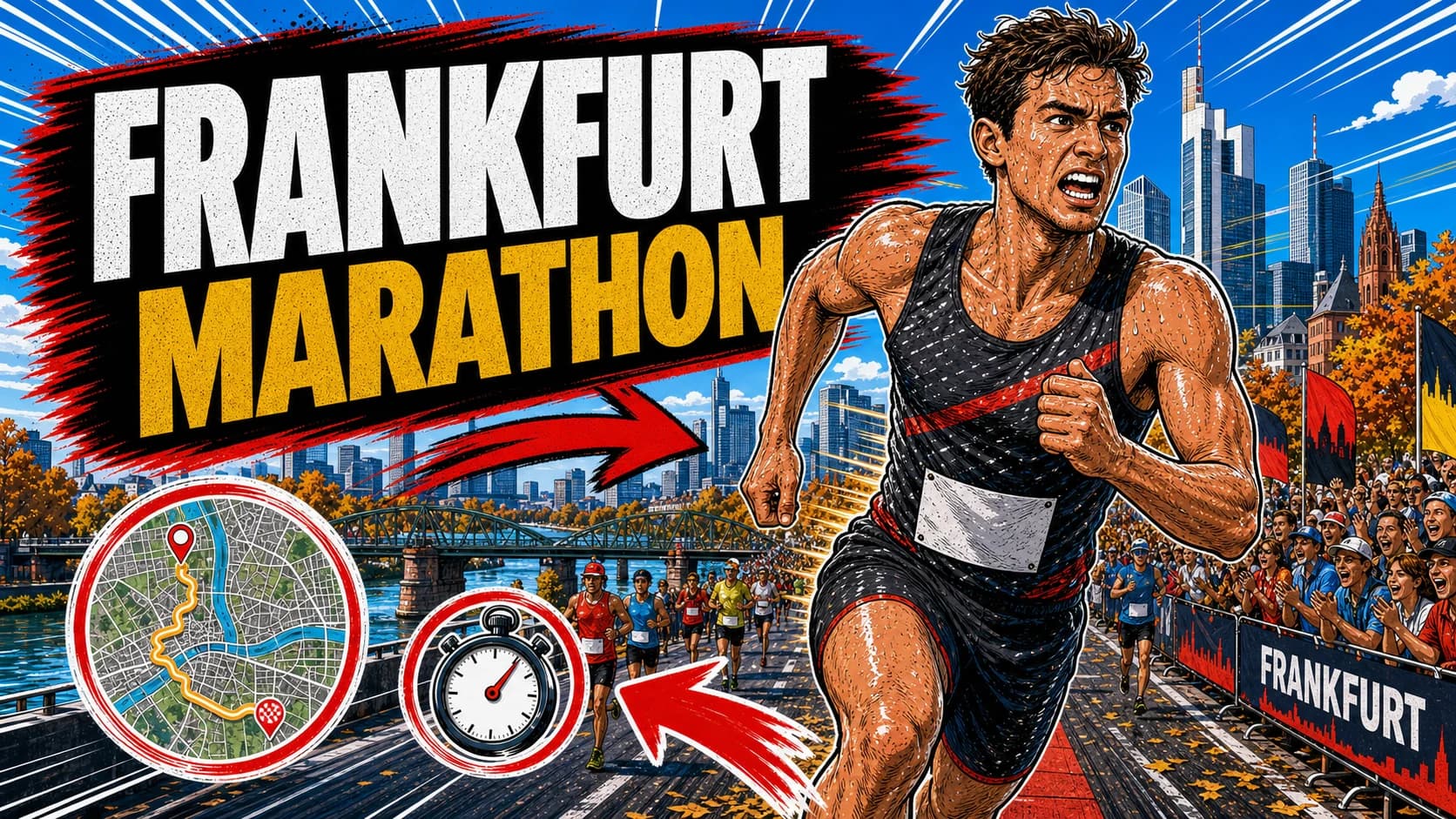
On Sunday October 25, 2026, Frankfurt closes one of Europe's fastest racing seasons with a finish unlike any other major marathon: inside the Festhalle, the city's historic exhibition hall, where runners stride through the open doors, hit red carpet under the iron-and-glass dome, and cross the line as the announcer calls names with bleachers full on either side. No other major marathon ends indoors. Pair that scene with a sub-30-meter elevation profile and a late-October climate where start temperatures hover at 5–10°C, and you understand why Frankfurt is — after Berlin — the German course where most PBs fall every year. This guide covers what the official site does not fully explain: what the riverside course actually feels like, where the race breaks, how to plan registration and logistics, and how to build a 16-week training block that respects this course's quirks.
| Item | Information |
|---|---|
| Date | October 25, 2026 (Sunday) — 45th edition |
| Distance | 42.195 km (marathon) · 5K + Mini Marathon for kids |
| Net elevation | <30 m — one of Europe's flattest courses |
| City | Frankfurt am Main (Hesse, Germany) |
| Start | Friedrich-Ebert-Anlage (next to Messe Frankfurt) |
| Finish | Festhalle — historic exhibition hall, indoor red-carpet finish |
| Start time | 10:00 CET |
| Organizer | Frankfurt Marathon GmbH · Mainova title sponsor |
| World Athletics | Gold Label |
| Men's record | 2:03:42 — Wilson Kipsang (KEN, 2011, world record at the time) |
| Women's record | 2:21:01 — Meselech Melkamu (ETH, 2012) |
| Registration | frankfurt-marathon.com |
The Mainova Frankfurt Marathon is Germany's oldest marathon (first edition in 1981) and the country's second-fastest course after Berlin. It draws 15,000 to 18,000 marathon finishers and roughly 25,000 across the companion 5K and the Mini Marathon for kids. It has held World Athletics Gold Label status for over a decade, and its men's course record — 2:03:42 by Wilson Kipsang in 2011 — was the world record at the time. It isn't the most globally televised marathon, but it's one of the best-organized races in Europe.
Aerial of the Mainhattan skyline with the runner field cutting across downtown Frankfurt — the postcard image from the early kilometers of the Frankfurt Marathon route.
Frankfurt is a flat, cool, efficient marathon. Total elevation across the 42 kilometers stays below 30 meters, with no real climb. The route winds through the financial district (the famous "Mainhattan" — the only continental European skyline with multiple skyscrapers above 250 meters), runs along the River Main, heads northeast into the Riederwald and Bornheim suburbs, returns along the south riverside through Sachsenhausen, and finishes inside the Festhalle, a 1909 exhibition hall with a central iron-and-glass dome. The indoor finish is Frankfurt's signature image: the doors swing open, the amplified PA echoes off the dome, and you cross the line on red carpet with grandstands on both sides and the dome overhead.
Frankfurt's course is an irregular loop with start and finish near the Messe exhibition complex in the western part of downtown. The race rolls out along Friedrich-Ebert-Anlage, cuts across the financial district (with the Commerzbank Tower, Main Tower, and Westend Tower as backdrop), drops down to the River Main around km 5, follows the north bank east, swings out to Riederwald around km 18 with a short out-and-back, returns through Bornheim and the south river bank past Sachsenhausen between km 28 and 38, crosses the river back north, and enters the Festhalle at km 42 for the finish.
Lead pack passing the Commerzbank Tower and Main Tower at km 6–8 — the vertical postcard of Mainhattan.
Frankfurt is Germany's oldest marathon. The first edition was held in 1981, three years before Berlin in its modern format. The race has held its slot on the last Sunday of October almost without interruption ever since, making it one of the most stable autumn classics in Europe. The title sponsor is Mainova, Frankfurt's public utility company (electricity, water, gas), which has lent its name for nearly two decades.
The men's roll of honor is anchored by Wilson Kipsang, who ran 2:03:42 here in 2011 — a world record at the time (later broken by Dennis Kimetto in Berlin 2014). Frankfurt has produced sub-2:05 men's times and sub-2:22 women's times across multiple editions, putting it in the global top-10 for course speed.
| Year | Men's winner | Time | Women's winner | Time |
|---|---|---|---|---|
| 2011 | Wilson Kipsang (KEN) | 2:03:42 WR | Mamitu Daska (ETH) | 2:21:59 |
| 2012 | Patrick Makau (KEN) | 2:06:08 | Meselech Melkamu (ETH) | 2:21:01 CR |
| 2018 | Lawrence Cherono (KEN) | 2:04:52 | Meskerem Assefa (ETH) | 2:20:36 |
| 2019 | Fikre Bekele (ETH) | 2:07:08 | Valary Aiyabei (KEN) | 2:20:53 |
| 2023 | Brimin Kipkorir (KEN) | 2:04:53 | Buzunesh Getachew (ETH) | 2:20:36 |
For deeper history: Wikipedia — Frankfurt Marathon and the official World Athletics — Gold Label Road Races page.
Registration for the Mainova Frankfurt Marathon 2026 opens in November 2025 at frankfurt-marathon.com. There is no lottery — slots are first-come, first-served. There are roughly 15,000 marathon spots, and they sell out 4–8 weeks before race day — not in December, but not with unlimited margin either.
| Distance | Early price (Nov 2025–Apr 2026) | Late price (May–Oct 2026) |
|---|---|---|
| Marathon | €100–135 | €150–180 |
| 5K companion | €25–30 | €30–35 |
| Mini Marathon (kids) | €10–15 | €15–20 |
Bib pickup happens only at the Frankfurt Marathon Expo, hosted in the Messe Frankfurt halls (same complex as the start). Typical hours:
Bring ID/passport and the registration confirmation email (PDF or printed). If you can't pick up in person, third-party pickup is allowed with a signed authorization and copy of the registrant's ID.
Frankfurt Airport (FRA) is 12 km west of the city center. It's the main Lufthansa hub and one of the most connected airports on the planet: direct flights from all major European cities and most world capitals. From Madrid or Barcelona it's a ~2-hour flight.
From the airport to downtown: S-Bahn S8/S9 direct to Hauptbahnhof (central station) in 15 minutes, departing every 15 min, ticket €5.80. Taxi €30–40, Uber similar.
Frankfurt is connected by high-speed rail (ICE) across Europe:
The central station (Hauptbahnhof) is a 15-minute walk from Messe Frankfurt (start and finish). That makes Frankfurt one of the most rail-accessible European marathons — no flight needed if you live within ICE range.
Frankfurt has U-Bahn (subway), S-Bahn (regional rail), and tram with dense coverage. On race day, your bib doubles as a free transit pass across the entire RMV network (regional rail included) — standard for German marathons, very useful for getting back to the hotel without dealing with tickets.
We don't recommend driving in Frankfurt the marathon weekend. If you're coming by car from Switzerland, the Netherlands, or other nearby points:
Frankfurt is a small city (700,000 inhabitants, urban area ~2.5 million) with a walkable downtown. For a marathon with start and finish at Messe Frankfurt, three zones offer the right quality/distance ratio.
5–15 minutes on foot from the start and finish. Premium, but unbeatable on logistics:
Next to the central station, 2 S-Bahn stops from Messe (5 min). The most versatile option if you combine the marathon with sightseeing.
Across the River Main, in the bohemian quarter. The marathon route passes through here between km 28 and 38, so you sleep "on the course". More authentic vibe, with traditional apple-wine (Apfelwein) taverns.
Frankfurt on the last Sunday of October is in the heart of central European autumn. Median historical conditions:
| Variable | Start (10:00) | Halfway | Finish (~13:00–14:00) |
|---|---|---|---|
| Temperature | 5–10°C | 8–13°C | 10–15°C |
| Humidity | 70–85% | 60–75% | 50–65% |
| Wind | 10–15 km/h | 10–20 km/h | 10–20 km/h |
| Rain | Low probability | Low probability | Low probability |
Probability of significant rain: 7 of the last 10 editions ran dry or with negligible drizzle. Frankfurt is statistically more reliable than Berlin in September for clean weather.
A flat course like Frankfurt doesn't forgive a thin aerobic base. There are no climbs to "hide" in by walking 30 seconds to drop heart rate. If you blow up at km 32, you blow up for 10 km. The plan has to be designed to hold pace on flat ground for 3 hours without cracks.
Six weeks out from Frankfurt, do a 32–35 km long run on flat ground, ideally along a greenway or river (mimicking the Main profile). Finish the last 8 km at marathon goal pace. If you handle it with fresh legs, you're ready for Frankfurt. If you crack at km 28, adjust your goal time down by 5%.
Once in the plan, week 8 or 10: 18 km easy run. First 6 km easy Z2. Km 6 to 16: 10 km tempo at marathon goal pace (simulating km 6–16 of the real course, right after Mainhattan). Last 2 km cool-down. This trains you not to bolt off the start because of the skyline rush.
| Punto | Tiempo acumulado | Parcial |
|---|---|---|
| 5 km | 24:53 | 24:53 |
| 10 km | 49:46 | 24:53 |
| 15 km | 1:14:39 | 24:53 |
| Media (21,1 km) | 1:45:00 | 30:21 |
| 30 km | 2:29:18 | 44:18 |
| Meta | 3:30:00 | 1:00:42 |
Splits asumen ritmo constante. En carreras con desnivel real (Mainova Frankfurt Marathon) — banca 5–8 s/km en bajadas y pierde el mismo margen en subidas; el ritmo medio se mantiene.
| Goal | Min/km | Km 5 | Km 10 | Km 15 | Km 21.1 | Km 25 | Km 30 | Km 35 | Km 40 | Finish 42.195 |
|---|---|---|---|---|---|---|---|---|---|---|
| Sub 2:30 | 3:33 | 17:45 | 35:30 | 53:15 | 1:14:45 | 1:28:30 | 1:46:15 | 2:04:00 | 2:21:45 | 2:29:30 |
| Sub 2:45 | 3:54 | 19:30 | 39:00 | 58:30 | 1:22:15 | 1:37:30 | 1:57:00 | 2:16:30 | 2:36:00 | 2:44:35 |
| Sub 3:00 | 4:15 | 21:15 | 42:30 | 1:03:45 | 1:29:45 | 1:46:15 | 2:07:30 | 2:28:45 | 2:50:00 | 2:59:25 |
| Sub 3:15 | 4:37 | 23:05 | 46:10 | 1:09:15 | 1:37:25 | 1:55:25 | 2:18:30 | 2:41:35 | 3:04:40 | 3:14:25 |
| Sub 3:30 | 4:58 | 24:50 | 49:40 | 1:14:30 | 1:44:50 | 2:04:10 | 2:29:00 | 2:53:50 | 3:18:40 | 3:29:25 |
| Sub 4:00 | 5:41 | 28:25 | 56:50 | 1:25:15 | 1:59:55 | 2:22:05 | 2:50:30 | 3:18:55 | 3:47:20 | 3:59:25 |
| Sub 4:30 | 6:24 | 32:00 | 1:04:00 | 1:36:00 | 2:15:00 | 2:40:00 | 3:12:00 | 3:44:00 | 4:16:00 | 4:30:00 |
| Sub 5:00 | 7:06 | 35:30 | 1:11:00 | 1:46:30 | 2:29:50 | 2:57:30 | 3:33:00 | 4:08:30 | 4:44:00 | 4:59:35 |
Want a personalized version of the 16-week plan with your goal pace, training days, and current level? Subscribe to the SportPlan newsletter and you'll get the editable template plus a weekly email with sessions specifically tuned for Frankfurt 2026.
You can also sign up directly on the event page in SportPlan to get automatic updates (start time changes, expo, bag drop).
You roll out of the corral on Friedrich-Ebert-Anlage heading east, cross the avenue belt, and enter the financial district. Foot traffic is dense the first 2 km: hold corral pace, don't weave. Run goal pace, not a second faster. 99% of Frankfurt blow-ups come from runners who left 10 seconds per km too fast.
Here you see the towers: Commerzbank (259 m), Main Tower, Westend Tower. Crowd is respectful and constant. You drop down to the River Main around km 6–7. First gel at 25 minutes (km 5.5–6). Maintain nose/mouth alternating breathing; if it's mouth-only already, you went out too hot.
The course tracks the Main eastward, leaves the center, and rolls through residential blocks. Crowd thins but stays steady. Pace settles here. Second and third gels at 50 and 75 minutes.
The loneliest stretch. You head northeast to Riederwald with a short out-and-back. Watch the head game: this is where runners "leave" mentally. Hold heart rate, hold carbs, hold the plan. You hit the half marathon mark around km 21.1 — check the watch. If you're on plan, cool head. If you're 30 seconds over, dial back.
The critical section. Glycogen starts knocking. The course is still flat — meaning you can't "hide" on a downhill. The fueling you did earlier wins here. Fourth and fifth gels around km 30 and 37. If you cramp at km 35, it's most likely sodium, not hydration: salt tab and keep moving.
You cross the Main back north. Here a runner either fully cracks or kicks hard. The last 3 km drop gently toward Messe Frankfurt and the Festhalle. The hall doors are open. You cross the threshold, the PA blares, red carpet, grandstands on both sides, dome overhead, finish arch. Frankfurt veterans will tell you those 200 indoor meters compensate for the rougher 30–35 stretch.
Shot of runners entering the Festhalle hall on red carpet with the iron-and-glass dome overhead and bleachers full on both sides — the visual signature of the Mainova Frankfurt Marathon.
On a flat marathon like Frankfurt, the body burns glycogen at a near-constant rate. There are no climbs to drop you into low aerobic on descents. The consequence: carbohydrate depletion hits between km 30 and 35 without warning. Your plan has to bulletproof that section.
Total: 6–7 gels = 150–210 g carbs in race. Combine with 750 ml of sports drink spread across aid stations.
Frankfurt serves water and sports drink every ~5 km (km 5, 10, 15, 20, 25, 30, 35, 40). Marked zones also offer fruit (banana, orange) and official sponsor gels (check the website 2 weeks out for the brand). Bring your own gels — don't discover whether the official ones agree with your stomach mid-race.
A 5–10°C start means you'll sweat less. Don't overdo water in the first 15 km — there's a hyponatremia risk for slower runners who over-drink. 150–200 ml per aid station is plenty.
Frankfurt is carbon plate territory. Flat course, homogeneous asphalt, and cool temperatures make ideal conditions for Nike Vaporfly/Alphafly, Adidas Adios Pro Evo, Saucony Endorphin Pro, Asics Metaspeed Sky, Hoka Rocket X. If your block has been solid and you have ≥40 km in plate shoes, use them. If you haven't tested them in a long run, don't break them out at Frankfurt.
The chip is integrated into the bib. Pinned to the chest, not on the thigh or back. There are timing mats every 5 km — splits publish to the official app in near-real time so family can follow.
Frankfurt has good GPS coverage on most of the course, except in the Mainhattan stretch where the towers can add 50–80 m of drift on km 6–8 (multipath effect). Don't trust the watch in that section: rely on the official km 5 and km 10 mats.
Frankfurt is in the Schengen Area. If your passport is EU/UK/USA/Japan/Australia/Canada/several LATAM countries, no visa for stays under 90 days. If your passport requires a Schengen visa, apply at least 8 weeks ahead and keep a digital copy of your travel insurance.
Yes. Bag drop at Messe Frankfurt between 8:00 and 9:30. Bag must be tagged with your bib number. You collect it after crossing the finish inside the Festhalle.
No lottery. Registration is first-come, first-served, opening in November 2025. Sells out 4–8 weeks before race day. Sign up early to lock the early price (€100–135).
18 years old on race day. The 5K companion allows runners from 16 with a parent's authorization. The Mini Marathon is for accompanied minors.
Yes, there's a transfer window until ~4 weeks before race day (check exact dates on the official site). There's a €15–25 admin fee.
Yes. Frankfurt fields official pacers for 2:45, 3:00, 3:15, 3:30, 3:45, 4:00, 4:15, 4:30, and 5:00. Visible balloons from the corral.
Yes, literally inside the hall. The doors open at 9:30 and runners stride through them in the final stretch. The finish arch sits under the central dome, about 150 meters from the hall threshold, on red carpet. It's the only indoor finish on the global major-marathon calendar.
Frankfurt isn't a mass tourism destination but has top-tier museums (Städel, Schirn, German Film Museum), the restored Römer old town, Apfelwein (apple wine) taverns in Sachsenhausen, and 30 minutes by train you'll find Heidelberg, Wiesbaden, the Rhine Valley. Recommended: arrive Thursday, rest Friday/Saturday, race Sunday, tourism Monday, fly Tuesday.
| Marathon | Date | Course speed | Atmosphere | Registration difficulty |
|---|---|---|---|---|
| Berlin | September | ⚡⚡⚡⚡⚡ (the fastest) | High, big crowds | Very tough lottery |
| Frankfurt | October | ⚡⚡⚡⚡ (top-3 in Germany) | Medium, unique indoor finish | Easy (4–8 weeks before) |
| Munich Generali | October | ⚡⚡⚡ | High, beer-fest energy | Easy |
| Cologne | October | ⚡⚡⚡ | High, carnival vibe | Easy |
| Hamburg | April | ⚡⚡⚡⚡ | Medium | Medium |
| Vienna | April | ⚡⚡⚡ | High, imperial | Easy |
| Valencia | December | ⚡⚡⚡⚡⚡ (top-2 in the world) | High, Latin-style | Medium |
This guide is updated with every official release from Frankfurt Marathon GmbH. Last revision: 2026-05-08.
Planifikatzen jarraitu
Erabili SportPlan datak konparatzeko, gertaerak gordetzeko eta zure asteburuetara egokitzen den denboraldi bat eraikitzeko.