31 min de lecturarunningultra
Complete Marathon des Sables 2027 Guide — The World's Toughest Footrace (250K Sahara)
📖 32 min read 📝 9,000 words 🎯 Skim friendly
Complete Marathon des Sables 2027 Guide
By Ramon Curto · Updated 2026-05-06
📖 32 min read 📝 9,000 words 🎯 Skim friendly
By Ramon Curto · Updated 2026-05-06
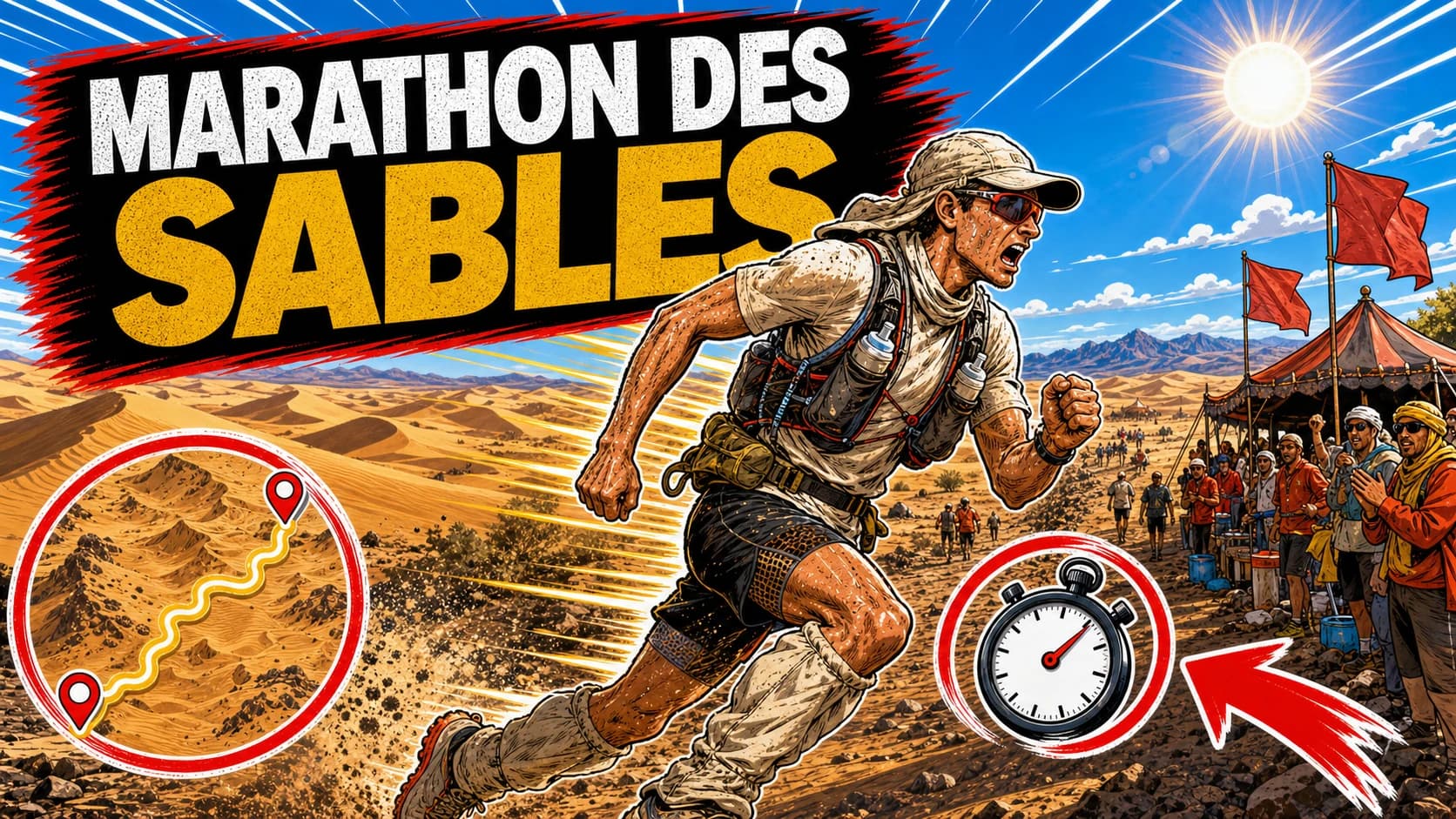
On March 19, 2027, the 41st edition of the Marathon des Sables (MdS) kicks off in the Moroccan Sahara — 250 km in 6 stages over 7 days, while you carry every gram of food, kit and sleeping bag yourself. No solid aid stations. No hotels. No shortcuts. It's "the world's toughest footrace" — a label that gets thrown around a lot, but at MdS it's earned: 30–45 °C by day, 5–15 °C at night, dunes that swallow your calves with every step, and a day 4 long stage of ~85 km that takes 18 to 36 hours. This guide covers what neither the official site nor the finishers' blogs lay out in full: how the race breaks down, what to pack, how to train for 40 weeks for an event you can't simulate, and what really happens when the thermometer crosses 42 °C in the middle of an erg.
| Data | Information |
|---|---|
| Start date | Friday March 19, 2027 |
| Duration | 7 days (6 stages + rest/finish day) |
| Total distance | ~250 km |
| Stages | Day 1 ~30 km · Day 2 ~35 km · Day 3 ~38 km · Day 4 long stage ~85 km · Day 5 marathon stage ~42 km · Day 6 charity stage ~7 km |
| Location | Southern Morocco · Sahara · Erfoud / Merzouga / Erg Chigaga / Erg Chebbi area |
| Format | Stage race in food self-sufficiency |
| Field size | ~1,400 athletes |
| Minimum age | 18 (with medical certificate) |
| Organiser | Atlantide Organisation Internationale (Patrick Bauer) |
| Registration | marathondessables.com |
The Marathon des Sables is not a trail race, not a classic ultramarathon and not a tourist challenge. It's a stage race in food self-sufficiency in the heart of the Sahara desert — for one week you literally carry everything you'll eat (~14,000 calories), your sleeping bag, the mandatory safety kit, spare clothing and electronics. The organisation only provides two things: a shared tent (the "bivouac") and rationed water (between 9 and 14 litres a day depending on the stage). Everything else comes out of your pack.
Is this race for you?
MdS is not for ultra debutants. The race assumes you arrive with:
If you've been running 6 months or you're on your first marathon, MdS is not your race yet. Come back in 2 years with more kilometres in your legs.
What MdS IS:
What MdS is NOT:
The MdS course changes every year — Patrick Bauer and his scout team draw new routes to keep the surprise, but the overall structure (~250 km in 6 stages) and the terrain types repeat edition after edition. What follows is the typical pattern of a modern edition in the Erfoud–Merzouga–Zagora area.
The first stage is the "friendliest" in distance — but not in feel. You set off with the pack at maximum weight (8–10 kg with the entire week's food) and the body is not yet acclimatised to the heat. The terrain typically combines regs (flat hard stone plains), the odd oued (sandy dry riverbed) and a first taste of small dunes at the end.
Day two raises the stakes. It usually includes a first crossing of a small erg (dune field) and a jbel (rocky mountain) climbed and descended steeply. Feet start complaining — the first blisters appear here, especially if sand has begun to creep through the gaiters.
Day 3 is the "long" stage before the real long one, and it usually drops you into hard ground: medium dunes for several kilometres, sun-baked regs, possibly a technical jbel section with a fixed rope. This is where many runners realise they packed too much kit or didn't drink enough on day 1.
This is the day. The MdS long stage runs about 80–90 km and you do it in one go, only stopping at Check Points (CP) every ~12 km to receive your water ration. You start Friday morning and finish Saturday — elites in 8–10 hours, the bulk between 18 and 30 hours, and the slowest in 35 hours.
Why the race breaks here:
How to manage day 4:
After the rest day, day 5 is the marathon — 42.195 km. On paper it's "only" a marathon distance, but you do it with 300 km in your legs, wrecked feet and the leftover-pack weight from the previous days. Elites run it in 3:00–3:30 h; most take 5–7 hours.
The last day is the charity stage — 7 celebratory kilometres, everyone in a UNICEF shirt, in a group. It's the day of applause, photos and closure. Some editions run it as a walk; others as a mini-race. Nobody is chasing a clock here.
Marathon des Sables was born in 1986 out of a personal expedition by Patrick Bauer, a Frenchman who in 1984 crossed 350 km of the Algerian Sahara alone on foot, carrying everything. The experience marked him so deeply that two years later he organised the first MdS edition with 23 runners. Four decades on, MdS is the oldest and most prestigious desert stage race, with over 40 editions and a central role in defining the modern "self-sufficient stage race" concept.
Milestones:
Recent men's roll of honour:
| Year | Winner | Country | Total time |
|---|---|---|---|
| 2026 | Rachid El Morabity | MAR | ~20:15 h |
| 2025 | Rachid El Morabity | MAR | ~20:25 h |
| 2024 | Rachid El Morabity | MAR | ~20:38 h |
| 2023 | Mohamed El Morabity | MAR | ~21:02 h |
| 2022 | Rachid El Morabity | MAR | ~20:52 h |
Historic record: the dominance of the El Morabity brothers (Rachid and Mohamed) over the last decade is comparable to Kilian Jornet in European trail: same lineage, same heat genetics, terrain knowledge from childhood.
In the women's category the podium is dominated by European runners with prior ultra experience (Aziza Raji, Audrey Tanguy, Elisabet Barnes in recent years), with typical podium times of 23–25 hours total.
MdS registration is first-come-first-served and opens 12–18 months out from the edition. For MdS 2027 (March 2027), the opening window is expected between July and November 2025. The race closes well before the theoretical deadline — the 1,400-bib quota typically sells out in weeks.
Entry types:
| Type | Approx. price | Includes | Doesn't include |
|---|---|---|---|
| Standard entry | €4,200–4,800 | Bib, charter flight Paris–Errachidia, desert transfers, water and tent, organisation fee | Food (you carry it), kit, flight to Paris, pre/post hotel, insurance |
| Entry from Spain (Mama Sahara or local operator) | €4,800–5,500 | Above + travel package from Madrid/Barcelona | Food, kit, insurance |
| Charity bib | €5,500–7,500 | Bib + obligation to fundraise for an NGO | The rest |
| Resale bibs (officially not allowed) | Variable | Total risk | Any guarantee |
What the bib actually includes:
What it does NOT include:
Charity bib: if you don't want to pay the standard entry, several NGOs (in Spain: Fundación Sergio García-Ramírez, Manos Unidas, Fundación Amigos de Mauthausen, among others) offer bibs in exchange for fundraising between €8,000 and €12,000, which you have to raise yourself from sponsors and donors. It's an option for people with a corporate network but no personal budget.
Reaching the Sahara from Europe goes through Morocco, and MdS organises the final leg. Your options:
The bib includes a charter flight Paris Orly → Errachidia (ERH) direct. From Errachidia it's 2–3 hours by bus to the start bivouac, organised by MdS. You only need to land in Paris Orly on the assigned day (typically the Thursday before the race) with all your kit.
Some Spanish operators (Mama Sahara, Yumping, Trotamundos) organise packages from Madrid/Barcelona with a flight to Marrakech (RAK) + bus transfer to the bivouac.
Ouarzazate is the closest airport to the desert, but has very few international connections. Some editions arrange direct charters from Paris to OZZ. If you find a regular Madrid–OZZ flight via Casablanca (Royal Air Maroc), you save 3 hours of bus.
Relevant airports:
| Airport | Code | Distance to bivouac | Connections from Spain |
|---|---|---|---|
| Errachidia | ERH | ~150 km | MdS charter only |
| Ouarzazate | OZZ | ~250 km | Casablanca → OZZ (Royal Air Maroc) |
| Marrakech | RAK | ~500 km | Direct flights from Madrid, Barcelona, Bilbao, Málaga |
| Casablanca | CMN | ~700 km | Royal Air Maroc hub, daily connections |
Recommendation: if it's your first MdS, pay for the official package. The day before the race is not the moment for your luggage to go missing or to land 30 hours late from a cancelled connection.
You need to think about three moments: pre-race, during the race and post-race.
There are no hotels on the course. You sleep all 7 days in a Berber tent (goat-hair tent open on the sides) shared with 4 other runners. The organisation sets up and tears down the bivouac each night at a new location, following the route. You only carry your sleeping bag and a thin mat (optional). The floor is sand.
If you go with the official package:
If you go with an operator package from Spain:
When the race ends, MdS transfers you to a 4-star hotel in Ouarzazate or back to Errachidia for the charter flight to Paris. Most runners stay 2–3 extra nights in Marrakech to recover before flying home.
Recommended Marrakech hotels post-MdS:
Recommendation: book the Marrakech hotel before leaving for the race — when you finish you won't have the head to do it from the desert.
The Sahara in March is in winter–spring transition: daytime temps milder than in summer (when it hits 50 °C), but still brutal for an unacclimatised European.
| Time of day | Range |
|---|---|
| Sunrise (~6:00) | 5–10 °C |
| Mid-morning (~10:00) | 20–28 °C |
| Midday (~13:00) | 35–42 °C |
| Afternoon (~16:00) | 35–45 °C (peak) |
| Sunset (~19:00) | 18–25 °C |
| Night (~3:00) | 5–12 °C |
Sahara sun is not European sun. At 40 °C in Madrid you sweat; at 40 °C in the Sahara with humidity <15 % and a vertical sun, you dehydrate without feeling thirst. CPs weigh you (scales): if you lose >5 % body weight, they stop you and force rehydration. If you lose >10 %, you're out.
The 15 days before the trip are critical. Typical plan:
Heat acclimatisation isn't improvised in race week. Start 6 weeks out.
MdS takes 40 weeks (10 months) of training. The 16- or 24-week plans that work for a marathon or UTMB don't prepare you for this. The accumulated load you'll absorb on day 5 with 300 km in your legs is built over a year of honest training. We assume you arrive with a base of 60+ km/week and at least one 50K ultra completed.
| Block | Weeks | Focus |
|---|---|---|
| Aerobic base | 1–8 | Volume 60→80 km/wk, long runs without pack, muscle base |
| Specific strength | 9–16 | Gym 2x/wk (squats, deadlifts, core), runs with light pack (3–4 kg) |
| Volume + back-to-backs | 17–28 | Progressive long runs: 30 → 40 → 50 km. Saturday-Sunday back-to-backs |
| Desert specific | 29–36 | Heavy pack (8–10 kg), sand simulation (beach or fields), heat acclimatisation |
| Tapering | 37–40 | Volume drop, intensity maintenance, logistics prep |
The weekend back-to-back is the session closest to MdS. It teaches you to run day 4 with day 3's legs.
Unlike a standard marathon, in MdS per-km splits aren't useful — pace shifts radically between dunes (you walk at ~10 min/km), hard regs (you run at 6 min/km) and oueds (5–6 min/km). The only day that makes sense for a marathon calculator is day 5, the marathon stage, where you already know your legs, the terrain tends to be more rolling and you can set a realistic time goal.
This calculator gives you the average required pace for the day 5 marathon stage, assuming reasonable mixed terrain, and the control splits at 5K, 10K, 15K, half marathon, 30K and finish. Change the target time and the table updates instantly:
| Punto | Tiempo acumulado | Parcial |
|---|---|---|
| 5 km | 35:33 | 35:33 |
| 10 km | 1:11:06 | 35:33 |
| 15 km | 1:46:39 | 35:33 |
| Media (21,1 km) | 2:30:00 | 43:21 |
| 30 km | 3:33:18 | 1:03:18 |
| Meta | 5:00:00 | 1:26:42 |
Splits asumen ritmo constante. En carreras con desnivel real (MdS Marathon Stage) — banca 5–8 s/km en bajadas y pierde el mismo margen en subidas; el ritmo medio se mantiene.
How to use it for MdS:
Configure your goal, heat acclimatisation strategy and aid plan (which in MdS means what you put in the pack). The planner gives you a personalised plan per stage (with paces, heat management, daily food, foot plan and mental cues), a morning checklist for each stage, and a Plan B for the unexpected (sandstorm, massive blisters, GI issues). Download as a PDF to take in your pack.
PDF A4, optimizado para imprimir y llevar el día de carrera.
The MdS race plan is not measured in splits, but in stage management. The master rule is simple: finish day 4 in one piece. Everything you do on days 1–3 serves arriving at day 4 with legs, feet and head. And everything you do on day 4 dictates whether you'll run or walk days 5 and 6.
This is the day. The decisions of the next 24–30 hours define your MdS.
In MdS there are no solid aid stations. You carry in your pack all the food you'll eat over 7 days (~14,000 kcal total). The organisation only gives water. That makes nutritional planning one of the race's pillars, and probably the most underestimated by debutants.
You'll burn 5,000–7,000 kcal/day between stage, active recovery and thermoregulation. You'll eat 2,500–3,500 kcal/day. That means a real deficit of 2,500–3,500 kcal/day for 7 days. You'll arrive at the finish 3–6 kg lighter, mostly muscle and water. It's inevitable. Nutritional planning minimises that loss without overweighting the pack.
| Moment | Example | Calories |
|---|---|---|
| Breakfast (5:30 AM) | 1 freeze-dried oats with chocolate sachet (Real Turmat Granola) + instant coffee | 500 |
| During stage | 4 gels + 2 bars + nuts | 800 |
| Bivouac arrival | Recovery shake (protein + carbs) | 250 |
| Dinner (19:00) | 1 freeze-dried main meal (Lyofood Quinoa, Trek'n Eat Pasta) + 2 squares dark chocolate | 600 |
| Before sleep | Nuts + bar | 250 |
| TOTAL | ~2,400 kcal |
The organisation hands out 9 to 14 litres of water per day depending on the stage. CPs are every ~12 km. Rules:
Kit at MdS is 30 % of your final score. A badly fitted pack sinks you on day 2. A too-thin sleeping bag wakes you every hour from day 3 to day 6. Shoes badly protected against sand leave your toes raw on day 4.
The organisation publishes an official mandatory list that's checked at the pre-race pack inspection. Without any item, you don't start.
Without any of these: 2-hour penalty per item. Without sleeping bag or headlamp: out of race.
Capacity: 25–30 litres to carry 7 days of food + sleeping bag + clothing + mandatory kit. Much less doesn't fit; much more is dead weight.
Popular models in the field:
The critical thing isn't the brand: that it fits you and that you've trained with the actual load for at least 200 km.
Sahara nights in March drop to 5–10 °C (sometimes less). You need a bag that's warm but light.
Recommendation: 800-cuin goose down sleeping bag, comfort temperature 0 °C or slightly below, weight <700 g.
Models:
Not recommended: synthetic bag (double the weight), generic adventure bag (triple the weight).
Protective trail running shoes, one full size larger than your street size (feet swell in the desert with the pack).
Common MdS models:
Essential. Without gaiters, on day 1 you already have sand inside the sock, and on day 3 blisters are systematic.
Recommendation: gaiters sewn or glued to the shoe with perimeter velcro (not generic boot-style gaiters).
Models: Raidlight Desert Gaiters, MyRaceKit Gaiters (UK, very tested at MdS), Sandbaggers (USA). €60–100.
Critical: carry the gaiters already sewn to the shoe from home, and train with them at least 100 km. Sewing them at the bivouac in the heat is a nightmare.
Powerful headlamp for day 4 (long stage, 8–12 hours of night). Essential: 300+ lumens and 8+ hours of battery.
Models: Petzl Nao+, Silva Trail Speed 5XT, Ledlenser NEO9R. €100–250.
Allowed and very useful in dunes and on the day 4 long stage. Foldable, ultralight.
Models: Black Diamond Carbon Z, Leki Cross Trail FX Carbon, Naturehike Z.
To boil water for the freeze-dried meals.
What you wear + 1 spare set. No more.
Minimum list:
70 % of MdS abandons are due to feet. Carry a serious kit.
Doc Trotters (medical team) treats feet at the bivouac, but with a 2-hour queue. Treat them yourself first.
It's one of the 4 or 5 toughest, and the toughest in the self-sufficient stage format. Compared to Badwater 135 (hotter, but with support), Western States 100 (faster but not self-sufficient), Bigfoot 200 (longer but less extreme on climate) or La Diagonale des Fous (more vertical), MdS wins on combination of variables: distance + heat + self-sufficiency + 7 days + broken sleep. Patrick Bauer's marketing label ("the toughest footrace on Earth") is debatable, but the difficulty is real.
Don't sign up for MdS if you've never done an ultra. The theoretical plan for someone without a base is 24–30 months: year 1 marathon + 50K + 80K, year 2 specific 40-week MdS plan. People who try without that base end up in a helicopter on day 3. If your base is pure marathon, consider UTMB CCC or a 100K before MdS.
Yes, there is risk. There have been deaths in MdS history — 2 in 2021, sporadic cases in other editions, almost always from heatstroke or cardiac complications. The finisher rate is ~85–90 % (high for an ultra of this level) thanks to CP density and the medical team. But it is NOT a "safe" race — it's a well-organised race with managed risk, not eliminated.
Different races. UTMB is vertical European trail, supported, not self-sufficient, in 1 stage. MdS is a self-sufficient stage race in flat desert. UTMB takes 6 months to train; MdS, 10. UTMB costs €350; MdS €4,500+. If you come from road, do UTMB first. If you come from adventure/trekking, MdS fits earlier. They're not alternatives: they're different.
Minimum: 18 with medical certificate. Maximum: not official, but the organisation requires a reinforced medical certificate and a stress ECG from age 60. There are 70+ year-old finishers every edition. The average pack age is 40–50 years — it's a race for mature runners, not kids.
Yes, but with extra planning. Freeze-dried meals have vegan versions (Real Turmat Vegan, Lyofood Vegan). Gluten-free also exists. The hard part is finding vegan freeze-dried with 600+ kcal per sachet without losing weight/calories. Plan B: use more dense nuts (cashews, Brazil nuts, almond butter sachets) to reach minimum kcal.
Women make up ~25 % of the field and tend to have better long-distance heat management than men at MdS. The specifics:
There are top female finishers near the absolute podium (top 30 overall). No technical barrier.
The official language is French, briefings in French + English. There are ~100 Spanish runners every edition and they typically request a Spanish-speaking tent. The organisation (Atlantide) is French, so basic French helps. If not, English always works.
If you drop out, they take you to the next stage's bivouac and you stay the rest of the week there (you can't return to Marrakech early, there's no logistics for it). You stay in a "non-finisher" tent and ride the official bus at the end. The bib isn't refunded. Many people who drop continue accompanying their group to the finish.
Yes, brutally so. The vast majority of finishers describe MdS as "the most intense experience of their sporting life". It's expensive, painful, takes forever to prepare for, but transforms how you understand your body and mind. People who do it twice (~10 % of the field) confirm it: the first to discover it, the second to race it.
MdS is the world's best-known stage ultra, but other "extreme" races compare to it in marketing. None are really equivalent:
| Race | Distance | Days | Format | Type of extreme |
|---|---|---|---|---|
| Marathon des Sables (this guide) | ~250 km | 7 | Stage, self-sufficient | Heat + sand + self-sufficiency |
| Badwater 135 (USA) | 217 km | 1 (non-stop) | Supported, non-stop | Extreme heat (50 °C) |
| Western States 100 (USA) | 161 km | 1 (24–30 h) | Supported, non-stop | Speed + heat + mountain |
| UTMB (FR/IT/CH) | 171 km | 1 (20–46 h) | Supported, non-stop | Vertical (10,000 m D+) + altitude |
| Bigfoot 200 (USA) | 322 km | 1 (~80–100 h) | Supported, sleep on the move | Distance + broken sleep |
| Comrades (RSA) | 89 km | 1 | Supported | Speed + atmosphere |
| Two Oceans (RSA) | 56 km | 1 | Supported | Atmosphere + scenery |
| TransLagorai (IT) | ~250 km | 5–6 | Stage, semi-supported | Alpine vertical |
MdS is unique for:
If your priority is...
Did this guide help? If you're racing Marathon des Sables 2027, save the event on SportPlan to receive registration window alerts, medical check reminders, kit submission deadlines and, after the race, log your finish.
Seguir planificando
Usa SportPlan para comparar datas, gardar eventos e construír unha tempada adaptada aos teus fins de semana.