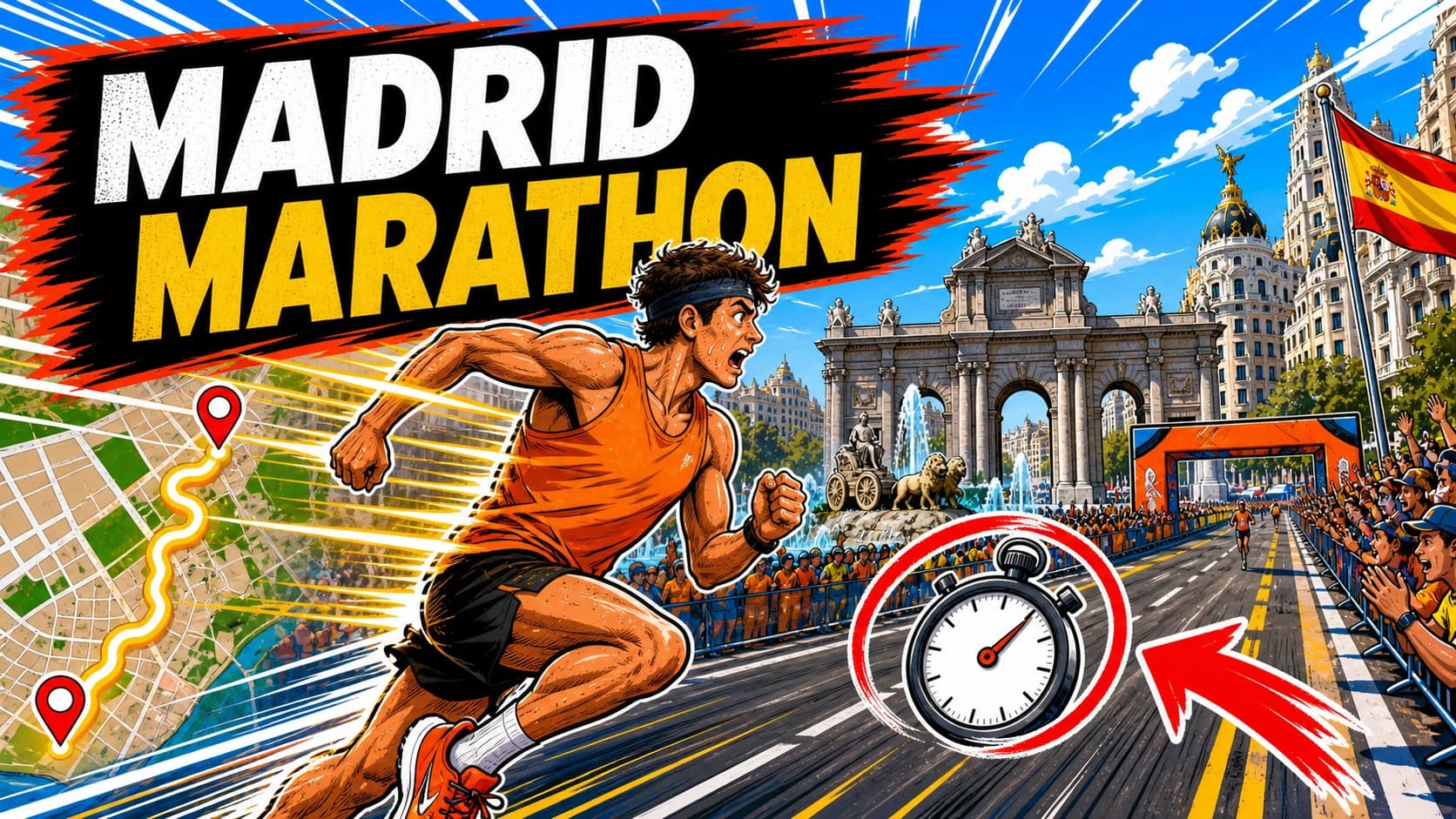
On 25 April 2027 Madrid hosts one of the five oldest marathons in Spain. The EDP brand, the 42.2 km through downtown and the 600 m of cumulative elevation gain make the Madrid Marathon the big spring race for runners chasing urban experience, atmosphere and an honest test rather than a fast time. This guide covers what the official site never quite spells out: what the course is really like, where most runners who go out hard fall apart, how to train for the hills, what time is realistic and how to put together the logistics for race weekend.
What kind of marathon Madrid actually is, who it fits and who it doesn't.
The EDP Madrid Marathon is the most historic international marathon in Spain, organised by AD MAPOMA since 1978. It pulls ~30,000 participants across the three distances (marathon, half marathon and 10K), draws runners from 60+ countries every year and combines a downtown party atmosphere with a course made tough by altitude (650 m) and cumulative elevation gain (~600 m). It's not a PB track; it's the "experience" marathon on the Spanish calendar.
📷 Photo pending · About the race header
Lead pack of the marathon coming past the Plaza de Cibeles fountain with the lead motorbike out front — the postcard that defines the Madrid race.
Madrid is not a flat marathon for hunting times. The city sits roughly 650 m above sea level on rolling terrain, and the course rewards anyone who runs honest pace through long false-flats over runners who go out fast. What you lose in fast geometry you gain in atmosphere: closed avenues with crowds on both sides all day long, a festive vibe along the route and a finish that drops you in the heart of the city. The altitude + elevation factor typically costs 5 to 10 minutes versus your time on a flat marathon like Valencia or Seville.
If you've run sub-3:30 recently in another marathon: target 3:35–3:40 here. Altitude + elevation collect a predictable tax.
If you've run halves but never done 42K:don't debut in Madrid if your goal is a specific time. Madrid is for racing, not for risking. Pick a flat fall marathon first.
If you want your first marathon without time pressure: yes, it fits really well. Atmosphere, organisation, solid aid stations and a finish in the city centre make for a memorable debut.
If you want a pure PB: go to Valencia (December) or Seville (February). Madrid is not the track for your fastest time of the year.
If you're training for Boston, NYC, Berlin: use it as a test 6 months out — the altitude + elevation combo teaches you to manage pace under real metabolic stress.
A single 42 km loop through the city centre with four structural climbs — where you make time, where the race blows up and why altitude matters.
The EDP Madrid Marathon course is a single 42.195 km loop through the city centre with ~600 m of elevation gain. It starts next to Paseo del Prado, climbs through Cibeles and Gran Vía, drops down to Madrid Río, crosses the western part of the city, comes back through Casa de Campo and finishes near the start after four structural climbs spread across km 7–9, km 16–18, km 25–27 and km 30–32.
📷 Photo pending · 3D course map
Official 3D map of the full EDP Madrid Marathon course (published by the organiser), with the central and western sections of the route clearly visible.
Recent editions have started right by Paseo del Prado, in front of the Prado Museum. The opening kilometres climb north past Plaza de Cibeles and head down Gran Vía — typically closed end to end for the race — before turning west towards the Royal Palace. From there the route drops down to Madrid Río along the western edge of the city, crosses Casa de Campo in a more natural, quieter section (km 18–25 roughly), comes back along the Manzanares and threads through the Salamanca neighbourhood and the perimeter of Retiro park before finishing on Paseo del Prado.
Asphalt is the dominant surface (with short cobble stretches near Plaza Mayor and the Royal Palace). Liquid aid stations with water and sports drink come roughly every 5 km, with solid aid stations (gels, fruit, bars) at km 21.1 and km 32. Crowd density peaks in Gran Vía, Plaza de España, the centre and the finish line — much thinner in the western zone / Casa de Campo, where you'll cover several kilometres without spectators.
Forget the "flat downtown" myth. Madrid climbs more than it looks. Total elevation gain is around ~600 m spread across four structural climbs:
Km 7–9: coming up from the river path back into the city. Long, sustained (3–4 % grade), but it lands while your legs are still fresh.
Km 16–18: the climb towards Retiro. The one that punishes the half marathon pack; in the marathon you feel it less because you're running more conservatively.
Km 25–27: the climb back from Casa de Campo into the city. Easy glycogen is starting to thin out by now.
Km 30–32: the last meaningful climb up into Salamanca. This is where most runners who went out too hot crack.
Descents are moderate and gentle — they give you a bit of time back if your form holds — but don't expect freebies in the last 10 km. They're rolling with a slight net positive.
🚨 Where the race blows up
Course data for Strava / Garmin: the organiser publishes the official GPX a few weeks before race day on their website. To preview the final Retiro stretch midweek, look up the Strava segment "Subida Retiro Cibeles" — same profile you'll suffer on race day.
Since 1978: one of Spain's oldest marathons, recent verified winners and finisher stats.
The Madrid Marathon has been run since 1978, making it one of the five oldest marathons in Spain (along with Barcelona, San Sebastián, Seville and Zaragoza). EDP has been the title sponsor since 2014 (the Rock'n'Roll Running Series format applied to the half and the 10K, not the marathon). Madrid's road running tradition predates the modern era by a long way; the race has changed sponsor and format several times, but the route and the late-April date remain its trademark.
📷 Photo pending · History header
Winner of the most recent edition crossing the finish line — iconic image to anchor the roll of honour section.
When it opens, how fast it sells out, what's included, refund policy and everything about the expo.
Registration for the EDP Madrid Marathon 2027 opens summer/autumn 2026 with tiered pricing (early-bird → standard → final spots). The marathon sells out before the half; by March of race year, only Marketplace bibs remain. The RFEA federation licence is +€5 on top of the bib.
📷 Photo pending · Aerial pack shot
Aerial view of the massive pack mid-flow through central Madrid — reinforces the "thousands every year, slots disappear" message.
Reference numbers from the 2026 closing window:
Marathon: sold out (closed in February).
Half marathon: last spots available.
10K: last spots available.
Assuming Madrid always has last-minute bibs is a mistake: runners who wait until March end up on the Marketplace or shut out entirely.
The EDP Madrid Marathon uses a tiered pricing system — the bib price goes up every time a tier closes. If you can afford it and you know you're running, register in the first tier: the saving vs the final spots is €20–30 per marathon bib.
Tier
Approx. open
Approx. close
Marathon
Half
10K
🟢 Early-bird
Sept 2026
Dec 2026
€65–70
€38–42
€20–22
🟡 Standard
Jan 2027
Feb 2027
€80–90
€48–55
€25–28
🔴 Final spots
Mar 2027
Until close
€95–100
€58–65
€30–35
Indicative prices based on the 2026 structure. Always confirm on the official registration page — amounts and tiers are updated there.
Refund policy: 90 % refundable with a medical certificate filed before 31 March 2027. Registrations are not transferable to a different edition or another race.
Official Marketplace: if you get injured or can't run, there's an internal market to resell your bib — open until mid-March.
Full event cancellation: registration is rolled to the next edition; no money refunded.
Family members and runners at the expo (IFEMA), with stands or the bib pickup counter visible.
Bib pickup happens at the Runner Expo, normally held the two days before the race (Friday and Saturday) at IFEMA Madrid. Bibs are not handed out on race day: you have to pick yours up in person before the expo closes on Saturday, historically around 21:00.
You'll need:
Your registration confirmation (printed or on your phone)
A valid photo ID
Family and friends can pick up for you with a signed authorisation and a copy of your ID. The race kit usually includes the technical finisher tee, the bib with chip, a bag tag and a course map. Finisher medals are handed out in the post-finish zone after you cross the line.
The metro solves nearly everything. Forget the car: downtown is closed and the LEZ restricts non-resident vehicles.
The most practical way to reach the EDP Madrid Marathon start is by metro: stations Banco de España (line 2), Estación del Arte (line 1) and Sevilla (line 2) are less than 5 minutes on foot from Paseo del Prado. The metro starts running at 06:00, and in some recent editions it's been free for runners with a bib. The Low Emission Zone (LEZ) restricts the centre to non-resident older vehicles.
📷 Photo pending · Plaza Mayor / central reference
Plaza Mayor or a recognisable central metro entrance (Banco de España, Sevilla) — visual reference for first-time visitors to Madrid.
Madrid has one of Europe's densest metro networks. On race morning the metro starts running at 06:00. Plan to be in your corral 45–60 minutes before the gun: the marathon goes off in waves and the porta-loo queues spike in the last 30 minutes.
For the expo, the closest metro stations to IFEMA are Feria de Madrid (line 8) and Mar de Cristal (lines 4 / 8). From the centre it's about a 25-minute door-to-door trip.
Driving in is not recommended. Most downtown streets are closed from early morning until afternoon, and central Madrid sits inside the Low Emission Zone (LEZ) that restricts non-resident older vehicles. If you must drive, park near a peripheral metro station and ride in.
Three neighbourhoods that work for runners (Sol, Atocha, Salamanca) and everything you need so the hotel doesn't sabotage your marathon.
For a marathon runner, staying within 15 minutes' walk of the start isn't a luxury — it's logistics. The marathon spits you out at the finish around 12:00–14:30 depending on goal — you head back to the hotel sweaty, hungry, with cramps creeping in. The difference between sleeping well with an early breakfast and walking 5 minutes to the corral versus catching a metro at 7:30 with two transfers can cost you 1–2 minutes on the clock and double that in mental stress.
📷 Photo pending · Recommended neighbourhood
Puerta del Sol or a wide shot of the Sol–Gran Vía axis showing hotel density and proximity to the start area.
Late April in Madrid is pleasant but variable. For the marathon the heat hits harder at km 30+ than it does in the half.
Madrid weather in late April averages 9 °C low and 21 °C high with sunny conditions about 70 % of days, per AEMET historical data. Rain is uncommon (one wet edition every 5 years), but the heat is variable: temperature can swing from 12 °C at the start to 28 °C by midday, and the altitude (650 m) shaves an extra 1–2 % off VO2max.
📷 Photo pending · Sunny day
Finishers from a recent edition holding their medals on a sunny day — the typical pattern of late-April race weekend in Madrid.
The variable to watch is the heat. For the marathon, the difference vs the half is critical: you're crossing the line between 11:30 and 14:30 depending on goal — exactly when sun and temperature peak. A 9:00 start gives you 1.5–2 hours of cool conditions, but km 25 onwards can find you running in 22–25 °C in the shade and more in exposed zones (Casa de Campo, Madrid Río, Salamanca).
Game plan by forecast:
<14 °C max: standard "European" marathon, no extra heat stress.
14–20 °C: ideal conditions. Most PBs land here.
20–24 °C: watch your pace from km 1 — dehydration shows up at km 25, not km 35. Drink at every aid station.
>24 °C: drop target pace 5–10 sec per km. Carry your own bottle if you'll be out longer than 4h.
Carry your own water if you're running slow and the forecast is over 22 °C — on-course aid is sufficient but not generous, and the back of the pack arrives at later stations after several hours. Wind tends to be light — under 15 km/h on most days. Madrid is not a windy city.
Volumes by goal, key sessions for Madrid (rolling terrain + altitude), and a calculator to figure out what time is realistic from your best half.
The recommended block to prepare for the EDP Madrid Marathon is 16 weeks with peak volume in weeks 11–13 (between 50 km and 130+ km/week depending on goal), one weekly long run and a 3-week taper. The key for Madrid: train on rolling terrain and put at least two long runs with 250+ m of cumulative gain in the bank to acclimatise to the structural climbs on course.
📷 Photo pending · Training header
Runner crossing a finish line or training on rolling Madrid terrain — aspirational image to anchor the 16-week plan.
Approach Madrid as a marathon with a ~600 m elevation budget, not as a flat marathon. Pick your goal and use the table — these are peak-week volumes (weeks 11–13), not averages across the full block.
Goal
Average pace
Peak weekly volume
Peak long run
5h00
7:06 min/km
35–45 km
25–28 km
4h30
6:24 min/km
45–55 km
28–30 km
4h00
5:41 min/km
55–70 km
30–32 km
3h30
4:58 min/km
70–85 km
32–35 km
3h00
4:16 min/km
90–110 km
32–36 km
≤2h45
3:54 min/km
110–130+ km
32–38 km
How to read the table and build the cycle:
These are peak volumes (weeks 11–13). The 16-week block average will be roughly 65 % of the row you pick.
One long run per week, never more. It's the session that builds the most aerobic fitness. The two peak long runs (weeks 11 and 12) are 32–36 km.
The rest of the volume is easy conversational running.
Standard distribution: 80 % easy / 20 % hard, measured in total time.
One quality session per week is enough up to 4h00; above that, two come in.
Three sessions worth their weight in gold for Madrid:
Tempo on rolling terrain (weeks 4–10). 8–12 km at goal pace on a circuit with 100–200 m of elevation gain. Learn not to crack on the climbs.
Long run with cumulative elevation. At least 2 of the long runs in the block should rack up 250+ m of gain. Madrid doesn't forgive legs that have never seen hills.
Long reps on a 1–2 % grade (weeks 8–13). 5–8 × 1.5 km at marathon pace. You learn to "spend" the climb without spiking heart rate.
Taper is three weeks, not two. Week 14 at 80 %, week 15 at 60 %, week 16 at 40 % keeping race pace in short pickups. The two peak long runs (in weeks 11 and 12) are what fill the cup.
Don't know what realistic target time you have for Madrid? Cross your best recent half marathon with the "Madrid marathon" factor (which discounts elevation and altitude):
Your best recent half
Flat marathon equivalent
Realistic Madrid
1:25
sub-3:00 flat
3:05–3:10
1:35
sub-3:20 flat
3:25–3:35
1:45
sub-3:42 flat
3:48–3:58
1:55
sub-4:05 flat
4:12–4:22
2:05
sub-4:25 flat
4:33–4:45
2:15
sub-4:48 flat
4:55–5:08
How to read it: the "flat" column is the unadjusted Riegel conversion (your half × ~2.11). Madrid loses an extra 3–5 % to the climbs + altitude combo — that's what gives you the realistic range. If you've banked rolling-terrain long runs and your form holds, target the low end. If your last hour usually falls apart, target the high end.
Calculate your average pace and the split times you have to hit at each checkpoint for your goal. Print it and tape it to your forearm on race day.
Once you have your target time, this calculator gives you the required average pace (in min/km and min/mi) and cumulative splits at 5K, 10K, 15K, half marathon, 30K and finish. Change the target in the field below and the table updates instantly:
🎯 Calculadora de ritmo y splitsEscribe tu tiempo objetivo para Madrid Marathon
Ritmo medio requerido4:59 min/km
Equivalente en millas8:01 min/mi
Punto
Tiempo acumulado
Parcial
5 km
24:53
24:53
10 km
49:46
24:53
15 km
1:14:39
24:53
Media (21,1 km)
1:45:00
30:21
30 km
2:29:18
44:18
Meta
3:30:00
1:00:42
Splits asumen ritmo constante. En carreras con desnivel real (Madrid Marathon) — banca 5–8 s/km en bajadas y pierde el mismo margen en subidas; el ritmo medio se mantiene.
The calculator above gives you the pace. But a real race plan answers more questions: what strategy do I go out with? How many gels do I carry? When do I take the caffeine? What do I do if at km 21 I'm 30 seconds above target?
Configure your goal, strategy and fuelling plan. The planner generates a personalised plan by segment (with paces, HR zones, mental cues and fuelling minute by minute), a race-morning checklist, and a Plan B for the unexpected. Download it as a PDF to take with you on race day.
📋 Plan de carrera personalizadoConfigura objetivo, estrategia y avituallamiento. Genera tu plan paso a paso y descárgalo en PDF para llevártelo el día de carrera.
Ritmo medio4:59/km
Tiempo previsto3:30:00
Geles totales6
📊 Ritmo por tramo con FC y cues mentales
⏱️ Avituallamiento minuto a minuto (24 eventos)
✅ Checklist de la mañana de carrera
🆘 Plan B para los imprevistos
PDF A4, optimizado para imprimir y llevar el día de carrera.
You're at the corral. You've done the 16-week plan. What separates a good build from a good time is what you do over the next 4–5 hours.
The Madrid race plan has to combine conservative pacing in km 1–10 (early climbs + crowding), goal pace between km 10–25, and either push or hang on from km 25 to 42 depending on how you arrive at the climb at km 30–32. Each goal time (sub-2:45 to finish) has its own splits pattern.
Km 1–10 (conservative): stay flat, don't get tangled up with runners surging on Gran Vía. The false flats invite you to let go — give yourself 3–5 sec/km, no more. If your watch reads 3:50/km at 5 km and you're chasing sub-2:45, it's already too much.
Km 10–25 (cruise): goal pace at a heart rate where you can chat in short sentences. Drink at every aid station, gels on your cadence. Casa de Campo (km 18–25) is the loneliest stretch — use your head, not your ego.
Km 25–32 (push or hang on): the key segment. If you hit km 30 with legs, hold pace through the last climb. If you hit it on the line, hold the effort.
Km 32–42 (hang on or close): the last 10 km roll. If you've got energy, the splits stay. If you've emptied the tank, you'll lose 30–60 sec/km in the final 5 km.
Saturday dinner, race-morning breakfast, carb plan by goal, sodium by heat, and the first 60 minutes of recovery.
The marathon nutrition strategy pivots on 60–100 g of carbs per hour depending on goal, with 5–8 gels spread every 25–30 minutes from km 8 onwards. Carb loading the 3 days before should be 8–10 g/kg/day, and Saturday dinner should be light and familiar (pasta or rice). Extra sodium if the forecast goes above 20 °C.
📷 Photo pending · Aid station
Volunteer at an EDP Madrid Marathon aid station handing out sports drink.
Saturday dinner is light, familiar and on the early side (eat before 21:00). Pasta or white rice with grilled chicken or fish, bread, fruit. Zero experiments.
Race-morning breakfast depends on whether you wake up hungry. Safe bet: toast with honey/jam + banana + coffee (if you usually have it). 80–100 g of carbs, eaten 3 hours before the gun. If your stomach closes up with nerves, swap to a sports drink with 80 g of carbs.
What the organisers put on course:
Liquid aid stations every ~5 km (km 5, 10, 15, 20, 25, 30, 35, 40). Water and sports drink.
Solid aid stations at km 21.1 and km 32 — gels, fruit, bars.
Cold-water sponges at least at one point if the forecast is hot.
Solid aid at the finish: fruit, bars, sports drink, water.
Carb plan by goal:
Goal
Carbs / hour
Gels to carry
When to take them
5h00
30–45 g/h
3–4 gels
km 8, km 18, km 28, km 36
4h00
45–60 g/h
5 gels
km 8, km 16, km 22, km 30, km 36
3h30
60–75 g/h
6 gels
km 6, km 12, km 18, km 24, km 30, km 36
3h00
75–90 g/h
7 gels + flask
km 5, every 5 km until km 35
≤2h45
90–100 g/h
8 gels + flask
km 4, every 4–5 km
Three errors you see every year at the Madrid Marathon:
Trying new gels on race day. Carbs get tested in at least 3 long runs beforehand; gut dysbiosis hits at km 30, not km 5.
Skipping the km 5 aid station because "I'm not thirsty." Madrid can start at 12 °C and climb to 22 °C in three hours. Drinking early avoids the bottleneck at km 25–32.
Relying only on the solid aid at km 21 and 32. That's two points across 42 km. Carry your own: 5 gels for sub-4h, 7 for sub-3h.
Hydration and sodium by forecast:
Cold (<14 °C max): water + sports drink at aid every 5 km. Optional extra sodium from km 25.
Mild (14–20 °C): sports drink at every aid station. Electrolyte salts every hour from km 15.
Hot (>20 °C): electrolyte salts every 45 minutes. Carry a 250 ml handheld if you'll be out longer than 4h and the forecast is over 24 °C.
Post-finish recovery — the first hour matters more than in the half:
First 5 minutes: sports drink at the finish + water.
0–30 minutes: space blanket + easy walking + second sports drink.
30–60 minutes: real food with protein + carbs. Aim for 30 g of protein and 80 g of carbs in this window.
2–4 hours later: full normal meal. The celebration beer goes here, not in the first 60 minutes.
Shoes for a hilly marathon (carbon plate or protective trainer), long-distance kit, GPS and the accessories worth their weight in gold from km 30 onward.
The best shoes for the EDP Madrid Marathon are carbon-plated race shoes for sub-3:30, carbon plate or super-trainer between 3:30–4:00 (Saucony Endorphin Speed, Hoka Mach X), and a protective daily trainer for over 4:00 (Nike Pegasus, ASICS Cumulus, Brooks Ghost). What's critical isn't the brand but that they're already broken in and don't have more than 250–350 km on them.
📷 Photo pending · Shoes on the start line
Tight shot of race shoes on the Madrid Marathon start line — multiple brands visible.
Unlike the half, in the marathon the muscular endurance factor weighs more than weight. An ultralight carbon plate can save you 4 % energy but leaves your quads pulped from km 30 onward. For non-elite runners, a carbon plate with good protection (Vaporfly 4, Adios Pro Evo, Metaspeed Sky) or a protective super-trainer beats the lightest option.
Recommendations by goal:
Goal
Category
Common models
≤2h45
Light "race" carbon plate
Nike Alphafly 3 · adidas Adios Pro Evo · ASICS Metaspeed Sky · Saucony Endorphin Elite
2h45–3h30
Protective carbon plate
Nike Vaporfly 4 · adidas Adios Pro 4 · ASICS Metaspeed Sky · Saucony Endorphin Pro
Mileage on your shoe. A carbon plate loses return after 250–350 km. If you used it for your March half and have done long runs in it, it's already worn out for Madrid.
Drop and footstrike style. Don't drop below your usual heel-to-toe drop "to gain 30 seconds" — your soleus and Achilles will collect the bill from km 25 onward.
Tested on at least two long runs of >25 km. Debuting shoes in a marathon is an expensive mistake.
GPS watch with >5 h battery. Models with a barometric altimeter (Garmin Forerunner 265+, Coros Apex, Apple Watch Ultra) are useful for actual elevation.
Lock target pace + total time on the main screen. GPS distance can come up +1–2 % in central Madrid (between tall buildings).
Hydration belt / vest:strongly recommended for the marathon if you'll be out more than 4h or the forecast is over 22 °C.
Phone: optional. If you carry one, in an arm sleeve or belt pocket.
10 honest answers to the real questions: elevation, cutoff, bibs, bag, headphones, altitude, shoes and the comparison with Valencia / Seville.
How much does the Madrid Marathon really climb?
Roughly 600 m of elevation gain over 42.2 km, spread across four structural climbs (km 7–9, km 16–18, km 25–27, km 30–32). It's a moderate elevation profile for an international marathon: enough to be 5–10 minutes slower than Valencia or Berlin, but not enough to call it "mountain." Treat it as 42 km of rolling road, not flat asphalt.
Is there a cutoff?
Recent editions close the marathon at 6 hours from the last corral, which works out to roughly 8:30 min/km. Walking is allowed; the course has staggered partial closures (streets reopen to traffic after the last runner has come through each zone). If you're going for a finish-without-time-limit, ask the organiser ahead of time — some editions allow up to 7 h on the sidewalk.
Can I pick up my bib on race day?
No. Pickup is restricted to the runner expo on Friday and Saturday at IFEMA. Bibs are not handed out on race day under any circumstances, so plan your travel to include at least one trip to the expo.
Where do I leave my bag during the race?
There's a bag check zone at the start. Tag your bag with the printed sticker that comes in the kit, drop it 30–45 minutes before the start and pick it up in the same zone after the finish. Staff is present but ID isn't checked, so don't leave valuables in there.
Are headphones allowed?
Yes, headphones are allowed at the EDP Madrid Marathon. That said, the on-course atmosphere is one of the race's draws — bands, the crowd on Gran Vía, the PA at the finish — so many runners prefer to run without headphones. The loneliest stretch (Casa de Campo, km 18–25) is where music can actually help if it keeps you focused.
How does the altitude (650 m) affect a marathoner?
Madrid sits at 650 m above sea level. That's moderate altitude — enough to drop your VO2max by 1–2 % if you come from sea level and arrive less than 48 hours out. For a marathon that typically translates to 1–3 minutes off your projected flat time. Arriving 3–5 days early helps with partial acclimatisation; arriving 2 weeks early is optimal if your goal is aggressive.
How do I get to the start on race morning?
The metro is the most practical option. The Banco de España, Estación del Arte and Sevilla stations are 5 minutes on foot from the start area on Paseo del Prado. Trains start running at 06:00, and in some recent editions they've been free for runners with a bib.
What shoes are best for the Madrid Marathon?
For sub-3:30, a protective carbon plate (Nike Vaporfly, Adidas Adios Pro, ASICS Metaspeed Sky). For 3:30–4:00, a carbon plate or a super-trainer (Saucony Endorphin Speed, Hoka Mach X). For over 4:00, a protective daily trainer (Nike Pegasus, ASICS Cumulus, Brooks Ghost). What matters most isn't the brand — it's that they're already broken in and don't have more than 250–350 km on them.
How does Madrid compare to Valencia or Seville?
Madrid is the most festive (downtown closed, atmosphere, massive crowd on Gran Vía) and the slowest because of the elevation + altitude. Valencia is flat and at sea level — Spain's fastest marathon (record <2:03). Seville is flat and runs in winter — the best option if you want a PB without heat stress. Madrid is for running the experience, not for chasing a specific time.
Is it good for a first marathon?
Yes, if you walk in without a time goal. The atmosphere, organisation, aid stations and central finish make the experience memorable. No, if your goal is a specific time — the elevation + altitude penalise anyone chasing a PB. If it's your first marathon and you want a time, pick Valencia (December) or Seville (February) as your debut, and save Madrid for your second or third marathon, when you value experience over the clock.
How Madrid stacks up against the other big Spanish and European marathons — so you know exactly when to pick which.
The EDP Madrid Marathon is the best Spanish urban marathon in April for atmosphere, but it's not the fastest. If you're after a pure PB, Valencia or Seville are significantly faster; if you want atmosphere with massive crowds, Madrid or Barcelona are your best bet.
All of these are marathons (42.195 km), so the choice comes down to month, elevation and what you're looking for:
Race
Month
Elevation
Best for
Atmosphere
EDP Madrid (this guide)
April
~600 m
Atmosphere · experience
⭐⭐⭐⭐⭐
Valencia Marathon
December
<50 m
Pure PB · record
⭐⭐⭐⭐
Zurich Seville Marathon
February
<30 m
Winter PB
⭐⭐⭐
Zurich Barcelona Marathon
March
~150 m
PB with atmosphere
⭐⭐⭐⭐
Behobia–San Sebastián*
November
~150 m
Northern atmosphere
⭐⭐⭐⭐
*Behobia–San Sebastián is 20 km, not a full marathon, but competes for the same "urban experience" profile in Spain.
Did this guide help? If you're running Madrid 2027, save the event in SportPlan to get registration window alerts, expo reminders and, afterwards, log your result.