40 min leestijdrunningbehobia
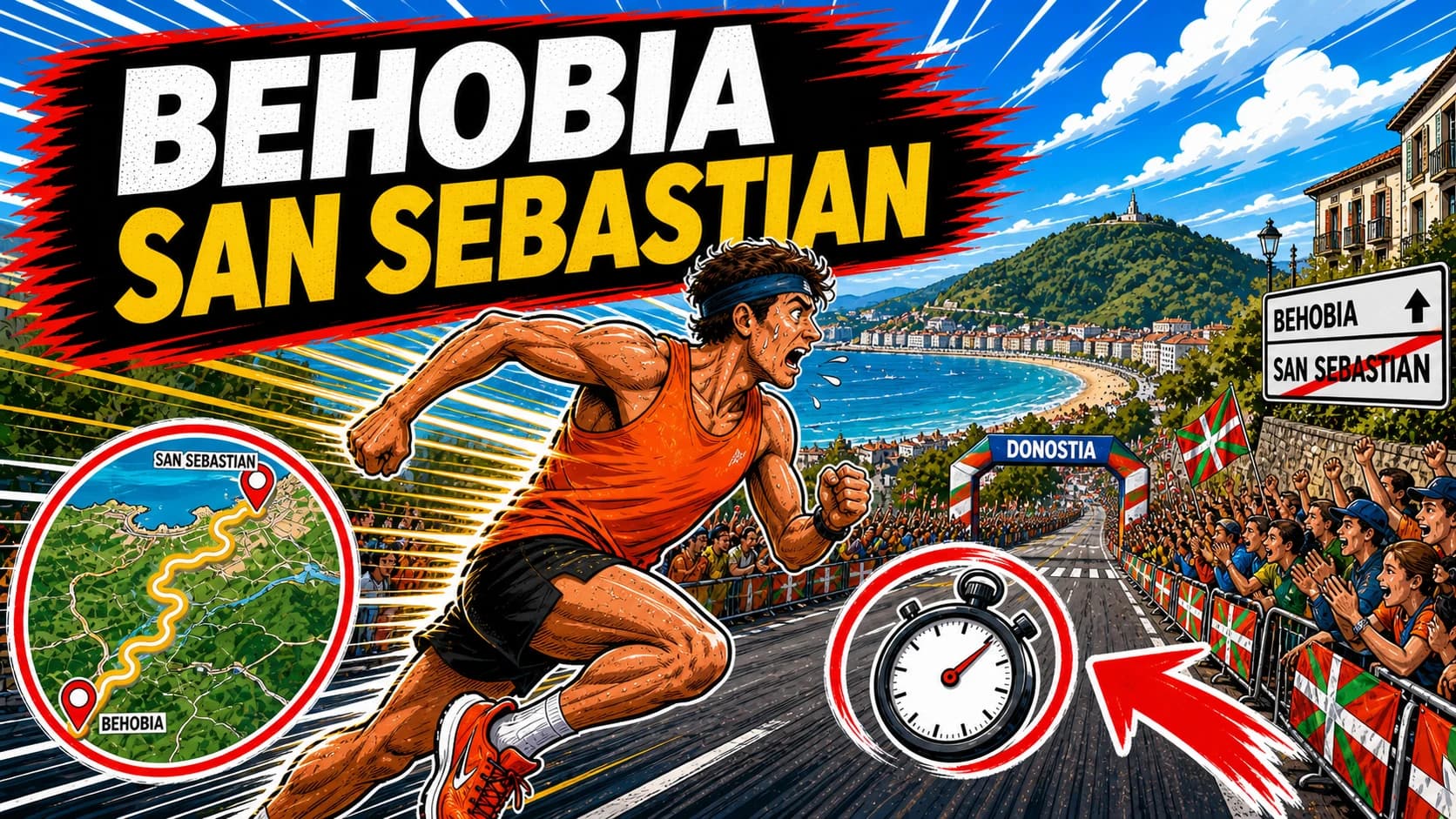
Behobia–San Sebastián 2027 Complete Guide — The Oldest and Most Mythical Race in the Basque Country
Behobia–San Sebastián 2027 Complete Guide
Behobia–San Sebastián 2027 Complete Guide
On November 14, 2027 Donostia (San Sebastián) hosts the 62nd edition of the Behobia–San Sebastián, Spain's oldest race (first edition in 1919, predating almost any other modern Spanish event). The most mythical 20K — running with the Cantabrian wind as backdrop — exactly 20.0 kilometres from Behobia (Irún, on the French border) along the coastal N-1 to the Donostia Boulevard, with the two structural climbs — Gainchurizketa at km 7 and, above all, Miracruz at km 14-15 — that break anyone who goes out too hard. This guide covers what the Fortuna KE website doesn't quite spell out: how to enter the lottery, where the race breaks, how to train both climbs, how to handle the mid-November Cantabrian weather, and why the Donostia finish on the Boulevard with pintxos waiting is the most mythical finish line on the Spanish calendar.
| Data | Information |
|---|---|
| Date | Sunday, November 14, 2027 |
| Distance | 20.0 km (NOT a half marathon — the original 20K) |
| Elevation gain | ~150 m (with two structural climbs) |
| Start | Behobia (Irún), French border, Bidasoa river |
| Finish | Donostia Boulevard / Avenida de la Libertad |
| Start time | ~09:00 (confirm in official communications) |
| Organiser | Real Sociedad Atlético / Fortuna KE |
| Entry | behobia-sansebastian.com (lottery system) |
The Behobia–San Sebastián is Spain's oldest popular race, organised in its modern form by the Real Sociedad athletics section (Fortuna KE) since 1979 on top of a first edition from 1919. It gathers ~30,000 finishers across individual and team bibs, draws runners from all over northern Spain and southern France, and combines an exact 20 km course with two structural climbs that turn it into a race of character — closer to a "fast asphalt trail" than a classic half marathon.
Lead pack leaving the Behobia international bridge with thousands of runners behind — the postcard that defines the start of the Behobia.
Behobia is not a half marathon and that's intentional. It's exactly 20 kilometres — the original 1919 format, kept out of respect for tradition. That decision makes it unique: fast runners can't chase it like a World-Athletics-record-eligible 21.1, and runners coming from 10K can't tell themselves it's just "a bit more". It's its own beast. And on a calendar where everything gets standardised, that's worth gold.
The "Behobia" factor has three components that set it apart:
The Behobia–San Sebastián course is a 20.0 km point-to-point along the coastal N-1, from Behobia (Irún), on the French border by the Bidasoa river, to the Donostia Boulevard. It passes through Oiartzun (km 9), Pasaia (km 12) and enters San Sebastián via Miracruz (km 14-15). Net elevation gain is modest (~150 m positive) but it's concentrated in two structural climbs that dictate the result: Alto de Gainchurizketa at km 7 and Alto de Miracruz at km 14-15.
Official 3D map of the full Behobia–San Sebastián course, with the two climbs (Gainchurizketa and Miracruz) clearly marked.
The first 7 km leave the Behobia international bridge heading west on the N-1, parallel to the Bidasoa first and opening into open country after. It's the fastest stretch and where 80% of runners make the classic tactical mistake: going 5-10 seconds per km below target pace because "this is easy". It isn't. Miracruz collects those seconds at double interest.
The Alto de Gainchurizketa (km 7) is the first warning. 800 metres of climb at 5% average gradient, with a couple of steeper ramps. It isn't brutal — trained runners get over it losing 5-10 seconds per km — but it's where you notice whether the legs are fresh or not. If you reach the top gasping, your plan needs immediate review.
After Gainchurizketa the course drops down to Oiartzun (km 9) via a technical descent with gentle curves. Recovery section: drink, take the chance to lengthen your stride, but don't recover faster than 90% of target pace — the km 14 climb will thank you for it.
The km 9-12 stretch (Oiartzun to Pasaia) is rolling, with views over the port of Pasaia and the Cantabrian coast opening to your left. It's the prettiest segment of the race and also the most lonely in terms of crowds. Hold pace. Not the time to philosophise.
Pasaia (km 12) marks the entry into the urban zone. There's a crowd, there's atmosphere, but you still have 8 km and the killer climb ahead. Don't get carried away by the cheering.
The Alto de Miracruz (km 14-15) is the moment of truth. 1.5 km of sustained climb at 6% average gradient, with a tougher 7-8% final section. It hits exactly when easy glycogen starts running out and the fatigue from the first stretch shows up. This is where the plan breaks. 60% of runners who went out hard in Behobia lose 30 seconds to 1 minute per km here — and the whole plan goes out the window.
After the top, the last 4-5 km are descent and final flat into Donostia: Avenida de Tolosa, entry into the centre, Avenida de la Libertad, finish on the Boulevard in front of City Hall. It's the fastest stretch of the course if you arrive with legs — and the most painful if you don't.
🚨 Where the race breaks
Course data for Strava / Garmin: the organisation publishes the official GPX on its site weeks before the race. To recce Miracruz during the week, search Strava for the segment "Subida Miracruz Behobia" — it's the same profile you'll suffer on race day.
The Behobia–San Sebastián has been run since 1919, which makes it Spain's oldest popular race and one of the oldest in Europe. The first edition was won by Juan Muguerza on March 30, 1919 with barely twenty participants. It was suspended during the Civil War and went through various interruptions before its major relaunch in 1979 as a mass popular race, organised since then by the Real Sociedad athletics section (Fortuna KE). Since that relaunch the race has not stopped growing up to today's ~30,000 finishers.
Last edition's male/female winner crossing the finish line on the Donostia Boulevard — iconic image that anchors the roll-of-honour section.
Roll of honour and race data (recent editions):
| Data | Value |
|---|---|
| First edition | 1919 (Spain's oldest) |
| Modern relaunch | 1979 |
| Editions held | 61 (as of 2026) |
| Distance | Exactly 20.0 km (original format) |
| Finishers (recent editions) | ~26,000-30,000 |
| Countries represented | 30+ |
| Men's all-time record | 0:59:56 (Chakib Lachgar, ESP/MAR, 2023) |
| Women's all-time record | ~1:06-1:08 (historical range) |
Verified winners and times from the 5 most recent editions:
| Year | 🥇 Men | Country | Time | 🥇 Women | Country | Time |
|---|---|---|---|---|---|---|
| 2025 | Raúl Celada | 🇪🇸 ESP | 1:01:29 | Katherine Tisalema | 🇪🇨 ECU | 1:09:34 |
| 2024 | Chakib Lachgar | 🇪🇸 ESP | 1:02:18 | Mireia Guarner | 🇪🇸 ESP | ~1:11 |
| 2023 | Chakib Lachgar | 🇪🇸 ESP | 0:59:56 🏆 | Laura Rodríguez | 🇪🇸 ESP | ~1:08 |
| 2022 | Nan Oliveras | 🇪🇸 ESP | 1:01:17 | Cristina Silva | 🇪🇸 ESP | 1:11:28 |
| 2021 | Eneko Agirrezabal | 🇪🇸 ESP | 1:01:47 | Nuria Lugueros | 🇪🇸 ESP | 1:12:43 |
Data verified against official Fortuna KE results and Basque press coverage (Diario Vasco, Noticias de Gipuzkoa). Lachgar's 0:59:56 in 2023 is the first and only sub-1:00:00 in the history of the race.
The Behobia–San Sebastián is the only Spanish popular race with a lottery system comparable to Boston, NYC or London. Lottery entry typically opens in July of the previous year (July 2027 for this edition), with results published in August-September. The individual bib price is €25 to €35 — cheap compared to any international half, because the organiser is a local club, not an events company.
The Donostia Boulevard on race day, packed with spectators applauding finishers — reinforces the message of "an atmosphere worth waiting for the lottery".
How the lottery works:
Real probability of getting in: ~37% in recent years (30k spots / 80k applications). It improves if you enter as a team (3-6 runners) or if you've completed 3+ consecutive editions as a finisher, which gives you priority points.
2026 edition reference:
Unlike most races, Behobia has no tiers — once assigned in the lottery, the price is single.
| Modality | Approx. price | Access |
|---|---|---|
| 🎟️ Individual bib | €28-32 | Open lottery in July |
| 👥 Team bib (3-6 runners) | €25-28/runner | Team lottery (separate quota) |
| ❤️ Charity bib | €150-300 | Partner NGOs (no lottery) |
| 🏆 Loyalty spot | Standard price | 3+ consecutive editions as a finisher |
Indicative 2026 prices. Always confirm on the official site — the actual amount is published when the lottery opens.
| Included in the price | NOT included |
|---|---|
| ✅ Bib with timing chip | ❌ Commemorative technical t-shirt (depends on edition) |
| ✅ On-course aid stations | ❌ Official professional photo (~€10-15) |
| ✅ Post-finish bag (fruit, isotonic, water) | ❌ Pasta-party / Saturday dinner |
| ✅ Bus service Donostia → Behobia (start) | ❌ Premium bag-drop service |
| ✅ Digital diploma with certified time | ❌ Cancellation insurance |
| ✅ Finisher medal |
Things to keep in mind:
Runners picking up their bib at Pabellón Illunbe or the venue designated by the organisation in Donostia — reinforces the pre-race logistics idea.
Bib pickup happens at the Race Expo, normally held the two days before the race (Friday and Saturday) at a hall in Donostia (historically Illunbe or an equivalent venue near the centre). Bibs are NOT handed out on race day — you must pick yours up on Friday or Saturday.
You'll need:
Family or friends can pick yours up with a signed authorisation and a copy of your ID. The kit normally includes the bib with chip, a bag tag and, depending on the edition, a commemorative t-shirt or a token from the organisation (not always race-grade technical).
The most practical way to reach Donostia for the Behobia is by train: AVE/Alvia connects Donostia with Madrid (5h), Barcelona (6h) and the rest of the network. Once in Donostia, the organisation provides a free bus service from the centre to the start in Behobia (Irún) on race morning — included in the bib and the option used by 90% of runners. Don't drive to Behobia on race day: the N-1 is partially closed and parking is impossible.
DBus or organisation special-service bus with runners boarding at 7:00 in the morning towards Behobia — reinforces the message "you don't need a car".
Reaching Donostia from outside the Basque Country:
Race morning (logistics from Donostia):
For a Behobia runner, staying within a 15-minute walk of the Donostia Boulevard (the finish) is the call: you come back from the 20K hungry, cold and probably wet, and you need a shower + real food as soon as possible. Sleeping in Irún or Hondarribia (close to the start) seems to make sense — but the organisation provides a free bus to the start, so the logic flips: sleep in Donostia, let the bus take you to Behobia at 7 on Sunday.
Donostia's La Concha bay at Saturday-pre-race dawn — the postcard that justifies sleeping in the centre and not in Irún.
| Hotel | Cat. | €/night* | To finish | Runner highlight |
|---|---|---|---|---|
| Hotel María Cristina (iconic Belle Époque) | 5* | €380–550 | 200 m · 3 min | Pure historic luxury, bathtub, strong AC |
| Hotel de Londres y de Inglaterra | 4* | €220–340 | 500 m · 7 min | Facing La Concha, views, breakfast from 7:00 |
| Hotel Niza | 3* | €150–220 | 600 m · 8 min | Mid-tier, sea-facing |
| Hotel Arrizul Center | 4* | €140–200 | 700 m · 9 min | Good value in the centre |
| NH Aránzazu | 4* | €160–230 | 800 m · 10 min | Reliable chain, late check-out negotiable |
| Hotel | Cat. | €/night* | To finish | Runner highlight |
|---|---|---|---|---|
| Hotel Zenit San Sebastián | 4* | €130–190 | 1.2 km · 15 min | Modern, near Zurriola |
| Hotel Codina | 3* | €110–160 | 1.3 km · 16 min | Solid base, gym for mobility |
| Apartamentos Welcomer Gros | Apt | €90–150 | 1.4 km · 17 min | Apartment with own kitchen |
| Hotel Arima | 4* | €180–260 | 1.5 km · 18 min | Sustainable boutique, strong AC |
| Hotel | Cat. | €/night* | To start | Note |
|---|---|---|---|---|
| Parador de Hondarribia | 4* | €180–260 | 5 km to Behobia | Historic castle, luxury, but far from the finish |
| Hotel Jauregi (Hondarribia) | 3* | €90–140 | 4 km to Behobia | Pretty town, mid-range option |
| Hotel Beko Errota | 3* | €75–120 | 3 km to Behobia | Budget, functional |
*Indicative race-weekend rate (second Sunday of November). Varies a lot with booking lead time — Behobia weekend is the most expensive of the year in Donostia, alongside the Film Festival in September. Book 4-6 months out.
The Donostia weather on the second Sunday of November averages 8-15 °C with overcast skies, high humidity (75-90%) and a 50% chance of rain, based on historical data from AEMET and Euskalmet. The Cantabrian wind — typically NW or N — can hit hard along coastal sections (km 9-12) with gusts of 30-50 km/h. It's not predictable weather: in the last 5 years we've seen everything from a dry, sunny 14 °C (rare) to 6 °C with rain and headwind (also rare). Most likely: 10-12 °C with overcast and chance of showers.
Runners deep in the Behobia under overcast sky and wet asphalt — the typical pattern of the second Sunday of November on the Cantabrian coast.
The variable to watch is rain and wind, not raw cold. For 20K at your target pace, 10-12 °C is ideal — you cool down quickly in the first 2 km and then run comfortably. But rain changes the shoes you wear (see Gear section) and the headwind between Pasaia and Miracruz (km 12-14) can add 10-15 seconds per km if it hits hard.
Plan by forecast:
Bring kit for all three scenarios: the Thursday-to-Sunday Cantabrian forecast shifts several times. Don't bet the race on a 5-day forecast — pick your kit on Saturday night with the 12-24 hour outlook.
The recommended plan to prepare for Behobia is an 8-10 week block (not 16 — this is 20 km, not a marathon) with peak volume in weeks 5-7 (between 30 km and 90+ km a week depending on goal), one weekly long run reaching 22-25 km, and a 10-day taper. The key for Behobia: train structural climbs and at least two long runs with 150 m+ of cumulative gain to acclimate to Gainchurizketa and Miracruz.
Runner training a sustained climb on terrain similar to Miracruz — aspirational image that anchors the 8-10 week plan.
Approach Behobia as a 20K with a budget of ~150 m of gain concentrated in two climbs, not as a flat 20K. Pick your goal and follow the table — these are peak volumes (weeks 5-7), not block averages.
| Goal | Average pace | Peak weekly volume | Peak long run |
|---|---|---|---|
| 2:00 (finish) | 6:00 min/km | 25–35 km | 16–18 km |
| 1:45 | 5:15 min/km | 35–45 km | 18–20 km |
| 1:30 | 4:30 min/km | 45–55 km | 20–22 km |
| 1:20 | 4:00 min/km | 55–70 km | 22–25 km |
| 1:15 | 3:45 min/km | 70–85 km | 22–25 km |
| sub-1:10 | ≤3:30 min/km | 85–100+ km | 22–28 km |
How to read the table and build the cycle:
Three sessions worth gold for Behobia:
The taper is 10 days, not 3 weeks. For 20K all you need: week -2 at 80%, week -1 at 50%, keeping intensity in short pickups. The last long run (in week -3) is the one that loads the cup.
Don't know what realistic target time you can hit at Behobia? Cross your most recent 10K or half time with the "Behobia" factor (which deducts the two climbs + possible wind):
| Your recent 10K | Your recent half | Realistic Behobia |
|---|---|---|
| 35 min | 1:18 | 1:14–1:18 |
| 40 min | 1:28 | 1:24–1:30 |
| 45 min | 1:38 | 1:34–1:42 |
| 50 min | 1:48 | 1:45–1:55 |
| 55 min | 1:58 | 1:55–2:05 |
| 60 min | 2:08 | 2:05–2:15 |
How to read it: the 10K → 20K conversion is roughly 10K × 2.15 (Riegel factor). Behobia adds 2-4% on top because of the two structural climbs — that gives you the realistic range. If you've trained climbs and the day is dry without wind, target the lower end. If it rains or there's headwind, the upper end.
Once you have your target time, this calculator gives you the required average pace (in min/km and min/mi) and the cumulative splits at 5K, 10K, 15K and finish — including the key splits at Gainchurizketa (km 7) and foot of Miracruz (km 14). Change the target time in the field below and the table updates instantly:
| Punto | Tiempo acumulado | Parcial |
|---|---|---|
| 5 km | 22:30 | 22:30 |
| 10 km | 45:00 | 22:30 |
| 15 km | 1:07:30 | 22:30 |
| Meta | 1:30:00 | 22:30 |
Splits asumen ritmo constante. En carreras con desnivel real (Behobia–San Sebastián) — banca 5–8 s/km en bajadas y pierde el mismo margen en subidas; el ritmo medio se mantiene.
The calculator above gives you the pace. But a real race plan answers more questions: what strategy do I start with? 1 gel or 2? what do I do if I'm 20 seconds over target on Gainchurizketa? how do I manage Miracruz if I arrive on the edge?
Configure your goal, strategy and fuelling plan. The planner generates a personalised plan by segment (with paces, HR zones, mental cues and minute-by-minute fuelling), a race-morning checklist, and a Plan B for the unexpected (rain, wind, bus delay, cramps on Miracruz). Download it as a PDF to take with you on race day.
PDF A4, optimizado para imprimir y llevar el día de carrera.
You arrive at Behobia. You've done the 8-10 week block. What separates good training from a good time is what you do over the next 1-2 hours.
The Behobia race plan should combine conservative pacing in km 1-7 (don't overdo it on the flats), target pace between km 8-13, and effort-management (not pace) between km 14-15 on Miracruz, closing from km 15 to the Boulevard depending on how you arrive at the top. Each target time (sub-1:10 to finish) has a specific split pattern.
| Goal | Average pace | Behobia-specific tactical note |
|---|---|---|
| sub-1:10 | 3:30 min/km | Bank 5 s/km in the first 7 km of flats. Hold effort on Miracruz; lose 5-10 s/km max. Recover on the descent to the Boulevard. |
| sub-1:15 | 3:45 min/km | Cross km 10 at 37:30. Hold Miracruz at 4:00; attack km 18 if you arrive with legs. |
| sub-1:20 | 4:00 min/km | No rush km 1-3 (cold asphalt + incomplete warm-up). Cross km 10 at 40:00. Walk 5 s through each aid station. |
| sub-1:30 | 4:30 min/km | Classic mistake is going out at 4:15 because "the flats invite it". Hold 4:30 the first 7 km. |
| sub-1:45 | 5:15 min/km | Very even splits: 5:10-5:20 the whole way. Walk-run strategy on Miracruz if you arrive on the edge. |
| sub-2:00 | 6:00 min/km | Plan B walk-run from km 1: 9 run / 1 walk. Gives you margin to finish on the Boulevard. |
| Finish | 6:00-7:00 | No watch. Enjoy Pasaia, suffer Miracruz with your head, and the Boulevard rewards you. |
This is where Behobia is decided. Three anchors:
The nutrition strategy for a 20K pivots on 30-60 g of carbs per hour depending on goal, with 1-2 gels (not 3-5 like in a half or marathon) spread out from km 8 onwards. Carb load over the previous 2 days should be 6-8 g/kg/day — you don't need the massive marathon load. And Saturday dinner: pintxos yes, but with your head set on running the next day.
Volunteer at a Behobia aid station serving water under the typical Cantabrian overcast.
Saturday dinner is the trickiest part when you're in Donostia. The temptation is to hit a Parte Vieja pintxo bar and demolish it — short answer: not entirely. What works:
Race-morning breakfast depends on whether you wake up hungry and what time you're catching the bus to Behobia. If the bus leaves at 7:00, breakfast at 5:30-6:00. The safe call: toast with honey/jam + banana + coffee (if you usually drink it). 60-80 g of carbs, eaten 2.5-3 hours before the gun. If your stomach closes up with nerves, swap for a sports drink with 60 g of carbs.
What the organisation puts on course:
Carb plan by goal:
| Goal | Carbs / hour | Gels to carry | When to take them |
|---|---|---|---|
| 2:00 | 25-35 g/h | 1 gel | km 12 (before Miracruz) |
| 1:30 | 35-50 g/h | 1-2 gels | km 8 + km 14 (foot of Miracruz) |
| 1:15 | 45-60 g/h | 2 gels | km 6 + km 13 |
| sub-1:10 | 50-60 g/h | 2 gels + isotonic | km 5 + km 12 |
Three mistakes seen every year at Behobia:
Hydration by forecast:
Post-finish recovery — the first hour:
The best shoes for the Behobia–San Sebastián are protective carbon plate with good grip for sub-1:30 (Saucony Endorphin Pro, ASICS Magic Speed), protective super-trainer between 1:30-1:45 (Saucony Endorphin Speed, Hoka Mach X, Puma Deviate Nitro), and stable daily trainer for 1:45+ (Nike Pegasus Plus, ASICS Cumulus, Brooks Ghost). The critical points: wet grip (it's November Cantabrian) and protection for the technical Gainchurizketa descent.
Close-up of shoes on the Behobia start line with the international bridge in the background — multiple brands visible.
Unlike a flat 21.1, at Behobia the grip + protection factor weighs more than weight. An ultralight race carbon plate can save you 2-3% of energy but slips in the wet and crushes quads on the Gainchurizketa descent and the final descent from Miracruz. For non-elite runners, a protective plate or a super-trainer beats the lightest option.
Recommendations by goal:
| Goal | Category | Common models |
|---|---|---|
| sub-1:10 | Race carbon plate with good grip | Nike Vaporfly 4 · adidas Adios Pro 4 · Saucony Endorphin Pro · ASICS Metaspeed Sky |
| 1:10-1:30 | Protective carbon plate or super-trainer | Saucony Endorphin Speed · Hoka Mach X · Puma Deviate Nitro Elite · ASICS Magic Speed |
| 1:30-1:45 | Protective super-trainer | Saucony Endorphin Speed · Hoka Mach X · Nike Pegasus Plus · Brooks Hyperion Max |
| 1:45+ | Stable daily trainer | Nike Pegasus Plus · ASICS Cumulus / Nimbus · Brooks Ghost · Hoka Clifton |
Check this before leaving the house:
Out of respect for tradition. The first 1919 edition was run over exactly 20 km, and since the modern relaunch in 1979 the organisation has held that distance despite pressure to standardise to 21.1 (which would be eligible for World Athletics records). Behobia is the only reference Spanish popular race over 20K, and that's part of its identity. The difference from a half is just 1.1 km, but psychologically and tactically it's its own beast: neither a long 10K nor a short half.
Yes, quite a bit harder. Even though it's 1.1 km shorter than a standard half, the two structural climbs (Gainchurizketa at km 7 and Miracruz at km 14-15) make it 5 to 8 minutes slower than a flat half like Valencia or the Madrid Half. If you run 1:25 in flat Valencia, in Behobia you'll likely run 1:32-1:36. Add the Cantabrian weather (cold, humid, possible wind) and the toll grows. For many runners it's harder than an "easy" marathon in terms of effort per minute.
Yes, a real lottery — it's not marketing. The lottery opens in July of the previous year (July 2027 for this edition). You register for free on the official site, wait for results in August, and only if selected do you pay for the bib. Typical odds: ~37% getting in as an individual. Team spots (3-6 runners) have better odds. If you want a guaranteed entry, charity bibs via partner NGOs (€150-300) are the only guaranteed route.
Recent editions close the race at 3 hours from the gun, which equals about 9 min/km. Walking is allowed; the course has staggered partial closings (the N-1 reopens to traffic after the last runner passes). If you're going beyond 2:30, make sure you start in the right corral and don't lose the first 30 minutes in the toilet queue.
Free organisation bus, from central points in Donostia (Boulevard, Anoeta) to Behobia. Departs ~6:30-7:30, arrives ~7:30-8:00. It's the option used by 90% of runners and it's included in the bib. Alternative: Topo train (Renfe Cercanías) Donostia-Irún every 30 min. Don't drive to Behobia — parking is impossible and the N-1 is partially closed from early morning.
No. Behobia runs in rain, wind and cold — that's part of its character. It has only been suspended in extreme circumstances (Civil War, COVID 2020). If the forecast includes rain, adjust kit: breathable waterproof vest, merino socks, cap. Accept losing 30 seconds per km if it rains hard and switch the goal to "finish well". The good news: the Basque crowd applauds in rain with the same intensity as in sun.
For sub-1:30, a protective carbon plate with good grip (Saucony Endorphin Pro, ASICS Magic Speed, adidas Adios Pro 4 — avoid the classic Vaporfly if it rains, slippery in the wet). For 1:30-1:45, super-trainer (Saucony Endorphin Speed, Hoka Mach X). For 1:45+, stable daily trainer (Nike Pegasus Plus, ASICS Cumulus, Brooks Ghost). The most important: wet grip and already broken in (not exceeding 250-350 km of use).
Behobia is the most mythical and traditional on the Spanish calendar. The Cursa El Corte Inglés (Barcelona, ~10K) and the San Silvestre Vallecana (Madrid, 10K) are urban and flat. The Carrera de la Mujer is a women's circuit over 5K-10K. Behobia plays in another league: a real 20K with climbs, Cantabrian weather, lottery entry, a century of tradition. It's the "Boston of Spanish popular races" — not the fastest, but the most prestigious for making personal history.
Only if you go in without a time goal. The atmosphere, tradition, aid stations and the Boulevard finish make the experience memorable. Not, if your goal is a specific time — the two climbs and the weather penalise too much. If it's your first race beyond 10K, better start with a flat half (Valencia, Lisbon, Madrid Half), learn to manage 21K, and then come to Behobia to live it fully.
An incredible amount. The Donostia Boulevard and Avenida de la Libertad are packed from 2 hours before the first finisher until evening. Whole families wait for their runners with banners, there's PA at low volume (the Basque tradition is respectful, this is not Times Square), pintxo bars around the corner, and the afternoon txuleta + sidra is the closing ritual. It's the most mythical finish on the Spanish popular calendar, and it's worth the lottery + the trip + the wait. Few race finishes leave you feeling so good.
Behobia–San Sebastián is the best Spanish popular race in November for tradition and character, but it's not the option for a PB. If you're chasing a fast time, a flat winter half (Valencia, Lisbon, Madrid Half) is 5-8 minutes faster; if you want mass urban atmosphere over a short distance, Cursa El Corte Inglés or San Silvestre Vallecana are the bet. Behobia is for living a mythical 20K — and in 2027, that's still unique.
Distances vary across these races, so the comparison is by character, not direct clocking:
| Race | Month | Distance | Elevation | Best for | Atmosphere |
|---|---|---|---|---|---|
| Behobia–San Sebastián (this guide) | November | 20.0 km | ~150 m (2 climbs) | Tradition · character | ⭐⭐⭐⭐⭐ |
| Cursa El Corte Inglés (Barcelona) | April | ~10 km | <30 m | Mass urban atmosphere | ⭐⭐⭐⭐ |
| San Silvestre Vallecana (Madrid) | Dec 31 | 10 km | <50 m | Year-end urban | ⭐⭐⭐⭐ |
| Carrera de la Mujer (multiple cities) | Various | 5-10 km | <30 m | Charity · women's | ⭐⭐⭐⭐ |
| Zurich Marató Barcelona | March | 42.2 km | ~150 m | Marathon with atmosphere | ⭐⭐⭐⭐ |
| EDP Maratón de Madrid | April | 42.2 km | ~600 m | Marathon experience | ⭐⭐⭐⭐⭐ |
| Maratón Valencia | December | 42.2 km | <50 m | Marathon PB | ⭐⭐⭐⭐ |
Was this guide useful? If you're going to run Behobia–San Sebastián 2027, save the event in SportPlan to get alerts for the July lottery opening, expo reminders and, after the race, log your result on the Boulevard.
Verder plannen
Gebruik SportPlan om data te vergelijken, evenementen op te slaan en een seizoen te bouwen dat bij je weekenden past.