41 min leestijdrunning10k
San Silvestre Vallecana 2027 Complete Guide — The World's Most Iconic NYE 10K
San Silvestre Vallecana 2027 Complete Guide
San Silvestre Vallecana 2027 Complete Guide
By Ramon Curto · Updated 2026-05-06
San Silvestre Vallecana 2027 Complete Guide
By Ramon Curto · Updated 2026-05-06
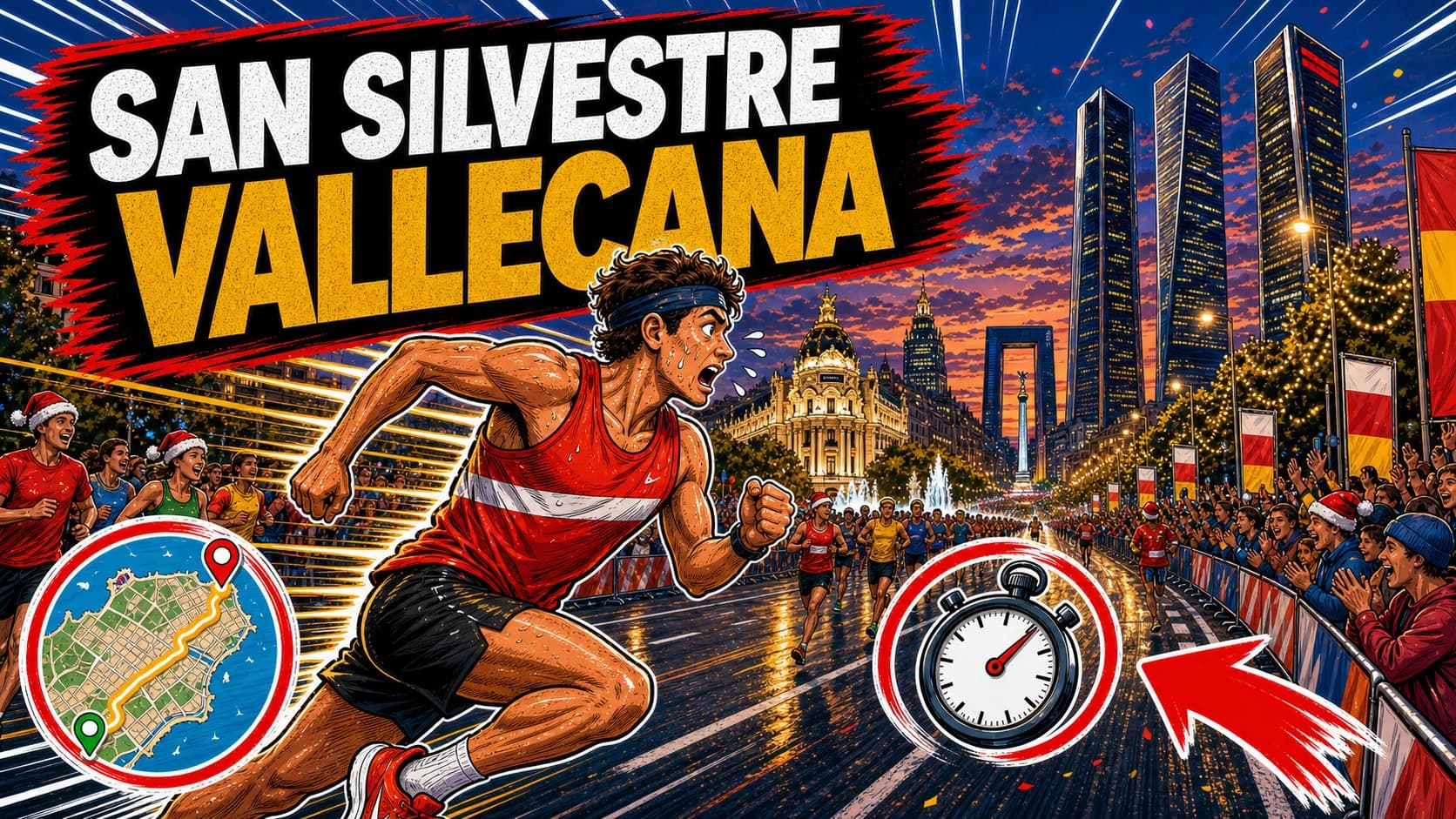
On December 31, 2027 Madrid closes the year with the world's most iconic 10K. The Nationale-Nederlanden San Silvestre Vallecana isn't just another race: it's the running world's New Year's Eve party — ~40,000 runners descending the Paseo de la Castellana to the working-class heart of Vallecas, Santa Claus costumes, reindeer and elves crossing the line, and a record book that has seen road 10K world records set by the best legs in Africa. This guide covers what the official site doesn't quite explain: how the downhill course really feels (yes, it descends, but it's no gift), how Atocha punishes you at km 7, what to do if you want a time and what to do if you came for the party, where to stay, how to fit Nochevieja dinner around the race, and a 6–8 week plan to arrive sharp.
| Data | Information |
|---|---|
| Date | Friday, December 31, 2027 |
| Distance | 10 km (popular + international elite) |
| Net elevation | ~40 m descent (net downhill) |
| City | Madrid (~660 m average altitude) |
| Start | Plaza de Castilla / Bernabéu area (north Madrid) |
| Start time | ~5:30–6:00 PM popular · evening international |
| Finish | Estadio de Vallecas (sports complex) |
| Organizer | MGM Producciones · Atletismo Vallecas |
| Sponsor | Nationale-Nederlanden (since 2018) |
| Entry | sansilvestrevallecana.com |
The San Silvestre Vallecana is Spain's oldest road race: the first edition ran in 1964, organized by the Atletismo Vallecas club as a way to close out the year in the working-class neighborhood of Vallecas. More than 60 editions later, it remains the unmissable date every December 31, with two parallel races (popular + international elite) sharing the same course on the same day and bringing ~40,000 runners onto the streets. It is the world's most iconic San Silvestre: it has seen road 10K world records, the best African distance runners on the start line, and it still carries the soul of a neighborhood race — costumes, family vibe, and a finish line inside a working-class football club's stadium.
Mass start of the popular pack in Plaza de Castilla at dusk on December 31, with Santa Claus costumes and Nochevieja (NYE) lights in the background — the postcard that defines the San Silvestre Vallecana.
San Silvestre Vallecana is not your usual race. It's Nochevieja (New Year's Eve) with a bib. The start drops at the end of the afternoon (Madrid gets dark early on December 31), the dry plateau cold cuts your breath, and half the field shows up dressed as Santa Claus, a reindeer, an elf, a Christmas tree or Spider-Man. If you want a time, it's there for you: the course is net downhill (~40 m descent) along Madrid's longest, flattest avenue and the clock works in your favour. If you came for the party, that's there too: the atmosphere on the Castellana, Cibeles and Atocha is one of Spain's great urban spectacles of the year.
The San Silvestre Vallecana course is a point-to-point 10 km layout starting at Plaza de Castilla (north Madrid, Bernabéu / Cuatro Torres area), descending the Paseo de la Castellana — Madrid's longest, flattest avenue — passing Plaza de Cibeles, turning at Atocha and heading southeast on the final section to the finish at the Estadio de Vallecas (sports complex). The net elevation is around 40 m of descent, making it one of the fastest popular 10Ks on the Spanish calendar.
Official full course map of the San Silvestre Vallecana published by the organizer, with the descending Castellana line and the Vallecas finish clearly visible.
The start is at Plaza de Castilla, in northern Madrid, next to the Cuatro Torres and a stone's throw from the Estadio Santiago Bernabéu. The first 3 km descend gently down the Paseo de la Castellana, a wide, paved avenue with six lanes closed to traffic for the race and thousands of spectators on either side. Kilometre 4 lands you in Plaza de Colón, km 5 in Plaza de Cibeles (with the city hall lit up for Christmas) and km 6 points you toward Atocha.
From Atocha (km 6–7) the race changes character. You leave the wide Castellana avenue and head into narrower streets to the southeast. This is where the race breaks: the cold sets in for real (sun already low, shade between buildings), the head sags after the freebie descent, and the next 3 km are falsely flat with micro-climbs that weren't in your head when you let it rip on the Castellana. The finish lands at the Estadio de Vallecas (also known as Estadio Teresa Rivero or sports complex), heart of the Rayo Vallecano neighborhood and soul of Madrid's grassroots running. Crossing the line there, with the local crowd cheering from the stands, is one of the most authentic moments on the Spanish calendar.
Tarmac dominates the entire course (main carriageway closed, no significant cobblestones). Liquid aid stations are at km 5 and finish (it's a 10K — you don't need more). Spectator density peaks on the Castellana, Cibeles, Atocha and the Vallecas finish line; thinner on the transition stretch km 6–8.
🚨 Where the race breaks
Course data for Strava / Garmin: the organizer publishes the official GPX a few days before the race on its website. To recce the Castellana-Cibeles stretch midweek, search Strava for the segment "Castellana sur Bernabéu Cibeles" — it's exactly the profile you'll have for the first 5 km.
The San Silvestre Vallecana has run since 1964, which makes it Spain's oldest road race and one of the most historic San Silvestres in the world (alongside São Paulo's São Silvestre International, founded in 1925). It was originally organized by the Atletismo Vallecas club as a year-end neighborhood race; it has cycled through several sponsors (Mahou, Nationale-Nederlanden since 2018) and the international elite format was added in the 1990s when it began to attract Kenyan and Ethiopian distance runners. It has hosted road 10K world records in several editions — thanks to the combination of moderate descent, end-of-season date and a top-tier elite field.
Front of the elite race crossing Cibeles at nightfall, with Christmas lights and a Rayo Vallecano flag in a finish-line stand — the iconic image anchoring the roll-of-honour section.
Race and roll-of-honour data (recent editions):
| Data | Value |
|---|---|
| First edition | 1964 |
| Editions held | 60+ (as of 2026) |
| Distance | 10 km |
| Participants (popular + elite, recent editions) | ~40,000 |
| Men's elite course record | 26:32 (Berihu Aregawi, ETH, 2024) |
| Women's elite course record | 29:54 (Brigid Kosgei, KEN, 2018) |
| Title sponsor | Nationale-Nederlanden (since 2018) |
Verified winners and times from the 5 most recent editions:
| Year | 🥇 Men | Country | Time | 🥇 Women | Country | Time |
|---|---|---|---|---|---|---|
| 2025 | Geoffrey Kamworor | 🇰🇪 KEN | 27:40 | Marta García | 🇪🇸 ESP | 31:11 |
| 2024 | Berihu Aregawi | 🇪🇹 ETH | 26:32 | Marta García | 🇪🇸 ESP | 31:19 |
| 2023 | Berihu Aregawi | 🇪🇹 ETH | 27:15 | Ababel Yeshaneh | 🇪🇹 ETH | 30:30 |
| 2022 | Joshua Cheptegei | 🇺🇬 UGA | 27:09 | Prisca Chesang | 🇺🇬 UGA | 30:19 |
| 2021 | Mohamed Katir | 🇪🇸 ESP | 27:45 | Degitu Azimeraw | 🇪🇹 ETH | 30:26 |
Data verified against the public archive at San Silvestre Vallecana (Wikipedia EN). Aregawi's men's record (26:32) in 2024 ranks among the fastest road 10K times ever run.
San Silvestre Vallecana 2027 entry opens in early November 2027 through a lottery + first-come-first-served system depending on bib type. The popular race historically sells out in a few hours (sometimes under 24 h). Prices sit around €15–25 for the standard popular bib — one of the most affordable popular 10Ks on the Spanish calendar given the size and organization.
Aerial view of the massive pack descending the Paseo de la Castellana at dusk, with Santa Claus costumes visible in the crowd — reinforces the message "40,000 runners, spots fly".
Reference from the 2026 edition at close:
Thinking there will always be last-minute bibs at Vallecana is a mistake. If you want to run it in 2027, mark late October on your calendar and hit the website on the day entry opens.
San Silvestre Vallecana uses a single-price or very compressed two-tier system — the bib barely rises through the entry window because the race sells out before the second tier even kicks in. Sign up on opening day or accept you'll have to go through the charity route.
| Tier | Approx. open | Approx. close | Popular | Charity |
|---|---|---|---|---|
| 🟢 Opening | Nov 2027 | until sold out | €15–18 | €25–35 |
| 🟡 Charity / second wave | Nov–Dec 2027 | until close | — | €25–40 |
Indicative prices based on the 2026 edition structure. Always confirm on the official entry page — that's where the amounts get updated.
| Included in the price | NOT included (optional extra) |
|---|---|
| ✅ Bib with timing chip | ❌ RFEA federation licence (~€5 if you want it) |
| ✅ Commemorative Nochevieja technical t-shirt | ❌ Official professional photo (~€10–15) |
| ✅ Finisher medal (in some editions) | ❌ NYE dinner (on you) |
| ✅ Liquid aid station at km 5 and finish | ❌ Costume (you bring it) |
| ✅ Post-finish bag (fruit, sports drink, water) | ❌ Cancellation insurance |
| ✅ Digital diploma with certified time |
What you need to keep in mind beyond the bib price:
Runners picking up the bib at the San Silvestre Vallecana expo, with the commemorative Nochevieja technical t-shirt visible on the counter.
Bib pickup happens at a runners' expo in the days before the race (typically December 28 to 30) at a central Madrid location (recent editions have been at El Corte Inglés on the Castellana or at sponsor sites). Bibs are not handed out on race day: you have to pick yours up in person during the expo days, so plan your arrival in Madrid to leave at least one afternoon free to swing by.
You'll need:
Family and friends can pick yours up with a signed authorization and a copy of your ID. The race kit usually includes the commemorative technical t-shirt, the bib with chip, and a course map.
The most practical way to get to the start of the San Silvestre Vallecana is by metro: the Plaza de Castilla station (lines 1, 9 and 10) is right at the foot of the start area. To get back from the Vallecas finish, the Portazgo or Buenos Aires (line 1) stations are closest to the stadium. Madrid's metro runs on December 31 with reinforced timetable from 6:00 AM to 2:00 AM on January 1 — no problem to arrive before the start and head back after the finish.
Plaza de Castilla with the Cuatro Torres lit up at dusk on December 31 — visual reference for the reader arriving in Madrid for the first time for the San Silvestre.
Arrival plan for December 31:
Renfe Cercanías (commuter rail) also works: Atocha station is 5 minutes from the course in its final stretch if you're coming from outside Madrid (AVE high-speed, regional Cercanías).
Driving is not recommended. Central Madrid is part of the Low Emission Zone (ZBE) and many course streets are closed from early afternoon into the night. If you have to drive in from outside, park at an outer-ring metro station (Las Tablas, Pitis) and switch to public transport.
San Silvestre Vallecana is a special case: the race ends around 6:30–7:30 PM depending on pace, and at midnight you're toasting with grapes (or out partying in Madrid). The hotel isn't just race logistics — it's the base for the most festive night of the year. There are three zones that work depending on priority: Centre (Sol/Gran Vía) if you want NYE atmosphere, Chamartín / Plaza de Castilla if you prioritize being a 5-minute walk from the start, and Vallecas / Cuatro Caminos if you'd rather finish the race and walk straight into your hotel.
Gran Vía with Christmas lights on the night of December 31 — captures Madrid's nightlife vibe in the central zone recommended for runners.
| Hotel | Cat. | €/night* | To start | Runner highlight |
|---|---|---|---|---|
| NH Collection Madrid Gran Vía | 4* | €180–260 | 5 km · 15 min metro | Early breakfast + Nochevieja dinner |
| Iberostar Las Letras Gran Vía | 4* | €160–230 | 5 km · 15 min metro | Location, in-house dining |
| Riu Plaza España | 4* | €150–210 | 4.5 km · 14 min metro | Gym, Gran Vía views |
| Hotel Vincci Vía 66 | 4* | €130–180 | 5 km · 15 min metro | Central, mid-range |
| Only YOU Boutique Madrid | 5* boutique | €240–360 | 5.5 km · 17 min metro | Boutique, terrace, January 1 brunch |
| Hotel | Cat. | €/night* | To start | Runner highlight |
|---|---|---|---|---|
| Eurostars Madrid Tower | 5* | €200–290 | 200 m · 3 min | Inside the Cuatro Torres — walk to start |
| NH Collection Madrid Eurobuilding | 5* | €220–320 | 1 km · 12 min | Big hotel, gym, top heating |
| Hotel Chamartín The One | 4* | €130–180 | 1.5 km · 18 min | Next to AVE Chamartín station |
| Pestana CR7 Gran Vía vía Eurostars | 4* | €160–220 | 1.2 km · 14 min | Modern, mid-upper range |
| AC Hotel by Marriott Cuzco | 4* | €140–190 | 800 m · 10 min | Discreet, business, strong heating |
| Hotel | Cat. | €/night* | To finish | Runner highlight |
|---|---|---|---|---|
| Sercotel Hotel Madrid Aeropuerto | 3* | €70–110 | 2 km · 25 min | Budget, simple, decent heating |
| Ibis Madrid Centro Las Ventas | 3* | €80–120 | 3 km · 10 min metro | Near Ventas metro, mid option |
| Holiday Inn Express Madrid Alcorcón | 3* | €70–100 | metro + Cercanías | Budget alternative if centre is full |
*Indicative rate for the night of December 31, 2027 (Nochevieja). Madrid rates that night are significantly higher than a normal day. Book 2–3 months in advance for the prices above; last-minute you may see x2 or x3 multipliers.
The weather in Madrid on December 31 in the late afternoon-evening averages 4–10 °C with dry, sunny conditions in around 75% of years, according to historical data from AEMET. Rain is infrequent (a December 31 with precipitation every 4–5 editions), wind typically sits below 15 km/h and the coldest recent San Silvestre had a start around 2 °C (with lower wind chill).
December 31 sunset in Madrid with clear sky and Christmas lights coming on — the typical weather pattern for the San Silvestre Vallecana.
The variable to watch is temperature combined with darkness. The sun sets in Madrid on December 31 around 5:55 PM, so when you start (~5:30–6:00 PM popular wave) you'll have twilight in the first km and lit darkness in the last. Temperature drops fast once the sun goes — start can be 8 °C and finish 4 °C 50 minutes later.
Plan by forecast:
Remember it's dark by the end. Bring reflective clothing or visible strips: the course runs along lit avenues but there are transition stretches into Vallecas with less light. A handheld or head torch isn't necessary but adds peace of mind if you'll be over 60 minutes. Madrid's dry cold is far more bearable than the damp cold of the Atlantic coast — don't overdo the layers.
The recommended plan to prepare the San Silvestre Vallecana is a 6–8 week block with peak volume in weeks 3–6 (between 25 km and 60+ km per week depending on goal), one quality session per week, a long run of 70–90 minutes on weekends, and a 7–10 day taper. The key for Vallecana: a moderate-downhill tempo session and a 10K-pace session in the last 3 weeks so the body learns to handle the naturally high pace the Castellana will impose on you.
Runner doing intervals on a tartan track at dusk in autumn — aspirational image anchoring the 6–8 week plan.
Approach Vallecana as a fast moderate-downhill 10K, not as a long-distance race. Pick your goal and follow the table — those are peak volumes (weeks 3–6 of an 8-week block), not block averages.
| 10K goal | Average pace | Peak weekly vol. | Peak long run |
|---|---|---|---|
| sub-60 | 6:00 min/km | 25–30 km | 10–12 km |
| sub-50 | 5:00 min/km | 30–40 km | 12–14 km |
| sub-45 | 4:30 min/km | 40–50 km | 14–16 km |
| sub-40 | 4:00 min/km | 50–60 km | 16–18 km |
| sub-35 | 3:30 min/km | 60–75 km | 18–20 km |
How to read the table and build the cycle:
Three sessions worth their weight in gold for San Silvestre:
The taper is 7–10 days, no more. In the final week drop volume to 40–50% while keeping short intensity (4 × 400 m at race pace on Tuesday, easy run Wednesday, rest Thursday, 3 km with 4 strides on Friday). You arrive with legs, not with excessive freshness.
Don't know what realistic target time you have for Vallecana? Cross your most recent 5K or 10K with the "Vallecana" factor (which discounts the moderate descent):
| Your recent 5K best | Equivalent flat 10K | Realistic Vallecana |
|---|---|---|
| 17:30 | ~36:30 flat | 35:30–36:00 |
| 20:00 | ~41:30 flat | 40:30–41:00 |
| 22:30 | ~46:30 flat | 45:30–46:00 |
| 25:00 | ~51:30 flat | 50:30–51:00 |
| 27:30 | ~56:30 flat | 55:30–56:00 |
| 30:00 | ~62:00 flat | 60:30–61:30 |
How to read it: the "flat" column is the unadjusted Riegel conversion (your 5K × ~2.11). Vallecana gains 1–2% from the moderate descent — that gives you the realistic range. If you've done 10K-specific sessions in the last 4 weeks, aim for the low end of the range.
Once you have your goal time, this calculator gives you the required average pace (in min/km and min/mi) and the cumulative splits at 1K, 3K, 5K, 7K and finish. Change the goal time in the field below and the table updates instantly:
| Punto | Tiempo acumulado | Parcial |
|---|---|---|
| 5 km | 25:00 | 25:00 |
| 10 km | 50:00 | 25:00 |
| Meta | 50:00 | 0:00 |
Splits asumen ritmo constante. En carreras con desnivel real (San Silvestre Vallecana) — banca 5–8 s/km en bajadas y pierde el mismo margen en subidas; el ritmo medio se mantiene.
The calculator above gives you the pace. But a real race plan answers more questions: what strategy do I start with? Do I drink at km 5? How do I manage the Castellana descent without overcooking? What do I do if at km 5 I'm 30 seconds under target (faster) and afraid of blowing up?
Set up your goal, strategy and race plan. The planner generates a personalized plan by segment (with paces, HR zones, mental cues), an afternoon-of-race checklist (because you start in the afternoon, not the morning), and a Plan B for the unexpected. Download it as PDF to take on race day.
PDF A4, optimizado para imprimir y llevar el día de carrera.
You're at the corral in Plaza de Castilla. You've done the 6–8 week plan. But here's what matters: if you want a PB, do it another day. This is a PARTY. San Silvestre Vallecana is Nochevieja with a bib — the atmosphere, the costumes and the crowd are part of the experience. If your top priority is a stopwatch-perfect time, come to a March 10K on a track or a cold February time-trial. Here, come to enjoy it.
That said, you can run Vallecana at a good pace if you manage the pacing well. The plan combines conservative running on the first 3 km (where the crowd and the buzz can shove you out of pace), 10K pace between km 3 and 7, and hold or close between km 7 and the finish depending on how you arrive at Atocha. Each goal time (sub-35 to finish) has a specific split pattern.
| Goal | Target splits | Vallecana-specific tactical note |
|---|---|---|
| sub-35 | 3:30 min/km | Bank 3–5 s/km on km 1–3 (descent). Hold pace on km 7–9 without losing more than 5 s/km on the Atocha-Vallecas stretch. |
| sub-40 | 4:00 min/km | Cross km 5 at 19:50. Don't get pulled to 3:50 on km 2 — you lose all of km 8. |
| sub-45 | 4:30 min/km | No rush km 1–2 (crowding). Cross km 5 at 22:20. Attack km 6–7 if you arrive with legs. |
| sub-50 | 5:00 min/km | The classic mistake is going out at 4:45 on the Castellana. Hold 5:00–5:05 on the first 3 km. |
| sub-60 | 6:00 min/km | Very even splits: 5:55–6:05 the whole way. Walk-run strategy from km 7 if you need it. |
| Finish / party | 6:30+ | No watch. Enjoy the Bernabéu in the first minutes, Cibeles lit up at km 5, the Vallecas stands at the finish. |
That's where Vallecana gets decided. Three anchors:
The nutrition strategy for an evening 10K like Vallecana pivots on a main meal at 2:00 PM and a snack at 4:00 PM, water and nothing else during the race (a 10K runs on your own glycogen with no need for gels), and a light-medium Nochevieja dinner instead of the usual heavy Spanish family feast. If you want to eat the 12 grapes and toast with cava without collapsing, plan the night with your head.
Volunteer at the km 5 aid station of the San Silvestre Vallecana handing out water to runners in costume.
The main meal of December 31 is at midday-early (1:30–2:00 PM), light, familiar and carb-focused. A plate of pasta or rice with grilled chicken, simple salad, bread, fruit. Zero experiments. Forget about cocido madrileño or fabada until after the race.
The pre-race snack depends on your wave. If you start at 5:30 PM:
What the organizer puts on course:
Carb plan by goal:
| Goal | Pre-race (4:00 PM snack) | On course | Immediate post-finish |
|---|---|---|---|
| sub-60 | 60–80 g carbs | Water at km 5 | Banana + sports drink |
| sub-50 | 60–80 g carbs | Water at km 5 | Banana + sports drink |
| sub-45 | 50–60 g carbs | Water at km 5 (optional) | Banana + sports drink |
| sub-40 | 50 g carbs | Water at km 5 (sip) | Sports drink + fruit |
| sub-35 | 30–40 g carbs | Nothing | Sports drink immediate |
Three mistakes you see every year at Vallecana:
Nochevieja dinner after the race:
The best shoes for the San Silvestre Vallecana are carbon-plate racers for sub-40, carbon-plate or super-trainer between 40–50 (Saucony Endorphin Speed, Hoka Mach X), and a light or comfortable daily trainer for over 50 (Nike Pegasus, ASICS Cumulus, Brooks Ghost). The critical thing isn't the brand but that they're already broken in and that they handle a moderate descent without trashing your quads.
Close-up of racing shoes at the San Silvestre Vallecana start line, with costumes and Nochevieja lights in the background.
For a moderate-descent 10K, a light carbon plate is optimal if your goal is below 45 minutes — the gain in metabolic efficiency offsets the lower cushioning because the race is short. Above 45 minutes the difference is marginal and a comfortable super-trainer makes you enjoy it more without significant penalty.
Recommendations by goal:
| Goal | Category | Common models |
|---|---|---|
| sub-35 | Light carbon-plate "race" | Nike Alphafly 3 · adidas Adios Pro Evo · ASICS Metaspeed Sky · Saucony Endorphin Elite |
| sub-40 | Carbon-plate race | Nike Vaporfly 4 · adidas Adios Pro 4 · ASICS Metaspeed Sky · Saucony Endorphin Pro |
| sub-45 | Carbon-plate or super-trainer | Saucony Endorphin Speed · Hoka Mach X · Puma Deviate Nitro Elite · ASICS Magic Speed |
| sub-50 | Comfortable super-trainer | Saucony Endorphin Speed · Hoka Mach X · Nike Vomero Plus · adidas Boston |
| +50 / party | Light daily trainer | Nike Pegasus · ASICS Cumulus · Brooks Ghost · Hoka Clifton |
Check this before leaving the hotel:
The San Silvestre Vallecana is the race with the most costumes on the Spanish calendar. It's part of the event's DNA. If you're here for the party:
No, it's not at midnight. The popular race starts between 5:30 and 6:00 PM (dusk-evening), and the international elite usually starts a bit later in the evening. By midnight you're at dinner, toasting with cava and eating the 12 grapes — the San Silvestre Vallecana finished hours ago. The name "San Silvestre" comes from the December 31 saint, not the time of day.
Not mandatory, but between 30 and 50% of the popular field is in costume and it's one of the great draws of the race. If you're going for time, run in normal technical kit guilt-free — nobody judges. If you're here for the party, go for it: Santa, reindeer, elf, Christmas tree, whatever. As long as it doesn't block running or hide the bib.
It's the race with the most atmosphere on the Spanish calendar, no debate. Mass start in Plaza de Castilla with thousands of costumed runners, descent down the Castellana with crowds on both sides, Cibeles lit up for Christmas as you pass, finish stands at Vallecas with the local Rayo crowd cheering, and a Madrid sunset sky that's one of Europe's great urban shows of the year. If you live in Madrid or come from outside, it's one of the unmissable days of the running year.
About 40 m of net descent over 10 km. It's not a brutal drop — it's moderate, gentle descent spread mostly over the first 5–6 km along the Paseo de la Castellana. The final Atocha → Vallecas stretch is falsely flat with micro-climbs that neutralize part of the early gift. Treat it as a fast 10K (it can give you 30–60 seconds vs a flat 10K), not as a free downhill.
Recent editions close the popular race around 80–90 minutes from the last wave. Walking is allowed; the course has staggered partial closures (streets reopen to traffic after the last runner). If you're aiming for a finish-without-time-limit, ask the organizer beforehand — some editions allow running up to 100 minutes on the sidewalk.
No. Pickup is restricted to the runners' expo on the days before (typically December 28 to 30) at a central Madrid venue. Bibs are not handed out on December 31 under any circumstance. Plan your arrival in Madrid with at least one afternoon free in the days before.
Madrid on December 31 in the late afternoon-evening typically sits between 4 and 10 °C, dry cold and light wind. It's manageable cold if you dress well (long tights, thermal long sleeve, hat and thin gloves for slower runners; light long sleeve and shorts for fast runners). The dry plateau cold is much milder than the damp cold of the northern coast. After the first 2 km in motion, you forget about it.
Yes, headphones are allowed at the San Silvestre Vallecana. That said, the atmosphere is one of the great reasons to run it — bands on course, crowds shouting on the Castellana, PA at Cibeles, finish stands at Vallecas. Many runners prefer to run without headphones to live the experience. If you bring them, keep the volume low enough to hear what's around — you start at dusk and there's coordination with volunteers and vehicles at crossings.
Totally compatible. The race ends between 6:30 and 7:30 PM depending on pace. You head back to the hotel, long hot shower (30 minutes), get dressed and by 9:00–9:30 PM you're at dinner. Recommended plan: main meal at 2:00 PM (light, carbs), snack at 4:00 PM, race at 5:30 PM, Nochevieja dinner at 9:00 PM (light-medium, avoid heavy cured meats and rich seafood), grapes at midnight, cava toast. The only thing that doesn't fit is eating cocido at 2:00 PM and racing at 5:30 PM — that flattens you.
San Silvestre Vallecana is the most iconic and biggest in Spain (and the world) — 40,000 runners, top-tier elite roll of honour, emblematic course, unrepeatable atmosphere. San Silvestre Barcelona (5K-10K, ~10,000) is more intimate and Mediterranean. San Silvestre Pamplona and San Silvestre Sevilla are more local, also festive but without the international scale. If you can only run one San Silvestre in your life, it's Vallecana.
San Silvestre Vallecana is the world's most iconic NYE race, but there are other options if you live in another city or want a different experience. They all run on December 31, they're all festive, but the character changes.
| Race | Distance | Size | Character | Best for |
|---|---|---|---|---|
| San Silvestre Vallecana (this guide) | 10 km | ~40,000 | Iconic · world-class elite · costumes | Maximum atmosphere + fast 10K |
| San Silvestre Barcelona | 5 km / 10 km | ~10,000 | Mediterranean · family · seafront | Sea + mild weather |
| San Silvestre Pamplona | 5.7 km | ~5,000 | Old town · local atmosphere | Intimate northern flavour |
| San Silvestre Sevilla | 5 km / 10 km | ~6,000 | Andalusian · mild weather · historic centre | Southern warmth in winter |
| Corrida de São Silvestre (São Paulo) | 15 km | ~30,000 | Tropical · international · Brazilian | Vallecana's South American sister |
San Silvestre Vallecana is the oldest in Spain (1964) and the most prestigious internationally. The Corrida de São Silvestre in São Paulo (1925) is the world's oldest, but Vallecana leads in Europe by roll of honour, atmosphere and size.
Was this guide useful? If you're going to run Vallecana 2027, save the event in SportPlan to get alerts for the entry-window opening, expo reminders and, after the race, log your result.
Verder plannen
Gebruik SportPlan om data te vergelijken, evenementen op te slaan en een seizoen te bouwen dat bij je weekenden past.