54 min de lecturarunningmaraton
Complete Guide to the Two Oceans Marathon 2027 — The World's Most Beautiful Ultra (56K Cape Town)
Complete Guide to the Two Oceans Marathon 2027
Complete Guide to the Two Oceans Marathon 2027
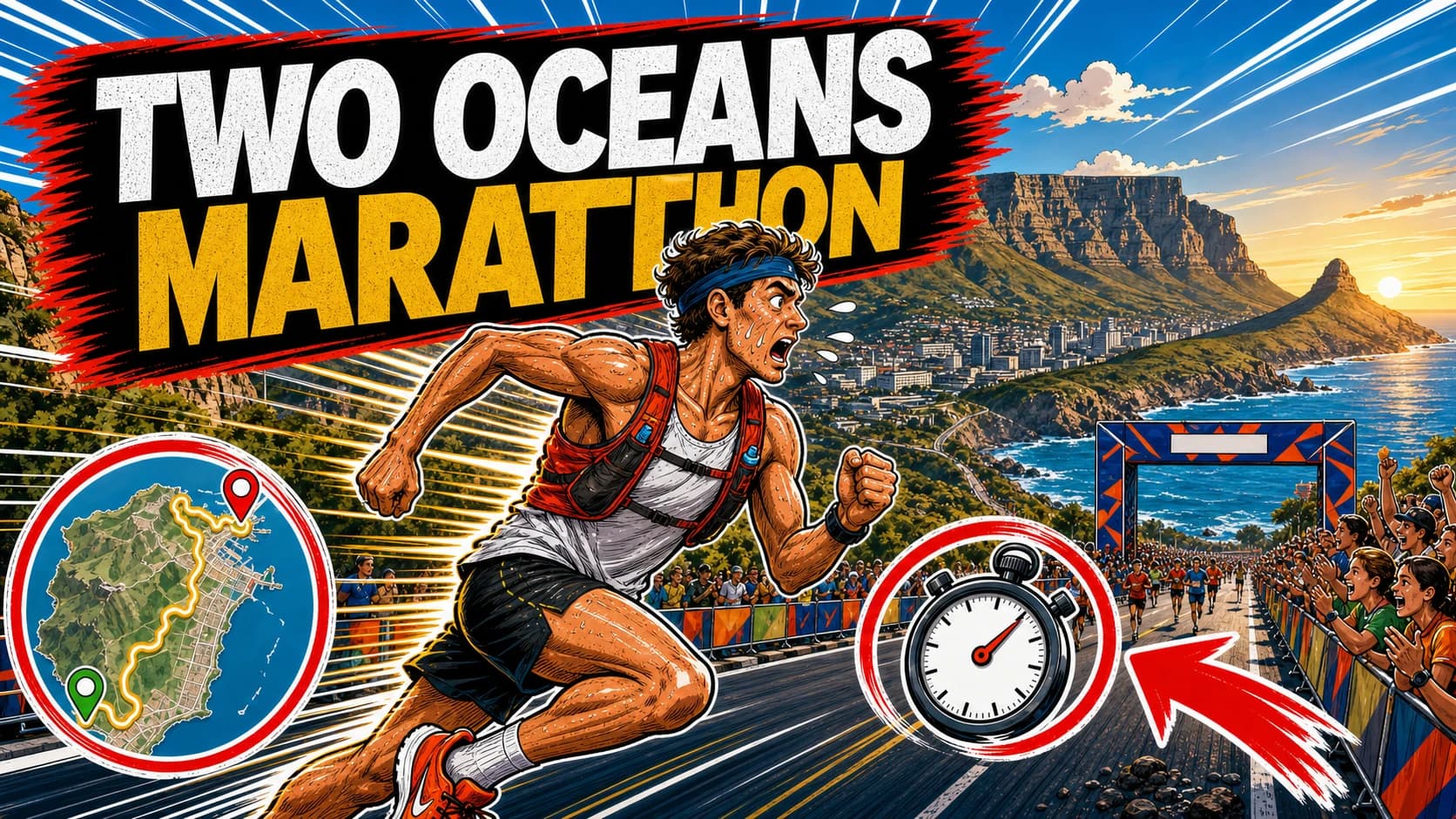
On Saturday, April 3, 2027, Easter weekend, Cape Town hosts one of the most iconic road ultras in the world: the Two Oceans Marathon. The "marathon" label is misleading — it's 56 km, not 42.2 — and that's just the first thing you need to understand before signing up. The two-oceans ultra runs between the Atlantic and the Indian, weaves along the legendary Chapman's Peak Drive with literal 200-meter cliffs dropping straight to the sea, and is decided on a hill called Constantia Nek — 4 km at 5–6% that lands when you already have 42 km in your legs. This guide covers what the official site never quite spells out: what the course actually feels like, where the race breaks, how to train 20 weeks for 56 km on rolling terrain, and how to put the trip together from Europe or Latin America.
| Item | Info |
|---|---|
| Date | Saturday, April 3, 2027 (Easter weekend) |
| Distance | 56.0 km (Ultra Marathon) — NOT a standard marathon |
| Elevation gain | ~600 m |
| City | Cape Town, South Africa |
| Start | Newlands Cricket Ground |
| Finish | UCT (University of Cape Town), Rondebosch |
| Start time | 6:30 am (Ultra 56K) — pre-dawn |
| Cutoff | 7 hours (closes 1:30 pm) |
| Organizer | Two Oceans Marathon NPC |
| Entry | twooceansmarathon.org.za |
The Two Oceans Marathon is the most prestigious road ultra in the southern hemisphere, organized annually since 1970 by Two Oceans Marathon NPC. The official distance is 56 km — not 42.2 — and it's always run on the Saturday of Easter weekend. It draws roughly 10,000 finishers in the 56K Ultra every year (plus thousands more in the 21.1 km half marathon and the Sunday short distances), receives between 30,000 and 35,000 international lottery applications and is officially marketed as "the world's most beautiful marathon" — a commercial tag stuck on in the 1980s that has survived even though it's technically an ultra, not a marathon.
Lead pack of the Ultra Marathon running Chapman's Peak Drive at sunrise, Atlantic on one side and cliffs on the other — the universal Two Oceans postcard.
Why is it called "marathon" if it's 56 km? Because the very first 1970 edition was conceived as an alternative to the classic marathon for South African runners who wanted something more demanding than 42.2 km but shorter than the 90 miles (87 km) of Comrades, the country's flagship ultra. The distance was set at 56 km — roughly 35 miles — and the word "marathon" stuck around for marketing and habit. Today, the race is one of the largest mass-participation road ultras in the world, alongside Comrades (also South Africa) and the Marathon des Sables (Morocco, multi-stage, a different beast).
The name Two Oceans comes from the route: the course skirts the Cape Peninsula between the Atlantic Ocean (west side, Chapman's Peak Drive, Hout Bay) and False Bay of the Indian Ocean (east side, Muizenberg, although False Bay is technically part of the Atlantic, locally it's considered the "Indian" side). The race never touches the actual Indian Ocean — the Cape of Good Hope physically separates the two oceans further south — but the scenic contrast between the two coasts justifies the name.
The Two Oceans 56K course is point-to-point (not a loop) starting at Newlands Cricket Ground in the Newlands suburb of Cape Town, running the eastern face of the Cape Peninsula down to Muizenberg, turning west across to the Atlantic, climbing Chapman's Peak Drive between km 25 and 30, dropping into Hout Bay, attacking the brutal Constantia Nek climb between km 42 and 46, and finishing on the campus of UCT (University of Cape Town) in Rondebosch. Total: 56.0 km · ~600 m elevation gain · 2 structural climbs (Chapman's Peak + Constantia Nek).
Official 3D map of the full Two Oceans 56K course, with Chapman's Peak Drive and Constantia Nek clearly marked.
The Ultra start is at 6:30 am, still in pre-dawn light (Cape Town in April sees sunrise around 6:50). The first 5 km are flat through the Newlands and Wynberg neighborhoods, threading tree-lined residential streets with Victorian houses. It's a deceptively easy stretch — the crowd is quiet, the air is cool (12–14 °C at the start) and the temptation to push is brutal. Don't take the bait. The Two Oceans tactical plan starts here: the more conservative you are in the first 20 km, the better you arrive at Constantia Nek.
Between km 5 and 15 the course gradually drops toward the False Bay coast, passing through Plumstead and heading to Muizenberg — Cape Town's iconic surf beach with its colorful bathing huts. Km 15 lands you essentially at sea level on Muizenberg's Main Road, with the ocean on your left and the Cape silhouette in the distance. This is the first "wow" moment of the race. There are still 41 km to go, but you already know why you came.
Between km 15 and 25 the course hugs the False Bay coast along the M4 heading north, passing St James, Kalk Bay (with its fishermen and art galleries) and Fish Hoek. The sun is now coming up hard and the temperature is rising — you go from 14 °C at the start to 18–20 °C before km 25. It's an exposed stretch, no shade, ocean and the coastal train line on one side and the Silvermine cliffs on the other. The asphalt is good and the profile mildly rolling — nothing extreme, but not flat. This is where, without realizing it, you can have spent 10–15% more glycogen than your budget allowed if you've given in to the temptation to "use the flat".
Here's the section all 10,000 runners came for. Between km 25 and km 30, the course enters Chapman's Peak Drive, a 9 km road carved into the cliff face between Noordhoek and Hout Bay, considered one of the most spectacular coastal roads in the world. Every corner gives you the Atlantic Ocean 200 meters below, waves breaking against black volcanic rocks, and Hout Bay's seal islands in the distance.
Runners on Chapman's Peak Drive with the Atlantic on the left and the cliffs on the right — the iconic Two Oceans image.
The Chapman's Peak mistake: many runners get carried away here. The scenery is so spectacular that they accelerate without meaning to. There are climbs and descents — Chapman's Peak isn't flat, it gains around 150 m of elevation across its 5 km of official course — but the cool ocean air and the visual adrenaline make pace pop 10–15 seconds per km without the watch warning you. Keep it under control. There are 26 km after Chapman's, and the last 14 include the toughest climb of the entire race.
At the end of Chapman's Peak Drive, the course plunges down to Hout Bay, a picturesque fishing harbor where the km 33 aid station sits — classic, with local crowds, music, kids holding cold sponges. Many runners give themselves permission to stop here for 60 seconds, sipping isotonic, eating banana. Do it. The next 10 km are the toughest of the race and you need fresh legs.
Out of Hout Bay, the course turns north along the M63 and starts climbing gently toward Constantia Nek pass — the saddle between the Hout Bay mountains and the Constantia valley. Between km 33 and km 42 there's a progressive, gentle climb, almost imperceptible at first. When you hit km 42 — the exact marathon mark — the course starts the real Constantia Nek climb: 4 kilometers at 5–6% average gradient, with stretches of 7–8% in the middle. You've already run 42 km and now you've got a 4 km hill in front of you.
Runners climbing Constantia Nek with suffering on their faces — the moment the ultra is decided.
This is where 70% of the field cracks. Not exaggerating. Constantia Nek lands right when easy glycogen is gone, legs are loaded with impact, and the midday sun (around 11:00–12:00 depending on your pace) hammers the southern face of the pass. Runners who went out faster than goal pace in the first 30 km arrive here in debt, and the 4 km climb buries them. You'll lose 3–8 minutes off plan in this section if you've managed it badly. If you've been conservative from km 1, you'll arrive on the edge but you'll arrive. The difference between "finishing Two Oceans" and "DNF at km 45" is decided between km 1 and 25 — not at Constantia Nek.
🚨 Where the race breaks
Cresting the Constantia Nek pass at km 46, the course plunges down Constantia Main Road into the Constantia valley — Cape Town's historic wine region. It's a technical descent with curves, on good asphalt but dropping 150 m in 5 km (3% average). Runners with fresh legs are still moving here; those who emptied themselves on Constantia Nek walk the first 2 km of the descent before resuming a jog.
Between km 51 and 56, the course points toward the UCT (University of Cape Town) campus through the suburbs of Bishopscourt, Newlands and Rondebosch. The last 3 km are flat but rolling, with massive crowds (families camped on front lawns, braais going, kids with hoses). You enter the UCT campus, cross Stadium Road and cross the finish line on the Victorian Sports Field of the campus — one of the most beautiful finishes in the world, with Table Mountain behind the line.
🎯 Three mental anchors for the final 10 km
Course data for Strava / Garmin: the organizer publishes the official GPX a few weeks out on their site. To recon Chapman's Peak Drive remotely, search Strava for the "Chapman's Peak Drive Climb" segment — that's exactly the profile you'll suffer on Saturday.
The Two Oceans Marathon has been run since 1970, making it one of the oldest road ultras in the southern hemisphere, alongside Comrades (South Africa, since 1921) and JFK 50 (USA, since 1963). The first edition had just 26 runners; by 1980 it was 1,000; in the 90s the 5,000 finisher mark was crossed, and since 2010 the race has held steady between 9,000 and 11,000 finishers per year in the 56K Ultra (plus around 16,000 in the Saturday half marathon and several thousand more in the Sunday short distances).
Winner of a recent edition crossing the finish line at UCT with Table Mountain behind — iconic image anchoring the roll of honor section.
Roll of honor and race data (recent editions):
| Item | Value |
|---|---|
| First edition | 1970 |
| Editions held | 56 (through 2026, including COVID interruptions 2020–21) |
| Current distances | Ultra 56K (Saturday) · Half marathon 21.1K (Saturday) · 10K + Fun runs (Sunday) |
| 56K Ultra finishers (recent editions) | ~10,000 |
| International lottery applications | ~30,000–35,000 |
| Men's elite record (56K) | 3:03:44 (Thompson Magawana, 🇿🇦 RSA, 1988) |
| Women's elite record (56K) | 3:26:54 (Gerda Steyn, 🇿🇦 RSA, 2024) |
Verified winners and times of the 5 most recent editions:
| Year | 🥇 Men | Country | Time | 🥇 Women | Country | Time |
|---|---|---|---|---|---|---|
| 2026 | Arthur Jantjies | 🇿🇦 RSA | 3:09:25 | Gerda Steyn | 🇿🇦 RSA | 3:27:43 |
| 2025 | Khoarahlane Seutloali | 🇱🇸 LES | 3:10:46 | Gerda Steyn | 🇿🇦 RSA | 3:29:09 |
| 2024 | Onalenna Khonkhobe | 🇿🇦 RSA | 3:09:30 | Gerda Steyn | 🇿🇦 RSA | 3:26:54 |
| 2023 | Givemore Mudzinganyama | 🇿🇼 ZIM | 3:09:42 | Gerda Steyn | 🇿🇦 RSA | 3:29:06 |
| 2022 | Edndale Belachew | 🇪🇹 ETH | 3:09:05 | Gerda Steyn | 🇿🇦 RSA | 3:29:42 |
Data verified against the public archive of Two Oceans Marathon (Wikipedia EN).
Note on the women's roll of honor: Gerda Steyn has won 5 consecutive editions (2022–2026) — she's the most dominant runner in recent Two Oceans history. Her 2024 record (3:26:54) is the absolute women's mark of the race and one of the fastest 56 km ultra times ever recorded in the world.
Entry to the Two Oceans Marathon Ultra 56K is a lottery (random draw) — not first-come-first-served. Each year the organizer receives between 30,000 and 35,000 applications for roughly 11,000 spots in the Ultra, giving an acceptance rate of ~30–35% through the general route. Good news for European and Latin American readers: there's a guaranteed entry route for international runners that pays a surcharge and skips the lottery entirely.
Aerial view of the field leaving Newlands Cricket Ground at sunrise — reinforcing the message of mass scale and aspiration.
2027 lottery calendar (reference, confirm on the official site):
| Entry type | Price (ZAR) | EUR equivalent | USD equivalent |
|---|---|---|---|
| 🟢 General lottery (South Africans + internationals) | R 1,200 | €60–65 | $65–70 |
| 🟡 International Entry (guaranteed) | R 2,400 | €120–130 | $130–140 |
| 🔴 Charity Bond (via charity organization) | R 3,500–6,000 | €175–300 | $190–325 |
| Half marathon 21.1K (Saturday) | R 600 | €30–35 | $32–38 |
Indicative pricing based on the 2026 edition. The South African rand fluctuates — as of May 2026, R 1 ≈ €0.05 ≈ $0.055. Always confirm on the official entry site — amounts and tiers update there.
| Included in the price | NOT included (optional extra) |
|---|---|
| ✅ Bib with timing chip | ❌ Official technical race shirt (~R 350, ~€18) |
| ✅ Finisher medal (iconic, one per year) | ❌ Official professional photo (~R 250 basic package) |
| ✅ On-course aid stations (every ~3 km) | ❌ Friday-night pasta party (R 350) |
| ✅ Post-finish bag (fruit, biltong, isotonic) | ❌ Bag drop service (R 50) |
| ✅ Access to physio / massage at finish | ❌ Flights + lodging (obvious, all separate) |
| ✅ Digital diploma with certified time | ❌ South Africa visa (free for EU/UK/USA up to 90 days) |
Things to keep in mind beyond the bib price:
Family and runners at the official expo (Cape Town International Convention Centre - CTICC), with stands or the bib pickup counter visible.
Bib pickup happens at the Two Oceans Marathon Expo at the CTICC (Cape Town International Convention Centre), normally held Wednesday to Friday pre-race. Bibs are not handed out on race day: you have to pick yours up in person before the expo closes Friday at 7 pm.
You'll need:
Family and friends can pick up for you with signed authorization and a copy of your passport. The race kit normally includes the official bag, the bib with chip, the bag drop tags, the course map, a printed race programme and aid station coupons. Finisher medals are handed out in the post-finish zone after crossing the line — they're iconic, change design every year and are one of the most collected running trophies in the world.
The most practical way to get to Cape Town for Two Oceans is by air: Cape Town International Airport (CPT) is 20 minutes by car from downtown and 25 minutes from Newlands Cricket Ground. There are direct flights from London (Heathrow, Gatwick), Frankfurt, Doha, Dubai, Istanbul, Buenos Aires and São Paulo — from Madrid or Barcelona it's a connection (typically Doha with Qatar Airways or Istanbul with Turkish, 14–17 h total).
Aerial view of Cape Town with Table Mountain in the background from the plane — the first postcard of the trip.
When to book: target May–July 2026 for April 2027 flights. The optimal price window is 8–10 months out. From November 2026 prices climb 20–30%.
At 5 am on Saturday, Cape Town public transport is essentially shut down. MyCiTi buses run very low frequency at that hour, and the suburban train (which passes through Newlands) is unsafe at night by local consensus — not recommended. The organizer runs free official buses from downtown Cape Town (V&A Waterfront, CBD) to Newlands Cricket Ground, departures from 4:30 am to 5:30 am. That's the safest option.
The three real options:
Parking. Cape Town isn't Madrid; there's free street parking in many areas, but on race Saturday all of Newlands is closed to traffic from 3 am. If you drive, arrive before 5 am or park in Claremont (1.5 km south) and walk. For the UCT finish, there's parking on campus but it fills early — better to use Uber.
For a Two Oceans runner, staying within 20 minutes by car of Newlands Cricket Ground is basic logistics. The Ultra start is 6:30 am — that means waking at 4:30, breakfast at 5:00 and leaving the hotel by 5:30 at the latest. The difference between sleeping at V&A Waterfront (15 min on the official bus) and sleeping at Camps Bay (40 min by car with race traffic) can buy you 90 extra minutes of pre-race sleep.
Panoramic view of V&A Waterfront with Table Mountain behind — the most popular hotel zone for international runners at Two Oceans.
| Hotel | Cat. | €/night* | To start | Runner highlight |
|---|---|---|---|---|
| One&Only Cape Town | 5* L | €450–650 | 9 km · 18 min bus | Spa, massage, bathtub, late check-out |
| The Westin Cape Town | 5* | €200–300 | 8 km · 15 min bus | 24h gym, early breakfast |
| Table Bay Hotel (V&A) | 5* | €280–400 | 9 km · 18 min bus | Table Mountain view, strong AC |
| The Silo Hotel | 5* L boutique | €600–900 | 9 km · 18 min bus | Luxury, bathtub, 360° view |
| Protea Hotel Fire & Ice (CBD) | 4* | €130–180 | 7 km · 14 min bus | Modern, mid-range, runner-friendly |
| Hotel | Cat. | €/night* | To start | Runner highlight |
|---|---|---|---|---|
| Vineyard Hotel (Newlands) | 5* | €200–280 | 0.8 km · 10 min walk | The most practical hotel for Two Oceans |
| Cellars-Hohenort (Constantia) | 5* | €250–350 | 4 km · 7 min car | Gardens, spa, fine dining |
| Steenberg Hotel (Constantia) | 5* | €280–400 | 5 km · 10 min car | On-site winery, gourmet |
| The Andros Boutique Hotel (Claremont) | 4* | €110–150 | 2 km · 5 min car | Nearby boutique, mid-range |
| Protea Hotel Wynberg | 4* | €100–140 | 3 km · 7 min car | Functional, affordable |
| Hotel | Cat. | €/night* | To start | Runner highlight |
|---|---|---|---|---|
| Twelve Apostles Hotel | 5* L | €350–550 | 14 km · 30 min car | Spa, 360° view, post-race recovery |
| Bay Hotel Cape Town | 5* | €250–380 | 13 km · 28 min car | On Camps Bay beach |
| The Bantry Bay (Sea Point) | 4* | €150–220 | 12 km · 25 min car | Atlantic view, mid-range |
| Winchester Mansions (Sea Point) | 4* | €130–190 | 12 km · 25 min car | Victorian charm, Sunday jazz brunch |
| Atlantic Affair Boutique Hotel | 4* | €110–160 | 13 km · 28 min car | Small boutique, mid-range |
*Indicative race-weekend rate (first weekend of April, Easter 2027). Varies with booking lead time, availability and current promotions. Book 6+ months out: Cape Town is in peak season and prices climb 30–40%.
The weather in Cape Town in early April averages 12 °C low and 22 °C high with sunny conditions about 75% of days, per historical South African Weather Service data. It's southern autumn — local summer ends in late March and winter starts in May/June, so April is transition. Rain is occasional (one day with precipitation every 4 editions), but the factor that does vary year to year is the wind — the famous "Cape Doctor", a southeasterly gale that blows periodically and can reach 40–60 km/h in exposed areas (Chapman's Peak Drive is the worst).
Finishers from a recent edition with their medals on a sunny day with Table Mountain behind — the typical pattern of early-April race weekend in Cape Town.
The variable to watch is wind, not heat. For a 56K ultra starting at 6:30 and finishing between 11:30 (elite) and 13:30 (cutoff), the typical thermal range is 12 °C at the start → 18–22 °C at Constantia Nek (km 42–46) → 20–24 °C at the UCT finish at 13:00. It's not extreme heat — but the southern sun is more intense than European, especially at UV levels, and the combo of 8 hours on your feet + strong sun + Cape Doctor wind can dehydrate you much faster than the thermometer suggests.
Plan by forecast:
The Cape Doctor on Chapman's Peak Drive is the worst-case scenario. In 2023 there were 65 km/h gusts on Chapman's Peak, and runners reported it was hard to hold a straight line, with light runners literally pushed out of their lane by the wind. The organizer doesn't suspend for wind — you race in whatever lands. Bring a light short-sleeve layer or body-fitted singlet so you don't act as a sail on Chapman's Peak.
Carry your own water if you're going for more than 5 hours. Aid stations (every 3 km after km 15) are generous but very busy — the back of the field arrives at the final stations with low stocks in hot years.
The recommended plan to prepare for the Two Oceans Marathon Ultra 56K is a 20-week block (not 16 like a marathon) with peak volume in weeks 14–16 (between 60 km and 140+ km weekly depending on goal), two long runs per month (not weekly) and a three-week taper. The key for Two Oceans: train rolling terrain and at least three long runs of 40–50 km to teach the legs the real volume of 56K before race day.
Runner training on hills or on a long climb — aspirational image anchoring the 20-week plan.
Approach Two Oceans as an ultra with a budget of ~600 m of elevation and 56 km of impact on the legs, not as a long marathon. Pick your goal and follow the table — these are peak volumes (weeks 14–16), not averages of the full cycle.
| Goal | Average pace (min/km) | Peak weekly vol. | Peak long run |
|---|---|---|---|
| 7h00 (cutoff) | 7:30 min/km | 40–55 km | 32–35 km |
| 6h00 | 6:25 min/km | 55–70 km | 38–42 km |
| 5h30 | 5:53 min/km | 65–80 km | 40–44 km |
| 5h00 | 5:21 min/km | 75–95 km | 42–48 km |
| 4h30 | 4:49 min/km | 90–110 km | 45–50 km |
| 4h00 | 4:17 min/km | 110–130 km | 48–50 km |
| ≤3h30 | 3:45 min/km | 130–160+ km | 50 km |
How to read the table and structure the cycle:
Four sessions worth gold for Two Oceans:
The taper is three weeks, not two. Week 18 at 75%, week 19 at 55%, week 20 at 35% holding race pace in short pickups. The final two peak long runs (weeks 15 and 17) are what fill the cup.
Unlike the marathon, in an ultra quad + soleus + glute medius strength is critical — those are the muscles that hold up the 4 km climb at km 42–46 when you're already in debt. Two strength sessions per week during the block (weeks 1–17, rest in taper):
Don't know what realistic goal time you have for Two Oceans? Cross your best recent marathon with the "Two Oceans" factor (which adds 14 km extra + the Constantia Nek elevation):
| Your best recent marathon | Flat 56K equivalent | Realistic Two Oceans |
|---|---|---|
| 2:45 | sub-3:45 | 3:50–4:05 |
| 3:00 | sub-4:05 | 4:10–4:30 |
| 3:15 | sub-4:25 | 4:30–4:50 |
| 3:30 | sub-4:45 | 4:50–5:10 |
| 3:45 | sub-5:05 | 5:10–5:35 |
| 4:00 | sub-5:25 | 5:30–6:00 |
| 4:30 | sub-6:05 | 6:10–6:40 |
| 5:00 | sub-6:45 | 6:45–7:00 (cutoff risk) |
How to read it: the "flat" column is the unadjusted Riegel conversion (your marathon × ~1.36 to reach 56K). Two Oceans loses an additional 5–8% to the accumulated elevation and the Cape Peninsula's combined altitude — that gives you the realistic range. If your marathon is 5:00 or slower, you face serious cutoff risk (7h). Consider targeting the 21.1K half marathon until you bring your marathon down to 4:30 or less.
Once you have your goal time, this calculator gives you the required average pace (in min/km and min/mi) and the cumulative splits at 10K, 20K, half marathon, 30K, 42K (marathon) and 56K finish. Change the goal time in the field below and the table updates instantly:
| Punto | Tiempo acumulado | Parcial |
|---|---|---|
| 5 km | 26:47 | 26:47 |
| 10 km | 53:34 | 26:47 |
| 15 km | 1:20:21 | 26:47 |
| Media (21,1 km) | 1:53:01 | 32:40 |
| 30 km | 2:40:43 | 47:42 |
| Meta | 5:00:00 | 2:19:17 |
Splits asumen ritmo constante. En carreras con desnivel real (Two Oceans Marathon) — banca 5–8 s/km en bajadas y pierde el mismo margen en subidas; el ritmo medio se mantiene.
The calculator above gives you the pace. But a real race plan answers more questions: what strategy do I start with? how many gels do I carry? when do I add caffeine? what do I do if at km 25 I'm 60 seconds off pace? how do I manage Constantia Nek if I arrive in debt?
Configure your goal, strategy and fueling plan. The planner generates a personalized plan by segment (with paces, HR zones, mental cues and minute-by-minute fueling), a race-morning checklist, and a Plan B for race-day surprises (heat, Cape Doctor wind, stomach issues on Chapman's Peak). Download it as PDF to bring on race day.
PDF A4, optimizado para imprimir y llevar el día de carrera.
You arrive at the Newlands Cricket Ground corral at 6:00 Saturday morning. You've done the 20-week plan. What separates good training from a good Two Oceans time is what you do over the next 5–7 hours — and especially what you do in the first 25 km, where most break the race without knowing it.
The Two Oceans race plan must combine very conservative pacing in km 1–25 (Newlands → Muizenberg → False Bay), goal pace between km 25–42 (including Chapman's Peak Drive), and defensive management from km 42 to 56 (Constantia Nek + descent + finish) depending on how you arrive at the climb. Each goal time (sub-3:30 to the 7:00 cutoff) has a specific split pattern.
| Goal | Average pace | Two Oceans-specific tactical note |
|---|---|---|
| sub-3:30 (elite) | 3:45 min/km | You're fighting for the podium. Cool head on Chapman's Peak. Constantia Nek at 4:15/km — you lose 30 s/km, you take it back on the descent. |
| sub-4:00 | 4:17 min/km | Sub-elite. Cross km 25 at 1:48; cross km 42 at 3:00. Constantia Nek at 4:50/km. Descent at 4:00/km. |
| sub-4:30 | 4:49 min/km | Cross km 25 at 2:00; km 42 at 3:23. Constantia Nek at 5:30/km — walk 30 s at every aid station on the climb. |
| sub-5:00 | 5:21 min/km | The goal of the majority. Cross km 25 at 2:14; km 42 at 3:45. Constantia Nek 6:00/km. Plan B walk-run from km 42. |
| sub-5:30 | 5:53 min/km | Cross km 25 at 2:27; km 42 at 4:08. Walk the entire Constantia Nek climb if you need to. Recover on the descent. |
| sub-6:00 | 6:25 min/km | Cross km 25 at 2:40; km 42 at 4:30. Walk-run from km 30. Watch the cutoff. |
| sub-7:00 (cutoff) | 7:30 min/km | Cross km 25 at 3:08; km 42 at 5:15. Your margin is tight — only walk at aid stations, not between them. |
| Finish | 7:00–7:30 | No watch. Enjoy Chapman's Peak, suffer Constantia Nek, get to UCT. The medal doesn't tell times apart. |
Section 1 — Km 1 to 15 (Newlands → Muizenberg): pure conservative
The easiest section to misread. It's flat, cool, with thin crowds — the temptation to let it run is brutal. Don't. Go 5–10 seconds per km slower than your goal pace. This adds up to minutes that look like you're losing, but you're not — you'll get them back with interest in km 30–40, and especially at Constantia Nek where the difference between "running up at 5:30/km" and "walking at 8:00/km" is decided here, in the first 15 km.
Section 2 — Km 15 to 25 (False Bay → Noordhoek): cruise
Goal pace at a heart rate you can hold while talking in short sentences. Drink at every aid station (every 3 km from here on), gel at km 18 and another at km 24. The sun is up — cap mandatory, salt every 60 min, isotonic at every station. Don't stare at the scenery too much — Chapman's Peak comes soon and you need your head focused on pace.
Section 3 — Km 25 to 42 (Chapman's Peak Drive → Hout Bay → into Constantia Nek): controlled in spectacular scenery
Here Two Oceans turns into what you came for. Chapman's Peak is climb + descent in a serpentine, incredible scenery, possible wind. Don't accelerate on emotion — hold goal pace. Hout Bay (km 33) is the key aid station — stop for 60 seconds, drink isotonic, eat banana and biltong (local dried meat snack), continue. Between km 33 and km 42 there's a gentle progressive climb toward Constantia Nek — start to manage muscular load: if your legs feel heavy, walk 30 s at every aid station to decompress them.
Section 4 — Km 42 to 56 (Constantia Nek + descent + UCT): pure defense
Constantia Nek (km 42–46): accept losing 60–90 seconds per km off your average. Walk at the km 44 and km 46 aid stations if you need to. Hold the effort (not the pace) — heart rate zone 4, not zone 5. Technical descent km 46–51: if your legs hold up, accelerate slightly (5 s/km below average pace); if you emptied yourself on the climb, descend relaxed, don't force. Km 51–56: rolling, massive crowds, you hear UCT from km 53. Finish with the head, not the heart. The UCT finish sits in a garden with Table Mountain behind — enjoy it. Cross the line, stop the watch, hugs, photo, medal.
This is where the ultra is decided. Three anchors:
The nutrition strategy for Two Oceans pivots on 70–80 g of carbs per hour (more than a standard marathon) depending on goal, with 6–8 gels spread every 30–35 minutes from km 9. Carb loading the 3 days before should hit 8–10 g/kg/day (raised to 10–12 g/kg on Friday), and Friday's dinner should be light and familiar (pasta or rice). Extra sodium mandatory if the forecast tops 22 °C (in Cape Town in April, almost certain).
Volunteer at the key Hout Bay aid station (km 33) handing out isotonic + biltong + banana.
Friday dinner is light, familiar and early (eat before 8 pm). Pasta or white rice with grilled chicken or fish, bread, fruit. Zero experiments with South African curry or biltong the night before — save those tastings for after the race.
Race-morning breakfast depends on whether you wake up hungry. The safe bet: oatmeal with banana + honey + orange juice or toast with jam + banana + coffee (if you take it routinely). 120–150 g of carbs (more than for marathon), eaten 2 hours before the gun (at 4:30 if the start is 6:30). If your stomach shuts down with nerves, swap for a sports drink with 100 g of carbs dissolved in 500 ml.
What the organizer puts on course:
Carb plan by goal:
| Goal | Carbs / hour | Gels to carry | When to take them |
|---|---|---|---|
| 7h00 | 50–60 g/h | 5 gels | km 9, 21, 30, 42, 46 |
| 6h00 | 60–70 g/h | 6 gels | km 9, 18, 27, 36, 42, 48 |
| 5h00 | 70–80 g/h | 7 gels + drink | km 9, 18, 24, 30, 36, 42, 48 |
| 4h30 | 75–85 g/h | 7–8 gels + drink | km 9, 16, 22, 28, 34, 40, 46, 52 |
| 4h00 | 80–90 g/h | 8 gels + drink | km 6, 12, 18, 24, 30, 36, 42, 48 |
| ≤3h30 | 85–95 g/h | 8 gels + isotonic flask | km 5, every 6 km after |
Three mistakes you see every year at Two Oceans:
Hydration and sodium by forecast:
Post-finish recovery — the first hour matters more than in a marathon:
The best shoes for the Two Oceans Marathon Ultra 56K are protective super-trainers with plate or abundant cushion — Saucony Endorphin Speed, Hoka Mach X, Puma Deviate Nitro Elite, ASICS Magic Speed for sub-4:30, and ultra-protective daily trainers (Hoka Bondi, Nike Vomero, ASICS Cumulus, Brooks Glycerin) for over 4:30. Pure "race" carbon plates (Vaporfly, Adios Pro Evo) are NOT recommended for 56K — the rigid plate hammers quads after km 35 and you arrive at Constantia Nek with destroyed legs. The critical thing isn't the brand but that they're already broken in over a minimum of 2 long runs of 35+ km and don't exceed 300–400 km of use.
Close-up of ultra shoes on the Newlands Cricket Ground start line — several brands visible.
Unlike the marathon, in an ultra muscular endurance outweighs weight. An ultralight carbon plate can save you 4% of energy but leaves quads hammered from km 35 onward. For non-elite runners, a protective super-trainer (Saucony Endorphin Speed, Hoka Mach X, ASICS Magic Speed) or an ultra-protective daily trainer is clearly better than the lightweight carbon option.
Recommendations by goal:
| Goal | Category | Common models |
|---|---|---|
| ≤3h30 (elite) | Protective carbon plate | Nike Vaporfly 4 · adidas Adios Pro 4 · ASICS Metaspeed Sky |
| 3h30–4h30 | Super-trainer with plate or dense EVA | Saucony Endorphin Speed · Hoka Mach X · Puma Deviate Nitro Elite |
| 4h30–5h30 | Protective super-trainer | Hoka Mach 6 · ASICS Magic Speed · Saucony Endorphin Pro 4 |
| 5h30+ | Ultra-protective daily trainer | Hoka Bondi · Nike Vomero · ASICS Cumulus / Nimbus · Brooks Glycerin |
Look at this before leaving home:
It's an ultra. Although it's called "Two Oceans Marathon" for historical reasons (the race was conceived in 1970 as an alternative to the classic marathon), the official distance is 56 km, not 42.2. In world running, anything beyond standard marathon (42.195 km) is considered an ultra, so technically Two Oceans is a 56 km road ultra. There's also a 21.1 km half marathon run on the same Saturday — that one is a standard half.
For an experienced marathoner, it's hard but accessible. The distance (56K) is 14 km longer than a marathon — that's already 1.5–2 extra hours of running. The elevation (~600 m) is moderate but concentrated in two climbs (Chapman's Peak km 25–30 and Constantia Nek km 42–46), and the latter lands when you're already tired. The decisive factor is pace management in the first 25 km — not the course itself. If your marathon is 4:00 or less, you have margin to finish Two Oceans in 5:30–6:00. If your marathon is 5:00, you're at serious cutoff risk (7h).
Yes. The official cutoff is 7 hours from the start gun (6:30 → close 13:30). It's generous for a 56K ultra — equivalent to 7:30 min/km on average — but don't get cocky: walking the entire course with no time goal is a mistake. The organizer also enforces intermediate cutoffs at km 21, 35 and 45, where you have to pass before a set time or you're pulled. Confirm intermediate cutoffs on the official site the month before.
The lottery opens in September 2026, closes late October. Each year they get 30,000–35,000 applications for ~11,000 spots in the Ultra, giving a 30–35% acceptance rate via the general route. Internationals have a parallel "International Entry" route with guaranteed entry by paying a surcharge (R 2,400 vs R 1,200, roughly double). If you're willing to pay the extra, you save the uncertainty and can plan flights + hotel early. For European/Latin American internationals, this is the most recommended route.
Cape Town is safe in tourist zones (V&A Waterfront, CBD, Camps Bay, Sea Point, Constantia, Newlands, Hout Bay) day and night. South Africa's safety problems are real but highly concentrated in zones you won't visit as a tourist (townships, industrial areas, certain Johannesburg neighborhoods). Basic rules: don't walk alone in dark areas at night, always use Uber at night, don't flash jewelry/phones, don't accept rides from non-Uber/Bolt taxis. On race Saturday, the Newlands → UCT zone is locked down with police and volunteers — it's one of the safest areas of Cape Town for 8 hours.
Minimum 1 marathon in the legs in the last 12 months + 20 weeks of specific plan. If your last marathon is 4:30 or less, you're set to target 5:30–6:00 at Two Oceans. If it's 5:00, target "finish under 7h" with a walk-run plan from km 30. Don't debut at ultra in Two Oceans without having run at least one full marathon — skipping that progression is the recipe for DNF at Constantia Nek. The ideal plan: marathon in autumn 2026 (October/November) → 20-week ultra block → Two Oceans April 2027.
No, in the sense of "fast time". The course has 600 m of elevation and two structural climbs — that costs you 5–8 minutes vs a flat 56K ultra (of which there are barely any in the world). The absolute men's record is 3:03:44 (Magawana, 1988) and only 5–10 athletes per year break 3:30. Yes it's good for "your first 56K" or "your best 56K in top scenery" — but if you're chasing absolute time, there are flat 50–60K ultras in Europe (Tarawera New Zealand, Comrades down-run, Bjäre) that are faster.
Comrades Marathon is the other big South African ultra — 87 km between Pietermaritzburg and Durban (KwaZulu-Natal), not Cape Town. Comrades is longer (87K vs 56K), tougher (1,500 m of elevation), older (1921 vs 1970) and falls in June (8 weeks after Two Oceans). Many people run the Two Oceans → Comrades double the same year — it's the classic South African ultra season. If you're starting out, Two Oceans first; Comrades later. Comrades is the "Ironman" of world road ultras; Two Oceans is the most beautiful introduction.
For sub-4:00, protective carbon plate (Vaporfly 4, Adios Pro 4, Metaspeed Sky). For 4:00–5:00, super-trainer with plate (Endorphin Speed, Mach X, Magic Speed). For 5:00–6:00, protective super-trainer or premium daily trainer (Hoka Bondi, Vomero, Cumulus). For 6:00+, ultra-protective daily trainer with abundant cushion. The most critical isn't the brand but that they're broken in (min. 2 long runs) and don't exceed 300–400 km of use. Pure "race" carbon plates (Vaporfly Next%, Alphafly) are too aggressive for 56K except for elite.
Yes, perfectly. The recommendation: travel Monday/Tuesday pre-race to Cape Town (3–4 days to acclimate, pick up the bib, light training + tourism), race Saturday, rest Sunday–Tuesday in Cape Town (recovery + V&A Waterfront, Table Mountain by cable car, Robben Island, Constantia wine tour), and then extend 4–7 days through the rest of the country: Garden Route (Cape Town → Knysna → Port Elizabeth) by car + safari at Kruger Park (flight from Johannesburg). Total: 12–14 days of trip including the race. One of the best running + tourism combinations on the world calendar.
Two Oceans Marathon is the best road ultra in the world for scenery, but it isn't the only option for runners who want to combine long distance with spectacular landscape. If you're after pure classic road ultra with a record history, Comrades is the answer; if you want scenic at shorter distance, there are spectacular marathons like Big Sur or the Petra Marathon.
Each race has its profile — the choice depends on distance, geography and what you want:
| Race | Distance | Month | Country | Best for | Scenery |
|---|---|---|---|---|---|
| Two Oceans (this guide) | 56 km | April | 🇿🇦 South Africa | First ultra · scenic | ⭐⭐⭐⭐⭐ |
| Comrades Marathon | 87 km | June | 🇿🇦 South Africa | Classic ultra · history | ⭐⭐⭐⭐ |
| Marathon des Sables | 250 km (6 stages) | April | 🇲🇦 Morocco | Desert ultra · multi-stage | ⭐⭐⭐⭐⭐ |
| Western States 100 | 161 km (trail) | June | 🇺🇸 USA | World trail ultra | ⭐⭐⭐⭐⭐ |
| UTMB | 171 km (trail) | August | 🇫🇷🇮🇹🇨🇭 Alps | World trail ultra | ⭐⭐⭐⭐⭐ |
| Big Sur Marathon | 42.2 km | April | 🇺🇸 USA (CA) | Coastal scenic marathon | ⭐⭐⭐⭐⭐ |
| Petra Marathon | 42.2 km | September | 🇯🇴 Jordan | Historic/desert marathon | ⭐⭐⭐⭐⭐ |
| Bjäre Ultra | 100 km | October | 🇸🇪 Sweden | Flat road ultra · PB | ⭐⭐⭐ |
The trail races (UTMB, Western States) are technically a different beast from Two Oceans (road) — they're included for context for the runner who wants to complete the world ultrarunning "Big 5".
Did this guide help? If you're running Two Oceans 2027, save the event in SportPlan to get lottery-opening alerts, expo reminders and, afterwards, log your result.
Segueix planificant
Fes servir SportPlan per comparar dates, guardar esdeveniments objectiu i muntar una temporada que encaixi amb els teus caps de setmana.