
Absa Cape Epic 2026: route, results and race guide
Complete guide to the 2026 Absa Cape Epic: 707 km and 15,900 m of climbing over eight days, with route, results, rules and historical entry fees.
By Ramon Curto · Last updated: 2026-05-08
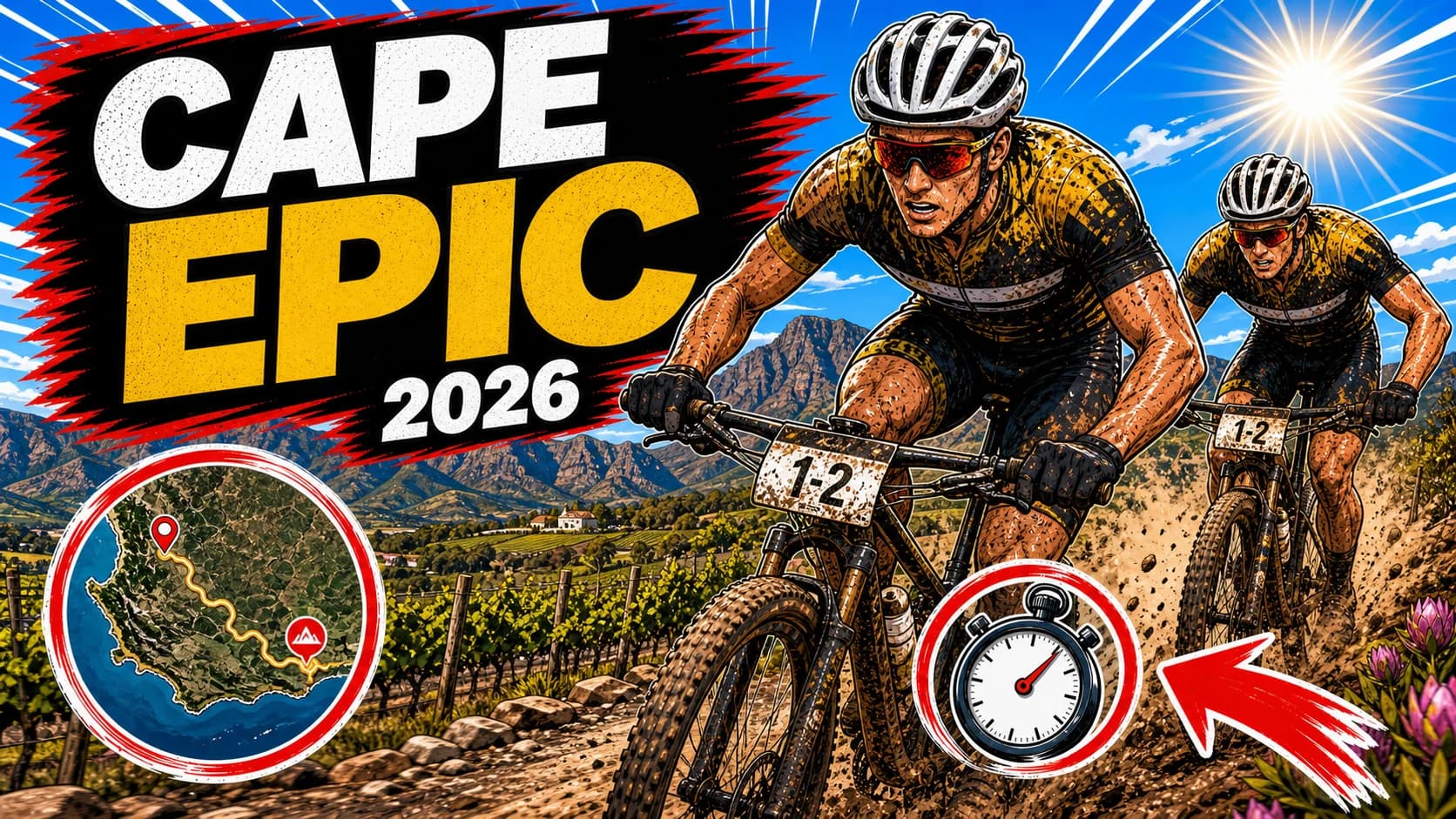
The Absa Cape Epic is an eight-day mountain-bike stage race in South Africa's Western Cape. The 2026 edition ran from 15 to 22 March, with a Prologue followed by seven stages. The general route totalled 707 kilometres and 15,900 metres of climbing. Its UCI classification is SHC, or Stage Hors Class, with XCM competition for Elite Men and Elite Women.
The two-rider team format shapes every part of the event. Partners must stay close while racing, so pacing, food, fluid and mechanical problems are managed together. A compatible pair that can communicate under pressure is more useful than two strong individual performances that cannot be coordinated.
This guide reviews the confirmed 2026 route, results, rules and prices. Entry status, fees and included services are historical facts about that edition, not an offer for a future race. Always check the organiser's current information before making a booking or training decision.
| Item | 2026 information |
|---|---|
| Dates | 15–22 March 2026 |
| Format | Teams of two riders |
| Structure | Prologue + Stages 1–7 |
| General-route distance | 707 km |
| General-route climbing | 15,900 m |
| Region | Western Cape, South Africa |
| UCI classification | SHC / Stage Hors Class; Elite Men and Elite Women XCM |
| Minimum age | 19 by 31 December of the race year |
| Age category | Determined by the younger team member |
Partners may not be more than two minutes apart. The gap is checked at starts, finishes and course checkpoints. That requirement should be rehearsed in joint training and reflected in the team's pacing plan.
Every figure below belongs to the general 2026 course. Maps and profiles are available on the official route page.
| Part | Date | Route | Distance | Climbing |
|---|---|---|---|---|
| Prologue | 15 March | Meerendal Wine Estate loop | 20 km | 650 m |
| Stage 1 | 16 March | Montagu loop | 90 km | 2,150 m |
| Stage 2 | 17 March | Montagu loop | 102 km | 2,250 m |
| Stage 3 | 18 March | Montagu to Greyton | 140 km | 1,750 m |
| Stage 4 | 19 March | Greyton loop | 87 km | 1,750 m |
| Stage 5 | 20 March | Greyton to Stellenbosch | 134 km | 2,750 m |
| Stage 6 | 21 March | Stellenbosch loop | 76 km | 2,450 m |
| Stage 7 | 22 March | Stellenbosch loop | 58 km | 2,150 m |
Stage 3 was the longest day at 140 kilometres. Stage 5 had the most climbing and transferred the race from Greyton to Stellenbosch. The Prologue counted towards the overall classification rather than serving as a ceremonial opener.
For Stage 1, the start moved to 06:30 and cut-off times were revised because of the heat. This is a historical example, not a forecast for another edition. It shows why riders must follow official app notices and briefings until each start.
Elite Women raced a dedicated 2026 course totalling 545 kilometres and 13,250 metres of climbing. The Prologue and Stage 7 matched the general course. On Stages 1–6, the category started from separate points and covered shorter distances in pursuit of equal racing time.
This arrangement applied only to Elite Women. It did not apply to other women's categories or the Mixed category. Route comparisons and results therefore need the correct category context: 545 kilometres for Elite Women cannot be substituted for the 707-kilometre general total.
The February 2026 rules (PDF) set out team duties and what happens when an individual rider misses a cut-off.
- Two-minute rule: partners must remain within two minutes of each other throughout the race, with checks at starts, finishes and intermediate points.
- No outside assistance: help from third parties is prohibited. Each rider is responsible for carrying or obtaining their own water and nutrition on course within the rules.
- GPS files: uploading or distributing the race route without authorisation is prohibited.
- Cut-offs: every stage has a time limit that the organiser may adjust for conditions. Updated app notices and briefings take precedence.
- First OTL: after a rider's first over-time-limit result, that rider becomes a Blue Board Rider. They may be allowed to continue but are no longer an official finisher.
- Second OTL: after a second over-time-limit result, that rider may not continue. The remaining partner follows separate conditions; one rider's first OTL does not automatically remove the whole team.
- Bike and bars: riders need a race-ready mountain bike with standard MTB handlebars. Road or gravel drop bars and aerodynamic extensions are not allowed.
The official entry page listed the following 2026 fees. Each amount covered a two-person team, not one rider.
| 2026 team type | Historical fee per team |
|---|---|
| South African team | ZAR 119,950 |
| International team | ZAR 157,000 |
The 2026 lottery closed and the edition sold out. Its standard package included seven nights of race-village tent accommodation. That does not guarantee the same price, allocation method or package in a later year. Prospective riders should verify the current entry page before paying for travel or related services.
A useful budget includes the entry, international travel, bike carriage, insurance, pre- or post-race accommodation, local transport, maintenance and contingency. Currency conversion and airline fees can change, so record which costs are confirmed and which are estimates.
An international Cape Epic trip has several dependencies. Confirm entry eligibility and team plans before committing to non-refundable travel. Check passport and entry requirements with the relevant authorities for the passport you will actually use; general advice for another nationality is not enough.
Airline bicycle policies vary by carrier, route and fare. Check size, weight, packaging, advance-notice and connection rules directly with the airline, then reconfirm close to departure. Photograph the packed bike and carry critical personal items separately where possible.
For 2026, seven race-village tent nights were included in the standard entry. Riders still had to plan accommodation outside that window. Future editions may package the event differently, so use the current organiser materials rather than treating the historical inclusion as permanent.
The route combined long climbs, rough surfaces, technical sections and repeated days of fatigue. Equipment should be chosen for reliability, control and a fit the rider has already tested. A race-ready MTB and conventional MTB bars are mandatory under the 2026 rules.
Build the repair kit around faults the team can diagnose and fix without prohibited outside help. Both partners should know where shared tools are stored and how to respond to punctures, chain problems and loose components. A pre-race service is useful, but it does not replace riding the final setup before travel.
Conditions can change by location and stage. Use recent official forecasts and organiser instructions for clothing and fluid planning. Do not rely on a generic idea of March weather in the Western Cape.
Preparation needs to address endurance, climbing, descending, technical control, recovery and team decision-making. The correct workload depends on current fitness, injury history, available time and experience; a fixed internet plan cannot safely replace individual assessment.
Progressive back-to-back riding can reveal how pacing and equipment choices behave under accumulated fatigue. Joint sessions should also rehearse the two-minute rule, communication, mechanical responses and decisions about when the stronger rider should reduce pace.
Increase volume gradually and preserve recovery. Pain, illness or persistent fatigue calls for adjustment, not automatic adherence to a schedule. Riders with health concerns or limited stage-race experience should seek qualified medical or coaching advice appropriate to their circumstances.
Food and fluid strategies should be tested before race week. Partners may need different amounts even when travelling at the same speed. Use training rides to learn what can be carried, opened and tolerated while riding, and agree how the team will notice and communicate emerging problems.
Each rider remains responsible for water and nutrition under the rules. That makes planning important, but it does not justify universal intake targets without context. Heat, stage duration, intensity and individual needs all affect demand.
After each stage, prioritise the basics that support the next start: eating, drinking, cleaning up, checking the bike, organising kit and sleeping. Follow event medical guidance, and seek qualified help for symptoms of illness, heat stress or another medical problem.
The winning pairs are recorded on the organiser's past winners page. The aggregate times below come from MTBData, a results source that should not be described as the organiser's official website.
| Category | Winners | Total time |
|---|---|---|
| Elite Men | Matthew Beers / Tristan Nortje | 26:55:51.2 |
| Elite Women | Candice Lill / Alessandra Keller | 24:32:38.0 |
These are 2026 results and should be read alongside each category's course. The lower Elite Women's aggregate time reflects the deliberate time-parity route design, not an error in the general distance.
Treat participation as both a sporting project and an international journey. Resolve the items that can stop the plan first: a compatible partner, an entry, an affordable budget, travel eligibility and safe bike transport. Add optional travel details afterwards.
- Use only the organiser's current page for future entry information; the 2026 lottery is closed.
- Recheck airline bicycle conditions before departure rather than relying on an old booking assumption.
- Practise basic diagnosis and repair together because outside assistance is prohibited.
- Pack from the event's current guidance and recent weather information, not a seasonal stereotype.
- Confirm payment methods with each provider and keep contingency in the budget.
No. The race uses two-rider teams. Partners must remain within two minutes, with checks at starts, finishes and intermediate points. Choose someone with whom you have already practised communication and problem-solving.
The general course covered 707 kilometres and 15,900 metres of climbing from 15 to 22 March, with a Prologue and seven stages. Elite Women used a dedicated 545-kilometre, 13,250-metre course.
The historical fee was ZAR 119,950 for a South African team and ZAR 157,000 for an international team. The edition sold out and its lottery closed. Check the current organiser page for any future race.
Riders need a race-ready mountain bike with standard MTB handlebars. Road or gravel drop bars and aerodynamic extensions are prohibited. Consult the current rules for every other equipment requirement.
After the first OTL, that rider becomes a Blue Board Rider and may be permitted to continue but is no longer an official finisher. After a second OTL, that rider cannot continue. The partner is subject to separate conditions.
It is a demanding eight-day competition with complex logistics. A shorter event can teach recovery and team skills first. Riders who already have relevant MTB experience may still make Cape Epic a realistic goal through progressive, individual preparation.
Keep planning
Use SportPlan to compare dates, save target events, and build a season that fits your weekends instead of another unstructured list.