
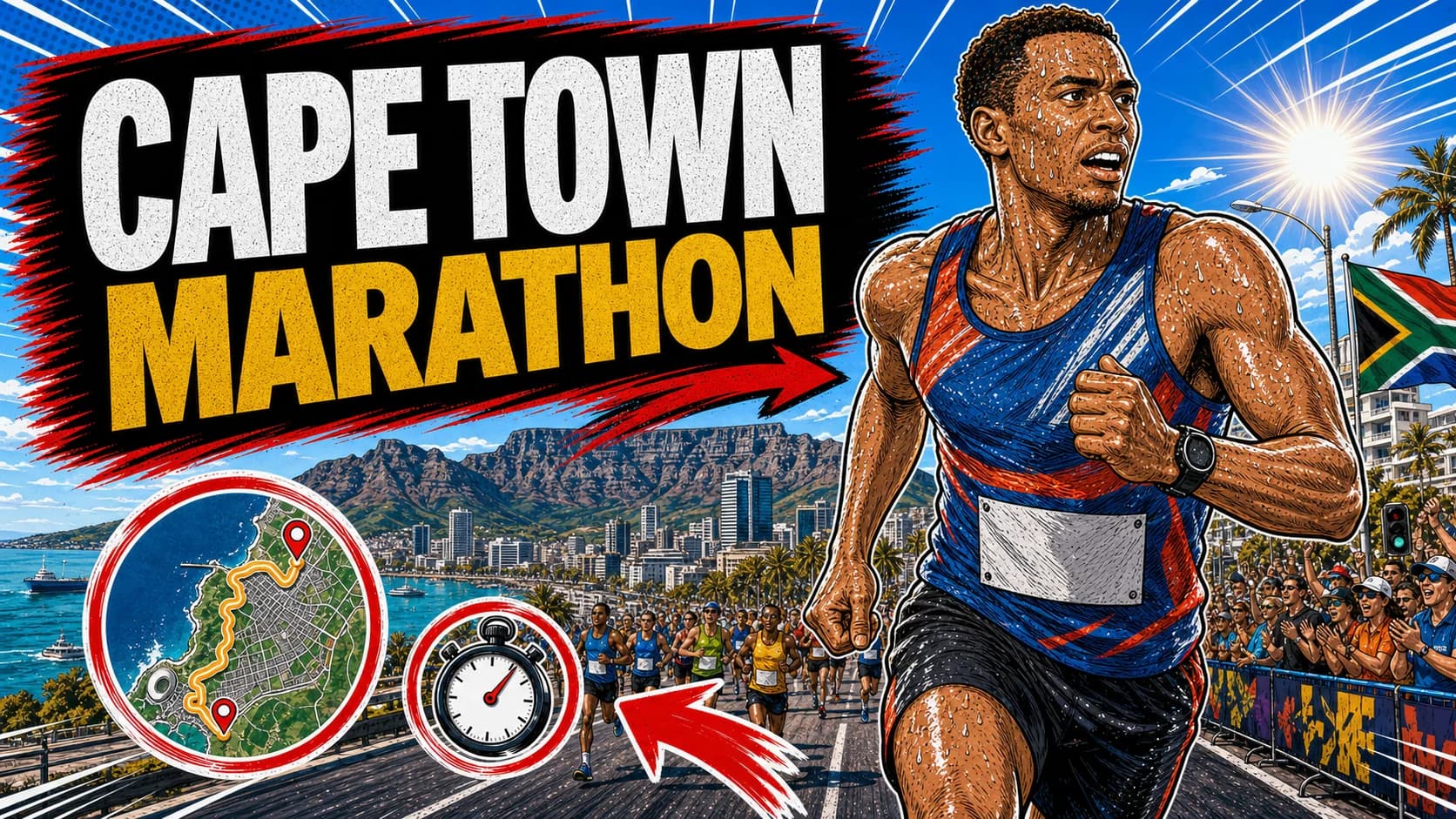
Sanlam Cape Town Marathon 2026 Complete Guide — 7th WMM Wanda Candidate, Atlantic Seaboard, Table Mountain and How to Train For It
Everything you need to run the 2026 Sanlam Cape Town Marathon: South Africa's flagship marathon and Abbott World Marathon Major Wanda candidate (aspiring 7th major), with Atlantic Seaboard and Table Mountain backdrop,...
By Ramon Curto · Updated 2026-05-08
On Sunday, October 18, 2026 Cape Town holds Africa's most spectacular marathon and the leading candidate to become the seventh Abbott World Marathon Major Wanda — the next major after Sydney's induction in 2025. Loop course from Green Point Stadium along the Atlantic Seaboard (Sea Point, Camps Bay, Llandudno to Hout Bay) with Table Mountain dominating the backdrop, ~140 m of modest rolling elevation and cool austral spring climate. This is the marathon with the optimal landscape + climate combination on the African calendar. This guide covers what the official site doesn't quite spell out: how to manage the "Cape Doctor" wind on km 22–35, what to do about jet lag from Europe (1h winter / 0h summer EU), and how to combine the marathon with safari/wine country without sabotaging training.
📑 Table of contents
| Item | Information |
|---|---|
| Date | Sunday October 18, 2026 |
| Distance | 42.195 km (marathon) |
| Other distances | Sanlam 10K · Peace Run 5K (same weekend) |
| Elevation gain | ~140 m (rolling coastal profile) |
| City | Cape Town, Western Cape, South Africa |
| Start & finish | Green Point Stadium / DHL Stadium (V&A Waterfront area) |
| Start time | 06:15 SAST (pre-dawn to beat wind + sun) |
| Organizer | Cape Town Marathon Trust + Western Province Athletics |
| Sponsor | Sanlam (since 2014) |
| Category | World Athletics Gold Label · Abbott WMM Wanda candidate |
| Participants | ~25,000 (all distances) |
| Registration | capetownmarathon.com |
The Sanlam Cape Town Marathon is South Africa's flagship marathon and the most likely candidate to become the seventh Abbott World Marathon Major Wanda after Sydney's circuit induction in September 2025. Organized by Cape Town Marathon Trust and Western Province Athletics since 2007, transformed in 2014 with Sanlam Insurance as title sponsor and the World Athletics Gold Label upgrade, it gathers ~25,000 runners across the marathon, 10K, and Peace Run 5K. 2026 will be a key edition in the WMM Wanda candidacy — the decision on the next major is expected between 2026 and 2027.
Cape Town is the opposite of Berlin or Valencia. Where those are flat tracks for pure PB, Cape Town is landscape, coastal rolling, and experience + safari/wine country. The pre-dawn 06:15 SAST start (at Green Point Stadium built for the 2010 World Cup) precedes the SE "Cape Doctor" wind that typically shows up by 09:00–10:00 SAST. The landscape more than compensates: 5 km of Sea Point Promenade by the ocean, ascent to Camps Bay with Twelve Apostles view, descent to Hout Bay, and return with Table Mountain dominating the horizon.
- If you've run sub-3:30 recently on a flat European track: target 3:35–3:45 here. Rollers + possible wind cost 5–10 minutes.
- If you want to combine marathon + safari (Kruger) or wine country (Stellenbosch, Constantia): fits perfectly. Cape Town is the perfect base for a 7–14 day trip.
- If you're chasing a pure PB: not Cape Town. Sevilla, Berlin, or Valencia are faster.
- If you're collecting Abbott Stars: Cape Town is a 7th WMM candidate. Running it now could be a "pre-Star" if it joins the circuit.
- If you want to qualify for Boston (BQ): the Sanlam Cape Town Marathon is an official BQ qualifier since 2018. Relatively fast course if Cape Doctor doesn't show.
The Sanlam Cape Town Marathon course is a single 42.195 km loop from DHL Stadium / Green Point Stadium with ~140 m of total positive elevation — modest but not flat. It starts next to the stadium (V&A Waterfront area), runs through Cape Town CBD, heads south along Sea Point Promenade (5 km of seafront walk by the Atlantic), ascends to Bantry Bay, Camps Bay and Llandudno, turns at Hout Bay turnaround (km 22), and returns along the same coast with Table Mountain dominating the landscape on the way back, finishing at Green Point Stadium.
The first 5 km cross Cape Town CBD and V&A Waterfront with massive pre-dawn crowd support. Km 5 to 13 is the Sea Point Promenade — 5 km of seafront walk along the Atlantic Ocean with Robben Island view. Strictly flat here but the coastal wind can be a factor.
From km 13 the course climbs through Bantry Bay and enters Camps Bay — the most challenging section. The repeated rollers (4–6 % grade, 200–500 m each) at km 14–17 are where the runner who went out too fast starts having problems. Camps Bay has white beaches, the Twelve Apostles (mountain range) on your left and the ocean on your right — definitive Cape Town postcard.
After Llandudno (km 18) the course descends to Hout Bay and turns (km 22 turnaround). The final third (km 22–42) is the return along the same Atlantic Seaboard with Table Mountain dominating and finish at Green Point Stadium.
Strava data: popular segments are "Sea Point Promenade" (km 7–11), "Camps Bay Coastal Climb" (km 14–17), and "Hout Bay Turnaround" (km 22). Official GPX is published a few weeks before.
The Cape Town Marathon was first run in 2007 as a modest event of a few thousand runners. The transformation came in 2014 with Sanlam Insurance as title sponsor, course improvements that earned World Athletics Silver Label (then Gold in 2017), and sustained growth to today's ~25,000 entries. WMM Wanda candidacy was officially announced in 2022; after Sydney's induction in September 2025, Cape Town is the leading candidate to be the 7th Major. 2026 will be edition 19 of the race.
Race data and palmarés (recent editions):
| Item | Value |
|---|---|
| First edition | 2007 |
| Annual edition since | 2007 |
| World Athletics category | Gold Label (since 2017) |
| Abbott WMM Wanda | Candidate (decision expected 2026/27) |
| Current distances | Marathon · Sanlam 10K · Peace Run 5K |
| Participants (all distances) | ~25,000 |
| Countries represented | 80+ |
| Men's course record | 2:08:14 (Stephen Mokoka, RSA, 2018) |
| Women's course record | 2:24:36 (Tadelech Birra, ETH, 2017) |
Stephen Mokoka (RSA, 2018) set the South African national marathon record on home soil (2:08:14). Verified winners and times of recent editions are published on the official Cape Town Marathon archive and on Wikipedia: Cape Town Marathon.
The Sanlam Cape Town Marathon 2026 entry opens in January 2026 and is managed via first-come-first-served (no lottery). Cap is ~14,000 marathon + ~8,000 10K + ~5,000 Peace Run 5K = ~27,000 total. Sells out 4–8 weeks before the race. Fees: marathon ZAR 1,000–1,400 (~$55–80) for residents and ZAR 2,500–3,500 (~$140–195) for international tier. Charity bibs available continuously with fundraising commitment.
| Distance | SA residents (ZAR) | International tier (ZAR / USD approx) |
|---|---|---|
| Marathon | ZAR 1,000–1,400 | ZAR 2,500–3,500 / $140–195 |
| Sanlam 10K | ZAR 350–500 | ZAR 700–900 / $40–50 |
| Peace Run 5K | ZAR 200–300 | ZAR 400–500 / $22–28 |
Indicative pricing based on the 2025 edition. Always confirm at the official site — international tier updates there. Tour operators (Marathon Tours, Travelling Fit) offer packages with flight + hotel + bib for $2,000–4,000 USD.
| Included | NOT included (optional extra) |
|---|---|
| ✅ Bib with timing chip | ❌ Official professional photo |
| ✅ Sanlam finisher tech tee | ❌ Saturday pasta party |
| ✅ Finisher medal | ❌ Premium gear-check service |
| ✅ On-course aid stations | ❌ International cancellation insurance |
| ✅ Post-finish bag | |
| ✅ Cape Town Marathon Expo access |
Refund policy: ~80 % refundable with medical certificate before mid-September. Entries are non-transferable.
Bib pickup happens at the Cape Town Marathon Expo, typically held at the Cape Town International Convention Centre (CTICC) or Green Point Stadium, on Friday and Saturday before. Race-day pickup is not allowed.
You'll need:
- Registration confirmation (printed or on phone)
- Passport (international runners) — South Africa allows 90-day visa-free entry for Spanish, Portuguese, Italian, French, German, and other EU/UK/US/AU passports.
The most practical way to reach Cape Town is via Cape Town International Airport (CPT), 22 km from V&A Waterfront, with direct connections from Joburg, Doha, Dubai, London (BA, Virgin Atlantic), Frankfurt (Lufthansa), and other European hubs. From Europe it's ~12 hours with stop (Doha, Dubai) or ~11 hours direct on some routes. Time gap with Madrid/Barcelona is +1h winter EU / 0h summer EU — no relevant jet lag for European runners.
On race day, walk if you stay in V&A Waterfront / Green Point. Options from CBD:
- Walking from V&A Waterfront / Green Point: 10–25 minutes — preferred for runners staying there.
- Pre-paid Uber/Bolt: viable for hotels >2 km. Book with 30 min margin; Cape Town pre-dawn has light traffic.
- MyCiti bus: regular routes from center to V&A Waterfront but not operating that early (first service typically 05:30 SAST).
Forget about parking near the start — the Green Point Stadium area has road closures from 04:30 SAST and stadium parking fills fast.
For European runners: direct flight from London (~12h, BA/Virgin Atlantic) or Frankfurt (~11h, Lufthansa). Visa: 90-day visa-free for EU/UK/US/AU passports. Cape Town in October = austral spring with optimal climate, ideal for combining with safari + wine country:
- Wine country (Stellenbosch, Franschhoek, Constantia) — 30–60 min by car from Cape Town. Cape wines, top-tier gastronomy. Reserve 2–3 days post-race.
- Kruger Park safari — domestic flight Cape Town → Joburg → safari lodge (~2 days total transit). 5–7 days recommended.
- Cape Peninsula — rental car, Cape of Good Hope, Boulders Beach (penguins), Chapman's Peak. 1 day.
- Robben Island + Table Mountain cable car — 2 days in Cape Town.
For a Cape Town marathoner, sleeping at V&A Waterfront / Green Point is the optimal option — walk to the start and walk to the finish. The marathon drops you around 10:30–12:30 SAST depending on goal; head back to the hotel with cramps starting and you need shower + food + rest. Cape Town is exceptional in 5* hotel offering with heated pools and spas — take advantage.
- Distance to start: 0.5–2 km on foot (5–25 min). The most convenient option Sunday at 05:30.
- Pros: unbeatable logistics. Top restaurants, cosmopolitan atmosphere, aquarium, V&A night market. Direct access to Robben Island ferry.
- Cons: more expensive tourist zone than the rest of Cape Town. Saturday night can be loud near the waterfront.
- Best for: PB-chasing runners + family tourism.
| Hotel | Cat. | $/night* | To start | Runner highlight |
|---|---|---|---|---|
| Cape Grace | 5* | 380–550 | 0.5 km · 5 min | Next to stadium, luxury spa |
| One&Only Cape Town | 5* | 450–680 | 1 km · 12 min | Marina front, heated pools |
| The Table Bay Hotel | 5* | 280–420 | 1 km · 12 min | Table Mountain view, strong AC |
| Radisson RED V&A Waterfront | 4* | 180–260 | 0.8 km · 10 min | Modern, mid-high range |
| Protea Hotel Sea Point | 4* | 130–180 | 2.5 km · 30 min | Next to Sea Point Promenade |
- Distance to start: 2.5–4 km on foot / 10–15 min by taxi. Near km 7–11 of the course.
- Pros: ocean view, local restaurants, more relaxed than waterfront. Promenade ideal for easy jogs.
- Cons: transport recommended Sunday 05:30 (walking 30+ min before race not ideal).
| Hotel | Cat. | $/night* | Runner highlight |
|---|---|---|---|
| The Bay Hotel Camps Bay | 4* | 280–380 | Camps Bay beach front (mid-course) |
| Twelve Apostles Hotel & Spa | 5* | 380–520 | Twelve Apostles view, premium spa |
| POD Camps Bay | 4* | 220–320 | Boutique in Camps Bay |
- Distance to start: 3–5 km by taxi (10–15 min).
- Pros: cultural atmosphere, next to Bo-Kaap (colorful neighborhood), Long Street (restaurants/bars), museums. More authentic than the tourist waterfront.
- Cons: transport mandatory Sunday. Further from expo.
| Hotel | Cat. | $/night* | Runner highlight |
|---|---|---|---|
| Mount Nelson Hotel | 5* | 320–480 | Historic hotel, gardens, high-end |
| The Cape Cadogan | 4* | 180–240 | Elegant boutique in Gardens |
| Cape Heritage Hotel | 4* | 150–210 | Boutique in CBD, local feel |
| Daddy Long Legs Hotel | 3* | 80–120 | Budget on Long Street |
*Indicative weekend-of-race rate (3rd Sunday of October) in USD. Varies with booking lead time and rising demand since the Wanda candidacy.
Cape Town weather on the third Sunday of October averages 8 °C low at pre-dawn start and 20 °C high at finish with sunny conditions on around 80 % of days, per South African Weather Service data. It's austral spring — optimal weather for a marathon. Humidity is low (45–60 %), no significant rain, and the only variable is the SE "Cape Doctor" wind.
The key factor is Cape Doctor, SE wind that blows in Cape Town between austral spring and summer. In October it can appear in 5 of 10 editions, typically from 09:00 SAST onward. Typical intensity 10–30 km/h, with bad years up to 50 km/h. You face it head-on on the return from Hout Bay back to Green Point (km 22–35).
Plan by forecast:
- <10 km/h wind + clear skies: optimal conditions. Target pace + 5 sec/km.
- 10–20 km/h Cape Doctor: typical conditions. Target pace + 8–12 sec/km.
- 20–30 km/h Cape Doctor: tough conditions. Target pace + 15 sec/km. Aggressive hydration (wind dehydrates faster).
- >30 km/h Cape Doctor: rare but happens. Procam may adjust route. Drop target 20 sec/km.
The recommended Cape Town training plan is a 16-week block with peak volume in weeks 11–13 (between 50 km and 100+ km weekly depending on goal), specific block of coastal hills + wind tempo between weeks 8 and 11 (essential for Camps Bay rollers and possible Cape Doctor), and a 3-week taper. Key for Cape Town: train coastal hills + tempo in wind = the runner who arrives without these pays the toll on km 14–17 and km 22–35.
Peak weekly volume by goal:
| Cape Town goal | Peak volume | Max long run | Sessions/week |
|---|---|---|---|
| Sub-3:00 | 80–100 km | 32 km | 6 |
| Sub-3:30 | 65–85 km | 30 km | 5 |
| Sub-4:00 | 55–70 km | 28 km | 4–5 |
| Sub-4:30 | 45–60 km | 26 km | 4 |
| Finish (5:00+) | 35–50 km | 24 km | 3–4 |
Cape Town-specific sessions (weeks 8–11):
- Coastal hills: 8 × 400 m at 5K pace up a 4–6 % grade, recovery on descent. Minimum 6 sessions.
- Tempo in wind: 12–15 km at goal pace on a >15 km/h wind day. Learn not to fight the wind (smooth pass, constant effort).
- Long run with hills: once a month, 30+ km including 4–5 long climbs to simulate Camps Bay.
Based on your best recent flat marathon (Berlin, Valencia, Sevilla), here's your realistic Cape Town time:
| Best on flat | Realistic Cape Town |
|---|---|
| 2:45 flat | 2:50–2:54 |
| 3:00 flat | 3:06–3:10 |
| 3:30 flat | 3:38–3:43 |
| 4:00 flat | 4:08–4:14 |
| 4:30 flat | 4:38–4:44 |
| Punto | Tiempo acumulado | Parcial |
|---|---|---|
| 5 km | 26:40 | 26:40 |
| 10 km | 53:19 | 26:40 |
| 15 km | 1:19:59 | 26:40 |
| Media (21,1 km) | 1:52:30 | 32:31 |
| 30 km | 2:39:58 | 47:28 |
| Meta | 3:45:00 | 1:05:02 |
Los parciales suponen un ritmo constante y no incluyen paradas. En Sanlam Cape Town Marathon, adapta el esfuerzo al terreno y a las condiciones; no fuerces las bajadas para recuperar segundos.
The Cape Town race plan starts at the gun in Green Point at 06:15 SAST with temperatures of 8–10 °C (real cold, throwaway layer recommended). The first 13 km cross CBD and Sea Point Promenade — deceptively easy feel. Don't let it. Bank conservation for the wind + hills to come from km 14 onward.
| Goal | 5K split | Cape Town tactical note |
|---|---|---|
| Sub-2:45 | 19:30 | Sea Point at 3:54/km. Camps Bay 4:00/km (climbs). Return 4:05/km with sodium if Cape Doctor. |
| Sub-3:00 | 21:18 | Sea Point at 4:14/km. Camps Bay 4:24/km. Return 4:24/km with conservation. |
| Sub-3:30 | 24:53 | Sea Point at 4:55/km. Camps Bay 5:08/km. Return 5:05/km. Conservation critical km 14–17. |
| Sub-4:00 | 28:25 | Sea Point at 5:35/km. Camps Bay 5:48/km. Return 5:48/km. Don't chase pace on hills. |
| Sub-4:30 | 31:58 | Sea Point at 6:18/km. Run-walk on Camps Bay OK. Enjoy the scenery. |
| Sub-5:00 | 35:30 | Sea Point at 7:00/km. Plan B: walk 30 sec on each climb. |
| Finish | — | Comfortable pace. The medal and the Table Mountain photo are worth any time. |
Race morning: wake 04:30 SAST, coffee + light breakfast at 05:00, leave hotel at 05:30 to reach corral by 05:45 (30 min before gun). Old hoodie for corral — morning temps can drop below 8 °C in October.
Aid stations: every 5 km with water + electrolyte + banana and gels at some points. Drink at every one from km 5, especially if Cape Doctor is active.
Mental at km 32: after the Hout Bay turnaround, the next 10 km are the toughest — return + possible wind + Camps Bay again. Crowd support on Sea Point Promenade and V&A Waterfront is massive in the last 5K. The finish crosses Green Point Stadium with Table Mountain dominating.
The Cape Town nutrition strategy is the standard for spring marathons — closer to Sevilla or Valencia than to Mumbai. Carb loading starts Friday (3 days before), with emphasis on Saturday: 8–10 g/kg body weight spread across 4 meals. Cape Town has excellent international cuisine — Italian, French, South African fusion, Cape Malay — all valid for loading.
Saturday dinner: pasta or rice with lean protein (chicken, fish), cooked vegetables. Cape Town is food-safe — no Mumbai-type restrictions apply. Dinner by 19:30 SAST at the latest.
Sunday breakfast (04:30 SAST): 1:30–2 hours before gun. White bread with honey + banana + coffee. Avoid full-fat dairy and fiber.
On course: one gel every 25–30 minutes from km 6, last at km 35. Total 5–6 gels = 250–300 g of carbs. Drink water + electrolyte at every aid station (every 5 km).
Cape Town-specific hydration: 8–20 °C climate similar to Berlin/Boston — 200–300 ml per aid station is enough. But if Cape Doctor active (>15 km/h): bump to 300–400 ml, the wind dehydrates silently.
Post-finish recovery: banana + protein bar + water + electrolyte. Hotel shower, lunch at 14:00 SAST (protein + carbs + vegetables), short nap.
Cape Town gear is the standard cool-spring marathon kit — throwaway layer for 8 °C start + lightweight clothing for 18 °C finish. The differentiator is the Cape Doctor wind: prepare a Velcro-adjustable cap so it doesn't blow off, and consider a packable windbreaker tied at waist if forecast >20 km/h.
Cape Town-specific gear:
- Throwaway layer for corral. 8–10 °C in Green Point at 05:45. Old hoodie or poncho you ditch before start.
- Light cap with adjustable Velcro. Strong spring sun by km 15, and Velcro keeps it from blowing off in Cape Doctor.
- Packable lightweight windbreaker. Tied at waist if Cape Doctor forecast >20 km/h. Put it on if needed.
- Anti-chafe + nipple plasters. October Cape Town is dry — less friction than warm humid climate, but still important.
- Light gel belt. Carry 5–6 of your own. Aid stations are generous but official gels may not match your training brand.
- Carbon-plate shoes. Vaporfly Next% 4, Adios Pro 4, Metaspeed Sky+. With minimum 200 km broken in across 2 prior long runs.
Will Cape Town really be the seventh WMM?
Cape Town is the most likely candidate to be the seventh Abbott World Marathon Major Wanda after Sydney (inducted September 2025). The official decision is expected between 2026 and 2027. Other candidates: Shanghai, Mumbai, Bogotá. Cape Town has Gold Label since 2017 and sustained growth. If you join early, you can be a finisher of the race before its official WMM induction.
Is it a BQ qualifier?
Yes, the Sanlam Cape Town Marathon is an official Boston Qualifier since 2018. If you run your qualifying time (sub-3:00 men 18–34, sub-3:30 women 18–34, etc.) in Cape Town, it counts for your Boston entry. The BAA accepts the times without altitude or gradient restriction.
What visa do I need from Spain?
90-day visa-free for Spanish, Portuguese, Italian, French, German, and other EU/UK/US/AU passports. You don't need to process a visa beforehand — just present a valid passport (with 6+ months validity) at the airport. Includes safaris in South Africa; you don't need an additional visa.
Cape Doctor — what to do if it blows hard?
If forecast >25 km/h: drop target pace 15–20 sec/km globally. Hydration 50 % more aggressive (wind dehydrates silently). Tight Velcro cap. Consider packable lightweight windbreaker tied at waist. If during the race you feel fighting wind: DON'T accelerate, maintain constant effort. Wind slows your pace but not your gait.
Is combining marathon + safari viable?
Yes, perfectly — Cape Town in October is the best marathon + safari combination on the calendar. Plan template: marathon Sunday, domestic flight Cape Town → Joburg → Kruger Park Monday (3 hours total transit), safari Wednesday to Sunday, fly home. 6–8 days total from Europe. If you only want wine country: 2–3 days post-race are enough (Stellenbosch + Constantia).
Is Cape Town safe for Western runners?
V&A Waterfront, Sea Point Promenade, City Bowl tourist area are very safe during the day and for runners on race Sunday. Standard rules apply: don't display money/jewelry, use Uber/Bolt instead of casual taxis, avoid non-tourist areas alone at night. Women running: V&A and Sea Point are comfortable; better to train in a group for pre-race jogs.
Compared to Two Oceans Ultra?
Cape Town Marathon = 42 km, October, urban coastal. Two Oceans Ultra = 56 km, April, Easter weekend, classic SA ultra with Chapman's Peak climb. Both are in Cape Town but distinct: Marathon is for BQ qualifying / first-time international, Two Oceans for ultra runners. If you want to start with SA running, begin with Marathon in October and then Two Oceans in April the following year.
Can I pick up my bib on race day?
No. Pickup is at the CTICC or Green Point Stadium expo on Friday and Saturday before. Race-day pickup is not allowed. You need passport + registration confirmation.
What shoes are best for Cape Town?
For sub-3:30, a protective carbon plate (Vaporfly 4, Adios Pro 4, Metaspeed Sky+). The Atlantic Seaboard asphalt is smooth. Camps Bay climbs don't require a specific shoe. Minimum 200 km broken in across 2 prior long runs. Bring a backup pair in case international travel loses your bag.
How does Cape Town compare to Boston / Sydney / NYC?
Cape Town is the most likely WMM Wanda candidate to be the 7th Major. Boston is the oldest WMM with BQ qualifying. Sydney is the seventh Major (inducted 2025), with similar rolling profile to Cape Town. NYC is the largest (50K runners) and has 250 m of elevation. Cape Town combines landscape + optimal climate + tourism wraparound — a unique combination on the international calendar.
Cape Town is Africa's most beautiful marathon and a 7th WMM candidate. This table compares Cape Town with its peers:
| Race | Month | Elevation | Best for | Entry |
|---|---|---|---|---|
| Cape Town (this guide) | October | ~140 m rolling | Landscape + safari combo | Direct entry |
| Two Oceans Ultra (CT) | April | Chapman's Peak | Iconic SA 56 km ultra | Qualifier required |
| Comrades Marathon (SA) | June | 750 m up/down | Mythical 87 km ultra | Sub-5h marathon qualifier |
| Sydney Marathon | August | 265 m rolling | Seventh WMM (since 2025) | Good for Age or lottery |
| Berlin Marathon | September | <30 m flat | Pure PB, world records | Lottery |
| Boston Marathon | April | 140 m descent | Prestige, BQ qualifying | BQ qualifying |
Did this guide help? If you're running Cape Town 2026, save the event on SportPlan to get registration alerts, the WMM Wanda decision, and later log your African Gold Label.
Keep planning
Use SportPlan to compare dates, save target events, and build a season that fits your weekends instead of another unstructured list.