
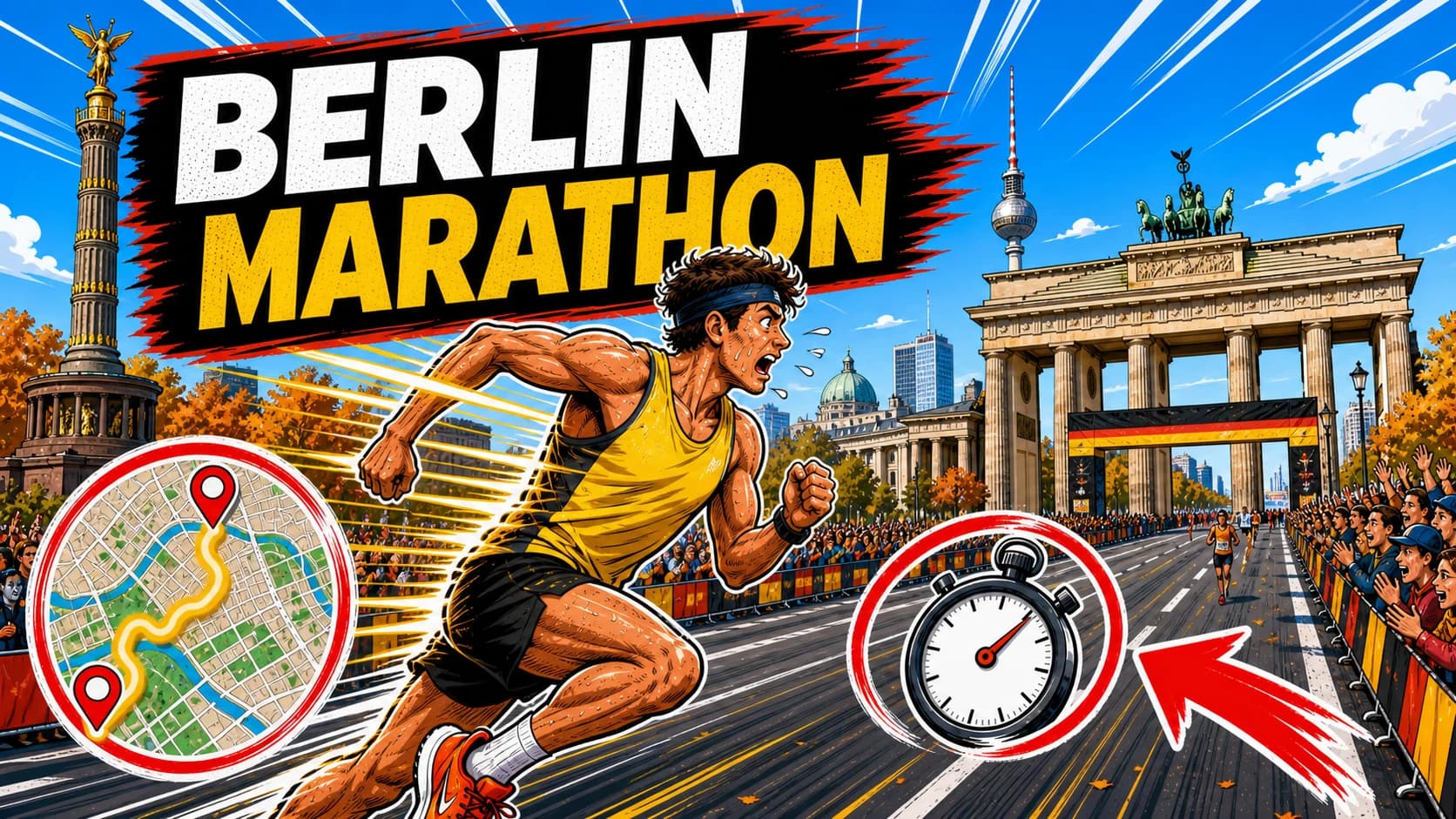
Complete Guide to the BMW Berlin Marathon 2026 — The World Record Course
Everything you need to know to run the BMW Berlin Marathon 2026: 42.195 km on the fastest course on the planet, genuinely flat profile, lottery entry, transport, accommodation, September weather, and a 16-week plan to...
By Ramon Curto · Updated 2026-05-06
On September 27, 2026 Berlin rolls out the red carpet for the fastest marathon on the planet. 8 men's marathon WRs have been set here, including Kipchoge 2:01:09 (2022), and Tigist Assefa's 2:11:53 women's WR (2023, briefly the WR until 2024) was also clocked on these streets. Wide avenues, 30 m of net elevation over 42 kilometers, and a September climate that rarely strays outside 8–18 °C make the BMW Berlin Marathon the destination the rest of the marathon calendar envies. This guide covers what the official site doesn't quite spell out: what the course actually feels like, where the mind cracks (not the legs), how to enter the lottery, what realistic time to expect, and how to stitch together a Berlin race weekend.
📑 Table of contents
| Item | Information |
|---|---|
| Date | September 27, 2026 (Sunday) |
| Distance | 42.195 km (marathon) |
| Net elevation | ~30 m (the flattest course on the WMM calendar) |
| City | Berlin (~40 m altitude) |
| Start | Strasse des 17. Juni (next to the Reichstag) |
| Start time | ~9:15 first elite wave — check the official app close to race day |
| Organizer | SCC EVENTS · BMW title sponsor since 2011 |
| Entry | bmw-berlin-marathon.com (lottery) |
The BMW Berlin Marathon is the world record course. Since 1974 it has gathered ~50,000 starters, attracts runners from 150+ countries every edition, and combines German urban atmosphere with a course so fast that 8 men's marathon world records have fallen here (Khannouchi, Tergat, Gebrselassie, Makau, Kimetto, Kipchoge — twice) along with the 2023 women's world record (Tigist Assefa, 2:11:53, briefly the WR until 2024). It isn't the loudest marathon on the calendar. It's the course where a cold head adds minutes.
Berlin is a flat, cold, fast marathon. The city sits practically at sea level and the net elevation across 42 kilometers is around 30 metres. The course doesn't have a single climb worth mentioning, the avenues are wide (Strasse des 17. Juni runs four lanes, Karl-Marx-Allee doubles that), and late-September weather dances between 8 and 18 °C — the physiological sweet spot for a 42K. What you lose in emotional rollercoaster you gain on the clock: 5–10 minutes under your best time on a marathon with 200+ m of elevation.
- If you've recently run sub-3:30 in another marathon: Berlin can leave you at 3:20–3:25 if the plan was honest. The course gives back what training earned.
- If you're stepping up from half marathons but have never done 42K: debuting here makes sense if your goal is a time, not survival. Berlin doesn't forgive blind starts; the straight line from km 30 to 35 will show you the calorie balance you didn't lock in.
- If you want your first marathon with no time pressure: yes, it fits. 95 %+ finisher rate, polished atmosphere, German organization.
- If you want a pure PB: Berlin is the answer, alongside Valencia. They are the two fastest courses on the planet for non-elite runners.
- If you're training for Boston, NYC, Tokyo: Berlin is the previous step. Anyone who lowers their PB here walks away with the confidence to attack the harder courses.
See other World Marathon Majors →
The BMW Berlin Marathon course is one single loop of 42.195 km through the centre and the eastern districts of the city with ~30 m of net elevation (positive or negative, depending on where you measure). It starts next to the Reichstag and the Brandenburg Gate (Brandenburger Tor) on Strasse des 17. Juni, drops south through Tiergarten, crosses Charlottenburg, Schöneberg, Kreuzberg and Friedrichshain, comes back via Karl-Marx-Allee toward the centre, and finishes by crossing the Brandenburger Tor at km 41 — the final 800 metres between Brandenburger Tor and the finish line are the most-replayed postcard on the marathon calendar.
The start is on Strasse des 17. Juni, one of Berlin's widest avenues. The first kilometers run straight west through the Tiergarten, the field doubles back and heads south down Kurfürstendamm (the "Berlin Champs-Élysées"), crosses Schöneberg and Kreuzberg, swings east through the heart of Friedrichshain, comes back along Karl-Marx-Allee toward the centre, passes through Alexanderplatz, drops onto Unter den Linden, and finishes by crossing the Brandenburger Tor 800 m before the line. The finish is back on Strasse des 17. Juni — start and finish sit roughly 1 km apart from each other.
Asphalt is the dominant surface (zero meaningful cobblestone on the current layout). Liquid stations are roughly every 2.5–3 km, with solid food stations (official BMW gels, banana, apple) at km 17.5 and km 30. Crowd density peaks at Brandenburger Tor, Potsdamer Platz, Alexanderplatz, and the final 800 metres — thinner along the long straights of Karl-Marx-Allee and Kurfürstendamm, where you'll run several kilometers without continuous spectator fences.
Forget the myth of "completely flat". Berlin has 30 m of net elevation, not zero. Small bridge elevations (Spree, Landwehrkanal) and gentle gradients between eastern districts add up to roughly 60 m of total ascent and 60 m of descent. The final feel is of a flat course, but the difference compared to Valencia (literally 0 m) is noticeable for elite runners.
🚨 Where the race breaks
Course data for Strava / Garmin: SCC EVENTS publishes the official GPX on its site ~4 weeks before race day. To recce the final stretch midweek, search Strava for the segments "Brandenburger Tor zur Ziel" (the final 800 metres) and "Karl-Marx-Allee East" (the km 30–35 straight).
The Berlin Marathon has been run since 1974, making it one of the five oldest marathons on the WMM calendar. BMW has been title sponsor since 2011 (previously Real Berlin Marathon). It shares World Marathon Major status with Boston, Chicago, London, New York, and Tokyo. Berlin's road-running tradition can be summed up in one stat: 8 men's marathon world records set on this course between 1998 and 2022. No other course on the planet comes close.
Roll of honour and race data (recent editions):
| Item | Value |
|---|---|
| First Berlin Marathon edition | 1974 |
| Editions held | 51 (as of 2025) |
| Men's marathon WRs set here | 8 |
| Men's course record | 2:01:09 (Eliud Kipchoge, KEN, 2022) |
| Women's course record | 2:11:53 (Tigist Assefa, ETH, 2023 — was the WR until 2024) |
| Participants (all distances) | ~50,000 finishers |
| Annual lottery applicants | 150,000+ |
| Countries represented | 150+ |
| Historic finisher rate | 95 %+ |
Verified winners and times from the 5 most recent editions:
| Year | 🥇 Men | Country | Time | 🥇 Women | Country | Time |
|---|---|---|---|---|---|---|
| 2025 | Sabastian Sawe | 🇰🇪 KEN | 2:02:16 | Rosemary Wanjiru | 🇰🇪 KEN | 2:21:05 |
| 2024 | Milkesa Mengesha | 🇪🇹 ETH | 2:03:17 | Tigist Ketema | 🇪🇹 ETH | 2:16:42 |
| 2023 | Eliud Kipchoge | 🇰🇪 KEN | 2:02:42 | Tigist Assefa | 🇪🇹 ETH | 2:11:53 (WR) |
| 2022 | Eliud Kipchoge | 🇰🇪 KEN | 2:01:09 (CR) | Tigst Assefa | 🇪🇹 ETH | 2:15:37 |
| 2021 | Guye Adola | 🇪🇹 ETH | 2:05:45 | Gotytom Gebreslase | 🇪🇹 ETH | 2:20:09 |
Data verified against the public archive at List of winners of the Berlin Marathon (Wikipedia EN).
The BMW Berlin Marathon doesn't take direct entries: spots are assigned via a lottery (sorteo) that opens every December for the following year's edition. Around ~150,000 runners apply and ~25,000 spots are awarded by lottery (plus ~25,000 additional spots through charity, travel partners, elite, club, and "good for age" routes). Standard bib pricing lands around €140–200 depending on date and runner origin.
The three ways to enter the BMW Berlin Marathon 2026:
- Opens: mid-December 2025.
- Closes: mid-January 2026.
- Results notification: late January or February 2026.
- Estimated odds: ~17 % (25,000 spots / 150,000 applications).
- Price if drawn: ~€140 base runner, ~€180 if you live outside Germany.
- Trick: two consecutive rejections do not guarantee a third-year spot (recurring false rumour). Each lottery is independent.
- Guaranteed places via charity organizations (Run for SOS Children's Villages, Aktion Mensch, etc.).
- Price: €500–1,500 depending on the charity — includes bib + mandatory donation.
- Idea: a guaranteed slot without the lottery, but the total cost is 4–10× the standard bib.
- Best for: runners with budget who've spent 2–3 years getting shut out of the lottery.
- Official operators like Marathon-Tours, Sports Tours International, and AbbottWMM Wanda Age Group World Championships offer packages with flight + hotel + guaranteed bib.
- Price: €1,500–3,500 all-inclusive, depending on hotel and origin.
- Pro: all logistics handled, guaranteed spot, briefing in your language.
- Con: the bib cost itself is buried inside the package — if you only want a bib without flight/hotel, do the math.
- If your most recent best marathon is sub-2:45 men or sub-3:00 women (estimated bands; official cutoffs are published yearly), you can apply through the elite/age-group route.
- Place confirmed based on the time submitted, no lottery.
- Price: similar to the lottery (~€140–180).
| Included in the price | NOT included (optional extra) |
|---|---|
| ✅ Bib with timing chip | ❌ Official professional photo (~€30–60) |
| ✅ Official tech t-shirt | ❌ Saturday pasta party (sometimes ~€15 extra) |
| ✅ Finisher medal | ❌ Premium bag-drop service |
| ✅ On-course aid stations (every ~2.5 km) | ❌ Cancellation insurance |
| ✅ Post-finish bag (fruit, isotonic) | ❌ Berlin Welcome Card (public transport) |
| ✅ Digital diploma with certified time | |
| ✅ Access to the runners' expo (Berlin Vital) at Tempelhof |
Bib pickup happens at the Berlin Vital Expo, normally held over the three days before race day (Thursday, Friday, and Saturday) at the former Tempelhof airport. No bibs are handed out on race day: you must pick yours up in person before the expo closes on Saturday, historically around 19:00–20:00.
You'll need:
- The entry confirmation (printed or on your phone)
- Valid passport or ID with photo
Family and friends cannot pick up your bib without a notarized authorization — the organizers are strict on this point, unlike Madrid or Barcelona. The race kit usually contains the official tech t-shirt, the bib with chip, a bag tag, and a course map.
The most practical way to reach the BMW Berlin Marathon start is by U-Bahn / S-Bahn: Hauptbahnhof (lines S3, S5, S7, S9, U5), Brandenburger Tor (lines U5, S1, S2, S25, S26), and Bundestag (line U5) are all under 10 minutes' walk from the start area on Strasse des 17. Juni. The network runs 24/7 on weekends, so there's no schedule problem for early-rising runners.
Berlin has one of the most efficient public transport networks in Europe, run by BVG (U-Bahn + bus + tram) and S-Bahn Berlin (commuter rail). Buy a Berlin Welcome Card for the weekend (~€25 for 48 h) — it includes unlimited transport plus museum discounts.
For the expo at Tempelhof, the closest stations are U-Bahn Platz der Luftbrücke (U6) and U-Bahn Tempelhof (U6, S41/S42/S45/S46/S47). From Mitte the trip is roughly 25 minutes door-to-door.
Airports:
- BER (Berlin Brandenburg Airport): opened in 2020, the only active commercial airport. 30 minutes by S-Bahn S9 to Hauptbahnhof or ~45 minutes by taxi to the centre. TXL (Tegel) closed in 2020 — if your ticket says TXL, it's outdated.
Driving is not recommended. Most central streets are closed from early morning into the afternoon, and parking in Mitte on a Saturday/Sunday costs €20–35/day and is virtually impossible near the Reichstag during race weekend. If you must drive, park near a suburban S-Bahn station (Spandau, Zoologischer Garten, Ostkreuz) and finish the trip by public transport.
For a marathon runner, staying within 15 minutes' walk of the start isn't a luxury: it's logistics. The marathon drops you at the finish around 12:00–14:30 depending on goal — you walk back to the hotel sweaty, hungry, with cramps brewing. The difference between sleeping well with an early breakfast and a 5-minute walk to the corral, versus catching a U-Bahn at 7:30 with a transfer, can cost you 1–2 minutes on the clock and twice that in mental stress.
- Breakfast before 7:00 (or a bag the night before). Eating 2:30–3 h before the start is critical; buffets that open at 7:30 arrive too late for a ~9:15 start.
- Late check-out until 15:00–16:00. In a marathon you finish later than in a half — you need slack for shower, meal, rest.
- Bathtub for ice / contrast baths post-race. More useful after 42K than after 21K. Filter on Booking ("bath with tub").
- Independent, working air conditioning. Even if late-September Berlin is cool, you'll want temperature control to sleep.
- Inner-facing or upper-floor room. Saturday night in Mitte is noisy (not Madrid-loud, but Friedrichstrasse bars close late).
- Real distance in metres, not advertising minutes. <1,000 m: easy walk. 1,000–2,000 m: U-Bahn required. >2,000 m: skip.
- Distance to start: 0.5–1.5 km on foot (5–18 min). The most comfortable option for Sunday at 7:30.
- Pros: unbeatable logistics. Brandenburger Tor in view. Pasta-dinner restaurants a stone's throw away.
- Cons: expensive, especially for marathon weekend.
- Best for: runners who value zero logistical stress or are travelling with family.
| Hotel | Cat. | €/night* | To start | Runner highlight |
|---|---|---|---|---|
| Hotel Adlon Kempinski | 5* luxury | €450–800 | 0.8 km · 10 min | The historic next to the Brandenburger Tor |
| Westin Grand Berlin | 5* | €280–420 | 1.2 km · 14 min | Bathtub, strong AC, early-buffet negotiable |
| NH Collection Berlin Mitte | 4* | €180–260 | 1.5 km · 18 min | Frequent late check-out, mid-high range |
| Hotel de Rome | 5* boutique | €350–550 | 1.4 km · 17 min | Quiet luxury, useful sauna post-finish |
| Catalonia Berlin Mitte | 4* | €140–200 | 1.3 km · 16 min | Balanced price-location pick |
- Distance to start: 1.5–2.5 km on foot (18–28 min) or 1–2 U-Bahn / S-Bahn stops.
- Pros: guaranteed quiet, top restaurants, the Tiergarten park next door for a Saturday shakeout.
- Cons: transport recommended on Sunday at 7:30.
| Hotel | Cat. | €/night* | To start | Runner highlight |
|---|---|---|---|---|
| Hotel Bristol Berlin (Kempinski) | 5* | €320–500 | 2.3 km · 28 min | Kurfürstendamm classic, bathtub |
| Sofitel Berlin Kurfürstendamm | 5* | €260–400 | 2.2 km · 27 min | High-end boutique, strong AC |
| Waldorf Astoria Berlin | 5* luxury | €400–650 | 1.8 km · 22 min | Absolute luxury, Tiergarten views, bathtub |
| Hotel Palace Berlin | 5* | €230–340 | 2.4 km · 29 min | Near the Zoo, gym for mobility work |
| 25hours Hotel Bikini Berlin | 4* | €180–260 | 2.6 km · 31 min | Modern design, Tiergarten views |
- Distance to start: 1.2–1.8 km on foot (15–22 min).
- Pros: central, well-connected, restaurants and 24h supermarkets nearby.
- Cons: very touristy area, moderate night noise.
| Hotel | Cat. | €/night* | To start | Runner highlight |
|---|---|---|---|---|
| Regent Berlin | 5* luxury | €380–600 | 1.6 km · 19 min | Luxury boutique, bathtub, late check-out |
| Hilton Berlin | 5* | €220–340 | 1.5 km · 18 min | Guaranteed early buffet, gym |
| Melia Berlin | 4* | €160–230 | 1.3 km · 16 min | Spree-front, views, mid-high range |
| Titanic Chaussee Berlin | 4* | €140–200 | 1.8 km · 22 min | Useful spa post-finish, German sauna |
| Park Inn by Radisson Alexanderplatz | 4* | €130–190 | 2.0 km · 24 min | Near km 30 — useful for spectators |
*Indicative race-weekend rate (last Sunday of September 2026). Varies with booking lead time (book ideally 6+ months out — hotels near the Reichstag sell out), availability, and current promotions.
Late September weather in Berlin averages 8 °C low and 18 °C high with dry conditions on roughly 70 % of days, according to historical data from the Deutscher Wetterdienst (DWD). Relative humidity drops from 70 % at the start to 50 % by midday, and historic average wind sits below 15 km/h — Berlin isn't a windy city. It is, almost, the perfect climate window of the marathon calendar.
The variable to watch is the easterly wind. Roughly 1 in 5 editions sees an easterly wind in the km 25–35 corridor (Karl-Marx-Allee), which runs exactly against the direction of travel. When it shows up, it usually blows 15–25 km/h and can cost you 20–40 seconds per km in that specific stretch. It's the only weather factor that puts small asterisks on Berlin times; when there's no wind, this course doesn't tolerate excuses.
Plan by forecast:
- <8 °C high: "cold" marathon. Short sleeves + arm sleeves. The ideal condition for sub-2:30, surplus clothing for >4h runners.
- 8–14 °C: optimal conditions. The majority of personal records happen here. Berlin almost always lands in this band.
- 14–18 °C: good conditions. Wear a tech singlet if you're going beyond 3h00.
- >18 °C: rare for Berlin. Watch the pace from km 1 — dehydration arrives sooner than expected on a flat course where nobody's used to sweating.
The sun isn't a factor: the late-September solar angle in Berlin is low, there's partial shade on many avenues (especially in Charlottenburg), and UV is half of Madrid or Seville. Forget cap and sunglasses unless the forecast nails 18 °C.
The recommended plan to prepare the BMW Berlin Marathon is a 16-week block with peak volume in weeks 11–13 (50 km to 130+ km per week depending on goal), one weekly long run, and a three-week taper. The key for Berlin is training long tempo runs — the flat course allows and demands single-pace consistency over 42 km, not the rolling-hills management Madrid asks for.
Approach Berlin as a flat, fresh, fast marathon. Pick your goal and follow the table — these are peak volumes (weeks 11–13), not block averages.
| Goal | Avg pace | Peak weekly vol. | Peak long run |
|---|---|---|---|
| 5h00 | 7:06 min/km | 35–45 km | 25–28 km |
| 4h30 | 6:24 min/km | 45–55 km | 28–30 km |
| 4h00 | 5:41 min/km | 55–70 km | 30–32 km |
| 3h30 | 4:58 min/km | 70–85 km | 32–35 km |
| 3h00 | 4:16 min/km | 90–110 km | 32–36 km |
| 2h45 | 3:54 min/km | 110–130 km | 32–38 km |
| ≤2h30 | 3:33 min/km | 130–160+ km | 35–40 km |
How to read the table and build the cycle:
- These are peak volumes (weeks 11–13). The 16-week block average will be roughly 65 % of the row you pick.
- One long run per week, no more. It's the session that builds the most aerobic fitness. The two final peak long runs (weeks 11 and 12) hit 32–36 km at Berlin goal pace.
- The rest of the volume is easy running at conversational pace.
- Standard split: 80 % easy / 20 % hard, measured by total time.
- One quality session per week is enough up to the 4h00 goal; beyond that, two come in.
Three sessions worth gold for Berlin:
- Long tempo runs (weeks 4–10). 12–18 km at goal pace on flat terrain. Berlin rewards consistency, not climbing strength. This is the most important session of the block.
- Long run with race-pace blocks. Weeks 8 and 12: 32 km total with the final 16–20 km at goal pace. Teaches you to hold the pace once easy glycogen has run out.
- Long intervals on track or flat asphalt (weeks 6–13). 4–6 × 2 km at marathon pace with 90 s recovery. Teach you to keep cadence and form when fatigue arrives. For Berlin specifically, this session is worth more than the long hill repeats other marathons demand.
The taper is three weeks, not two. Week 14 at 80 %, week 15 at 60 %, week 16 at 40 % keeping race pace in short pickups. The two final long runs (in weeks 11 and 12) are the ones that fill the cup.
Don't know what realistic goal time you have for Berlin? Cross your recent best half marathon with the "Berlin marathon" factor (which rewards the flat course):
| Your recent best half | Flat-course equivalent (marathon) | Realistic Berlin |
|---|---|---|
| 1:15 | sub-2:38 flat | 2:35–2:40 |
| 1:25 | sub-3:00 flat | 2:55–3:00 |
| 1:35 | sub-3:20 flat | 3:18–3:25 |
| 1:45 | sub-3:42 flat | 3:38–3:48 |
| 1:55 | sub-4:05 flat | 4:00–4:10 |
| 2:05 | sub-4:25 flat | 4:20–4:32 |
| 2:15 | sub-4:48 flat | 4:42–4:55 |
How to read it: the "flat" column is the unadjusted Riegel conversion (your half × ~2.11). Berlin gains a 1–2 % bonus on top of generic flat thanks to the course + climate combo — that gives you the realistic range. If you arrive in peak shape with the plan executed, aim for the bottom of the range. If you have a weak month from work or injury, the top.
Find another marathon in the world →
Once you have your goal time, this calculator gives you the required average pace (in min/km and min/mi) and the cumulative splits at 5K, 10K, 15K, half marathon, 30K, and finish. Change the goal time in the field below and the table updates instantly. Berlin default = 2:45 because this is the PB course par excellence: if you go to Berlin, you go for a personal best:
| Punto | Tiempo acumulado | Parcial |
|---|---|---|
| 5 km | 19:33 | 19:33 |
| 10 km | 39:06 | 19:33 |
| 15 km | 58:39 | 19:33 |
| Media (21,1 km) | 1:22:30 | 23:51 |
| 30 km | 1:57:19 | 34:49 |
| Meta | 2:45:00 | 47:41 |
Los parciales suponen un ritmo constante y no incluyen paradas. En Berlin Marathon, adapta el esfuerzo al terreno y a las condiciones; no fuerces las bajadas para recuperar segundos.
The calculator above gives you the pace. But a real race plan answers more questions: what strategy do I open with? how many gels do I carry? when do I take the caffeine? what do I do if at km 21 I'm 15 seconds over goal?
Configure your goal, strategy, and fueling plan. The planner generates a personalized plan by segment (with paces, HR zones, mental cues, and minute-by-minute fueling), a race-morning checklist, and a Plan B for surprises. Download it as a PDF and bring it on race day.
- 📊 Ritmo por tramo con FC y cues mentales
- ⏱️ Avituallamiento minuto a minuto (19 eventos)
- ✅ Checklist de la mañana de carrera
- 🆘 Plan B para los imprevistos
PDF A4, optimizado para imprimir y llevar el día de carrera.
You're at the corral. You did the 16-week plan. What separates good training from a good time is what you do over the next 2.5–5 hours.
Berlin's trick isn't pace, it's the head needed to hold a single pace for 3 hours. Unlike Madrid (climb management) or Boston (Heartbreak Hill), Berlin demands one thing only: single pace, kilometre after kilometre, no rushes and no slumps. The flat course allows what other courses forbid — but it also punishes any oscillation with compound effects across 42 km. There are no aggressive negative splits here: if it's going well, splits are flat through km 35 and you accelerate the last 7 km if anything's left.
| Goal | Target splits | Berlin-specific tactical note |
|---|---|---|
| sub-2:30 | 3:33 min/km | Zero bank. Single pace, kilometre by kilometre. Don't get dragged by elite pacers cruising at 3:25. |
| sub-2:45 | 3:54 min/km | Cross the half at 1:22:00 exactly. Single pace. Accelerate only at km 41 (Brandenburger Tor). |
| sub-3:00 | 4:16 min/km | Cross the half at 1:30:00. The km 30–35 straight tempts you to lose 5 s/km — don't. |
| sub-3:30 | 4:58 min/km | Cross the half at 1:45:00. Resist the mental slump at km 32, not the physical one. |
| sub-4:00 | 5:41 min/km | The classic mistake is opening at 5:30 with the Brandenburger Tor euphoria. Hold 5:45 the first 10 km. |
| sub-4:30 | 6:24 min/km | Very steady splits: 6:20–6:30 the whole way. Walk-run from km 30 if needed. |
| sub-5:00 | 7:06 min/km | Walk-run Plan B from km 1: run 8 / walk 1. Buys you margin to finish on your feet. |
| Just finish | 7:00–7:30 | No watch. Enjoy the WMM experience and the Brandenburger Tor finish. |
- Wake up: 3.5 hours before (05:30 if the start is at 09:15).
- Breakfast: 3 h before. What you've tested in long runs, no experiments. 80–100 g of carbs.
- Leave the hotel: 90–100 minutes before. Corrals fill from 60 minutes out.
- Warm-up: light. A 5–10 minute jog + 4 strides of 50 m. If you're sub-3:30, add 10 minutes more.
- Corral: enter 30–45 minutes before the gun. The marathon starts in waves.
- Km 1–10 (control): wave after wave goes off. Tiergarten west, then back east through Charlottenburg. Opening euphoria wants to drag you 5–10 seconds per km above goal. Don't follow. Berlin rewards controlled boredom in the first third.
- Km 10–25 (cruise): goal pace at an HR you can hold while talking in short sentences. Drink at every aid station (every 2.5–3 km), gel on schedule. The half marathon passes through Friedrichstrasse, one of the loudest sections.
- Km 25–35 (mind first): the key segment. Karl-Marx-Allee is 5 km of dead-straight line. If you arrive with legs, hold goal pace without varying it. If you arrive on the limit, hold the effort (not the pace) — you'll lose 5–10 s/km, no more.
- Km 35–42 (closing): Alexanderplatz, Unter den Linden, Brandenburger Tor at km 41, the final 800 metres to the finish on Strasse des 17. Juni. If you have rope left, the last 5 km are the fastest on the watch.
- Km 5: drink even if you're not thirsty. The most underrated aid station.
- Km 17.5 (solid): official BMW gels + banana. Bring your own too, don't trust only the organization.
- Km 30 (solid and critical): the key aid station. If you're hurting, walk 30 seconds and rehydrate; you lose less than you'd lose collapsing at km 35.
- Km 35–40: the last ones. If glycogen is left, skip them. If not, drink + a fast gel.
This is where the marathon is decided. Three anchors:
- Break the straight line into 1-km blocks: "one less, one less, last one". The brain accepts small numbers better than big distances.
- Count back from km 35: "seven km, six km, last 5K". The brain accepts small numbers better than big distances.
- Pace by the feet, not the watch: keep cadence (180–185 spm). The watch can lie; the cadence won't.
Extra psychological anchor: the Brandenburger Tor 800m to finish — the postcard. When you think you can't anymore, calculate which km you're on and how many km to the postcard. That adds force when the body is shutting down.
- Don't stop. Keep walking 10–15 minutes. Stopping cold is the recipe for dizziness + cramps.
- Hydrate before eating. Isotonic drink + water in the first 10 minutes.
- Thermal blanket: use it. Berlin in late September with sweat sticking to skin cools you fast.
- Very light stretching: hamstrings, calves, quads. 30 seconds each, no bouncing. Better to walk gently than stretch hard.
- Stop the watch when you cross the finishers' zone, not before. Your official time comes from the chip.
Save this event in SportPlan →
The nutrition strategy for a marathon pivots on 60–100 g of carbs per hour depending on goal, with 5–8 gels spaced every 25–30 minutes from km 8. Carb loading over the 3 days before should be 8–10 g/kg/day, and Saturday's dinner light and familiar (pasta or rice). In Berlin specifically: the cold reduces thirst but not dehydration — drink early even if you're not thirsty.
Saturday dinner is light, familiar, and tending toward early (eat before 21:00). Pasta or white rice with grilled chicken or fish, bread, fruit. Zero experiments. Berlin has heavy German cuisine — avoid roast lamb and sauerkraut the night before. Italian pasta, simple sushi, or margherita pizza are safe bets.
Race-morning breakfast depends on whether you wake up hungry. The safe play: toast with honey/jam + banana + coffee (if you take it normally). 80–100 g of carbs, eaten 3 hours before the gun. If your stomach closes with nerves, swap for a sports drink with 80 g of carbs.
What the organization puts on course:
- Liquid stations every ~2.5–3 km (km 5, 7.5, 10, 12.5, 15, 17.5, 20, 22.5, 25, 27.5, 30, 32.5, 35, 37.5, 40). Water and the official isotonic (Erdinger Alkoholfrei at some points for oat-based isotonic).
- Solid stations at km 17.5 and km 30 — official BMW gels, banana, apple in quarters.
- Cold-water sponges at least at one point if the forecast is warm (rare in September).
- Solid food at the finish: fruit, bars, isotonic, water, Erdinger Alkoholfrei beer (the German post-finish classic).
Carb plan by goal:
| Goal | Carbs / hour | Gels to bring | When to take |
|---|---|---|---|
| 5h00 | 30–45 g/h | 3–4 gels | km 8, km 18, km 28, km 36 |
| 4h00 | 45–60 g/h | 5 gels | km 8, km 16, km 22, km 30, km 36 |
| 3h30 | 60–75 g/h | 6 gels | km 6, km 12, km 18, km 24, km 30, km 36 |
| 3h00 | 75–90 g/h | 7 gels + flask | km 5, every 5 km up to km 35 |
| 2h45 | 90–100 g/h | 8 gels + flask | km 4, every 4–5 km |
| ≤2h30 | 100–110 g/h | 9 gels + double flask | km 3, every 3.5 km |
Three errors you see every year in Berlin:
- Trying official BMW gels for the first time on race day. Carbs are rehearsed in at least 3 prior long runs; gut dysbiosis hits at km 30, not km 5. Bring your own and use the official ones only if you've tested the flavour.
- Trusting thirst in cool weather. Berlin at 10 °C makes you forget you're still sweating 1 L/h. Drink at every aid station even if you're not thirsty — the km 30 funnel is silent dehydration.
- Heavy Saturday dinner (sauerkraut, roast pork, fatty soups). Berlin cuisine is heavy and the marathon asks for lightness.
Hydration and sodium by forecast:
- Cold (<10 °C high): water + isotonic at stations every 2.5 km. Optional extra sodium from km 25.
- Mild (10–16 °C): isotonic at every station. Electrolyte salt every hour from km 15.
- Warm for Berlin (>18 °C): electrolyte salt every 45 minutes. Carry a 250 ml handheld if you're going over 4h.
Post-finish recovery — the first hour matters more than in the half:
- First 5 minutes: isotonic at the finish + water.
- 0–30 minutes: thermal blanket + gentle walking + second isotonic + the official Erdinger Alkoholfrei (post-Berlin alcohol-free beer is tradition).
- 30–60 minutes: real food with protein + carbs. Aim for 30 g of protein and 80 g of carbs in this window.
- 2–4 hours later: full normal meal. Celebration beer with alcohol goes here, not in the first 60 minutes.
Berlin is the perfect course for lightweight carbon plates. Unlike Madrid (where elevation protection matters) or Boston (where Heartbreak Hill demands a super-trainer), Berlin rewards the most efficient shoe your form can carry. The best shoes for the BMW Berlin Marathon are ultralight carbon-plate racers for sub-2:45 (Alphafly 3, Adios Pro Evo, Endorphin Elite), carbon-plate "race" shoes for sub-3:30 (Vaporfly 4, Adios Pro 4, Metaspeed Sky), and plated super-trainers for sub-4:00 (Endorphin Speed, Mach X). Critical isn't the brand but that they're already broken in and have under 250–350 km of use.
Unlike Madrid, in Berlin the propulsion efficiency factor weighs more than muscular protection. The flat course minimizes eccentric impact (which is what wrecks quads on courses with descents), so a "race" carbon plate works for more runner profiles than at any other WMM.
Recommendations by goal:
| Goal | Category | Common models |
|---|---|---|
| ≤2h30 | Ultralight carbon-plate "race" | Nike Alphafly 3 · adidas Adios Pro Evo · ASICS Metaspeed Sky · Saucony Endorphin Elite |
| 2h30–3h00 | Carbon-plate "race" | Nike Vaporfly 4 · adidas Adios Pro 4 · ASICS Metaspeed Sky · Saucony Endorphin Pro |
| 3h00–3h30 | Protective carbon plate | Nike Vaporfly 4 · ASICS Metaspeed Edge · adidas Adios Pro 4 |
| 3h30–4h00 | Carbon plate or super-trainer | Saucony Endorphin Speed · Hoka Mach X · Puma Deviate Nitro Elite · ASICS Magic Speed |
| 4h00+ | Protective daily trainer | Nike Pegasus · ASICS Cumulus / Nimbus · Brooks Ghost · Hoka Clifton |
Check this before you leave the house:
- Mileage on your shoes. A carbon plate loses return after 250–350 km. If you wore them for your June half and have done long runs in them, they'll arrive in Berlin spent.
- Drop and footstrike. Don't drop your usual offset "to gain 30 seconds" — soleus and Achilles will charge you for it from km 25 onward.
- Tested in at least two long runs of >25 km. Trying shoes for the first time in a marathon is an expensive mistake, especially in Berlin where you're going for a time.
- Top: tech singlet + arm sleeves if forecast is 8–14 °C, normal short sleeve if 14–18 °C. Materials: polyester or fine merino, never cotton.
- Bottoms: 5–7" shorts with gel pockets. Short tights if start is <8 °C.
- Socks: thin technical, no toe seams, already tested in at least 5 long runs. Cotton socks are the source of half the blisters out there.
- Sports bra: high support, already tested in long runs.
- Anti-chafing: Vaseline or BodyGlide on nipples, armpits, groin, sports-bra line. More marathoners finish with bloody nipples than with cramps.
- Arm warmers: yes, almost always in Berlin. You can roll them down to the elbow from km 10 and not lose them.
- GPS watch with >5 h battery. Models with barometric altimeter (Garmin Forerunner 265+, Coros Apex, Apple Watch Ultra) are useful even though Berlin barely has elevation — for the Strava upload.
- Pin goal pace + total time to the main screen. GPS distance can read +1–2 % long in Berlin Mitte (between tall buildings).
- Hydration belt / vest: optional for Berlin if you're under 4h (aid stations every 2.5 km are enough). Recommended over 4h.
- Phone: optional. If you carry it, in an arm sleeve or belt pocket.
- Sunglasses: optional. The low September sun rarely bothers, except on east-facing stretches at sunrise.
- Cap or visor: rarely recommended for Berlin. It's cool, you don't need solar protection.
- Throwaway layer: an old t-shirt for the 30–45 minutes in the corral. Essential — Berlin at 8:30 can sit at 6 °C in the corral.
- Gel belt: to carry 5–7 of your own gels. Don't underestimate the space you need.
- Electrolyte salts: capsules or tablets every 60 min — less critical than in hot climates but useful if you're going over 4h.
- Arm warmers: safe bet. Roll them to the elbow at km 10 and discard or stash.
Compare with other European marathons →
What's the real probability of getting into the Berlin Marathon lottery?
Roughly 17 % based on public SCC EVENTS figures: 25,000 spots awarded by lottery against ~150,000 annual applications. The probability shifts slightly year to year. Three false rumours: 1) "after two rejections you're guaranteed in" — false, each lottery is independent. 2) "German runners get higher odds" — false, the lottery is international. 3) "applying as a group raises your odds" — groups do have a specific option with higher probability, but it isn't open to all runners.
How much does the Berlin Marathon actually climb?
~30 metres of net elevation over 42.195 km. It's the flattest course on the WMM calendar, beating Chicago (~50 m) and Tokyo (~70 m). There are small bridge elevations and gentle east-west gradients between districts, totalling ~60 m of ascent and ~60 m of descent. The feel is of an absolute flat course, but it isn't mathematically zero like Valencia.
Is there a cutoff time?
Yes. Recent editions close the marathon at 6 hours 15 minutes from the start of the last corral (~9:30 + 6h15 = 15:45). Walking is allowed; the course has staggered partial closures. If you go beyond 6h15, you can keep running on the sidewalk but without an official chip and without aid stations. The historic 95 %+ finisher rate confirms the cutoff rarely affects runners with a reasonable plan.
Can I pick up the bib on race day?
No. Pickup is restricted to the Berlin Vital Expo on Thursday, Friday, and Saturday at the former Tempelhof airport. No bibs are handed out on race day under any circumstances, so plan your arrival to fit in at least one expo visit.
Where do I leave my bag during the race?
There's a bag-drop area near the start on Strasse des 17. Juni. Tag your bag with the printed sticker that comes in the kit, drop it 30–45 minutes before the start, and pick it up in the same area at the finish. Staff are present and ID is checked — German organization is strict. Don't bring valuables anyway.
Are headphones allowed?
Yes, headphones are allowed at the BMW Berlin Marathon. That said, the atmosphere is one of the WMM draws — German jazz bands, Brandenburger Tor crowds, Erdinger Alkoholfrei music on the PA — so many runners prefer to run without headphones at least the first and last 5 km. The long Karl-Marx-Allee straights (km 30–35) can benefit from music if it helps break the mental straight line.
How does the easterly wind affect Berlin?
Roughly 1 in 5 editions sees an easterly wind of 15–25 km/h in the km 25–35 corridor (Karl-Marx-Allee runs west to east, so an easterly is against the direction of travel). When it happens, it can cost you 20–40 seconds per km in those specific 5 km. It isn't predictable more than 48 hours out. Plan B: if you reach km 25 with a headwind, drop goal pace 2–3 % in that stretch and compensate over the last 7 km under the Brandenburger Tor.
Which shoes are best for the Berlin marathon?
Berlin is the perfect course for a lightweight carbon-plate racer. For sub-2:45, an ultralight carbon plate (Alphafly 3, Adios Pro Evo, Endorphin Elite). For 2:45–3:30, a carbon-plate race shoe (Vaporfly 4, Adios Pro 4, Metaspeed Sky). For 3:30–4:00, carbon plate or super-trainer (Endorphin Speed, Hoka Mach X). Beyond 4:00, a protective daily trainer. The flat course minimizes eccentric impact, so the ultralight carbon plate works for more runner profiles than at any other WMM.
How does Berlin compare to Valencia?
Berlin and Valencia are the two fastest courses on the planet for non-elite runners. Differences: Valencia is literally flat (~0 m of net elevation vs Berlin's ~30 m) and warmer (10–18 °C vs 8–18 °C), but Berlin has WMM status, historic prestige, and the record-run pedigree (8 men's WRs). On strict watch time they can be interchangeable — the choice depends on whether you value the WMM atmosphere (Berlin) or easy European logistics without lottery (Valencia, opens regular registration every year).
Is it good for a first marathon?
Yes, if you arrive with the plan executed and a time goal. The flat course, cool weather, and German organization make Berlin a great first marathon if your prep is high. No, if your goal is just "to finish" and you haven't been able to enter the lottery in time — total cost (charity bib + flight + hotel) can easily push past €2,000, too much for a debut without a clock target.
The BMW Berlin Marathon is the global PB benchmark alongside Valencia, but it competes with other WMM races on atmosphere, prestige, and urban experience. If you want a pure PB, Berlin and Valencia are the bets. If you want a massive crowd atmosphere, NYC and London win. If you want WMM historic weight, Boston has no rival.
All are marathons (42.195 km), so the choice depends on month, profile, atmosphere, and goal:
| Race | Month | Net elevation | Best for | Atmosphere |
|---|---|---|---|---|
| BMW Berlin (this guide) | September | ~30 m | Pure PB · WMM record run | ⭐⭐⭐⭐ |
| Valencia Marathon | December | ~0 m | Pure PB · European record run | ⭐⭐⭐⭐ |
| Bank of America Chicago | October | ~50 m | PB · WMM USA atmosphere | ⭐⭐⭐⭐⭐ |
| Tokyo Marathon | March | ~70 m | WMM · first Asian marathon | ⭐⭐⭐⭐ |
| TCS London Marathon | April | ~60 m | Atmosphere · charity culture | ⭐⭐⭐⭐⭐ |
| TCS New York City | November | ~250 m (5 bridges) | Atmosphere · epic · 5 boroughs | ⭐⭐⭐⭐⭐ |
| Boston Marathon | April | -140 m net · Heartbreak Hill | Historic prestige · qualifying time | ⭐⭐⭐⭐⭐ |
Berlin and Valencia are the two fastest courses on the planet for non-elite runners (the world's two PB references). Chicago is a WMM with unpredictable weather (cold or hot depending on year). Tokyo is the youngest WMM to earn Major status. London has the strongest charity-bib culture. NYC has the 5 bridges that make it a unique experience (not a fast course). Boston requires a qualifying time BQ — there's no lottery.
Did this guide help? If you're running Berlin 2026, save the event in SportPlan for lottery alerts, Berlin Vital expo reminders, and to log your result afterward.
Keep planning
Use SportPlan to compare dates, save target events, and build a season that fits your weekends instead of another unstructured list.