
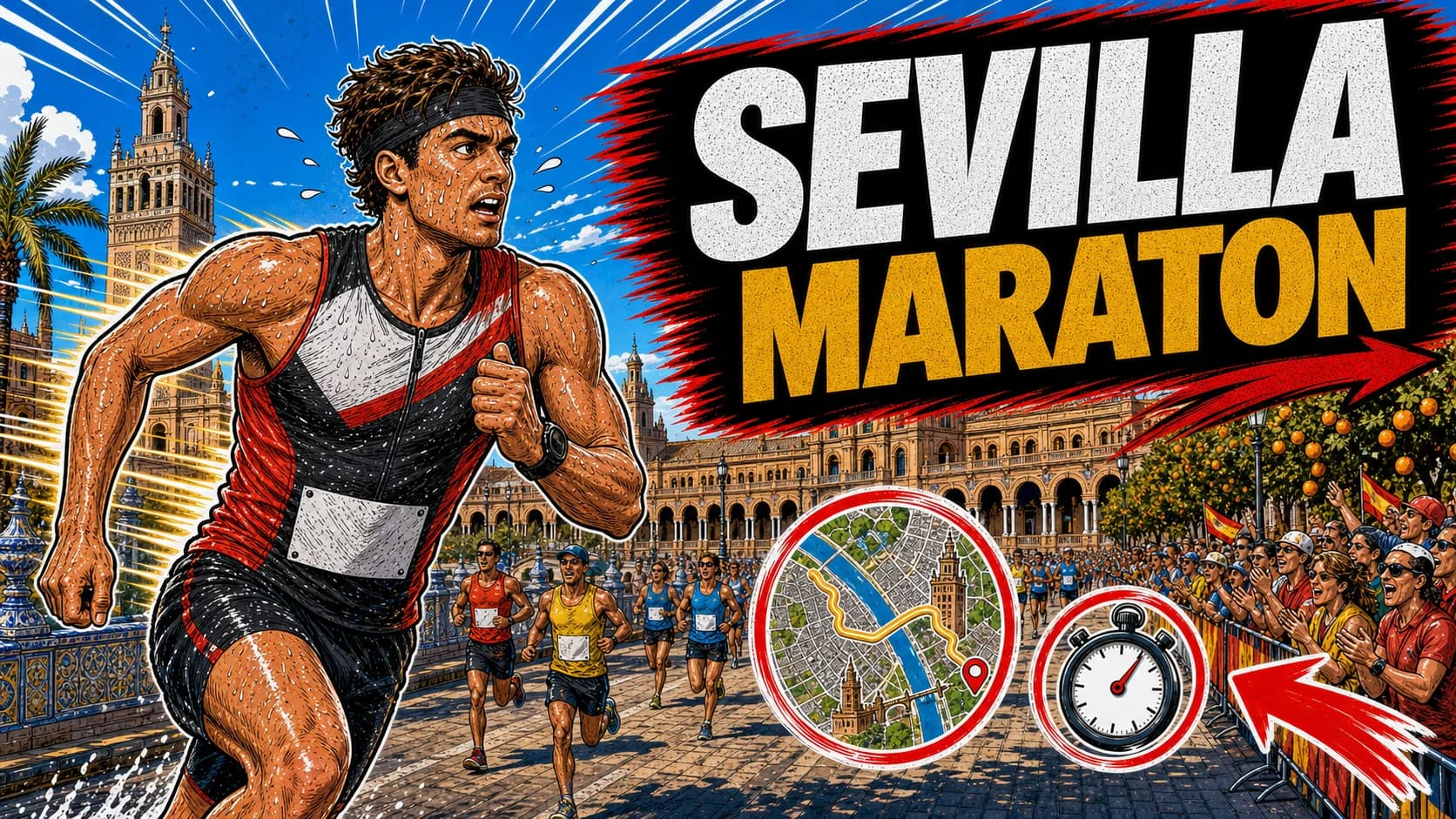
Zurich Seville Marathon 2027 Complete Guide — Spain's Fastest Flat Course, Cathedral, Triana and How to Train For It
Everything you need to know to run the Zurich Seville Marathon 2027: 42.2 km essentially at sea level, flat course past the Cathedral and Triana, World Athletics Platinum Label, ideal February weather, and a 16-week...
By Ramon Curto · Updated 2026-05-08
On February 21, 2027 Seville hosts Spain's second-fastest marathon after Valencia. Essentially flat course (<50 m total elevation gain), World Athletics Platinum Label since 2024, ~14,000 finishers, ideal Andalusian winter weather (8–15 °C, low humidity) and a route past the Cathedral, the Giralda, the Royal Alcázar, Plaza de España and Triana. This guide covers what the official site does not fully explain: why Seville is the best PB alternative to Valencia, what the course actually feels like, where the race breaks (kilometers 30–37 returning through Triana), and how to plan logistics for a weekend in the Andalusian capital.
📑 Table of contents
| Item | Information |
|---|---|
| Date | Sunday February 21, 2027 (3rd Sunday of February) |
| Distance | 42.195 km (marathon) |
| Elevation gain | <50 m (flat profile) |
| City | Seville, Andalusia (~10 m above sea level) |
| Start | Estadio Olímpico de la Cartuja |
| Finish | Estadio Olímpico de la Cartuja (loop course) |
| Start time | 08:30 CET |
| Organizer | IMD Sevilla + Zurich Spain |
| Category | World Athletics Platinum Label (since 2024) |
| First edition | 1985 |
| Registration | zurichmaratonsevilla.es |
The Zurich Seville Marathon is Spain's second-fastest marathon and one of Europe's most reliable PB courses. Organized by IMD Sevilla (the city's Sports Department) together with Zurich Insurance as title sponsor since 2017, the race has been built into a flat-course PB machine since 1985. The route starts at the Estadio Olímpico de la Cartuja, crosses the Puente del Alamillo, traverses the historic centre passing the Cathedral, the Giralda, the Royal Alcázar, Plaza de España and Parque de María Luisa, heads south along Avenida de la Palmera, returns through Triana crossing the Puente de Triana, and ends back at the stadium. Since 2024 it holds World Athletics Platinum Label, the highest tier in the international calendar — together with Valencia, the only two Spanish races at this level.
Seville is the best alternative to Valencia. If Valencia is sea-level course in December, Seville is near-flat course in February with monuments. What you give up in altitude (Seville sits at ~10 m, still effectively sea level) you gain in weather — February in Seville is one of Europe's best marathon weather profiles: 5–8 °C at the start, 12–18 °C at the finish, low humidity, typical sunshine. The average amateur runner trims 2–4 minutes off their previous best when switching from a hilly marathon (Madrid, Bilbao, Donostia) to Seville. And the finish rate exceeds 97% — one of the highest in Europe, thanks to the combination of flat course + mild weather + polished organization.
- If you ran a recent sub-3:30 on rolling terrain: target 3:23–3:27 here. Flat course + ideal climate give you back 2–4 minutes.
- If you come from half marathons and are debuting at the marathon distance: Seville is an excellent choice — flat profile, mild temperature and ~97% finish rate support first-timers.
- If your goal is sub-3h, sub-2:45, sub-2:30: it is the best February option and Spain's second alternative after Valencia.
- If you want a mega-event with massive crowds: Berlin, London or NYC play in another league. Seville sits around 14,000 finishers — more intimate.
- If tourism tempts you: the route passes Seville's top monuments. A weekend of race + tapas + Alcázar is one of the calendar's best sports getaways.
The Seville Marathon course is a loop that starts and finishes at the Estadio Olímpico de la Cartuja (north Seville), passes every iconic monument in the historic centre, and returns. The profile is dead flat: <50 m total elevation gain, no significant ramp anywhere on the course. The only "climb" of the route is the Puente del Alamillo ramp at km 1 — irrelevant for the clock.
- Km 0–3 — Start at Estadio Cartuja → Puente del Alamillo: you exit the stadium heading south and cross the Guadalquivir River via the Puente del Alamillo (Calatrava). Only "ramp" of the route. Resist the urge to start fast.
- Km 3–10 — North into the historic centre: wide avenues, smooth asphalt, comfortable pace. Keep heart rate under control.
- Km 10–18 — Monumental centre: you pass the Cathedral, the Giralda, the Alcázar, Plaza de España and Parque de María Luisa. The most beautiful stretch of the route. Do not speed up because of the visual rush — classic mistake.
- Km 18–28 — South along Avenida de la Palmera: long straight avenue heading south. Pace shakeout zone. Lock target pace.
- Km 28–35 — Return through Triana: you cross the river back via the south, run through the Triana neighborhood and re-cross via the Puente de Triana. This is where the race breaks for most runners.
- Km 35–42 — Final approach to Cartuja: north back to the stadium. If you have managed effort, the final 7 km feel manageable. If not, you pay for the centre overpacing.
- "Sevilla Marathon Cathedral Pass" (km 12): iconic segment passing the Cathedral.
- "Triana Bridge Loop" (km 32): the Triana Bridge crossing — critical closing point.
- "Estadio Cartuja Final Approach" (km 41): final ramp to the finish line.
The Seville Marathon was born in 1985 as a popular race in the Andalusian calendar. For two decades it stayed a mid-scale regional event. The qualitative leap came in 2017 with Zurich Insurance entering as title sponsor — since then, Zurich Maratón de Sevilla. Investment in organization, certified course, professional pacers and African elite attraction earned the race Bronze Label (2018), Silver Label (2020), Gold Label (2022) and finally Platinum Label in 2024 — World Athletics' highest tier, shared with Valencia as the only Spanish race at that level.
Course records were substantially updated in the 2024 edition. For definitive figures consult the official archive at zurichmaratonsevilla.es — absolute men's times hover around ~2:03 and women's around ~2:23, placing Seville among the world's fastest marathons in elite category.
| Tier | Approximate price |
|---|---|
| Early bird (June–September 2026) | €60–75 |
| Standard (October–December 2026) | €80–95 |
| Last minute (January 2027) | €100–120 |
| RFEA license (if not federated) | +€5 |
- Registration opens: June 2026 via zurichmaratonsevilla.es.
- Capacity: ~17,000–18,000 total bibs.
- Typically sells out: 4–6 weeks before race day (mid-January 2027).
- Bib pickup: Runner Expo at the Estadio Olímpico de la Cartuja or Pabellón Marrubial — Friday and Saturday before. NO race-day pickup.
📩 SportPlan Newsletter — we send an alert when Seville 2027 registration opens (June 2026) and another when it starts filling up. Subscribe here.
- By plane: Seville Airport (SVQ) — ~10 km from the centre. EA bus to Plaza de Armas in ~30 min, taxi €20–25.
- AVE (high-speed rail): from Madrid 2 h 30 min, from Barcelona 5 h 30 min, from Valencia 4 h 30 min. Santa Justa station.
- By car: A-4 from Madrid, A-92 from Granada, A-49 from Huelva. Limited parking on race day — better to use public transport.
- Metro Line 1: reaches the centre but does not go to Cartuja directly. Combine with bus or walking.
- City bus: lines C1, C2 and special reinforcements connect the centre with Estadio Cartuja on race morning.
- Tram (Metrocentro): connects Plaza Nueva with Prado de San Sebastián — useful if you stay in the centre.
- On foot: ~3 km from the centre to Estadio Cartuja — feasible walk for runners staying in Triana or near the river.
Ideal if: you want monumental tourism + easy access to the course (km 12–18 passes here).
- Hotel Alfonso XIII (5*) — iconic, next to the Alcázar.
- EME Catedral Mercer (5*) — Giralda views.
- Hotel Mercer Sevilla (5*) — restored palace.
- H10 Casa de la Plata (4*) — Macarena area.
- NH Collection Sevilla (4*) — Plaza Nueva area.
Ideal if: you want authentic Andalusian atmosphere, neighborhood tapas and you are 5 min walk from the course (km 32 passes here).
- Hotel Adriano (3*) — Triana classic.
- Aire de Sevilla Apartments — apartments with thermal pool.
- Casa del Capitel Nazarí (3*) — boutique.
Ideal if: you prioritize start/finish proximity — all 10–20 min walk from the stadium.
- Barceló Sevilla Renacimiento (4*) — closest to the stadium.
- Hesperia Sevilla (4*) — Cartuja area.
- AC Hotel Sevilla Forum (4*) — modern, next to the venue.
| Variable | Start 8:30 | Finish 11:00–12:30 |
|---|---|---|
| Temperature | 5–8 °C | 12–18 °C |
| Humidity | 65–80% | 45–60% |
| Wind | Light (Guadalquivir) | Light-moderate |
| Rain (last 10 years) | 2 editions with light rain | — |
| Sun | Typical from km 8 | Full sun |
February in Seville is one of the European calendar's most favorable climates for a marathon. The combination of cool start (5–8 °C) gradually rising to mild finish (12–18 °C), low humidity and consistent sunshine puts the race in the world's top "weather profiles". Compare with Berlin (September, ~12–18 °C but high humidity), Valencia (December, 8–14 °C, also ideal) or Boston (April, unpredictable).
- Top: technical short-sleeve; most runners start in shorts. For sub-3h: singlet.
- Bottoms: shorts. Long tights only if forecast <5 °C at start.
- Cap: optional — full sun in second half but mild temps. Useful if forecast >15 °C at finish.
- Arm sleeves: very useful — start cold, ditch them around km 8.
- Pre-race throwaway: old jacket to discard before the start (the organization collects items for donation).
A 16-week plan for Seville 2027 starts on November 2, 2026. Block structure:
- Weeks 1–4 (aerobic base): 4 sessions/week, 35–45 km/week, long run 18–22 km. No heavy quality work.
- Weeks 5–8 (introducing quality): 4–5 sessions/week, 45–55 km/week, long run 22–28 km. Short intervals (5×1,000 m, 6×800 m).
- Weeks 9–12 (marathon specificity): 5 sessions/week, 55–65 km/week, long run 28–32 km with target-pace segments.
- Weeks 13–14 (peak load): maximum volume and 32–35 km long run at 15–20 s/km slower than target pace.
- Weeks 15–16 (taper): progressive volume reduction, maintain intensity. Last week 30% of normal volume.
- Week 8: 24 km easy.
- Week 10: 28 km, last 10 km at target pace + 5 s/km.
- Week 12: 30 km with 16 km block at target pace.
- Week 14: 32 km dress rehearsal — test fueling and gear.
More detail in our marathon training plan guide.
| Punto | Tiempo acumulado | Parcial |
|---|---|---|
| 5 km | 24:53 | 24:53 |
| 10 km | 49:46 | 24:53 |
| 15 km | 1:14:39 | 24:53 |
| Media (21,1 km) | 1:45:00 | 30:21 |
| 30 km | 2:29:18 | 44:18 |
| Meta | 3:30:00 | 1:00:42 |
Los parciales suponen un ritmo constante y no incluyen paradas. En Zurich Maratón de Sevilla, adapta el esfuerzo al terreno y a las condiciones; no fuerces las bajadas para recuperar segundos.
| Goal | Average pace | Km 10 | Km 21.1 (½) | Km 30 | Km 42.2 |
|---|---|---|---|---|---|
| Sub-2:30 | 3:33 /km | 35:30 | 1:14:55 | 1:46:30 | 2:29:50 |
| 2:45 | 3:54 /km | 39:00 | 1:22:20 | 1:57:00 | 2:44:38 |
| 3:00 | 4:16 /km | 42:30 | 1:29:45 | 2:08:00 | 3:00:00 |
| 3:15 | 4:37 /km | 46:10 | 1:37:30 | 2:18:30 | 3:15:00 |
| 3:30 | 4:58 /km | 49:50 | 1:45:00 | 2:29:30 | 3:30:00 |
| 4:00 | 5:41 /km | 56:50 | 2:00:00 | 2:50:30 | 4:00:00 |
| 4:30 | 6:24 /km | 1:04:00 | 2:15:00 | 3:11:30 | 4:30:00 |
| 5:00 | 7:06 /km | 1:11:00 | 2:30:00 | 3:33:00 | 5:00:00 |
| Finish | 7:06+ /km | — | — | — | <6:00 cutoff |
- Start: pace 6:30–7:00 /km. Do not speed up in the monumental centre — that is the trap.
- Aid stations: water at EVERY point, sports drink from km 15.
- Gels: 1 every 35 min from km 8 (4 gels total).
- Final: from km 35, single mission: walking is OK, stopping is not. Finishing is the win.
- Start: target pace from km 1. Flat course, no extra conservation needed.
- Aid stations: sports drink from km 10, water at every point.
- Gels: 1 every 25 min from km 6 (6 gels total).
- Final: km 30–37 is decision time — pace or bust. If you arrive with margin, drop pace in the last 5 km.
- Start: neutral first km, target pace from km 2.
- Official pacers: the organization fields pacers at 2:30, 2:45, 3:00, 3:15, 3:30, 4:00.
- Gels: 1 every 20 min with caffeine from km 12.
- Final: attack from km 35 — final 7 km has <20 m elevation.
- Moderate negative split: target first half 30–60 s slower than the second. Flat course allows it.
- Conserve first 15 km: Seville's trap is speeding up in the monumental centre due to the visual high of the Cathedral, the Giralda and the Alcázar. Every second banked at km 12 you pay back multiplied at km 35.
- Triana return is where you break: if you reach km 28 with legs, you decide the race. If you arrive empty, the next 14 km feel long.
- Final stretch: the last 2 km return to Estadio Cartuja with a slight downhill into the finish — save fuel for the final 800 m.
- Thursday: 7–10 g of carbohydrates per kg of body weight.
- Friday: 8–10 g/kg.
- Saturday: 8–10 g/kg, low fiber and fat.
- Sunday breakfast (3 h before): 100–150 g of carbohydrates. White bread + honey + banana + coffee.
- Gels: 30–60 g of carbohydrates every 25–35 min depending on goal.
- Water: sip at every station from km 5.
- Sports drink: from km 15 alternate with water.
- Caffeine: 100–200 mg total — one caffeine gel near km 30.
Seville in February starts at 5–8 °C — a black coffee 60–90 min before helps wake up and oxidize fat. Take coffee at the hotel, not at the start-line bar (huge queue).
- Shoes: carbon-plated if going sub-3:30 (Nike Vaporfly/Alphafly, Adidas Adios Pro, ASICS Metaspeed Sky). For finishers, your usual long-run shoe — do not break in anything new.
- Socks: technical, tested in at least one long run. Anti-chafe Vaseline on toes.
- Top: short-sleeve technical. The official bib shirt do not break in — test beforehand.
- Bottoms: shorts with pockets for 4–6 gels.
- GPS watch: yes, but do not obsess over per-km pace — Seville has GPS-loss zones (bridges, tall centre buildings).
- Gel belt: optional if your shorts have enough pocket capacity.
| Marathon | Month | Elevation | Category | Speed | Best for |
|---|---|---|---|---|---|
| Valencia | December | ~12 m | Platinum | #1 Spain | Absolute PB |
| Seville | February | <50 m | Platinum | #2 Spain | PB with ideal weather |
| Madrid | April | ~270 m | Gold | Slow | Atmosphere, not PB |
| Barcelona | March | ~150 m | Gold | Medium | Urban hilly |
| Roma Ostia (½) | March | <30 m | — | Fast | Half marathon |
| Berlin | September | ~50 m | Platinum | World record | Mega-event |
For more calendar options, visit the race agenda and browse by region.
Sunday February 21, 2027, 08:30 CET start from the Estadio Olímpico de la Cartuja.
Yes. Course with <50 m total elevation gain, ~10 m above sea level and World Athletics Platinum Label since 2024. The only faster Spanish race is Valencia (December).
June 2026. Typically sells out 4–6 weeks before race day. Total quota around 17,000–18,000 bibs.
Between €60–75 in early bird (June–September 2026) and €100–120 in last-minute (January 2027). RFEA license +€5 if not federated.
No. The Seville Half Marathon runs in January as a separate event (slug medio-maraton-de-sevilla-2027). Marathon day is marathon-only.
No. The Runner Expo closes Saturday at 20:00. Mandatory pickup Friday or Saturday at Estadio Cartuja or Pabellón Marrubial.
Start 5–8 °C, finish 12–18 °C, low humidity, typical sunshine. 8 of the last 10 editions had ideal conditions. One of the European calendar's best marathon weather profiles.
Kilometers 30–37, on the Triana return toward Estadio Cartuja. Breaking is not from terrain (all flat) — it is from overpacing in the monumental centre or under-fueling. Solution: gel every 25 min from km 6.
- zurichmaratonsevilla.es — official website.
- Wikipedia — Seville Marathon — history and palmarès.
- RFEA — Spanish Athletics Federation — federative license.
- World Athletics — Label Road Races — official Platinum listing.
- SportPlan — Seville Marathon 2027 — event page, discounts, SportPlan community.
- Spanish road races calendar — full agenda.
This guide is updated each edition. Last review: 2026-05-08. If you spot stale data, reach out via SportPlan.
Keep planning
Use SportPlan to compare dates, save target events, and build a season that fits your weekends instead of another unstructured list.