
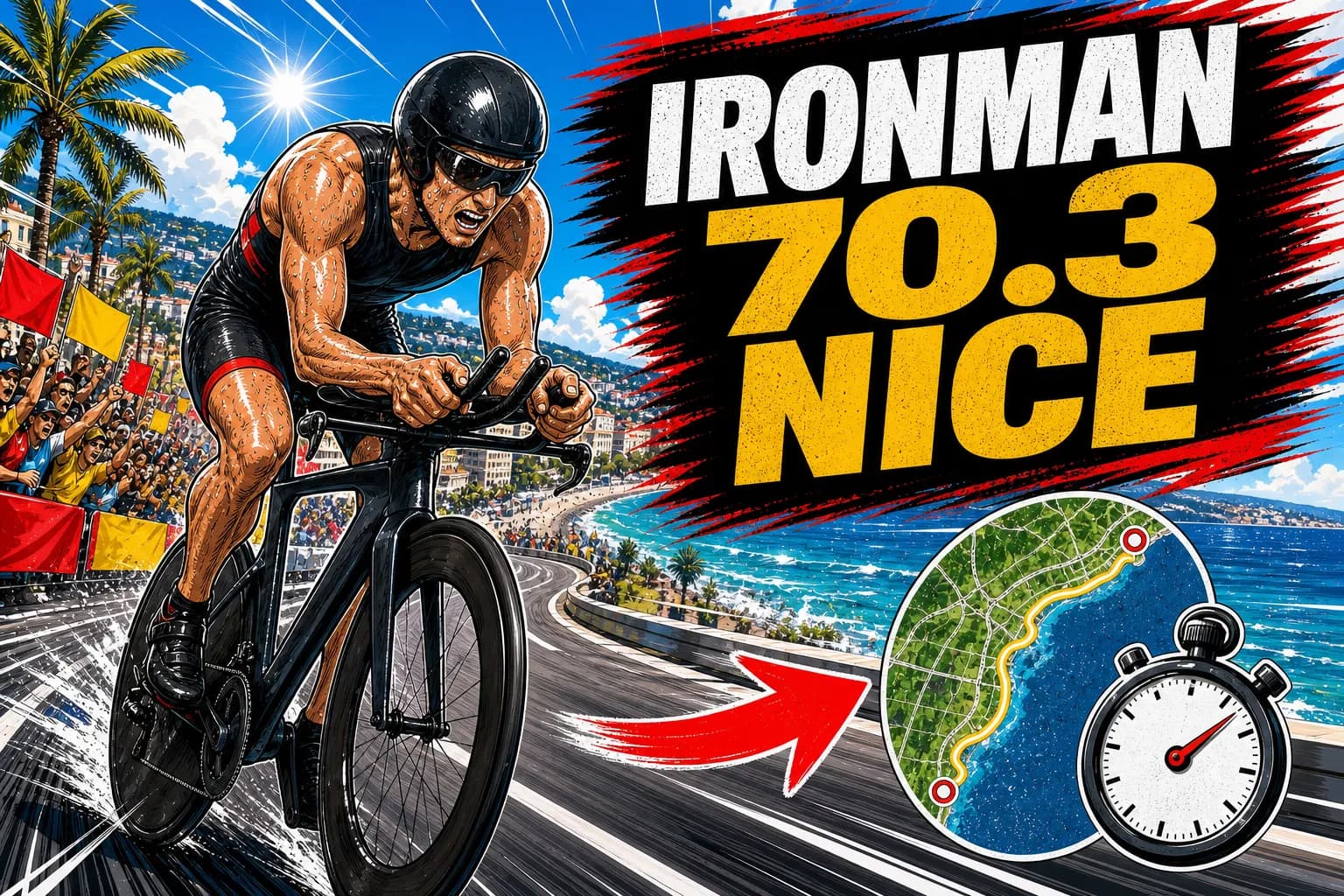
IRONMAN 70.3 World Championship Nice 2026: Athlete Guide
Confirmed guide to the 2026 IRONMAN 70.3 World Championship in Nice on 12–13 September: qualification, course status, travel, training and race-week checks.
By Ramon Curto · Updated 12 July 2026
The 2026 IRONMAN 70.3 World Championship takes place in Nice, France, on 12–13 September 2026, and it is a qualifier-only championship: there is no open registration, so every start spot must be earned at a qualifying IRONMAN 70.3 race. Nice is one of the most proven venues in long-course triathlon, and the organizer has confirmed the shape of the day — an ocean swim, a hilly bike leg through the Alpes-Maritimes and a flat run on the Promenade des Anglais — but not the final maps, schedule or cutoffs. This guide separates what is confirmed from what is still pending, so you can qualify, book travel and train with confidence without gambling on details that do not exist yet. If you are still hunting for a slot, browse upcoming qualifying races in our worldwide event discovery calendar.
Start with what the organizer has actually published. The official 2026 IRONMAN 70.3 World Championship page is the canonical reference for everything below.
| Question | Confirmed answer |
|---|---|
| Where? | Nice, France |
| When? | 12–13 September 2026 |
| How do I enter? | Qualification only — no open registration |
| Swim | 1.9 km ocean swim |
| Bike | 90 km through hilly Alpes-Maritimes terrain |
| Run | 21.1 km on the flat Promenade des Anglais |
| Total distance | 113.1 km (standard 70.3) |
| Planning indicators | High air 26 °C, low air 18 °C, average water 16 °C |
Nice has earned this championship the hard way. The city hosted the IRONMAN 70.3 World Championship in 2019, the men's full-distance IRONMAN World Championship in 2023 and the women's full-distance IRONMAN World Championship in 2024, so the venue and its supporting logistics have already absorbed several world-championship weeks.
As of 12 July 2026, the official course page describes the character of each leg but not the detail. Full course maps, the exact roads, the elevation profile, the race-week schedule, start times and cutoff times have not been released. The temperature figures above are planning indicators supplied by the organizer, not forecasts. The practical consequence: do not build your race plan, your accommodation choice or your pacing targets around numbers that are not yet official. Everything in this guide that depends on unpublished detail is framed so it stays true when the maps arrive.
Every age-group athlete on the start line earned a slot at a qualifying IRONMAN 70.3 race. The process is described on the official age-group qualification page: slots are allocated at qualifying events, and if you earn or inherit one you must accept it in person at that race's post-race awards and roll-down ceremony. If you leave before roll-down, the slot passes down the line — so if a Nice start matters to you, plan to stay for the ceremony at every qualifier you race. Note that Nice itself hosts a separate qualifying race, IRONMAN 70.3 Nice, on 28 June 2026; racing it is one route to a championship slot, but it is not the World Championship. If your longer-term ambitions run to the full distance, our IRONMAN World Championship Kona 2026 guide covers how that pathway differs.
The swim is 1.9 km in the open sea. The organizer's average-water indicator of 16 °C is on the cool side, so do a meaningful share of your swim training in a wetsuit and in open water, and wait for the official ruling on wetsuit use rather than assuming it. The bike is 90 km through hilly Alpes-Maritimes terrain. Until the profile is published, prepare for sustained climbing and confident descending rather than a flat time-trial effort — that is the character the region's roads impose. The run is 21.1 km on the flat Promenade des Anglais. Flat does not mean easy: a seafront run offers little shade, and with a planning high of 26 °C you should practise running off the bike in warm conditions long before race week.
Nice is one of the easiest world-championship venues to reach. The airport sits about 3 km southwest of the city centre, close enough that many athletes need no more than a short tram or taxi ride with a bike bag. Nice-Ville is the main rail station for arrivals by train, and drivers reach the city on the A8 motorway. Once you are in town, the Lignes d'Azur network covers trams and buses across the city and advertises a seven-day pass for 20 euros, which comfortably spans a race week. Check the official travel directions page before you book, because event-week road closures and venue access details will appear there first.
With no final maps published, anchor your booking to the one location fact you have: the run takes place on the Promenade des Anglais, so staying centrally, within easy walking distance of the seafront, keeps you close to the run course and well placed for wherever registration and transition land when the schedule is confirmed. Two practical rules follow. Book refundable accommodation now, because championship weeks fill early and you want the freedom to adjust once official venue details appear. And resist paying a premium for proximity to any specific point on the bike course, because that detail simply is not known yet.
Counting back from 12–13 September, a 16-week block starts in late May. Weeks 1–4: consolidate your base with consistent swim frequency, easy aerobic riding and running, and regular strength work. Weeks 5–10: build specificity — one long ride per week that seeks out sustained climbs and practises the descents, one long run, and open-water swims in your wetsuit. Weeks 11–14: sharpen with race-simulation sessions — a ride at your intended effort followed immediately by a run in warm conditions, plus at least one full rehearsal of your fuelling plan. Weeks 15–16: taper, cutting volume while keeping short doses of intensity, and protect your sleep. This framework deliberately avoids prescribing exact targets: set your own numbers from your training data, and adjust the terrain emphasis once the official profile is published.
- Re-read the official pre-race information page when you arrive; check-in windows, briefings and transition timings will be published there.
- Complete athlete check-in early in the window rather than at the last minute.
- Build or collect your bike with time to spare and test-ride it, including the brakes and every gear.
- Swim at least once in the sea before race day to confirm your wetsuit choice against the actual water temperature.
- Recon whatever course sections have been published officially by then, on foot or by bike.
- Lay out race kit and nutrition the night before, and keep a backup transport plan for the early start.
Without an elevation profile or official cutoffs, pace by effort rather than by course landmarks. In the swim, settle into a rhythm you have rehearsed in open water instead of chasing feet that are too fast. On the bike, cap your effort on the climbs at an intensity you have sustained in training, and ride the first half conservatively — a hilly 90 km punishes early enthusiasm. On the run, the flat promenade invites even or negative splits: start at an effort you know you can hold for a half marathon in warm conditions, and only lift in the final third. Treat heat, not gradient, as the likeliest variable on the run, and adjust effort to conditions on the day.
The official on-course nutrition listing currently names Maurten GEL 100 and GEL 100 CAF 100 gels alongside Precision Fuel & Hydration PH 1000 electrolyte drink, which carries 1,000 mg of sodium per litre. If you plan to race on course nutrition, train with those exact products for months, not weeks; if they do not agree with you, rehearse carrying your own instead. There is no universal dose — carbohydrate and sodium needs vary widely between athletes, so test and adjust in your race-simulation sessions rather than borrowing someone else's numbers. On equipment: fit gearing you can climb comfortably on, have your brakes serviced ahead of a descending-heavy region, and check your wetsuit for fit and wear in open water well before you travel.
More detail is answered on the official race FAQ page as it is updated.
It takes place in Nice, France, on 12–13 September 2026. Nice previously hosted the 70.3 World Championship in 2019 and the full-distance World Championship races of 2023 (men) and 2024 (women).
No. IRONMAN 70.3 Nice on 28 June 2026 is a separate race that serves as a qualifier. The World Championship is the standalone event on 12–13 September 2026, open only to athletes who have qualified.
Not yet. The organizer has confirmed an ocean swim, a hilly Alpes-Maritimes bike leg and a flat run on the Promenade des Anglais, but detailed maps, elevation data and timings are still pending.
You must earn a slot at a qualifying IRONMAN 70.3 event and accept it in person at that race's post-race awards and roll-down ceremony. There is no open registration for the World Championship itself.
Fly into Nice's airport, roughly 3 km southwest of the centre, or take a train to Nice-Ville station. Locally, Lignes d'Azur trams and buses cover the city, with a seven-day pass advertised at 20 euros.
The organizer's planning indicators are a high of 26 °C, a low of 18 °C and an average water temperature of 16 °C. Treat these as training-planning guides, not forecasts, and check real conditions during race week.
This article was corrected on 12 July 2026. An earlier version described the 2026 IRONMAN 70.3 World Championship with a different Spanish host city and a late-March date; that information was wrong. The confirmed venue and dates are Nice, France, on 12–13 September 2026. Course maps, the race-week schedule, start times and cutoffs will be added to this guide only when they appear on official organizer pages or in the official athlete guide — never from third-party speculation.
Keep planning
Use SportPlan to compare dates, save target events, and build a season that fits your weekends instead of another unstructured list.