
SPORTPLAN
DiscoverTop RacesBlogCalculators
Sign in
SPORTPLAN

A clearer way to discover events, build your season, and keep results in one place.

DiscoverAboutContactPrivacy Policy
Email us

© 2026 SportPlan. All rights reserved.

by Dockia Labs

SPORTPLAN

A clearer way to discover events, build your season, and keep results in one place.

Email us

Product

  • Discover
  • Top Races
  • Blog
  • Calculators

Sports

  • Running
  • Trail Running
  • Triathlon
  • Gravel
  • Road Cycling
  • HYROX
  • OCR / Spartan
  • Swimming

Cities

  • Barcelona
  • Madrid
  • Valencia
  • Sevilla
  • Bilbao
  • Málaga
  • Girona
  • Zaragoza

Company

  • About
  • Contact
  • Privacy Policy
  • Terms of Service
  • Cookie Policy

© 2026 SportPlan. All rights reserved.

by Dockia Labs

DiscoverTop RacesSign in
IRONMAN World Championship Kona 2026 Complete Guide — The Cathedral of Triathlon | SportPlan
IRONMAN World Championship Kona 2026 Complete Guide — The Cathedral of Triathlon
51 min read·triatlontriathlon

IRONMAN World Championship Kona 2026 Complete Guide — The Cathedral of Triathlon

IRONMAN World Championship Kona 2026 Complete Guide

IRONMAN World Championship Kona 2026 Complete Guide

By Ramon Curto · Updated 2026-05-06

📖 28 min read 📝 ~9,000 words 🎯 Skim friendly

On Kailua-Kona once again hosts what most triathletes consider the most demanding race in the world: the . 226 km split across , the and the lava fields of the , with hammering crosswind at km 75–95 of the bike. This is not a mass-participation event: it's through a regional IRONMAN, and the bib costs over before you even talk about flights to KOA or hotels on Ali'i Drive. This guide covers what the official site doesn't quite spell out: how you actually qualify, what each of the three segments really feels like, where the race breaks, how to train 40+ weeks for a World Championship in Hawaii, and how to put the trip together from Europe.

On this page

Key factsAbout the raceThe course — the three segmentsHistory and past championsQualification and pricingGetting there and parkingWhere to stayWeatherHow to train for it — 40+ week planPace calculatorPersonalized race planRace plan — the three segmentsNutritionGearFAQCompared with other IRONMAN races

Related articles

October 10, 2026
IRONMAN World Championship
Kailua Bay
Queen Kaahumanu Highway
Energy Lab
28–32 °C heat, 70–90 % humidity and the Mumuku winds
mandatory qualification
$1,300
⚡ Quick verdict
  • One line: the cathedral of triathlon. The most prestigious race in the sport and one of the toughest events on the global calendar — heat + humidity + wind as a triangle of difficulty.
  • Best for: advanced triathletes who have already qualified, with at least 3–4 IRONMAN finishes and a dedicated heat block in the legs.
  • Skip if: you're debuting at long distance, or your best IRONMAN bike split tops 6h00 — Kona is the worst place in the world for a debut.
  • Key data: 3.86 km swim + 180.25 km bike + 42.195 km marathon = 226 km · ~1,700 m elevation gain on the bike · ~3,500 bibs · 90+ countries.
  • Registration: qualification mandatory — not for debutants at a regional IRONMAN within your age-group slot count. Also via Foundation slots, Janus Charity Challenge (~$2,000), Kona Inspired and a very limited lottery.
📑 Table of contents
  1. Key facts
  2. About the race
  3. The course — the three segments
  4. History and past champions
  5. Qualification and pricing
  6. Getting there and parking
  7. Where to stay
  8. Weather
  9. How to train for it — 40+ week plan
  10. Pace calculator
  11. Personalized race plan
  12. Race plan — the three segments
  13. Nutrition
  14. Gear
  15. FAQ
  16. Compared with other IRONMAN races

Key facts#

The essentials in one table: date, triathlon distances, bike elevation, start, organizer and official link.
ItemInfo
DateSaturday, October 10, 2026
Total distance226 km (3.86 km swim + 180.25 km bike + 42.195 km run)
Bike elevation gain~1,700 m
Run elevation gain~250 m
LocationKailua-Kona, Big Island of Hawaii, USA
Swim startKailua Bay, in front of Kailua Pier
Start time~06:25 pros · ~06:50 amateurs (confirm with official communication)
OrganizerThe IRONMAN Group (Wanda Sports)
RegistrationQualification mandatory · ironman.com/im-world-championship

The Kona triangle of difficulty: heat (28–32 °C) + humidity (70–90 %) + wind (30–50 km/h crosswind in the Mumuku zone). Any European IRONMAN you've completed in good conditions runs at 80–85 % of the physiological cost of Kona. This is the race where a sub-10h in Lanzarote turns into a sub-11h.


About the race#

What the IRONMAN World Championship really is, how exclusive it is, and why Kona is not for debutants.

The IRONMAN World Championship is the world final of the IRONMAN circuit and the most prestigious race in long-distance triathlon. It has been raced since 1978 on the Big Island of Hawaii — first on O'ahu, then in Kailua-Kona since 1981 — and is the only event on the calendar where every participant has to have qualified. There are no general bibs, no open registration, no early-bird. To stand on the start line in Kailua Bay you need to have finished a regional IRONMAN inside the slot count for your age group during the previous qualifying cycle, win one of the Foundation slots, complete the Janus Charity Challenge with the corresponding donation, or get in via the very limited Kona Inspired lottery.

📷 Photo TBD · About the race header

Mass swim start at sunrise in Kailua Bay with hundreds of swim caps entering the water next to Kailua Pier — the postcard of the sport.

Kona isn't just longer, it's a different race. Every IRONMAN on the calendar covers the same distances (3.86 + 180.25 + 42.195 km), but the physiological cost of Hawaii doesn't look like anywhere else. The combination of radiant heat + high humidity + Mumuku winds turns an athlete who rolls sub-9h00 in Frankfurt into a sub-9h45 in Kona. The difference isn't training, it's context: water at 26–28 °C, asphalt that hits 50 °C at midday, crosswinds at km 75–95 of the bike that have knocked moto press riders off at 60 km/h, and the lava fields of the Energy Lab at km 25–32 of the marathon, where radiant temperature under your visor can hit 40 °C.

Is this race for you?#

  • If you've qualified at a regional IRONMAN with comfortable margin inside the slot count: yes. This guide is for you.
  • If you've barely qualified (rolldown from the last slot): yes, but arrive 10–14 days early to acclimatize to the heat. The difference between an acclimatized athlete and one who flies in straight from European winter is 20–40 minutes in Kona.
  • If you're not qualified and you're getting in via Foundation / Janus Charity Challenge: make sure you have at least 3–4 IRONMAN finishes before stepping into Kailua Bay. Don't debut in Kona. It's the worst place in the world for your first long-distance race.
  • If you're coming from IRONMAN 70.3 and have never raced the full distance: absolutely no. Race a flat European IRONMAN first (Barcelona, Hamburg, Roth) and save Kona for your fourth or fifth.
  • If you're training to validate a sporting dream: yes, that fits. But arrive humble — Kona doesn't get "completed" like any IRONMAN; it demands a specific heat + wind + nutrition prep that an average European IRONMAN doesn't.

See other IRONMAN races on the calendar →

The course — the three segments#

Three races within the race: a bay with currents, a highway with crosswind, and a marathon through lava fields — where it's won, where it's lost, and where it breaks.

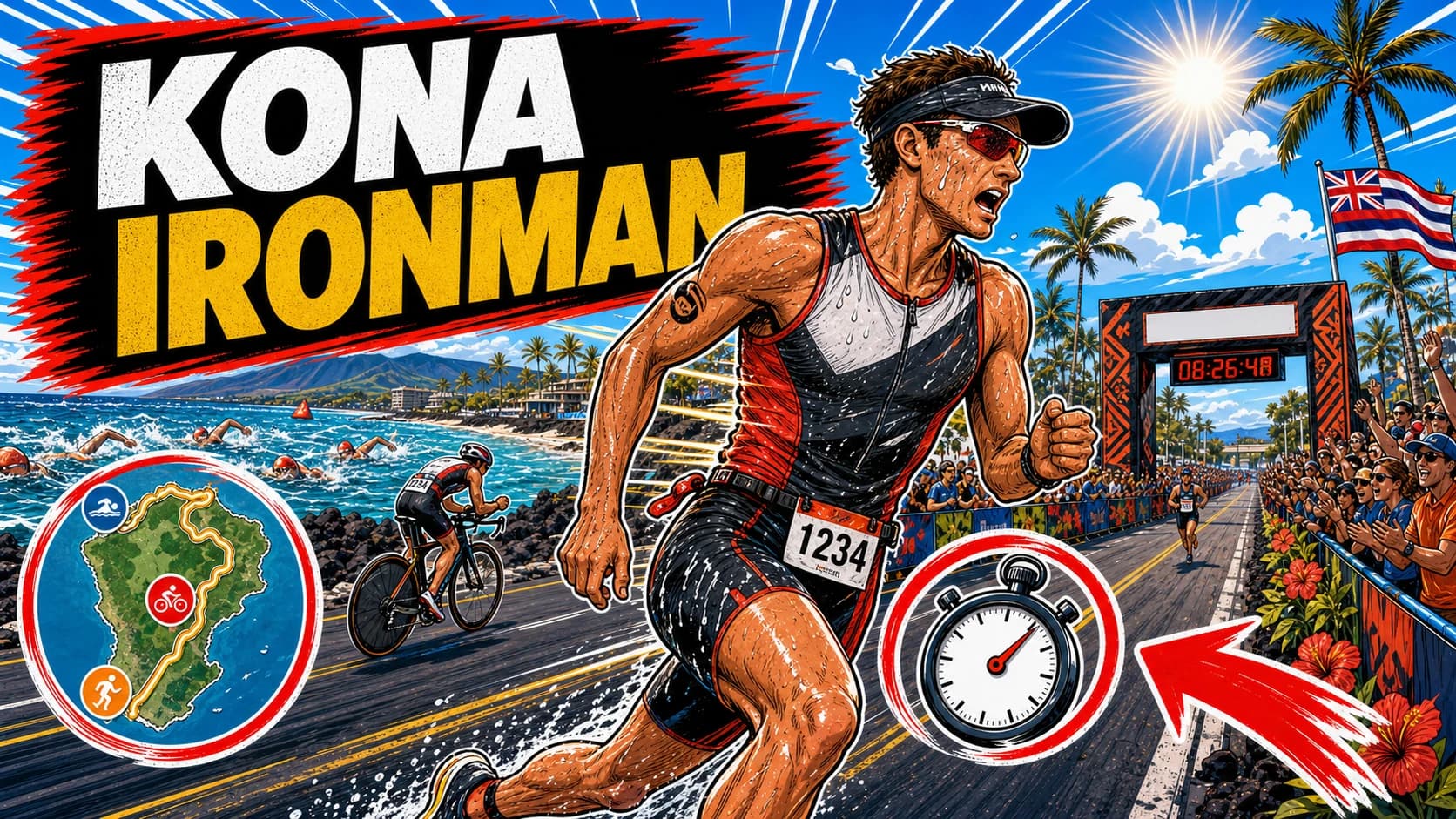
IRONMAN Kona is run on a single course that starts and finishes in Kailua-Kona. The swim is a rectangle in Kailua Bay (3.86 km, one lap), the bike is an out-and-back along the Queen Kaahumanu Highway to Hawi (180.25 km, ~1,700 m elevation gain), and the marathon covers Ali'i Drive first and then Queen Kaahumanu out to the Energy Lab (42.195 km, ~250 m gain). The race isn't decided in any single one of the three segments: it's decided by how you manage the sum.

📷 Photo TBD · 3D map of the full course

Official 3D map of the IRONMAN Kona course with the three segments highlighted — the bay, the highway out to Hawi, and the marathon to the Energy Lab.

Swim — 3.86 km in Kailua Bay#

The swim start is right in front of Kailua Pier, in the heart of Kailua-Kona. It's a mass start by gender (men and women going off in separate groups a few minutes apart) directly into the Pacific. The course is a single rectangle marked by big yellow buoys: 1.9 km north, right turn, ~150 m crossing, 1.9 km south back to the pier — the postcard of the sport.

What makes the Kona swim unique:

  • Crystal-clear but salty water (26–28 °C) — no wetsuit allowed for pros and most age-groupers (IRONMAN rule: above 24.5 °C wetsuits cannot be used to qualify for anything).
  • Lateral currents — the current can push you 10–15 m off line if you don't lock visual references on every breath.
  • Big contact early — the mass start creates 2–3 minutes of washing-machine contact until the group spreads. It's brutal, especially at the first buoy.
  • Underwater visibility 15–20 m — you'll see tropical fish below you, which paradoxically becomes a distraction.
  • No easy draft — the start is wide and there's no lateral wall; the strong swimmers pull away fast.

Target swim time: 55:00–1:05:00 for strong swimmers (sub-1:00 marks the front pack); 1:05:00–1:15:00 for the middle pack; 1:15:00–1:25:00 for comfortable but not fast swimmers. Swim cutoff: 2 hours 20 minutes from the start.

Bike — 180.25 km on Queen Kaahumanu Highway#

Transition 1 (T1) is at Kailua Pier, 50 metres from the swim exit. You come out of the water, quick towel, helmet, bike shoes, and head north on the Queen Kaahumanu Highway (the "Queen K"). It's a single out-and-back with the turnaround at Hawi at km 90 — the northernmost point of the course.

📷 Photo TBD · Queen Kaahumanu Highway

Triathlete in aero position riding the Queen Kaahumanu Highway with black lava fields on both sides — the iconic image of the Kona bike.

The profile:

  • Km 0–25 (Kona → Kawaihae): gentle false flats. Warm up. Don't get sucked into early breakaways — Hawi is still 65 km away.
  • Km 25–75 (Kawaihae → Mumuku zone): light rolling climb. Average speed drops, heart rate stays steady.
  • Km 75–95 (Mumuku winds zone): the stretch where the bike is decided. Crosswinds of 30–50 km/h pushing the front wheel sideways. Press motos have crashed here. If you're running a tall aero helmet, you'll feel it.
  • Km 95–105 (Hawi turnaround): final ~3 km climb at 5 % into the turnaround. Highest point of the course (~150 m). This is where most riders lost the rhythm.
  • Km 105–135 (descent from Hawi): fast but dangerous because of the lateral wind. Keep hands close to the brakes. Hawaii descents aren't technical but they are fast and exposed.
  • Km 135–180 (back to Kona): the stretch that destroys the amateur field. Radiant sun, asphalt at 50 °C, headwind or crosswind. This is where pace falls apart if nutrition and hydration have failed.

Total elevation: ~1,700 m gain — moderate for a 180 km bike, but the combination with wind and heat multiplies it. Average speed for an amateur ranges from 28–32 km/h (5h45–6h30); pros roll at 40–43 km/h (4h10–4h25).

🚨 Where the Kona bike breaks

🚨 Mumuku winds km 75-95 — where the bike is decided

The stretch between Kawaihae and Hawi is officially called the Mumuku zone because of the local wind. The Mumuku winds are gusts that come off the western flank of Mauna Kea and cross the Queen Kaahumanu almost perpendicular to the direction of travel. Average speeds of 30–50 km/h, gusts up to 70 km/h.

The problem: a disc rear wheel or a tall aero helmet turn into a sail. Athletes who train with deep-section gear on flat European bike paths discover here that they can't control the bike. Crashes in this section are frequent.

The trick: if you have any doubt about your crosswind technique, run mid-profile wheels (50–60 mm) instead of a disc and a short aero helmet without long tails. Drop your power target by 5–10 W in this section and keep hands close to the brakes. You give up 90 seconds but you get to the marathon in one piece.

Marathon — 42.195 km from Ali'i Drive to the Energy Lab#

T2 is back at Kailua Pier. Bike on the rack, run shoes, hat, handheld bottle, and head south on Ali'i Drive. It's a marathon in three clearly different blocks: 16 km along the coast, 12 km up the Queen K to the Energy Lab, and 14 km through the lava fields + back to the finish.

Block 1 — Ali'i Drive (km 0–16):

This is the "easy" stretch — in quotes. You leave Kailua Pier heading south, parallel to the ocean along Ali'i Drive (Kona's residential coastal walk), with crowds on both sides, palm trees, partial shade and ocean breeze. Turnaround at km 8 (Lyman Street) and back to the pier to head north on the Queen K. Pace runs higher here than the rest of the marathon because the temperature is the most manageable, the sea breeze cools you, and your body still has glycogen.

Block 2 — Climb to the Queen K and Energy Lab (km 16–32):

This is where it all changes. You leave the coastal walk, climb a short 4 % ramp to the Queen Kaahumanu Highway and head north. The asphalt soaks up the sun like an oven (radiant surface temperature at 14:00 tops 50 °C), there is no shade, the sea breeze ends and humidity stays at 70 %.

Km 25–32 — the Energy Lab. The course leaves the Queen K to the left, drops a deceptive descent to the Natural Energy Laboratory of Hawaii Authority (the "Energy Lab"), a research compound surrounded by black lava fields. It's the lowest point of the course, down to sea level, in a wind-blocked basin where radiant temperature peaks. This is where the marathon meets you.

🚨 Energy Lab km 30 — the lava fields where the marathon meets you

Three factors collide in these 7 km:

  1. Radiant temperature 40 °C+ — the black lava reflects and emits heat at chest height.
  2. Wind-blocked basin — the air is dead still, sweat doesn't cool you.
  3. Solitude — minimal crowds, long quiet kilometres without external stimulus.

The classic "Kona breakdown" happens here. Athletes who passed km 21.1 on target pace enter the Energy Lab, watch their pace climb 30 seconds per km in five kilometres, and by km 32 they are walking.

The trick: don't reach km 25 at the limit. If your Ali'i Drive pace (km 0–10) was 4:30 min/km and by km 20 you're already at 4:50, you've lost the race. Hold Ali'i Drive pace 5–10 seconds slower than your overall marathon goal pace to leave margin for the Energy Lab. Hydrate at every aid station, ice on your head, cold sponges on shoulders and neck.

Block 3 — Energy Lab back to the finish (km 32–42):

You leave the Energy Lab, climb the same deceptive descent in reverse (now a 4 % climb) and rejoin the Queen K. 10 km of Queen K heading south with headwind or crosswind, low sun on the horizon if you're in a late amateur group, and the final descent into Kailua-Kona via Palani Road. The last 1.5 km is a loop on Ali'i Drive with the crowd on its feet.

Marathon target time in Kona: 3h00–3h15 for the front age-group pack; 3h30–3h50 for the middle pack; 4h00–4h30 for the mid-late pack. Add 20 to 40 minutes to your best stand-alone marathon — that's the cost of Kona.

Total cutoff for IRONMAN Kona: 17 hours from the swim start (typically midnight). Intermediate cutoff T1: 2h20. Intermediate cutoff T2: 10h30 after the start.

History and past champions#

Since 1978 — the original triathlon World Championship, the last 5 editions cross-checked against Wikipedia, course records.

The IRONMAN World Championship has been raced since 1978. The original idea came out of an O'ahu argument among swimmers, cyclists and runners about who was the most complete athlete. Gordon Haller won the first edition (15 entrants) in 11h46. The race moved to Kailua-Kona in 1981 and has been the continuous home of the World Championship ever since, with two exceptions: 2020 cancelled by the pandemic, and 2021 raced in St. George (Utah) in May 2022 as an alternate venue.

📷 Photo TBD · History header

Iconic image of a finisher crossing the line in Kailua-Kona at sunset, with the "You Are An Ironman" banner — the postcard of the sport.

Key data for the IRONMAN World Championship:

ItemValue
First edition1978 (O'ahu, 15 athletes)
First edition in Kailua-Kona1981
Editions raced45+ (through 2025)
Distances3.86 km swim · 180.25 km bike · 42.195 km run = 226 km
Participants (Kona, typical year)~3,500
Countries represented90+
Absolute Kona record men7:35:53 (Patrick Lange, GER, 2024)
Absolute Kona record women8:24:31 (Lucy Charles-Barclay, GBR, 2023)

Past champions (last 5 editions)#

Verified winners and times for the 5 most recent editions (2021 raced in St. George; 2023 with split Kona/Nice format; 2024–2025 both genders in Kona):

YearVenue🥇 MenCountryTime🥇 WomenCountryTime
2025Kailua-KonaCasper Stornes🇳🇴 NOR7:51:39Solveig Løvseth🇳🇴 NOR8:28:27
2024Kailua-KonaPatrick Lange🇩🇪 GER7:35:53 (CR)Laura Philipp🇩🇪 GER8:45:15
2023Nice (M) / Kona (W)Sam Laidlow🇫🇷 FRA8:06:22Lucy Charles-Barclay🇬🇧 GBR8:24:31 (CR)
2022Kailua-KonaGustav Iden🇳🇴 NOR7:40:24Chelsea Sodaro🇺🇸 USA8:33:46
2021St. George (UT)Kristian Blummenfelt🇳🇴 NOR7:49:16Daniela Ryf🇨🇭 SUI8:34:59

Data verified against the public archive at Ironman World Championship (Wikipedia EN). 2020 was cancelled due to COVID. The 2023 format split the two competitions by gender: men in Nice (France) and women in Kona. For 2026 both are back to Kailua-Kona.

📊 Real stats for IRONMAN World Championship Kona
  • Finisher rate: ~92 % (vs. 88–90 % for a regional IRONMAN in temperate climate). DNFs in Kona usually concentrate on the marathon — the heat + Energy Lab combo triggers heat-stroke or GI shutdowns.
  • Time-band distribution (age-group, recent editions):
    • sub-9h00 — 4 % (front age-group elite)
    • 9h00–10h00 — 14 %
    • 10h00–11h00 — 22 %
    • 11h00–12h00 — 24 %
    • 12h00–13h00 — 18 %
    • 13h00–14h00 — 11 %
    • 14h00–17h00 — 7 %
  • Gender split: ~70 % men / 30 % women. The female share keeps climbing.
  • Median age: 42 (most-represented band: 40–49).
  • Historical weather (last 5 editions): ambient temperature 28–32 °C, humidity 70–90 %, water 26–28 °C, average bike wind 25–35 km/h with gusts up to 60 km/h in the Mumuku zone.

Qualification and pricing#

How you actually qualify, what slots are available by age and gender, alternative routes (Foundation, Janus, Kona Inspired) and the total cost of the adventure.

Unlike any other IRONMAN on the calendar, Kona doesn't get registered — it gets earned. The official qualification system works like this: every regional IRONMAN on the circuit (Frankfurt, Lanzarote, Hamburg, Nice, Cozumel, Cairns, etc.) hands out a fixed number of Kona slots to age-groupers, in proportion to the size of each category. If you finish inside your age-group slot count and claim the slot at the Roll-Down ceremony the next day, you've qualified. If you decline, the slot rolls down to the next athlete.

📷 Photo TBD · Roll-Down ceremony

Athlete standing up to claim their Kona slot at a regional IRONMAN Roll-Down ceremony — the moment that changes the next 12 months of their life.

Official routes to Kona 2026:

  1. Regular qualification at a regional IRONMAN (qualifying cycle August 2025 → July 2026). The vast majority — ~85 % of bibs.
  2. Foundation slots — slots reserved for the IRONMAN Foundation. ~50 slots a year, minimum donation $5,000–10,000.
  3. Janus Charity Challenge — slot in exchange for raising ~$2,000 for a charity tied to the program. ~60 slots a year.
  4. Kona Inspired — narrative program where 8 inspirational stories are picked each year. Application by video + essay.
  5. Lottery age-group — ~50 slots drawn among qualifiers who didn't get a slot at their regional IRONMAN. Typical ratio: 1 in 30.

Qualifying times by age group (reference)#

These are the approximate times that have historically qualified in each age band. They are not official times — slot count changes every year depending on category size and field strength:

Age groupMen (qualifying threshold)Women (qualifying threshold)
18–24~9h45~10h45
25–29~9h30~10h45
30–34~9h25~10h35
35–39~9h25~10h35
40–44~9h35~10h45
45–49~9h45~11h00
50–54~10h10~11h30
55–59~10h45~12h15
60–64~11h30~13h15
65–69~12h30~14h00

Reference times based on recent roll-down counts at IRONMAN Hamburg, Frankfurt and Lanzarote. Confirm the actual slot count published by the organizer of whichever IRONMAN you're targeting.

Total cost of the adventure#

An IRONMAN Kona 2026 from Europe runs between €6,000 and €12,000 all-in. Typical breakdown:

ItemEstimated cost (EUR)
IRONMAN Kona bib$1,300 ≈ €1,250
USAT federation license$50 ≈ €48
Regional IRONMAN qualifier (previous bib)€700–900
Direct Europe → KOA flights (10 days early, 2 people)€2,500–4,000
Lodging in Kailua-Kona (10 nights, double)€3,000–6,000
Rental car for 10 days (mandatory)€600–900
Bike air transport€200–400
Food + supplements on island€500–800
Travel + cancellation insurance€100–200
Total~€9,000–14,500
💡 SportPlan tip

If total cost is the blocker, split the trip in two: your partner or supporter can arrive 2–3 days before the race, not 10 like you. You need the heat acclimatization and the recon rides on the Queen K; your supporter does not. Saves €1,500–3,000 on flights, hotel and food.

Getting there and parking#

Direct flights to KOA from the US west coast + connections from Europe, mandatory rental car on the island, and why you should forget about public transport.

Kailua-Kona is on the western coast of the Big Island of Hawaii. The reference airport is Kona International Airport (KOA), located about 12 km north of the town of Kailua-Kona. Direct flights into KOA come mostly from San Francisco (SFO), Los Angeles (LAX), Seattle (SEA), Vancouver (YVR), Tokyo (NRT/HND), Sydney (SYD) and Honolulu (HNL). There are no direct flights from Europe — the standard combination is a flight to Los Angeles or San Francisco + a domestic connection to KOA (8 + 5 hours + 4–6 h of layover).

📷 Photo TBD · KOA Kona International Airport

Arrival at Kona International Airport — open-air Hawaiian-style terminal with palm trees and ocean view. The first heat + humidity slap for the European athlete.

Common routes from Europe:

  • Madrid / Barcelona → LAX → KOA (via American, United or Iberia + domestic connection): 16–20 h total, 3–6 h layover.
  • Frankfurt / Munich / Amsterdam → SFO → KOA (Lufthansa/KLM + United): 18–22 h total.
  • London → LAX → KOA (BA + American): 16–20 h total.
  • Paris → SFO → KOA (Air France + United): 18–22 h total.

What to keep in mind:

  • Bike as sports luggage — most airlines charge it as "oversize" (~€150–250 each way). Confirm with your airline, especially for the domestic leg into Hawaii — Hawaiian Airlines has different policies.
  • Jet lag acclimatization — Hawaii is 11–12 hours behind central Europe. You arrive at 14:00 local time with your body on 02:00. Arrive 7–10 days before the race to settle the circadian rhythm and acclimatize to the heat.

Rental car — mandatory:

Kailua-Kona has no functional public transport for an athlete. The distance between the airport and downtown (12 km), between downtown and the hotels in Keauhou (10 km south) or Waikoloa (45 min north), between your hotel and the supermarket to grab breakfast — all of it is done by car. Book an SUV or crossover with room for a bagged bike or bike box, or a minivan if you're travelling as a couple with two sets of luggage.

Race-day parking:

  • Don't drive to Kailua Pier on race morning. Streets are closed from 03:00.
  • Use the designated parking lots the organizer publishes a week before the race — usually between Walua Road and the Old Industrial Area, with shuttle to the pier from 04:00.
  • If you're staying within 1 km of the pier (Royal Kona, King Kamehameha): walk over with your transition bag. It's the simplest option.

Where to stay#

Three zones that work for an IRONMAN triathlete: Kailua-Kona village (next to the start), Keauhou (10 min south) and Waikoloa (45 min north). Pros, cons and specific hotels.

For an IRONMAN in Kona, staying less than 2 km from Kailua Pier isn't luxury — it's pure logistics. On race morning you leave the hotel at 04:30, drop your transition bag, head back to finish prepping, grab cold bottles from the fridge and walk to the pier at T-90 minutes. Any lodging that forces you into a car or shuttle that day adds unnecessary stress to the most important day of your year.

📷 Photo TBD · Kailua Pier at sunrise

View of Kailua Pier at sunrise with the bay lit up, the village in the background, and the main hotels (Royal Kona, King Kamehameha) in view — the "must-have" lodging zone.

What matters for an IRONMAN triathlete#

  • Big in-room fridge. For chilled bottles, salts, gels, fruit. A standard hotel mini-fridge isn't enough.
  • Independent and powerful AC. You'll spend 7–10 days on an island at 28–32 °C; you need to sleep well.
  • Bathtub with cold water or a temperate pool. For ice baths after training and recovery.
  • À la carte breakfast from 04:00 on race day — or fridge to prep breakfast yourself (pancakes, banana, coffee).
  • Late check-out until 16:00 Monday. Sunday you cross the line at 22:00–23:00; Monday you need sleep.
  • Free or cheap parking. Car is mandatory on the island, hotels charge $25–35/night for parking.
  • Real distance to Kailua Pier: <1 km on foot (village zone) or <1 km to the shuttle (outer zones).

Best zones for triathletes#

Kailua-Kona village — the definitive option (next to the start)#

  • Distance to Kailua Pier: 100–800 m on foot (1–10 min).
  • Pros: unbeatable logistics. Walk to the start and walk back. Restaurants nearby for Saturday night pasta. 24 h pharmacies.
  • Cons: prices spike a lot during race week — runner rates inflated 40–60 %. Book 12 months out.
HotelCat.USD/night*To Kailua PierTriathlete edge
Royal Kona Resort4*350–550600 m · 7 minBathtub, AC, bay view
Marriott Courtyard King Kamehameha's Kona Beach4*380–600100 m · 1 minNext to the pier, transition 50 m away
Outrigger Kona Resort & Spa4*320–500800 m · 10 minTemperate pool, gym
Kona Tiki Hotel3* boutique200–320700 m · 9 minEquipped kitchen, ocean balcony
Kona Seaside Hotel3*180–280200 m · 3 minBudget-friendly, next to the pier

Keauhou — the quiet option (10 min south)#

  • Distance to Kailua Pier: 10 km north (15 min by car).
  • Pros: guaranteed quiet, snorkel with sea turtles outside the door for supporters, resort properties with top-tier AC, big pools for recovery dips.
  • Cons: car required for every move. On race morning you wake at 03:30 to drive and drop your transition.
HotelCat.USD/night*To Kailua PierTriathlete edge
Sheraton Kona Resort & Spa at Keauhou Bay4*350–50010 km · 15 minBig pool, manta ray night view
Outrigger Keauhou Beach Resort4*300–4509 km · 14 minSnorkel, gym, early restaurant
Kona Coast Resort (apartments)3*+250–40011 km · 16 minApartment with full kitchen, ideal for couples

Waikoloa — the cheaper option (45 min north)#

  • Distance to Kailua Pier: 50 km north (40–55 min by car).
  • Pros: 30–50 % cheaper than Kailua-Kona. Big resorts with all amenities. Dry air (the dry side of the island).
  • Cons: 45 min by car on race morning. Wake at 03:00. And T2 brings you back to the pier; your car is in Waikoloa. Not recommended for your first IRONMAN Kona.
HotelCat.USD/night*To Kailua PierTriathlete edge
Waikoloa Beach Marriott Resort & Spa4*250–40050 km · 45 minPool, golf, AC, gym
Hilton Waikoloa Village4*+280–50050 km · 45 minMega resort, mantas, dolphins, all in-house
Mauna Lani Auberge Resorts5*600–1,00055 km · 50 minFull luxury if budget allows

*Reference rate for IRONMAN World Championship weekend (second week of October). Rates jump 40–60 % above normal Kona pricing. Book 12 months ahead if your qualification looks likely — Kailua-Kona village hotels sell out by March of race year.

💡 SportPlan tip

If your budget can't handle Kailua-Kona village, the optimal play is booking an AirBnB or VRBO in a private home in Holualoa (15 min by car from the pier, on the mountainside). Houses with pool, full kitchen, AC and cooler air — 40 % cheaper than the equivalent hotel, and many triathletes have historically rented in Holualoa for the "home" feel during 10 days.

Weather#

Heat + humidity + wind — the Hawaiian triangle of difficulty. Historical data, expected temperatures, and why arriving 7–10 days early is mandatory.

Kailua-Kona's weather in October averages 28–32 °C highs with 70–90 % relative humidity and water at 26–28 °C. It's the combination of all three variables — not any of them alone — that makes Kona the toughest race on the IRONMAN calendar. For a European athlete who's trained March through October at average temperatures of 18–24 °C, the physiological cost shows up on the very first ride.

📷 Photo TBD · Athlete hydrating in T1

Triathlete pouring water over their head in T1 with radiant sun, sweat and brutal heat appearance — the image that defines nutrition in Kona.

Kona's October heat map:

VariableTypical valueImplication
Ambient temperature at sunrise (06:00)23–25 °CComfortable swim start
Ambient temperature midday (12:00)30–32 °CBike under radiant sun
Ambient temperature afternoon (15:00)31–33 °CMarathon at peak heat
Average relative humidity70–90 %Sweat doesn't cool you — critical
Sea water temperature26–28 °CNo wetsuit most years
Asphalt temperature midday50–55 °CFeet burn through running shoes
Average bike wind (Mumuku zone)30–50 km/hCrosswind, not headwind
Rain probability20–30 %Short showers possible, not sustained

Why humidity is worse than heat:

At 32 °C with 30 % humidity (a dry day in Spain in July) your sweating works — sweat evaporates, cools you, you keep regulating temperature. At 32 °C with 80 % humidity (Kona in October) sweat doesn't evaporate — it pours off. You lose salts and water without getting the cooling effect. Core temperature climbs from the usual 37 °C to 38.5–39.5 °C — heat-stroke territory.

Heat acclimatization plan (minimum 14 days before the race):

  • Arrive in Kailua-Kona 7–10 days before race day. It is the most underrated factor in Kona success.
  • Heat sessions in the 4 weeks before flying out: sauna 20–30 min/day post-training (2–3 sessions/week), or indoor training in winter clothing (not glamorous, but it works).
  • On island, the first 3 days: rides of 60–90 minutes at low intensity (Z2). Don't test race pace. Core temperature spikes fast from jet lag + heat.
  • Day -7 to -3: specific rides on the Queen K rehearsing target pace. One 90 min bike session in the Mumuku zone to feel the wind.
  • Day -2 and -1: complete rest. Sodium loading. Don't get sunburned — you'll get sun on race day.

Pre-race hydration: in the 3 days before the race drink 3–4 litres/day with extra sodium (1–2 g of salt per litre). Your body needs to be over-hydrated by the time you hit the start line. Weigh yourself every morning when you wake up — overnight you sweat off weight; rebuild it with sports drink at breakfast.

How to train for it — 40+ week plan#

Volume by goal, Kona-specific sessions (heat + Mumuku winds), pre-trip heat acclimatization block, and how to combine the three disciplines.

The recommended plan to prepare for IRONMAN Kona is a 40+ week macrocycle split into four blocks: aerobic base (weeks 1–16), specific strength (weeks 17–24), specific IRONMAN build (weeks 25–36) and taper + heat acclimatization (weeks 37–40+). The difference compared to a regional IRONMAN is the heat + wind acclimatization and the total weekly bike load (12–18 h/week on the bike during the build block).

📷 Photo TBD · Long bike session

Triathlete in aero position riding a long session on open coastal terrain similar to the Queen Kaahumanu — real Kona-prep training.

Peak weekly volume by goal#

These are the peak-week volumes during the build block (weeks 28–34). The macrocycle average will be roughly 60–70 % of these numbers:

Final goalSwim/weekBike/weekRun/weekTotal hours/week
sub-9h0012–16 km350–450 km75–90 km24–28 h
9h00–10h0010–14 km300–400 km65–80 km20–25 h
10h00–11h008–12 km250–350 km55–70 km17–22 h
11h00–12h007–10 km220–300 km50–65 km15–19 h
12h00–13h006–8 km180–250 km45–55 km13–17 h
Finish (>13h00)5–8 km150–220 km40–50 km11–14 h

Macrocycle principles:

  • 80/20 polarized — 80 % in low aerobic zone (Z2), 20 % in high zones (threshold, VO2max). In IRONMAN, aerobic base beats any "fun" interval session.
  • One long bike per week of 4–7 hours during the build block. The two peak long rides (weeks 30 and 32) are 180 km — full race-day rehearsal.
  • Three long runs of 30+ km in the build block. Maximum long run is 35 km, not 42 — the IRONMAN marathon isn't trained, it's managed.
  • Mandatory brick every 2 weeks — combo session with a long bike + 30–60 min run off the simulated T2. The decisive factor in Kona.
  • Swim 3–4 times/week, with one long open-water session of 3–4 km (if you have access) in the 6 weeks before the race.

Sessions worth their weight in gold for Kona#

  1. Long brick simulating Hawi turnaround (weeks 28–34). 4 h on the bike with the final 60 min at race pace + a 45–60 min run at marathon goal pace. Learn to manage stacked fatigue.
  2. Heat session in the sauna (weeks 30–40). 20–30 min sauna post-training, 3 times/week. Boosts plasma volume and improves thermoregulation. Equivalent to training 5–7 °C cooler in Kona.
  3. Bike in lateral wind (whenever possible). If you live near coast or exposed terrain, hunt down 30+ km/h wind days and ride your aero gear. Crosswind technique can't be improvised.
  4. Progressive long run in heat zone (weeks 32–38). 25–30 km finishing the last 8 km at marathon goal pace, in the hottest hour of the day (not a fresh morning). Simulates the Energy Lab.
  5. Open-water swimming without a wetsuit (weeks 30–40). If you've got used to swimming in a wetsuit, you're missing the real feel. On Kona day you'll go without and you'll feel water on shoulders and hips like never before.

Heat acclimatization — the final 4 weeks#

Weeks outAction
-43 sessions/week sauna 20 min post-training · winter clothing on Z2 rides
-34 sessions/week sauna 25 min · long bike at the hottest hour of the day
-2Fly to Kailua-Kona (8–14 days early) · short Z2 rides at sunrise · sauna no longer needed
-1Short sessions on the Queen K · reinforced rest · 3–4 L/day with sodium loading

The taper is three weeks, not two. Week -3 at 70 % of volume, week -2 at 50 %, week -1 at 30 % keeping intensity in short pills. The two peak long sessions (weeks -7 and -5) are the ones that fill the cup.

Find a regional IRONMAN to qualify →

Pace calculator#

Calculate your pace and the times you have to hit at every checkpoint of the IRONMAN marathon. Print it and tuck it into your race belt.

Once you have your final IRONMAN marathon goal (after 3.86 km of swim + 180.25 km of bike, with 7–10 hours of racing already in the legs), this calculator gives you the average required pace (in min/km and min/mi) and the cumulative splits at 5K, 10K, 15K, half marathon, 30K and finish. Change the goal time in the field below and the table updates instantly:

🎯 Calculadora de ritmo y splitsEscribe tu tiempo objetivo para IRONMAN Kona Marathon
Ritmo medio requerido4:59 min/km
Equivalente en millas8:01 min/mi
PuntoTiempo acumuladoParcial
5 km24:5324:53
10 km49:4624:53
15 km1:14:3924:53
Media (21,1 km)1:45:0030:21
30 km2:29:1844:18
Meta3:30:001:00:42

Splits asumen ritmo constante. En carreras con desnivel real (IRONMAN Kona Marathon) — banca 5–8 s/km en bajadas y pierde el mismo margen en subidas; el ritmo medio se mantiene.

Important: this calculator is for the final marathon (the last 42.2 km of the IRONMAN), not for the full 226 km. To set your Kona marathon target split, use this rule: your best stand-alone marathon + 30–45 minutes. A sub-3h00 in a stand-alone marathon turns into a 3h30–3h45 in Kona after 7+ hours of prior racing.

Personalized race plan#

The calculator above gives you the marathon pace. But a real IRONMAN plan answers more questions: what target power on the bike? how do you swim the first 200 m? how many bottles do you carry? how much sodium per hour on the bike? when does the caffeine come in?

Set your goal, strategy and fueling plan. The planner generates a personalized plan by section (with paces, HR zones, bike power, mental cues and minute-by-minute fueling), a race-morning checklist, and a Plan B for the unexpected. Download it as a PDF to take with you on race day.

📋 Plan de carrera personalizadoConfigura objetivo, estrategia y avituallamiento. Genera tu plan paso a paso y descárgalo en PDF para llevártelo el día de carrera.
Estrategia de pacing
Ritmo medio4:59/km
Tiempo previsto3:30:00
Geles totales6
  • 📊 Ritmo por tramo con FC y cues mentales
  • ⏱️ Avituallamiento minuto a minuto (24 eventos)
  • ✅ Checklist de la mañana de carrera
  • 🆘 Plan B para los imprevistos

PDF A4, optimizado para imprimir y llevar el día de carrera.

Race plan — the three segments#

Detailed strategy for swim, bike and marathon. Pacing by goal, typical mistakes, and how to react if you slip off the plan.

An IRONMAN race plan isn't a plan — it's three sequential plans. The swim start, the transition to the bike, and T2 + marathon are three separate races with three different logics, connected by nutrition and thermoregulation.

Swim strategy (3.86 km)#

What decides the swim: positioning in the first 200 m, sighting every 6–8 strokes, not torching your upper body before getting on the bike.

  • Start position: if you swim sub-1:00:00, front row left. If you swim 1:00–1:10, mid-left. If you swim >1:10, right side or back. Don't get tangled up with faster groups — you'll lose 30 seconds to kicks and broken breathing.
  • First 200 m: fight for your square metre. 2–3 minutes of contact. If you get hit, lock the head pace and breathe to one side only.
  • Sight every 6–8 strokes: big yellow buoys mark the turns. Don't hug the side wall — the strong group goes wide, on the straight buoy-to-buoy line.
  • Legal drafting: sit on the feet of a swimmer 1–2 seconds faster than you. Saves you 5–10 % of energy. Across 3.86 km that's 5–8 minutes.
  • Final stretch back to the pier: lift the cadence slightly, loosen the shoulders to prep for T1. Don't sprint — sprinting at the end of the swim torches the most important segment (the bike).
  • T1 — Kailua Pier: rinse your feet, trisuit zipper already pre-cracked, helmet, glasses, race number, shoes clipped on the bike (if pre-installed). Out in under 2:30.

Bike strategy (180.25 km)#

What decides the bike: pacing by power/HR — not by speed, hydration every 15 minutes without fail, and controlled technique in Mumuku winds.

GoalTarget power (% FTP)Target HRExpected average speed
sub-4h30 bike70–75 % FTPHigh Z2 → Low Z340+ km/h
4h30–5h00 bike65–72 % FTPHigh Z236–40 km/h
5h00–5h30 bike60–68 % FTPMid-high Z232–36 km/h
5h30–6h00 bike55–65 % FTPMid Z230–32 km/h
6h00+ bike50–60 % FTPHigh Z1 → Low Z228–30 km/h

Tactical rules for the Kona bike:

  • Km 0–25 (easy start): 5 % less power than your target. You're warm, the headwind is variable, T1 cost more than you think. Hold low Z2.
  • Km 25–75 (cruise): target pace. Drink every 15 minutes, 80–100 g of carbs per hour, sodium 1.5 g/h.
  • Km 75–95 (Mumuku zone): 5–10 % less power, hands close to the brakes. Short aero helmet, no disc. If a gust hits you, gradual brake and reposition — don't fight the gust.
  • Km 90 (Hawi turnaround): final 5 % ramp. Hold your power, don't blow up on the climb — you have 90 km back and a marathon to run.
  • Km 95–135 (descent from Hawi): hands on the brakes, follow the white painted lines on the asphalt. Speeds of 60+ km/h with crosswind. A crash here is the end of your IRONMAN.
  • Km 135–180 (back to Kona): the stretch where amateurs break. Radiant sun, headwind, low glycogen. Hold the effort, not the speed. Average speed will drop 2–3 km/h, don't fight it.
  • T2 — Kailua Pier: running shoes, hat, sunglasses, race number, gels in the back pocket. Out in under 2:00.

Marathon strategy (42.195 km)#

What decides the marathon: patience in the first 16 km on Ali'i Drive, ruthless management of core temperature in the Energy Lab, push or hold from km 32 to the end depending on how you arrive.

Marathon goalTarget paceKona-specific tactical note
sub-3h004:16 min/kmBank 5–10 s/km in km 0–10 (Ali'i Drive). Hold pace km 10–25. Survive the Energy Lab.
sub-3h304:58 min/kmDon't go out at 4:50. Hold 5:05 the first 10 km. Gel every 4 km, salts every 30 min.
sub-4h005:41 min/kmSplits very even at 5:40–5:45. Walk 30 s at every aid station. Don't lose the pace at the Energy Lab — earn it back km 35–42.
sub-4h306:24 min/kmWalk-run from km 21 (walk 30 s every km). Hydration mandatory at every aid station.
sub-5h007:06 min/kmWalk-run from km 1: 8 run / 1 walk. Ice on the head from km 10.
Finish7:30+No watch. Enjoy Ali'i Drive at night, the spectator signs, the lit-up finish line.

Specific tactics for the Kona marathon:

  • Aid stations every 1.6 km (1 mile): drink at every single one. Water, sports drink, cola, chicken broth (yes — it's real, the organizer puts it out from km 30+).
  • Ice on head, neck and inside the trisuit — volunteers hand out ice bags at every aid station. The single most important trick of the Kona marathon.
  • Cold sponges — 2–3 sponges in the trisuit chest panel, squeezed over the head every 5 minutes.
  • Heart rate — not pace: in heat, HR climbs 5–10 bpm for the same speed. Adjust by HR, not by the watch.
  • Solid food outside, liquid inside: gels + cola + chicken broth. Heavy solid food (bars) does NOT work in Kona — the gut shuts down with the heat.

Race morning#

  • Wake up: 04:00 (3 h before the start).
  • Breakfast: 03:00 before the start. Pancakes + banana + honey + coffee (tested in bricks). 100–120 g of carbs.
  • Leave the hotel: 04:30. Hotel in Kailua-Kona village = walk; Keauhou/Waikoloa = car + designated parking + shuttle.
  • Transition bag: already dropped the day before at official check-in. You only carry bottles and clothes.
  • Swim warm-up: get in the water 15 minutes before the start, 200 m of easy breaststroke + 4 build-ups of 30 m.
  • Corral: start position in the water by pace (see swim strategy).

Post-finish — the first hour#

  • Hydrate before you eat. Sports drink + 500 ml water in the first 5 minutes.
  • Mylar blanket. Yes, in Hawaii too — core temperature drops fast once you stop.
  • Finisher tent: basic massage available, light food (roast chicken, fruit, the traditional IRONMAN ice cream).
  • Walk back to the hotel if it's nearby. 10–15 minutes of stir-walking prevents vasovagal syncope.
  • Lukewarm shower, NOT cold — the thermal shock after 11 hours in heat is real. Shower at 25–28 °C, 10 minutes.
  • Light dinner: sandwich + soup + beer (the celebration). Monday morning full breakfast.

Save this event in SportPlan →

Nutrition#

IRONMAN nutrition is science. Carbs per hour on the bike, sodium loading by heat, gels + solids + liquids, and the first 60 minutes of recovery.

The nutrition strategy for IRONMAN Kona pivots on 70–90 g of carbs per hour on the bike, 50–70 g/h on the marathon, 1.5–2 g of sodium per hour (key in Hawaii) and 800–1,000 ml of fluid per hour on the bike (more than at any other IRONMAN on the calendar). Nutrition starts the Tuesday before the race with carb-loading and doesn't end until the Monday after with recovery.

📷 Photo TBD · Pre-race nutrition table

Triathlete laying out gels, salts, sports-drink mix bottles and bars on the hotel table the night before — nutrition is half the game in Kona.

Carb-loading the 3 days before#

  • Wednesday–Thursday: 8–10 g/kg/day of carbs. Pasta, rice, bread, fruit. Cut fibre to avoid GI issues on the bike.
  • Friday (race-eve): 10–12 g/kg/day. Early dinner (18:00–19:00), light, familiar food. Zero alcohol, zero spicy food, zero raw vegetables.
  • Saturday (race day): breakfast 03:00 before the start. 100–120 g carbs. Pancakes, banana, honey, coffee.

Bike fueling plan (180.25 km)#

Bike goalCarbs/hourBottles/hourWhen to take them
sub-4h3080–100 g/h2 bottles + aero bottleEvery 15 min — gel + sports drink
4h30–5h0070–90 g/h2 bottles + aero bottleEvery 15 min — gel + sports drink
5h00–5h3070–85 g/h2 bottles + aero bottleEvery 15–20 min
5h30–6h0060–80 g/h2 bottlesEvery 20 min
6h00+50–70 g/h2 bottlesEvery 20–25 min

Bike aid stations (IRONMAN Kona organization):

  • Every 15–18 km (~10 stations across 180 km).
  • Liquids: water + Gatorade Endurance (orange).
  • Solids: gels (Maurten, GU), bars, bananas, dates.
  • Ice and water for the head.
  • Don't experiment in the race with products you haven't tested — diarrhea at km 130 ends your day.

Marathon fueling plan (42.195 km)#

Marathon goalCarbs/hourWhen to take them
sub-3h0070–80 g/hGel every 4 km + cola at aid stations
sub-3h3060–75 g/hGel every 5 km + cola at aid stations
sub-4h0050–65 g/hGel every 6 km + cola at aid stations
sub-4h3045–60 g/hGel every 8 km + cola
5h00+35–50 g/hGel every 10 km + cola + occasional solid

Marathon aid stations:

  • Every 1.6 km (1 mile): ~26 stations across the marathon.
  • Liquids: water, Gatorade Endurance, Coca-Cola (yes — legal and very effective at km 25+).
  • Solids: gels, bananas, fruit, chicken broth at km 30+ (sodium + warm restarts the gut).
  • Ice: head, neck, armpits. At every aid station.

Sodium — the critical Kona variable#

Unlike a European IRONMAN (where 800–1,200 mg/h of sodium is enough), in Kona you need 1,500–2,000 mg/h because of the heat + humidity combo. How you stack it:

SourceTypical sodiumQuantity
Sports gel (Maurten Drink Mix 320)250 mg1 every 30 min
Gatorade Endurance (600 ml bottle)500 mg1 bottle every 30 min
Salt capsule (Salt Stick)215 mg1 every 30–45 min
Chicken broth (cup)800 mg1 every 60 min from km 30+

Total target: ~1,500–2,000 mg/h on the bike, 2,000+ mg/h on the marathon.

Hyponatremia warning sign: if at km 100 of the bike you feel nausea + headache + finger swelling, DO NOT drink more water — take 2 salt capsules with the next sports drink. Hyponatremia (low sodium) takes 50–100 athletes/year out of Kona.

Recovery post-finish — first 4 hours#

  • 0–10 min: sports drink + water (500–1,000 ml total).
  • 10–30 min: light real food. Sandwich + banana + soup. If you're nauseous, fluids only.
  • 30–60 min: second meal. 30 g protein + 80 g carbs (turkey sandwich + banana + juice).
  • 2–4 h: full normal meal. Celebration beer here, not earlier.
  • Night sleep: cool mattress, AC at 22–23 °C, gentle hydration if you wake (350 ml water + salts).
  • Monday: 20-minute walk or easy swim in the hotel pool. Zero hard exercise. Water + normal food + massage if you booked one.

Gear#

IRONMAN Kona gear — wetsuit (or not), TT bike with short aero helmet, transition bags, shoes, multisport GPS, and the details that fail.

Gear for IRONMAN Kona is complex and expensive. A well-spec'd TT bike runs €5,000–10,000, the aero helmet €300–600, the full transition with official bags €150–250, and supplements for 10 days on island €300–500. What's critical isn't expensive — it's tested. Debuting new gear in Kona is the recipe for a DNF.

📷 Photo TBD · TT bike in transition

Time-trial bike with short aero helmet, mid-profile wheels and aero bottle in the frame, racked on Kailua Pier the day before the race.

Swim#

  • Wetsuit: almost certainly NOT allowed (water at 26–28 °C, IRONMAN rule limit 24.5 °C). Wear a thin trisuit with good buoyancy and practice without a wetsuit in open water in the 6 weeks before the race.
  • Trisuit: one piece, fast-drying, back pocket for 2–3 gels, minimal pad for the 180 km of bike. Brands: Zoot, Roka, 2XU, HUUB.
  • Goggles: mirrored (radiant sun in the bay), antifog already applied. Two pairs: one on the head + one spare in T1.
  • Swim cap: provided by the organizer (color by wave). Bring a backup latex cap of your own.
  • Body Glide: armpits, neck, groin. Without a wetsuit the trisuit chafe is real.

Bike#

  • TT bike with short aero helmet — key in Kona because of the lateral wind. Common brands: Cervélo P5, Trek Speed Concept, Specialized Shiv, Canyon Speedmax.
  • Mid-profile wheels (50–60 mm) — NO disc rear. In Mumuku winds a disc is a sail. Trade off the 1–2 W aero loss for safety.
  • Short aero helmet without long tails — Giro Aerohead, Specialized Evade Tri, Kask Mistral.
  • Pedals and shoes — Look Keo or Shimano SPD-SL, already broken in. Bike shoes with velcro, not laces.
  • 2 aero bottles + 1 frame bottle — 2 L total capacity between aid stations.
  • Aero bottle between the aerobars with straw — makes it easy to drink every 15 min without lifting hands.
  • Garmin Edge 530/830/1040 or Wahoo ELEMNT — with power, HR, Queen K map loaded.
  • Spares: 2 tubes + CO2 cartridge + multitool + 1 brake pad. Punctures in lava are common.

Marathon#

  • Running shoes: carbon plate if you're sub-3h30 (Vaporfly 4, Adios Pro 4, Metaspeed Sky), super-trainer if you're 3h30–4h00 (Endorphin Speed, Mach X), protective daily trainer if you're >4h00 (Pegasus, Cumulus, Ghost). Tested across at least 3 long runs.
  • Thin technical socks — seamless, already broken in. Blisters in Kona come from the sock, not the shoe.
  • White cap with ice pocket — essential. A black cap soaks up the sun and raises core temp.
  • Sunglasses — Oakley Radar, Goodr, Roka. No exceptions. Hawaii's radiant sun + sweat washing your eyes = blurred vision.
  • Race belt with pockets for 6–8 gels + 1 small bag of salts.
  • Mineral SPF 50+ sunscreen, applied before the start to shoulders, arms, neck, back of calves.

Transition bags (official IRONMAN)#

BagTypical contents
Morning Clothes BagClothes you arrive at the pier in (flip-flops, t-shirt, hat) — collected at the end
Bike Bag (blue)Helmet, sunglasses, socks, bike shoes, pre-bike gel, vaseline
Run Bag (red)Run shoes, cap, race number, dry sunglasses, gels, salts
Special Needs Bike (km 90 Hawi)Extra bottle, special gel, spare aero gel
Special Needs Run (km 21 marathon)Extra gels, extra salts, change of socks if you plan it

GPS and electronics#

  • Multisport GPS watch: Garmin Forerunner 965 / Fenix / Epix · Coros Pace 4 · Apple Watch Ultra 2. Battery for 12+ hours. Charge to 100 % the night before, airplane mode.
  • Chest strap: yes, on top of the wrist sensor. More accurate than the optical reading on the watch for HR on the bike.
  • Headphones: NOT allowed at any segment of an IRONMAN.
  • Phone: optional. If you carry one, in a waterproof bag.

Pre-trip list from Europe#

  • Bagged or boxed bike → confirm with the airline
  • Aero helmet + backup training helmet
  • Bike shoes + run shoes + walking shoes
  • 2 trisuits, 4 technical socks, white cap
  • Watch + charger + chest strap + charger
  • Pedal-based or spider power meter — already calibrated
  • Gels, salts, sports-drink powder for 10 days (you won't find Maurten in Kona)
  • Vaseline, body glide, mineral SPF 50+ sunscreen
  • First aid: ibuprofen, anti-diarrheal, anti-emetic, bandages, kinesiology tape
  • Documents: passport, ESTA, travel insurance, IRONMAN qualification card

Compare with other IRONMAN races →

FAQ#

10 honest answers to the real questions: qualification, cost, danger, Kona vs Nice, and how to handle the heat.
How do I qualify for IRONMAN Kona 2026?

You need to finish a regional IRONMAN (Frankfurt, Hamburg, Lanzarote, Nice, Barcelona, Cozumel, Cairns, etc.) during the qualifying cycle (August 2025 → July 2026) inside the slot count for your age group. Each regional IRONMAN hands out a fixed number of Kona slots in proportion to the size of each category. If you finish inside the slot count and claim it at the Roll-Down ceremony the day after your IRONMAN, you've qualified. If you decline, it rolls down to the next athlete.

Alternative routes: Foundation slots ($5,000–10,000 donation), Janus Charity Challenge (raise ~$2,000), Kona Inspired (8 slots a year for inspirational stories), age-group lottery (1/30 ratio among qualifiers without a slot).

What does IRONMAN Kona cost in total from Europe?

Between €6,000 and €14,500 all in. Typical breakdown: Kona bib €1,250 + IRONMAN qualifier €700–900 + flights €2,500–4,000 + 10-night lodging €3,000–6,000 + rental car €600–900 + bike transport €200–400 + food and supplements €500–800 + travel insurance €100–200. A couple pushes the total to €12,000–18,000. It's the most expensive race on the global triathlon calendar — but also the only cathedral of the sport.

Is IRONMAN Kona dangerous?

Yes, more than the average European IRONMAN. The risks are:

  1. Bike crashes from Mumuku winds (km 75–95). Crosswind 30–50 km/h with aero gear. Run mid-profile wheels and a short aero helmet, not a deep-section setup.
  2. Heat-stroke on the marathon Energy Lab (km 25–32). Radiant temperature 40 °C. Hydration every mile mandatory, ice on head and neck.
  3. Hyponatremia from over-drinking water without salts (~50–100 athletes/year DNF for this). 2,000 mg sodium/h on the marathon.
  4. Drowning in heavy chop on rough sea days. Don't line up front row if you swim >1:10:00.

The organizer has medical aid stations every 5 km on the bike and every mile on the marathon. Historical IRONMAN World Championship mortality is similar to other IRONMAN races (~1 in 75,000 finishers), not higher.

Is it better to train for Kona or Nice?

Depends on your strength. The IRONMAN World Championship rotates the men's venue between Kona (even years: 2024, 2026, 2028) and Nice (odd years: 2023, 2025, 2027). Women race in Kona from 2024 onward. Each venue rewards different profiles:

  • Kona rewards strong rouleurs with heat tolerance + good in flat with wind. Bike less demanding in elevation (1,700 m gain) but brutally demanding in thermoregulation.
  • Nice rewards strong climbers + good descenders. Bike with 2,500+ m elevation in French alpine terrain. Marathon along a fresher seafront than Kona.

If you weigh <70 kg and have a climbing background, Nice fits you better. If you weigh >75 kg and perform on flat + heat, Kona. Decide by physiology, not by prestige (Kona has the history; Nice is building its own).

When should I arrive in Kailua-Kona before the race?

Minimum 7 days, optimal 10–14 days early. Reasons:

  1. Jet lag: Hawaii is 11–12 hours behind central Europe. The body needs 5–7 days to settle the circadian rhythm.
  2. Heat acclimatization: the heat adaptation curve starts at 48 h and completes at 10–14 days. Arriving 3 days before leaves you half-adapted.
  3. Course recon: riding the Queen K, swimming in Kailua Bay, running Ali'i Drive — knowing what's coming reduces anxiety by 30–40 %.

Pro tip: arrive on the Saturday before race week (8 days early), train easy 3–4 days, rest 4 days, prep gear 2 days out, race day. Your supporter can fly in 2–3 days later to save costs.

What if the Mumuku winds are extreme on race day?

The organizer keeps the race on unless gusts top 80 km/h sustained or waves in Kailua Bay prevent the swim start (historical case: 2003, 2.5 m sea, 30-minute delay). The most common scenario is gusts of 40–60 km/h in the Mumuku zone — challenging but rideable with the right gear.

Athlete Plan B: if you have any doubt about your crosswind technique in extreme gusts, drop your power target by 5–10 W in km 75–95 and keep hands close to the brakes. You give up 90 seconds but you arrive at the marathon in one piece. The athlete who insists on holding power target in extreme Mumuku winds is the athlete who hits the deck at 50 km/h.

What about jet lag — how do I manage it?

Hawaii is GMT-10 (11 hours behind peninsular Spain). Tested strategy:

  • 2 weeks before flying out: progressively push your bedtime back 30 min/day. Land on travel day going to bed at 01:00–02:00 European time.
  • Flight: try to sleep on the LAX → KOA leg (daytime in European clock, nighttime in Hawaiian clock).
  • Arrival: DO NOT nap when you land (late local time). Stay awake until 21:00 local. Light dinner, lukewarm shower.
  • Days 1–3: very easy rides at sunrise (06:00 local). Zero hard training. Reinforced hydration.
  • Days 4–7: you're inside the local rhythm. Work the reduced plan + course recon.
Can I race Kona with a wetsuit?

Almost never. The IRONMAN rule is: water >24.5 °C → wetsuit not allowed for any athlete who wants to qualify for anything afterwards (in Kona, everyone). Kailua Bay water in October usually sits at 26–28 °C, clearly above the limit. Historically only two editions (2010, 2014) saw water cold enough for wetsuit.

What you can use: a swimskin — non-buoyant textile suit that reduces drag without adding flotation. Brands: Roka SR1, HUUB Lurz X, blueseventy PZ4TX. Worth 30–60 seconds across 3.86 km — pays off if budget allows.

How do I handle the heat coming from European winter?

Heat is the real adversary in Kona and it has to be trained. Tested plan:

  1. Post-training sauna — 4 weeks before flying, 3–4 sessions/week of 20–30 min. Boosts plasma volume ~5 %, lowers HR for the same effort.
  2. Training in winter clothing — Z2 rides in a hoodie + long tights April–September simulate heat without a sauna. Not glamorous but effective.
  3. Reinforced hydration in the 7 days before flying — 3–4 L/day with sodium loading.
  4. Arrive 7–10 days early — completes the adaptation curve.
  5. Careful execution on race day — heart rate, not pace. Hydration at every aid station. Ice on head from km 1 of the marathon. Cola + chicken broth at km 25+.

Acclimatized athletes finish 20–40 minutes ahead of unacclimatized athletes in Kona. That's the difference between an age-group podium and being outside the top 30.

How does Kona compare to other regional IRONMAN (Lanzarote, Roth, Nice)?

Kona vs Lanzarote: Lanzarote is the toughest IRONMAN in Europe (2,500 m elevation gain on the bike, extreme wind). Physiological cost similar to Kona but for different reasons (Lanzarote elevation + wind; Kona heat + humidity + wind).

Kona vs Roth (Challenge Roth, not official IRONMAN): Roth covers 226 km in Germany on a fast profile (1,300 m gain). 40–60 minutes faster than Kona because of the lack of extreme heat. It's where world records get broken (Iden 7:18 in 2022).

Kona vs Nice: Nice has 2,500 m gain on the bike on French alpine terrain, fresher Mediterranean water. Rewards lean climbers. Marathon along a cool seafront, not lava. Times similar to Kona but a different athlete profile.

Kona vs Cozumel: Cozumel (Mexico, November) is the fastest race on the IRONMAN calendar — flat island bike, Caribbean water, mild November heat. 30–60 minutes faster than Kona because of less extreme heat.

Kona vs Cairns: Cairns (Australia, June) is Kona but with a more relaxed town, similar wind but less radiant heat. 15–25 minutes faster than Kona.

RacePlaceBike gainHeatPhysiological cost vs Kona
Kona (this guide)Hawaii1,700 m★★★★★Reference 100 %
LanzaroteSpain2,500 m★★★95 % (different profile)
NiceFrance2,500 m★★★92 %
RothGermany1,300 m★★75 %
FrankfurtGermany1,200 m★★★80 %
CozumelMexico<500 m★★★75 %
CairnsAustralia1,500 m★★★★90 %
BarcelonaSpain800 m★★★78 %

Compared with other IRONMAN races#

How Kona stacks up against the other big IRONMAN races on the global calendar — so you know exactly when to pick which.

The IRONMAN World Championship Kona is the World Championship — it doesn't compare to a regional IRONMAN, it's the level above that you only access via qualification. But understanding how the big IRONMAN races on the calendar position themselves helps you plan the path: which race to pick as a qualifier, which to pick as a "post-Kona" goal, and which to pick if Kona doesn't fit your physiology.

All these races are IRONMAN-distance (3.86 + 180.25 + 42.195 km), so the choice depends on month, profile, heat and prestige:

RaceMonthBike gainTypical heatBest for
IRONMAN Kona (this guide)October~1,700 m28–32 °C / 80% RHWorld Championship · qualification mandatory
IRONMAN NiceSeptember~2,500 m22–28 °CWorld Championship M (odd years) · climbers
IRONMAN LanzaroteMay~2,500 m20–28 °C / wind"Tough" European qualifier · wind
Challenge RothJuly~1,300 m18–28 °CPersonal records · not official IRONMAN
IRONMAN FrankfurtJune/July~1,200 m22–32 °CMain European qualifier · atmosphere
IRONMAN HamburgJune~500 m18–24 °CFlat European qualifier · fast
IRONMAN BarcelonaOctober~800 m22–26 °CEnd-of-cycle qualifier · Mediterranean
IRONMAN CozumelNovember<500 m26–30 °CPersonal record · end-of-calendar
IRONMAN CairnsJune~1,500 m22–28 °CAustralasian qualifier · scenic
IRONMAN Western Australia (Busselton)December<300 m20–28 °CEnd-of-year qualifier · flat

See all IRONMAN on the calendar →


Did this guide help? If you're racing Kona 2026, save the event in SportPlan to get weather forecast alerts, logistics reminders, and later, log your finish time. And if you're still qualifying, explore the upcoming IRONMAN calendar to find your qualifier.

Keep planning

Use SportPlan to compare dates, save target events, and build a season that fits your weekends instead of another unstructured list.

Browse events

On this page

  • Key facts
  • About the race
  • The course — the three segments
  • History and past champions
  • Qualification and pricing
  • Getting there and parking
  • Where to stay
  • Weather
  • How to train for it — 40+ week plan
  • Pace calculator
  • Personalized race plan
  • Race plan — the three segments
  • Nutrition
  • Gear
  • FAQ
  • Compared with other IRONMAN races
Home
Blog
← Back to blog
triatlontriathlon
16 min read

IRONMAN 70.3 World Championship 2026 Marbella Complete Guide — The Half-Ironman Pinnacle, Costa del Sol and How to Train For It

IRONMAN 70.3 World Championship 2026 Marbella Complete Guide

triatlontriathlon
23 min read

DATEV Challenge Roth 2026 Complete Guide — The World's Most-Loved Iron-Distance Triathlon, Solar Hill, Roth Stadium and How to Train For It

DATEV Challenge Roth 2026 Complete Guide

triatlontriathlon
20 min read

Norseman Xtreme Triathlon 2026 Complete Guide — The World's Most Extreme Iron-Distance Triathlon, Ferry-Jump Swim, Gaustatoppen Summit and How to Train For It

Norseman Xtreme Triathlon 2026 Complete Guide

R

Written by

Ramon Curto· Founder & editor

Fundador de SportPlan. Lleva una década corriendo carreras populares en España. Autor de las guías de Madrid, Valencia y Zegama-Aizkorri en SportPlan.