
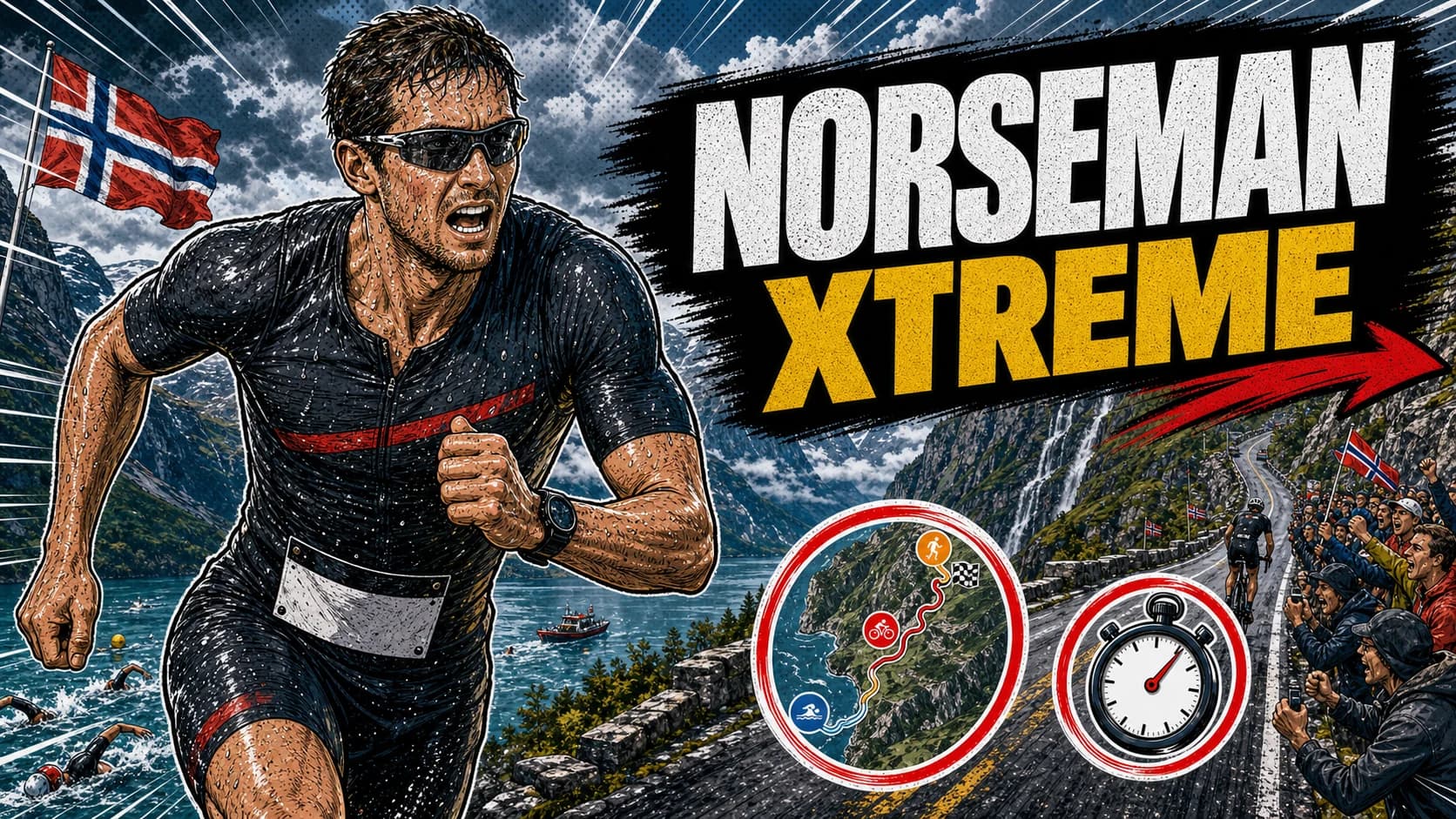
Norseman Xtreme Triathlon 2026 Complete Guide — The World's Most Extreme Iron-Distance Triathlon, Ferry-Jump Swim, Gaustatoppen Summit and How to Train For It
Everything you need to race Norseman Xtreme Triathlon 2026: 226 km in Norway with a pre-dawn ferry-jump swim into Hardangerfjord, a brutal bike across the Hardangervidda plateau and a marathon that finishes on the...
By Ramon Curto · Updated 2026-05-08
On Saturday, August 1, 2026, at 05:00 CEST in pitch dark, 250 triathletes will jump from the deck of the MS Vøringfoss ferry into Hardangerfjord. The Norseman Xtreme Triathlon (NXTRI) begins: 3.8 km swim + 180 km bike + 42.2 km run = 226 km finishing on the summit of Gaustatoppen, 1,883 m above sea level. This is not a regular IRONMAN. It's the most extreme iron-distance triathlon on the planet, XTRI World Championship, with only 250 bibs per edition via lottery (3-4% chance of getting in) and a mandatory support crew. This guide covers what the official site doesn't spell out: how the race breaks down, where it actually goes wrong, what to wear for 5-15 °C on the bike and 0 °C on the summit, how to organise your support crew and why ~64% finish with the black T-shirt while ~16% finish with the white T-shirt.
📑 Table of contents
- Key data
- About the race
- The course — 3 extreme legs
- History and roll of honour
- Registration and prices
- Getting to Eidfjord
- Where to stay
- August weather in Norway
- How to train — 40-week plan
- Pace calculator
- Personalised race plan
- Race plan and where it breaks
- Nutrition and support crew
- Mandatory kit
- FAQs
- Comparison with other iron-distance races
| Item | Value |
|---|---|
| Date | Saturday, August 1, 2026 |
| Start | 05:00 CEST (pre-dawn) jumping from MS Vøringfoss ferry into Hardangerfjord |
| Location | Start: Eidfjord (Norway). Finish: summit of Gaustatoppen (1,883 m) |
| Distance | 3.8 km swim + 180 km bike + 42.2 km run = 226 km |
| Elevation | ~5,000 m total climbing across bike and run |
| Type | Extreme iron-distance · XTRI World Championship |
| Participants | 250 athletes (lottery, ~30:1 oversubscription) |
| Men's record | 9:46:21 — Lars Christian Vold (NOR, 2024) |
| Women's record | 11:24:18 — Allison Hayes (USA, 2024) |
| Entry fee | NOK 18,000-24,000 (€1,600-2,200) |
| Support crew | MANDATORY (typically 2 people + vehicle) |
| Black T-shirt | Top 160 reaching the km 32 checkpoint within the cutoff |
| White T-shirt | Athletes redirected to the lower trail finish |
| Official site | nxtri.com |
SportPlan note: the records are extremely conservative. Norseman is weather-dependent (rain, wind, summit fog). A solid race in average conditions sits between 11:00 and 12:30.
The Norseman Xtreme Triathlon was created in 2003 by Hårek Stranheim and Bent Gjelsten, who wanted "the most extreme iron-distance possible" using Norwegian geography — fjord, mountain, plateau and summit. The organising body (Norseman Xtreme Triathlon AS) has kept three identity elements untouched: the ferry jump, the Hardangervidda crossing and the Gaustatoppen summit finish.
Since 2018 it's been part of the XTRI World Tour, and since 2022 it officially hosts the XTRI World Championship. The 250-athlete cap will not grow — the organisation is militant about keeping it intimate and hand-crafted: in-person bib pickup, mandatory briefing, support vehicles tracking each triathlete.
Main 2026 sponsors: Garmin, Compressport, Stadium Pulse.
Why it's special: there's no other iron-distance in the world where you jump off a ferry to start and finish at 1,883 m on a snow-capped peak. The story is unique, but so is the commitment: if you fail, your crew fails too, and the trip to Norway isn't cheap (€3,000-5,000 all-in for athlete + 2 crew).
At 04:30 CEST, all 250 athletes board the MS Vøringfoss at the Eidfjord harbour. The ferry sails to the middle of the fjord. At 05:00 sharp (still dark, 8-14 °C air, 12-14 °C water), the horn blasts: athletes jump from the side deck — about 3 metres of free fall into the water.
- Distance: 3.8 km
- Layout: clockwise rectangle, ferry → yellow buoys → Eidfjord shore
- Water temp: 12-14 °C — 5/4 mm wetsuit mandatory, neoprene cap strongly recommended, latex cap on top
- Lighting: the first 20-30 minutes are twilight; buoys have strobes
- Currents: moderate; the fjord is relatively calm but a westerly wind can produce 30-50 cm chop
- Expected time: 60-80 minutes for the bulk; sub-1h needs 9:30/100 m or faster
Key risks:
- Hypothermia: a 3/2 mm wetsuit will not cut it; switch to 5/4 mm, no exceptions
- The jump: entering on your back can rip your goggles off; the recommended technique is feet-first with arms crossed over your chest
- Cold-water shock: the first 200 m are hyperventilation; swim slow, exhale underwater, find rhythm by minute 3
T1 in Eidfjord opens around 06:15-07:00. The bike has three distinct blocks:
Block 1 — km 0-40: brutal climb to Hardangervidda (1,250 m of vertical in 40 km)
- From Eidfjord (3 m above sea level) to the Hardangervidda plateau (1,250 m)
- Sustained 4-7% gradients for 30 km
- Temperature drops fast: 8 °C colder going from sea level to 1,250 m
- This is where clothing strategy is decided: long sleeves, vest, light gloves, neck warmer
Block 2 — km 40-110: Hardangervidda plateau (rolling, exposed wind)
- Treeless alpine plateau, fully exposed
- Short ups and downs, accumulated 800-1,000 m extra
- Temperature 5-12 °C, typical wind 15-30 km/h
- Midpoint: Geilo (km 95)
Block 3 — km 110-180: technical descent + final rolling to Austbygde (T2)
- Fast descent off the plateau, watch frozen hands for braking
- National Road 7 → 364, moderate but respectful traffic
- ~600 m extra climbing on the Imingfjell
- T2 at Austbygde, foot of the Tinnsjø valley
Expected time: 5h 30' (sub-9h overall elite) to 7h (mid-pack finishers). Bike record is around 5h.
The final leg is a tale of two marathons:
Km 0-25 — "normal" marathon
- Out of Austbygde, paved road along Tinnsjø lake
- Mild rollers, average +1% grade
- Temperature 5-18 °C depending on the day
- Strong runners drop into 5:00-5:30/km here
Km 25-32 — base of Gaustatoppen, first ramp
- Start of the climb toward Rjukan-Gaustablikk
- 4-8% gradients, still asphalt/gravel
- The make-or-break checkpoint at km 32: the first 160 athletes through within the strict cutoff earn the right to the black T-shirt and to crown Gaustatoppen. Athletes 161+ are redirected to the "lower trail finish" and receive the white T-shirt.
Km 32-37 — mountain trail
- Real trail running, gravel and rocks, +700 m of climbing
- Sustained 12-18% gradients
- Pace shifts: it's no longer running, it's power-hiking
Km 37-42.2 — the summit
- The last 5 km are technical trail over loose rock
- +500 m of climbing
- Temperature can be 0-5 °C, wind +40 km/h, possible fog/sleet
- Finish at 1,883 m above sea level — on clear days, you see one-sixth of Norway
Expected time: 4h 30' to 6h. The Norseman marathon is 40-60 minutes slower than a flat marathon.
| Leg | Distance | Average time | Climbing |
|---|---|---|---|
| Swim | 3.8 km | 65-80 min | 0 m |
| Bike | 180 km | 5h 30'-7h | 3,000 m |
| T1 + T2 | – | 10-20 min | – |
| Run | 42.2 km | 4h 30'-6h | 1,700 m |
| Total | 226 km | 11-13 h | ~5,000 m |
- 2003: first edition, 21 athletes, won by Hårek Stranheim (co-founder)
- 2005: the cutoff for the black T-shirt is introduced
- 2014: edition filmed in the documentary Norseman: A Love Story
- 2018: joins the XTRI World Tour
- 2022: named host of the XTRI World Championship
- 2024: current records — Lars Christian Vold 9:46:21 (M), Allison Hayes 11:24:18 (W)
Notable athletes: Allan Hovda (3 wins), Tine Holst (historic women's record), Carrie Lester, Diana Riesler.
SportPlan take: the Norseman roll of honour weighs heavier on "did you finish" than on time. There are no national PRs here — what counts is the black T-shirt.
- Opens: January 2026 (typically week 1-2)
- Drawn: February 2026 (mid-month)
- Success rate: ~3-4% (250 spots / 7,000-8,000 applications)
- Application fee:
NOK 250 (€22) non-refundable - Requirements: 18+, proof of an iron-distance finished in the last 3 years (link to result), medical waiver
- 2026 standard: NOK 18,000-24,000 (€1,600-2,200) — varies by category
- Includes: bib, chip, pre-race meal, briefing, registered support crew, ferry, T-shirt (black or white per finish), medal
- Does NOT include: lodging, travel, mandatory kit, support vehicle
- When: Friday before (July 31, 2026) at the Eidfjord Race Centre
- Bring: ID/passport, signed medical waiver, proof of prior iron-distance, complete mandatory kit for inspection (lights, helmet, cold-weather kit, PPE)
- Crew briefing: same afternoon, mandatory for both crew members
SportPlan tip: arrive Thursday minimum. Friday is mental marathon: bib pickup, bike check, packing the crew kit, and trying to sleep 4 hours before the 05:00 start.
Eidfjord has no airport. Two realistic options:
- Distance: 200 km, ~3h drive
- Flights: SAS, Norwegian, KLM, Lufthansa from across Europe (Madrid, Barcelona, Rome, Frankfurt)
- Car/van: Hertz, Sixt, Avis at BGO. Reserve a mid-size van 6 months out — most athletes need it for athlete + 2 + bike + kit
- Route: BGO → E16 → RV7 → Eidfjord. Solid road, spectacular fjord views
- Distance: 350 km, ~4.5h drive
- Pro: more daily flights from Spain (direct Iberia)
- Con: longer route via Geilo, you cross your own bike course
- Smart move: fly to OSL, return from BGO (open-jaw) — finish is in the south at Rjukan, OSL is closer
- Athlete finishes on Gaustatoppen (1,883 m) — official bus from the summit takes you down to Rjukan (included in fee)
- Crew picks up bike at Austbygde T2 — then drives to Rjukan/Gaustablikk to reunite with athlete
- Sunday: awards ceremony and drive back to Bergen or Oslo
Three natural bases depending on the week:
- Quality Hotel & Resort Vøringfoss ★★★★ — flagship, fjord views, generous buffet dinner. €180-240/night (race week, peaks). Book 9 months out.
- Eidfjord Hotel ★★★ — comfortable, central, walking distance to race centre. €120-160/night.
- Hardangerfjord Hotel ★★★ — mid-tier, big parking for vans. €100-140/night.
- Highland Hotel Geilo ★★★★ — modern, spa for recovery. €150-200/night.
- Geilo Hotel ★★★ — classic roadside, restaurant. €110-150/night.
- Bardøla Høyfjellshotell ★★★★ — mountain, views, ideal for an extra day before bib pickup. €170-220/night.
- Park Hotel Rjukan ★★★ — in town, restaurant, easy access. €120-160/night.
- Gaustablikk Høyfjellshotell ★★★★ — at the foot of Gaustatoppen, ski base, where the podium sleeps. €200-280/night. Book 12 months out.
Time/money strategy: athlete + 2 = 3 people. Double room + extra bed, or 2-bedroom Airbnb. Realistic 4-night lodging budget: €700-1,200 per person.
August in Norway is alpine summer with brutal variance. For Norseman 2026 you must prepare for three microclimates in 11-13 hours:
| Leg | Air temp | Water temp | Wind | Precip. |
|---|---|---|---|---|
| Swim 05:00 | 8-14 °C | 12-14 °C | 10-20 km/h | Possible drizzle |
| Bike plateau | 5-12 °C | – | 15-30 km/h (ridge) | Likely |
| Run valley | 10-18 °C | – | 10-20 km/h | Variable |
| Gaustatoppen summit | -2 to +8 °C | – | 30-50 km/h | Fog/sleet |
Historical odds:
- Rain at some point during the day: ~70%
- Summit fog: ~50%
- Summit sleet: ~25%
- Full clear sunny day: ~15%
Lesson: prep for worst case. Never assume warmth.
Norseman requires a minimum of 40 weeks assuming you've already finished an iron-distance. If you're stepping up from 70.3, add a bridge year first.
- 14-18 h/week
- Aerobic Z2 emphasis + max strength in the gym (1RM 80% squat, deadlift)
- Swim: 3 sessions/week, technique + easy 2-3 km long swims
- Bike: 2 long Z2 indoor rides (90-150 min) + 1 fartlek
- Run: 3 sessions, one 90-120 min hilly long run
- Cold: 3-5 min cold shower at the end, 3x/week
- 18-22 h/week (peak 24h in week 18-16)
- Swim: 4 sessions, one in open water from March
- Bike: 4-6h long rides with 2,000-3,000 m of climbing, simulating the Hardangervidda profile
- Run: 1 long 2.5-3.5h, 1 hill repeats, 1 trail
- Multi-discipline: 1 brick/week (3h bike + 30' run)
- Cold: 10-12 °C cold baths, 5 min, 2x/week
- 22-26 h/week
- 2 monthly simulations: 5-6h bike + 1-2h run in the mountains
- 1 "Norseman simulated" weekend: 1h open swim + 6h bike + 2h run
- Peak: week 8-7 = 26 h
- Bike test: 200 km + 3,000 m of climbing in one day
- Cut volume 30% per week
- Maintain intensity
- Last week: 8-10 h, activation only
- Day -3: travel and course recon
- Day -1: bike check, bib pickup, 30' active rest
- Cold: without cold adaptation, no Norseman. Minimum 8 weeks of progressive exposure (cold showers → cold baths → open-water swimming at 12-15 °C).
- Hills: train on real hills if you can (Pyrenees, Alps, Sierra Nevada). Technical descents trash your legs too.
- Power-hiking: practice 18% gradient with poles at 4-5 km/h for 90 min. That's the pace of the last 10 km.
- Crew: rehearse with your 2 crew members at least 2 simulations — feeding, clothing changes, communication.
Compute your target pace based on the total time you're going for. Norseman is slow by design — don't expect flat-marathon paces.
| Punto | Tiempo acumulado | Parcial |
|---|---|---|
| 5 km | 15:56 | 15:56 |
| 10 km | 31:52 | 15:56 |
| 15 km | 47:47 | 15:56 |
| Media (21,1 km) | 1:07:13 | 19:26 |
| 30 km | 1:35:35 | 28:22 |
| Meta | 12:00:00 | 10:24:25 |
Los parciales suponen un ritmo constante y no incluyen paradas. En Norseman Xtreme Triathlon, adapta el esfuerzo al terreno y a las condiciones; no fuerces las bajadas para recuperar segundos.
Reference paces by total time:
| Total time | Swim | Bike (avg) | Run (avg) |
|---|---|---|---|
| Sub-10h (elite) | 1:00 | 32 km/h | 4:30/km flat + 12'/km summit power-hike |
| Sub-11h | 1:10 | 29 km/h | 5:00/km + 14'/km summit |
| Sub-12h | 1:15 | 27 km/h | 5:45/km + 16'/km summit |
| Sub-13h | 1:20 | 24 km/h | 6:30/km + 18'/km summit |
| Sub-14h | 1:25 | 22 km/h | 7:30/km + 20'/km summit |
| Just finish | 1:30 | 20 km/h | 8:00/km + 25'/km summit |
Want a tailored strategy with your own data (previous iron-distance times, weight, bike FTP, run threshold pace, cold tolerance)? The SportPlan Pro planner generates your race sheet with crew feeding, clothing changes per leg and a Plan B in case of summit storm.
- Friday late dinner 19:00-20:00: pasta + rice + lean protein. NO new foods.
- Wake: 02:30. Coffee, toast, honey, banana. ~600-800 kcal.
- 03:30: wetsuit on at the hotel, transition bag ready.
- 04:00: arrive at Eidfjord harbour. Photo with crew.
- 04:30: board MS Vøringfoss.
- Feet-first jump, arms crossed over the chest, look forward.
- First 200 m: swim slow, don't push, control breathing.
- From minute 5: comfortable rhythm, follow buoy lights.
- Out of the water: crew waits in T1 with warm towels and a thermos.
- Full change: dry skin, base layer, long-sleeve jersey, thermal vest, light gloves, neck warmer.
- Bike shoes with winter socks.
- 1 gel + 200 ml warm sports drink.
- Climb to Hardangervidda: VERY conservative pace. 70-75% FTP max in the first 30 km.
- Hydration: 750 ml/h. Food: 90-100 g of carbs/h (bottle with maltodextrin + bars + gels).
- This is where Norseman is won or lost. If you blow up in the first 60 km, your legs are cooked and the marathon is impossible.
- Descent off the plateau: watch frozen hands, brake progressively.
- Technical descent km 110-130: leave space, crew can swap wet gloves.
- Imingfjell: final climb, 65-70% FTP.
- Arrival at Austbygde T2 between 13:00 and 14:00 (mid-pack).
- TOTAL change. Strip everything bike-related. Quick wash if your crew has warm water in thermoses.
- Clean run socks, trail shoes (carbon road shoes don't work here), pocketed shorts, technical T-shirt + light vest.
- 1 solid plate: white rice with salt, banana, gel.
- Foldable poles in the backpack for the last 10 km.
- Pace 5:30-6:30/km depending on goal time.
- Crew feeds you every 5 km.
- Hydration: 500 ml/h. Food: 60-80 g carb/h.
- Mentally: "this is the easy marathon; the hard one is coming".
- 30% of the field blows up here. Cramps, hypothermia, dizziness.
- Reasons: under-fuelling on the bike (typical: <70 g carb/h on bike), underestimated hypothermia going from valley to mountain, going out too hot in the first 25 km.
- Tactical fix: eat 90-100 g carb/h on the bike no matter what, change EVERYTHING in T2 (don't skimp on time), carry an extra layer for the 1,000 m of climbing ahead.
- Km 32 checkpoint: the first 160 athletes continue to Gaustatoppen (black T-shirt). The rest go to the lower finish (white T-shirt).
- Power-hiking with poles, 14-20'/km.
- Crew hands you the gore-tex jacket, beanie, heavy gloves.
- Watch out: loose rocks, fog, +40 km/h wind.
- Final 200 m ramp: pole-free, run it in to the finish at 1,883 m.
- Total finishers: ~80% (~200 athletes)
- Black T-shirt (top 160 + summit): ~64% of starters
- White T-shirt (lower finish): ~16% of starters
- DNF: ~20% (~50 athletes)
Time distribution:
- Sub-10h: ~5%
- 10-11h: ~22%
- 11-12h: ~30%
- 12-13h: ~22%
- 13-14h: ~13%
- +14h: ~8%
Gender split: ~85% men, ~15% women.
Norseman is 226 km in 11-13h with cold. You burn 7,000-9,000 kcal. Replacing them isn't realistic — the goal is keeping the deficit below 4,000 kcal.
| Segment | Calorie target | Carbs | Fluid |
|---|---|---|---|
| Pre-race | 600-800 kcal | 120 g | 500 ml |
| Swim | – | – | – |
| T1 | 100 kcal | 25 g | 200 ml |
| Bike (6h) | 1,800-2,400 kcal | 540-600 g (90-100 g/h) | 4,500 ml (750 ml/h) |
| T2 | 200 kcal | 50 g | 300 ml |
| Run (5h) | 1,200-1,500 kcal | 300-400 g (60-80 g/h) | 2,500 ml |
| Total intake | 3,900-5,000 kcal | 1,000-1,100 g | 8,000 ml |
Minimum 2 people + 1 vehicle. Not optional. No registered crew, no bib.
Crew roles:
- Driver: follows the athlete on the bike at 100-200 m, manages fluid feeds every 30 min by handing off bottles, takes photos, manages vehicle logistics.
- Assistant: preps food at T1 and T2, manages warm thermoses, lays out kit changes, communicates with race officials.
Hard rules:
- Vehicle must carry official Norseman sticker
- Forbidden to feed outside marked zones
- Forbidden for the crew to "pace" the athlete on the bike from the front
- Penalties: yellow = 5 min stop&go, red = DSQ
Crew cost: flights + lodging + vehicle = €2,000-3,500 for 2 people, 4-5 nights. They're your partner, parent, sibling, best friend — you don't hire strangers.
- Approved helmet
- Front + rear lights (start at 06:00 in twilight)
- Long-sleeve jersey + thermal vest
- Gloves
- Repair kit: 2 tubes, levers, pump, multitool
- 5/4 mm wetsuit (minimum)
- Neoprene cap
- Official latex cap on top
- Goggles (clear or light-tinted lens for the dark start)
- Trail shoes with grip
- Foldable poles (recommended, not mandatory)
- Light backpack with: gore-tex jacket, beanie, heavy gloves, thermal blanket, whistle, headlamp with fresh batteries, charged phone, 500 kcal emergency food
- Passport/ID
- Signed medical waiver
- Prior iron-distance result
What's the actual chance of getting in via lottery?
Historically 3-4%. For 2026, with 7,500-8,000 applications for 250 spots, count on a 3.2% chance. If you want a guaranteed spot, Norseman runs charity bibs through some Norwegian NGOs from NOK 60,000 (€5,500) — only viable if the cause genuinely matters to you.
Is the support crew really mandatory? Can I race solo? Yes, it's 100% mandatory. Without a registered crew briefed on Friday, you don't get the bib. Reason: safety. On the summit you might face hypothermia or a fall — your crew picks you up. If you don't have 2 people willing to fly to Norway with you, this isn't your race.
What's the difference between black and white T-shirts?
- Black T-shirt: the first 160 through the km 32 checkpoint within the strict cutoff. They continue to the Gaustatoppen summit (1,883 m). The official Norseman badge.
- White T-shirt: athletes 161+ and those who miss the cutoff. They are redirected to a lower finish (~1,000 m) for safety. Valid finish but no summit.
Statistically, ~64% of starters earn the black T-shirt and ~16% the white.
What wetsuit do I need for 12-14 °C? 5/4 mm is the minimum. A 3/2 mm will lead to hypothermia. Recommended: Orca Predator 5/4, Zone3 Vanquish 5/4, Blueseventy Helix 5/4. Add a 3 mm neoprene cap and a second official latex cap on top. Some athletes wear neoprene socks and mittens — legal at Norseman.
How does it compare to the IRONMAN World Championship Kona? Polar opposites:
- Kona: Hawaii, October, 30-35 °C, crosswind, 2,500 athletes, lava field, fast pace. Winner ~7:50.
- Norseman: Norway, August, 0-18 °C, mountain, 250 athletes, ferry jump, slow pace. Winner ~9:46. If you value pro logistics, global press and commercial prestige → Kona. If you value adventure, exclusivity and an epic story → Norseman.
Is Norseman OK as my first extreme triathlon? No. You need a minimum of 2 finished iron-distances plus cold-water and mountain experience. Otherwise, try a more accessible XTRI first: Celtman (Scotland), Swissman (Switzerland) or Patagonman (Chile).
How do I train for cold during a Spanish winter?
- Progressive cold showers from October (1 min → 5 min)
- Cold baths in an ice tub (10-12 °C) from December
- Outdoor non-heated pool swimming from January (typically 14-16 °C in southern Spain)
- Sea/reservoir swims from April (12-15 °C)
- Real cold mountain riding in the Pyrenees from May
Can I rent a bike in Norway or do I have to bring mine? Bring yours. Norseman is too specific (180 km with 3,000 m of climbing) to ride on an unfamiliar bike. Bike-transport services (BikeFlights, ShipBikes) deliver to Eidfjord 2-3 days before for €300-500. Pack in a Scicon or Bike Box Alan.
| Race | When | Where | Distance | M record | Character |
|---|---|---|---|---|---|
| Norseman XTRI | Aug 2026 | Norway | 226 km extreme | 9:46 | World's most extreme, lottery |
| IRONMAN World Champ Kona | Oct 2026 | Hawaii | 226 km flat | 7:50 | Heat, global elite, press |
| Challenge Roth | Jul 2026 | Germany | 226 km flat | 7:24 | Fastest, festive |
| Embrunman | Aug 2026 | France | 226 km mountain | 9:30 | Alps, hard but accessible |
| IRONMAN 70.3 Worlds Marbella | Mar 2026 | Spain | 113 km | 3:38 | Half-distance, elite |
| Patagonman | Feb 2026 | Chile | 226 km extreme | 10:15 | Southern sibling, similar XTRI |
SportPlan recommendation:
- If you have 2+ iron-distance and want the most epic experience possible: Norseman, year of dedicated training.
- If you want a beautiful first iron-distance without breaking yourself: Challenge Roth or IRONMAN Hamburg.
- If you want mountain but not Norway: Embrunman or Alpe d'Huez Triathlon.
- European triathlon calendar 2026
- How to train for your first iron-distance
- Heart rate Z2 calculator for aerobic training
- Official event page on SportPlan
- nxtri.com — Norseman Xtreme Triathlon official website
- XTRI World Tour — official series
- Wikipedia — Norseman Xtreme Triathlon
- Visit Norway — Hardangerfjord guide
- Gaustatoppen — official mountain guide
Have you raced Norseman? Share your data in SportPlan Community and help future athletes with your splits, mistakes and lessons learned.
Keep planning
Use SportPlan to compare dates, save target events, and build a season that fits your weekends instead of another unstructured list.