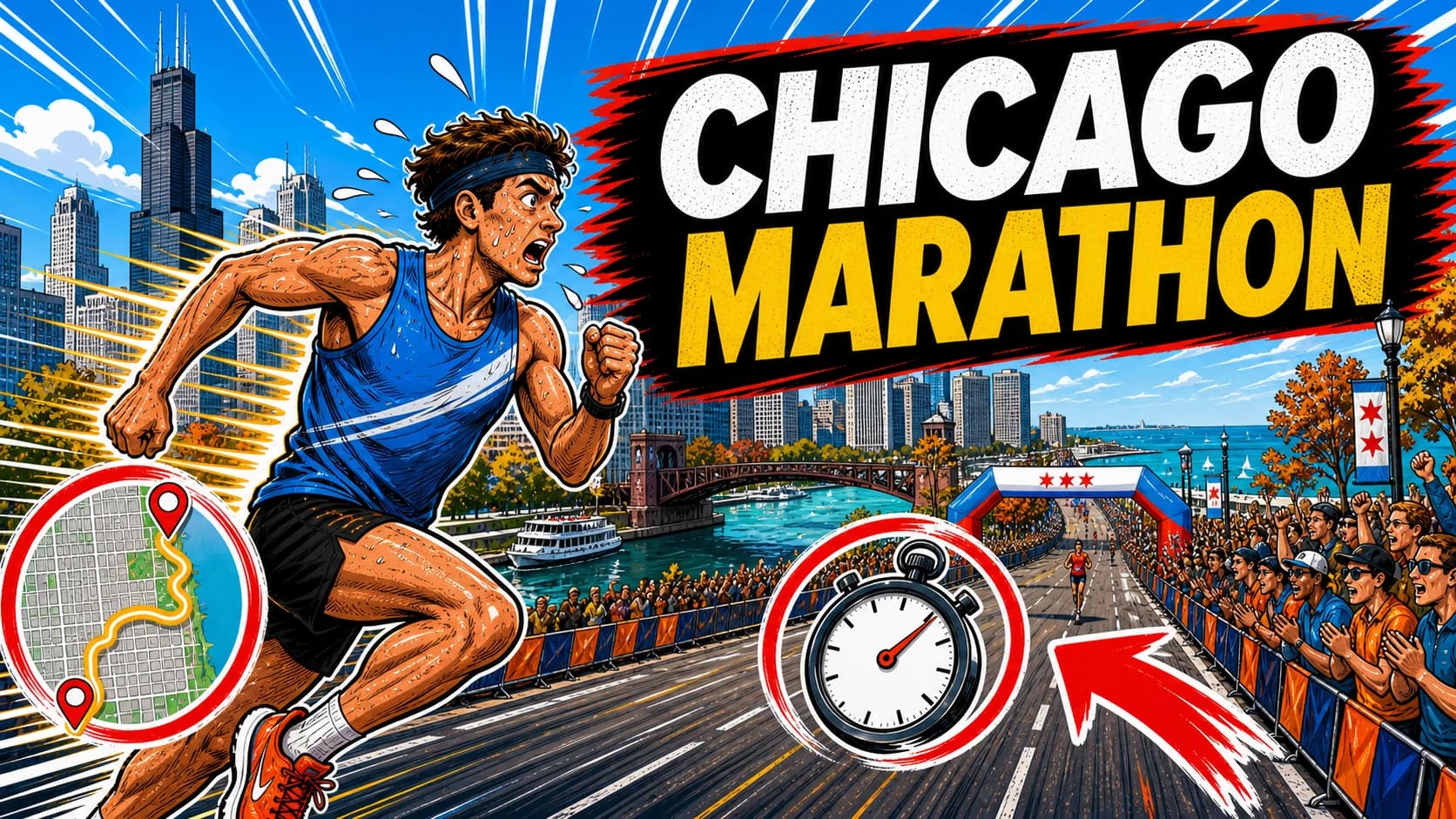
41 min de lecturarunningmaraton
Chicago Marathon 2026 Complete Guide — Flat Course, World Record and How to Run It
📖 16 min read 📝 3,600 words 🎯 Skim friendly
Chicago Marathon 2026 Complete Guide
By Ramon Curto · Updated 2026-05-06
📖 16 min read 📝 3,600 words 🎯 Skim friendly
By Ramon Curto · Updated 2026-05-06
On October 11, 2026 Chicago hosts the 48th edition of the Bank of America Chicago Marathon, one of the six World Marathon Majors and, on paper, the fastest course on the global calendar. This is the American flat-course PB factory — Kelvin Kiptum ran 2:00:35 here in 2023, the world record at the time, and Ruth Chepngetich smashed the 2:10 barrier with 2:09:56 in 2024. This guide is for non-elite runners who want to understand why Chicago is the global destination for an autumn PB: 29 neighborhoods, near-zero elevation gain, ~45,000 finishers, and a soft Lake Michigan breeze that almost always plays nice. We cover lottery, lodging, the course kilometer by kilometer, a 16-week plan, a splits calculator, and a personalized race plan.
| Data | Information |
|---|---|
| Date | Sunday, October 11, 2026 |
| Distance | 42.195 km (marathon) |
| Elevation gain | ~30 m (essentially flat) |
| City | Chicago, Illinois (180 m altitude) |
| Start and finish | Grant Park (Columbus Drive) |
| Start time | 7:20 (elite women) · 7:30 (elite men) · 7:30–8:35 (waves) |
| Organizer | Chicago Marathon LLC (director: Carey Pinkowski) |
| Title sponsor | Bank of America (since 2008) |
| Registration | chicagomarathon.com |
Chicago is the American flat marathon par excellence, a member of the World Marathon Majors alongside Boston, New York, London, Berlin, and Tokyo. The course covers 29 neighborhoods in 42 km — never boring, in a single loop that starts and finishes in Grant Park, with barely ~30 m of cumulative elevation across the entire race — the American equivalent of Berlin or Valencia. It draws ~45,000 finishers each edition (record of 53,000 in 2025), has a 95 % finish rate, and lines the course with 1.7 million spectators. This isn't the "experience" marathon that makes you fall in love with the scenery; this is the course for your fastest time.
Race leaders crossing a bridge over the Chicago River with the Loop skyscrapers in the background — the postcard that defines this race.
Chicago sells speed. Altitude is essentially zero (180 m), total elevation is ~30 m spread over false flats, October weather typically swings between 4 and 15 °C, and the organization has its machinery dialed after 47 editions. What you lose in scenery (no medieval cathedrals, no Mediterranean coast) you gain in raw speed: 7 world records have been set here, the latest being Chepngetich's 2:09:56 in 2024.
The Chicago Marathon course is a single 42.195 km loop that starts on Columbus Drive in Grant Park, climbs north to Lincoln Park and Wrigleyville, returns south through The Loop, crosses Greektown, West Loop, Pilsen, and Chinatown, runs south through Bronzeville and Bridgeport, and finishes back in Grant Park climbing the only real bump on the course at Mt. Roosevelt. Total elevation gain is around 30 meters — yes, thirty — spread over false flats that don't even feel like climbs.
Official Chicago Marathon map showing the full loop through 29 neighborhoods, start and finish in Grant Park, with The Loop, Lincoln Park, Pilsen, Chinatown, and Bronzeville clearly labeled.
The first kilometers head up Columbus Drive and turn north on State Street crossing the Chicago River — the first iconic moment, with Loop skyscrapers on both sides. The race heads north toward Lincoln Park (km 6–11), Wrigleyville, and Boystown (km 11–14), passing right by Wrigley Field (Cubs stadium) in one of the most spectator-dense stretches of the entire race. The southbound turn comes at km 14–15, heading back toward downtown via Old Town and dropping into The Loop (km 16–21).
The half marathon is crossed at State Street near Adams, in the heart of the Loop — a classic photo spot. From there the course heads west into Greektown (km 22), West Loop / Fulton Market (km 23–25), United Center (km 25, home of the Bulls), turns south through Pilsen (km 26–28, Mexican neighborhood with brutal energy), enters Chinatown (km 30, passing under the iconic gate), and heads south through Bronzeville and Bridgeport (km 32–37). The final stretch returns north along Michigan Avenue and ends with the only real climb of the day: Mt. Roosevelt — the only "climb", basically a joke (40-50 m of incline on Roosevelt Road) before the final turn onto Columbus Drive and the finish line in Grant Park.
The asphalt is smooth and clean throughout (it's an American city — no cobblestones). There are 20 aid stations with water and Gatorade Endurance, distributed every ~2 km. Carbs (Maurten Caf 100 gels) at km 22.5 and km 30. Crowd density is brutal in Lincoln Park, Boystown, The Loop, Pilsen, and the final straight on Michigan Avenue — thinner at km 32-37 crossing Bronzeville heading south, where you'll run the most mental zone of the race.
🚨 Where the race breaks
Course data for Strava / Garmin: the organizer publishes the official GPX 6-8 weeks out at chicagomarathon.com/course. If you want to train the Chinatown → Bronzeville segment before the race, search Strava for "Chicago Marathon Last 10K" — the exact profile is available.
The Chicago Marathon was born in 1977 as the Mayor Daley Marathon, inspired by the running boom that followed the modern New York City Marathon's debut in 1976. The first edition had 4,200 entrants and 2,128 finishers — laughable compared to today's ~45,000. Bank of America has sponsored the race since 2008, and historic director Carey Pinkowski has led it since 1990. The race has been part of the Abbott World Marathon Majors since 2006.
Kelvin Kiptum crossing the finish line in 2023 with the clock reading 2:00:35 — world record. The iconic image that anchors the roll-of-honor section.
Roll of honor and race data:
| Data | Value |
|---|---|
| First edition | 1977 (as Mayor Daley Marathon) |
| Editions held | 47 (through 2025) |
| World Marathon Major | Yes (since 2006) |
| Title sponsor | Bank of America (since 2008) |
| Executive director | Carey Pinkowski |
| World records set | 7 |
| Men's course record | 2:00:35 (Kelvin Kiptum, KEN, 2023) — world record at the time |
| Women's course record | 2:09:56 (Ruth Chepngetich, KEN, 2024) — world record at the time |
| American men's record | 2:04:43 (Conner Mantz, 2024) |
| Record finishers | ~53,000 (2025) |
Verified winners and times from the 5 most recent editions:
| Year | 🥇 Men | Country | Time | 🥇 Women | Country | Time |
|---|---|---|---|---|---|---|
| 2025 | Jacob Kiplimo | 🇺🇬 UGA | 2:02:23 | Hawi Feysa | 🇪🇹 ETH | 2:14:56 |
| 2024 | John Korir | 🇰🇪 KEN | 2:02:44 | Ruth Chepngetich | 🇰🇪 KEN | 2:09:56 (WR) |
| 2023 | Kelvin Kiptum | 🇰🇪 KEN | 2:00:35 (WR) | Sifan Hassan | 🇳🇱 NED | 2:13:44 |
| 2022 | Benson Kipruto | 🇰🇪 KEN | 2:04:24 | Ruth Chepngetich | 🇰🇪 KEN | 2:14:18 |
| 2021 | Seifu Tura | 🇪🇹 ETH | 2:06:12 | Ruth Chepngetich | 🇰🇪 KEN | 2:22:31 |
Data verified against the public archive at Chicago Marathon (Wikipedia EN).
Getting a Chicago bib has three official routes and all of them require planning 12+ months ahead: lottery (open lottery in November-December of the prior year), time qualifier (proving a recent mid-tier marathon mark), or charity bib (commitment to raise $1,750+ for an associated nonprofit).
Aerial view of the pack starting from Grant Park with Lake Michigan to the right and the Chicago skyline in the background — reinforces the "global destination, limited spots" message.
| Item | Cost |
|---|---|
| Lottery application | ~$12 (non-refundable) |
| US resident bib | ~$235 |
| International bib | ~$260 |
| Charity bib (minimum fundraising) | $1,750 |
| Official tour operator (Marathon Tours) | $3,500-5,500 (includes bib + hotel + transfers) |
Indicative prices based on the 2025 edition. Always confirm on the official site — amounts are updated annually.
| Included in price | NOT included (optional extra) |
|---|---|
| ✅ Bib with timing chip | ❌ Flights / lodging |
| ✅ Official Nike technical shirt | ❌ Official professional photo (~$80) |
| ✅ Finisher medal | ❌ Marathon Hall (post-race dinner) (~$125) |
| ✅ On-course aid (20 stations) | ❌ Premium bag check |
| ✅ Post-finish bag (Goose Island beer, fruit, snacks) | ❌ Photo + medal in premium frame |
| ✅ Access to Abbott Health & Fitness Expo | ❌ Travel insurance |
| ✅ Digital diploma with certified time |
Refund and deferral policy:
View of the Abbott Health & Fitness Expo at McCormick Place with runners queuing at the bib pickup counter and brand booths (Nike, Maurten, Garmin) in the background.
Bib pickup happens at the Abbott Health & Fitness Expo at McCormick Place (Hall A), normally open Thursday, Friday, and Saturday before the race. No race-day pickup: pickup closes Saturday at 6:00 PM, no exceptions.
You'll need:
The expo at McCormick Place is the largest on the WMM calendar alongside NYC: 200+ booths, elite presentations, shoe testing, free Maurten dispensers, Nike pop-up store with Chicago Marathon exclusives. Reserve 2-3 hours for the visit if you're coming from out of town.
The most practical way to reach Chicago is flying into O'Hare International (ORD) or Midway International (MDW) and from there taking public transport to downtown. Don't drive on race day — street closures start at 4:30 AM and the Grant Park area is fully closed to traffic until mid-afternoon. The CTA (Chicago metro/bus) and Metra (commuter rail) are the realistic way to move around.
CTA elevated station in the heart of the Loop with the train arriving — visual reference for European runners arriving in Chicago for the first time.
Don't drive. But if you insist:
For a marathon runner, staying within 20 minutes' walk of Grant Park is not luxury: it's logistics. Chicago in October can dawn at 4 °C, and walking 1 km to the corral in a singlet is very different from taking two metro transfers at 5:30 AM with thousands of runners. The three zones that fit the bill are The Loop (next to Grant Park, maximum convenience), Magnificent Mile / River North (prettier, 1-2 km walk), and South Loop (more affordable, near the start).
Chicago skyline viewed from Grant Park at dawn with the Sears/Willis Tower highlighted — reinforces the "downtown lodging, near the start" message.
| Hotel | Cat. | $/night* | To start | Runner strength |
|---|---|---|---|---|
| Hilton Chicago | 4* | 320-480 | 400 m · 5 min | Next to Grant Park, early breakfast for groups |
| Palmer House Hilton | 4* | 280-450 | 700 m · 9 min | Historic, strong AC, late check-out |
| Hyatt Regency Chicago | 4* | 260-420 | 600 m · 8 min | Riverside, gym for mobility |
| Conrad Chicago | 5* | 380-550 | 1,000 m · 12 min | Boutique, standard bathtub, luxury |
| Fairmont Chicago Millennium Park | 5* | 350-520 | 500 m · 6 min | Across from Millennium Park, perfect |
| Hotel | Cat. | $/night* | To start | Runner strength |
|---|---|---|---|---|
| Drake Hotel | 5* | 320-480 | 2,500 m · 30 min | Historic, lakeside, facing North Beach |
| InterContinental Magnificent Mile | 5* | 290-440 | 1,800 m · 22 min | Historic pool, 24h gym |
| Conrad Chicago | 5* | 380-550 | 1,500 m · 18 min | Premium, standard bathtub |
| The Peninsula Chicago | 5* luxury | 550-800 | 1,700 m · 21 min | Real five stars, spa |
| Hyatt Centric The Loop | 4* | 260-380 | 1,200 m · 15 min | Price-location balance |
| Hotel | Cat. | $/night* | To start | Runner strength |
|---|---|---|---|---|
| Renaissance Blackstone Chicago | 4* | 240-360 | 1,500 m · 18 min | Historic, next to south Grant Park |
| Hyatt Regency McCormick Place | 4* | 200-320 | 2,500 m · 30 min | Next to expo, direct connection |
| Hilton Garden Inn South Loop | 3* | 180-280 | 1,800 m · 22 min | Affordable, reliable AC |
| Best Western Grant Park | 3* | 180-260 | 2,000 m · 25 min | Cheaper, simple but effective |
| Marriott Marquis Chicago | 4* | 260-400 | 2,200 m · 26 min | Next to McCormick Place |
*Indicative race-weekend rate (second Sunday of October). Up 30-60 % vs any other weekend of the year due to the marathon. Book 6+ months ahead.
The weather in Chicago on the second Sunday of October averages 4 °C minimum at dawn and 15 °C maximum at midday with sunny conditions and low humidity around 75 % of editions, according to historic NOAA data. Rain is infrequent (one edition with light rain every 5 editions), and the average wind is 12-18 km/h from the west or northwest — predominantly headwind on some sections of the course running north along Lake Michigan.
Finishers from a recent edition with their medals on a sunny but cool day — the typical pattern for an October Sunday in Chicago.
Chicago conditions are almost always ideal for a PB. Optimal temperature for an elite marathon is 8-12 °C; Chicago in October falls right there. Dry air (mean relative humidity 65 %) is another factor in your favor compared to Berlin (more humid) or Tokyo (warmer).
Plan by forecast:
The wind factor. Lake Michigan introduces a soft-to-moderate breeze (12-18 km/h) typically from west/northwest. That means on the kilometers running north (km 5-15) you may have a light tailwind from your left; at km 22-30 (west-south) headwind or crosswind. No section is windy enough to wreck a PB, but use it to your advantage: tuck into the pack on the most exposed sections.
The recommended plan to prepare for the Chicago Marathon is a 16-week block with peak volume in weeks 11-13 (between 50 km and 130+ km weekly depending on goal), one weekly long run, and a three-week taper. The key for Chicago: train your single race pace. The course is flat, so there's no margin to "bank time on downhills" like in Madrid. Here you go in, hold the pace, and come out — that's it.
Runner training on a flat course at dawn — aspirational image that anchors the 16-week plan.
Approach Chicago like a Berlin- or Valencia-style flat marathon. Pick your goal and follow the table — these are peak volumes (weeks 11-13), not full-cycle averages.
| Goal | Average pace | Peak weekly vol. | Peak long run |
|---|---|---|---|
| 5h00 | 7:06 min/km | 35–45 km | 25–28 km |
| 4h30 | 6:24 min/km | 45–55 km | 28–30 km |
| 4h00 | 5:41 min/km | 55–70 km | 30–32 km |
| 3h30 | 4:58 min/km | 70–85 km | 32–35 km |
| 3h00 | 4:16 min/km | 90–110 km | 32–36 km |
| ≤2h45 | 3:54 min/km | 110–130+ km | 32–38 km |
How to read the table and build the cycle:
Three sessions worth gold for Chicago:
The taper is three weeks, not two. Week 14 at 80 %, week 15 at 60 %, week 16 at 40 % maintaining race pace in short pickups. The final two long runs (in weeks 11 and 12) are what fill the cup.
Don't know what realistic goal time you have for Chicago? Cross your best recent half marathon with the "Chicago" factor (which is basically the flat-course factor with no penalties):
| Your best recent half | Flat marathon equivalent | Chicago realistic |
|---|---|---|
| 1:25 | sub-3:00 flat | 2:58–3:02 |
| 1:35 | sub-3:20 flat | 3:18–3:24 |
| 1:45 | sub-3:42 flat | 3:40–3:48 |
| 1:55 | sub-4:05 flat | 4:02–4:12 |
| 2:05 | sub-4:25 flat | 4:23–4:35 |
| 2:15 | sub-4:48 flat | 4:45–4:58 |
How to read it: the "flat" column is the unadjusted Riegel conversion (your half × ~2.11). Chicago is basically that projection with no extra penalty — flat course, cool weather, dialed organization. If your form breaks at km 30, you land at the high end of the range. If you arrive with legs, the low end.
Once you have your goal time, this calculator gives you the required average pace (in min/km and min/mi) and the cumulative splits at 5K, 10K, 15K, half marathon, 30K, and finish. Change the goal time in the field below and the table updates instantly:
| Punto | Tiempo acumulado | Parcial |
|---|---|---|
| 5 km | 21:20 | 21:20 |
| 10 km | 42:40 | 21:20 |
| 15 km | 1:03:59 | 21:20 |
| Media (21,1 km) | 1:30:00 | 26:01 |
| 30 km | 2:07:59 | 37:59 |
| Meta | 3:00:00 | 52:01 |
Splits asumen ritmo constante. En carreras con desnivel real (Chicago Marathon) — banca 5–8 s/km en bajadas y pierde el mismo margen en subidas; el ritmo medio se mantiene.
The calculator above gives you the pace. But a real race plan answers more questions: what strategy do I start with? how many gels do I carry? when do I take in caffeine? what do I do if at km 21 I'm 30 seconds over goal?
Configure your goal, strategy, and fueling plan. The planner generates a personalized plan by segment (with paces, HR zones, mental cues, and minute-by-minute fueling), a race morning checklist, and a Plan B for the unexpected. Download it as PDF to take it with you on race day.
PDF A4, optimizado para imprimir y llevar el día de carrera.
You're at the corral. You've done the 16-week plan. What separates good training from a good time is what you do over the next 3-5 hours.
The Chicago race plan should combine conservative pacing in km 1-10 (crowding + euphoria + dense neighborhoods), absolute goal pace from km 10-32, and push or hold from km 32 to 42 depending on how you arrive at Bronzeville. The flat course is a double-edged sword: it invites you to hold an aggressive pace, and if you fail, the correction doesn't come from a hill warning you — it comes from a silent crash.
| Goal | Goal splits | Chicago-specific tactical note |
|---|---|---|
| sub-2:45 | 3:54 min/km | Absolute single pace. Don't accelerate on Bronzeville turns, don't accelerate at the sight of Mt. Roosevelt. Hold 3:54 from km 5 to km 38. |
| sub-3:00 | 4:16 min/km | Cross half at 1:30:00. If you're 30 s over at km 21, stay at goal pace — don't try to recover; this is Chicago, not Madrid. |
| sub-3:30 | 4:58 min/km | No rush km 1-8 (crowding + emotion). Cross half at 1:45:00. Walk 10 s at each aid station; you lose 30 seconds total and gain 2 minutes in the legs. |
| sub-4:00 | 5:41 min/km | The classic mistake is starting at 5:30 with the mass. Hold 5:42-5:45 the first 10 km. Walk 15-20 s at each aid station. |
| sub-4:30 | 6:24 min/km | Very even splits: 6:20-6:30 the whole way. Walk-run strategy from km 30 if you need it. |
| sub-5:00 | 7:06 min/km | Plan B walk-run from km 1: 8 run / 1 walk. Gives you margin to finish in shape. |
| Finish | 7:00–7:30 | No watch. Enjoy Lincoln Park, Wrigley Field, Pilsen, Chinatown. The finish in Grant Park is one of running's great moments. |
This is where Chicago is decided. Three anchors:
The nutritional strategy for Chicago pivots around 60-100 g of carbs per hour depending on goal, with 5-8 gels distributed every 25-30 minutes from km 8 onward. Carb loading over the 3 prior days should be 8-10 g/kg/day, and Saturday dinner should be light and familiar (pasta or white rice). Extra sodium only if the forecast tops 18 °C — rare in October in Chicago.
Volunteer at a Chicago Marathon aid station serving Gatorade Endurance — the typical pattern across the 20 course aid stations.
Saturday dinner is light, familiar, and on the early side (eat before 7 PM — Chicago has pasta restaurants that open early for the marathon). Pasta, white rice with grilled chicken, bread, fruit. Zero experiments with greasy or spicy American cooking. Specific recommendations: Quartino Ristorante, Eataly Chicago, Cantina Laredo (all in River North).
Race morning breakfast depends on whether you wake up hungry. The safe bet: toast with honey/jam + banana + coffee (if you take it regularly). 80-100 g of carbs, eaten 3 hours before the gun. If your stomach closes up with nerves, replace with a sports drink containing 80 g of carbs.
What the organization provides on course:
Carb plan by goal:
| Goal | Carbs / hour | Gels to carry | When to take them |
|---|---|---|---|
| 5h00 | 30-45 g/h | 3-4 gels | km 8, km 18, km 28, km 36 |
| 4h00 | 45-60 g/h | 5 gels | km 8, km 16, km 22, km 30, km 36 |
| 3h30 | 60-75 g/h | 6 gels | km 6, km 12, km 18, km 24, km 30, km 36 |
| 3h00 | 75-90 g/h | 7 gels + flask | km 5, every 5 km up to km 35 |
| ≤2h45 | 90-100 g/h | 8 gels + flask | km 4, every 4-5 km |
Three mistakes seen every year at the Chicago Marathon:
Hydration and sodium by forecast:
Post-finish recovery — the first hour matters more than for the half:
The best shoes for the Chicago Marathon are a lightweight carbon plate race shoe for sub-3:30, a protective carbon plate between 3:30-4:00 (Vaporfly 4, Adios Pro 4), and a protective daily trainer for over 4:00 (Pegasus, Cumulus, Ghost). On a flat course, the "energy savings" factor weighs more than "muscular protection" — Chicago rewards the lightweight shoe.
Close-up of race shoes at the Chicago Marathon start line — multiple brands visible, carbon plate dominant.
Unlike Madrid or Boston, in Chicago weight matters more than protection because the flat course minimizes accumulated muscle damage. Kiptum's 2:00:35 was set in Nike Alphafly 3; Chepngetich's 2:09:56 in Nike Alphafly 3 Proto. For non-elite runners, a lightweight carbon plate (Vaporfly 4, Adios Pro Evo, Metaspeed Sky) is the optimal choice.
Recommendations by goal:
| Goal | Category | Common models |
|---|---|---|
| ≤2h45 | Lightweight "race" carbon plate | Nike Alphafly 3 · adidas Adios Pro Evo · ASICS Metaspeed Sky · Saucony Endorphin Elite |
| 2h45-3h30 | Protective carbon plate | Nike Vaporfly 4 · adidas Adios Pro 4 · ASICS Metaspeed Sky · Saucony Endorphin Pro |
| 3h30-4h00 | Carbon plate or super-trainer | Saucony Endorphin Speed · Hoka Mach X · Puma Deviate Nitro Elite · ASICS Magic Speed |
| 4h00+ | Protective daily trainer | Nike Pegasus · ASICS Cumulus / Nimbus · Brooks Ghost · Hoka Clifton |
Check this before leaving home:
Yes. ~30 meters of cumulative elevation in 42 km make it one of the flattest courses on the WMM calendar, alongside Berlin. There's a single recognizable "climb": Mt. Roosevelt at km 41, a 40-50 m ramp on Roosevelt Road that lasts ~400 meters. Any European runner used to marathons with real elevation (Madrid, Athens, Barcelona) will lose respect for it in 30 seconds. What matters in Chicago isn't the elevation — it's the single sustained pace on a flat course.
Three routes. The lottery accepts ~25-30 % of US applicants and ~35-40 % of international (separate quotas). The time qualifier guarantees entry if you have sub-2:50 (M under 35) or sub-3:10 (W under 35) — standards drop with age. The charity bib is guaranteed but requires raising $1,750+ for an associated nonprofit. The optimal strategy if you're coming from Europe: try lottery first; if rejected, prepare a European marathon between February and May chasing a time qualifier for the following year.
Recent editions close the marathon at 6:30 hours from the last corral's start, equivalent to about 9:15 min/km. Walking is allowed; the course has staggered partial closures (streets reopen to traffic after the last runner passes). If your goal is sub-6h you have plenty of margin; if you're going for >6h, contact the organization beforehand to confirm protocol.
Arrive at least Thursday, ideally Wednesday if you can afford it. Chicago is 7 hours behind European time, which means your body "wakes up" naturally at 11:00 PM local time the first 2-3 days. Tricks: morning sunlight (best circadian synchronizer), coffee only in the morning (avoid after noon), early dinner (6:00-7:00 PM local). Saturday night before the race, go to bed early (9:30 PM) — race day you'll wake up at 4:00 AM without an alarm.
Technical singlet + disposable thermal sleeve + 5-7" shorts + technical socks. The critical piece is the disposable thermal sleeve: you put it on in the corral at 6:30 AM when it's cold, and ditch it at km 5-8 when you've warmed up. If forecast is <0 °C (rare but possible), add a thin beanie and thin gloves you can also throw away. Never run in a heavy sweatshirt — overheating at km 15 is worse than being cold in the corral.
Depends. If you've tried lottery 2-3 years without success and have fundraising capacity (large personal network, donor company, social profile), yes. If you're paying the $1,750 out of pocket, consider the time qualifier route first: a winter European marathon (Seville, Valencia) costs $80-100 and gives you guaranteed entry potential. Some runners leave charity bibs as a last resort after 3 lottery rejections.
All three are flat PB courses. Specific differences:
If you want a pure PB and have lottery: Chicago. If you want a safe PB without a lottery: Valencia. If you want to run where the historic world record was set: Berlin. All three are ~5-10 minutes faster than Madrid or Boston due to elevation.
For sub-3:30, a protective carbon plate (Nike Vaporfly 4, adidas Adios Pro 4, ASICS Metaspeed Sky). For 3:30-4:00, a carbon plate or super-trainer (Saucony Endorphin Speed, Hoka Mach X). For over 4:00, a protective daily trainer (Nike Pegasus, ASICS Cumulus, Brooks Ghost). In Chicago, the flat course rewards the lighter shoe more than in Boston or Madrid where muscular protection weighs more.
Yes, if you enter with a guaranteed bib (charity bib or time qualifier — lottery can reject you). The atmosphere, flat course, dialed organization, and aid station density make the debut accessible. But factor in the cost: bib + flight + hotel from Europe easily run €2,500-4,000. For a less expensive first marathon, consider Valencia (Spain, flat, similar) or Berlin (Germany, flat, similar). Chicago is in another budget league.
Indicative budget for 4 nights (Thursday to Monday) leaving from a major European city:
The Chicago Marathon is the best flat course on the WMM calendar, but not the only one. If you're chasing a pure PB, Chicago, Berlin, and Tokyo go head to head; if you want big-crowd atmosphere, NYC and London are superior; if you want historic prestige, Boston rules.
All are marathons (42.195 km), so the choice depends on month, elevation, weather, and what you're after:
| Race | Month | Elevation | Best for | Atmosphere |
|---|---|---|---|---|
| Chicago (this guide) | October | ~30 m | Pure PB · accessible WMM | ⭐⭐⭐⭐⭐ |
| Berlin Marathon | September | <50 m | PB world record | ⭐⭐⭐⭐ |
| Boston Marathon | April | ~140 m + Heartbreak | Prestige · legendary hill | ⭐⭐⭐⭐⭐ |
| London Marathon | April | <50 m | Atmosphere · iconic city | ⭐⭐⭐⭐⭐ |
| NYC Marathon | November | ~250 m + 5 bridges | Maximum atmosphere | ⭐⭐⭐⭐⭐ |
| Tokyo Marathon | March | <40 m | PB in Asia · culture | ⭐⭐⭐⭐ |
| Valencia Marathon | December | <50 m | Pure PB without lottery | ⭐⭐⭐⭐ |
Did this guide help? If you're going to run Chicago 2026, save the event in SportPlan to get registration deadline alerts, expo reminders, and afterward, log your result.
Sigue planificando
Usa SportPlan para comparar fechas, guardar eventos objetivo y montar una temporada que encaje con tus fines de semana.