28 min de lecturarunningultra
Complete Comrades Marathon 2026 Guide — World's Oldest Ultramarathon (87.7 km, Up Run)
📖 14 min read 📝 3,000 words 🎯 Skim friendly
Complete Comrades Marathon 2026 Guide
By Ramon Curto · Updated 2026-05-08
📖 14 min read 📝 3,000 words 🎯 Skim friendly
By Ramon Curto · Updated 2026-05-08
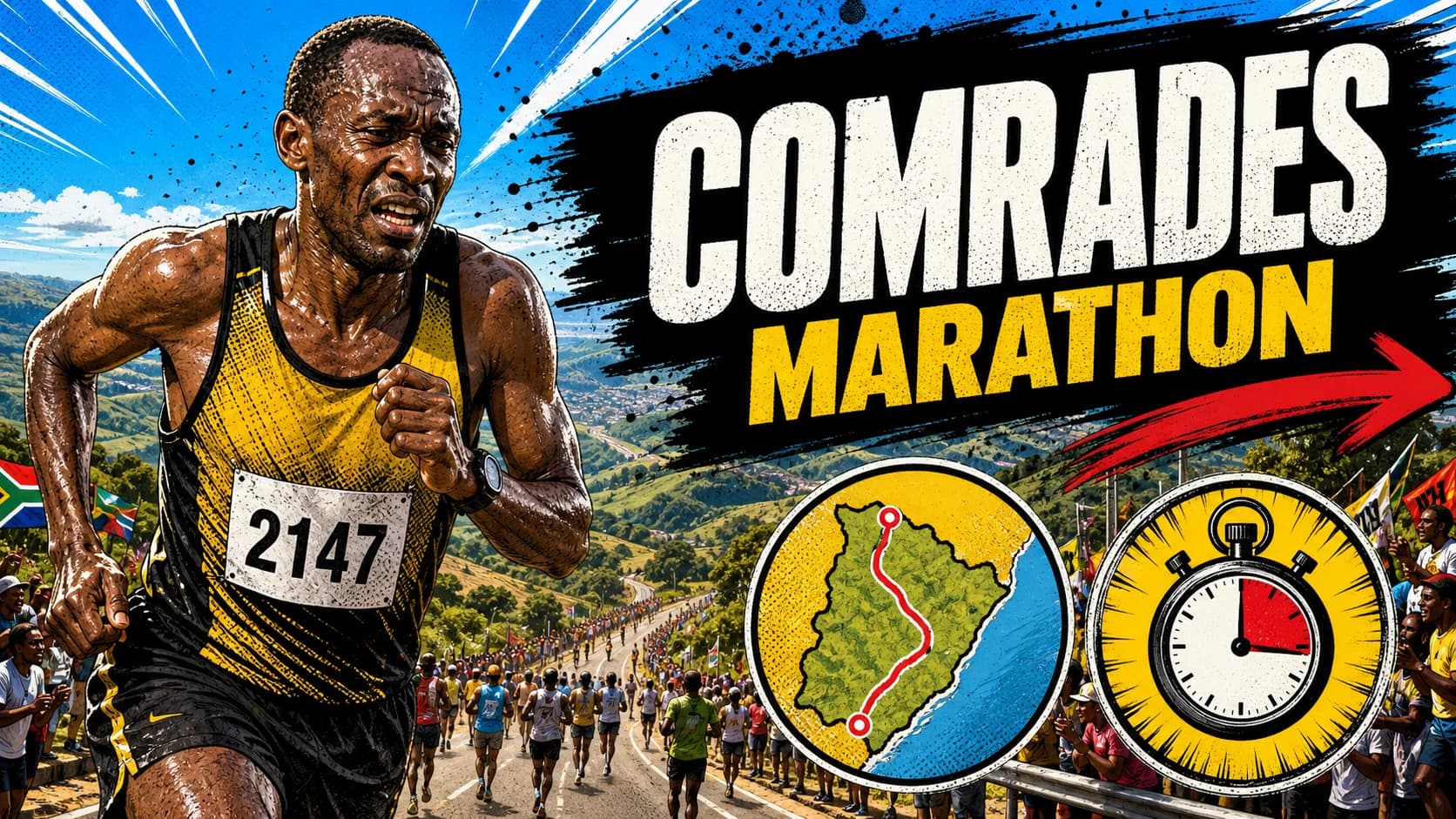
On Sunday June 14, 2026, the 101st edition of Comrades Marathon takes place — the world's oldest ultramarathon and the largest ultra by participation on the planet. 87.7 km between Durban and Pietermaritzburg in an Up Run year (climbing from sea level to PMB at ~700 m), with a strict 12-hour cutoff and a medal tier system that has become a rite of passage for global ultrarunning. The gun firing at 17:30 with the official's back turned to the field is probably the most iconic image in ultra running. This guide covers what neither the official site nor finisher blogs lay out in full: how the race breaks between Inchanga and Polly Shortts, what medal you can realistically aim for given your marathon time, and why Comrades demands a qualifying marathon.
Comrades Marathon 2026 is the 101st edition of the race: an 87.7 km event between Durban (coast) and Pietermaritzburg (inland, ~700 m altitude). 2026 is an Up Run year — direction alternates each year with the Down Run, and the climb is the more demanding version in terms of total elevation gain.
| Data | Information |
|---|---|
| Date | Sunday June 14, 2026 |
| Distance | ~87.7 km |
| Direction | Up Run (Durban → Pietermaritzburg) |
| Start | Durban City Hall, in front of the council building |
| Finish | Scottsville Racecourse, Pietermaritzburg |
| Start time | 05:30 SAST with "Shosholoza" anthem + cock-crow |
| Cutoff | 12 hours strict (gun fires 17:30) |
| Organiser | Comrades Marathon Association (CMA) |
| Edition | 101st |
| Registration | comrades.com — opens September 2025 |
Wide shot of the start at Durban City Hall at dawn with the field about to be released.
Comrades Marathon is an ultramarathon on tarmac road between the two largest cities of KwaZulu-Natal, in eastern South Africa. It's not trail. It's not mountain. It's road with constant elevation change, with a profile that climbs and drops over the five great hills (Big Five Hills) that define the race. What makes Comrades unique isn't the terrain — it's the history, the South African running culture, and the tiered medal system that recognises every finisher according to their time.
The race alternates direction each year: in even years like 2026 it runs Up (from coast inland, gaining ~700 m net altitude); in odd years it runs Down (in reverse, technical descent that hammers quads). The Up Run is slower but more uniform; the Down Run is faster on the clock but ends with many finishers walking lame.
Comrades is not for ultra debutants. The race assumes you arrive with:
If you've been running less than 18 months or never finished a marathon, Comrades isn't your race yet. Come back in 2 years with more kilometres in your legs and a couple of fast half-marathons to sustain the qualifying pace.
The field singing "Shosholoza" minutes before the start — Comrades' iconic moment.
The Up Run starts from Durban City Hall (sea level) and finishes at Scottsville Racecourse in Pietermaritzburg (~700 m). Net elevation gain is ~750 m, but with rolling profile total climbing exceeds 1,500 m. The route is fully tarmac, on open road closed to traffic, with aid stations every 1.5–2 km and medical support every 5–8 km.
The Big Five Hills are the five climbs that structure the race and that every finisher knows by heart:
| Hill | Km | Length | Gain | Notes |
|---|---|---|---|---|
| Cowies Hill | 17–25 | ~2.8 km | +180 m | The first warning. If you run it all, you're going too fast. |
| Field's Hill | 25–35 | ~3 km | +220 m | Steepest of Up Run. Walk the 8%+ sections, no debate. |
| Botha's Hill | 35–48 | ~6 km | +200 m | Long and gradual. Most middle-section gain accumulates here. |
| Inchanga | 48–62 | ~4 km net | +250 m | Longest climb. You cross halfway through it. |
| Polly Shortts | 80–82 | ~2 km | +130 m | The final hammer. Near-vertical for legs with 80 km in them. |
After Polly Shortts there are ~5 km of downhill and flat to Scottsville Racecourse, where the finish sits inside the racecourse oval. The finish gantry closes at exactly 17:30 and the gun firing is probably the most iconic image in global ultrarunning.
The final climb of Polly Shortts at 14:00 with runners walking single-file up the gradient.
The Comrades Marathon was created in 1921 by Vic Clapham, a WWI veteran, as a tribute to his fallen comrades in the East African campaign. Clapham, who had marched more than 2,700 km on foot during the war, wanted a race that tested human endurance the same way. The first edition had 34 entrants and 16 finishers. A century later, Comrades is the most participated race in global ultrarunning.
The race alternates direction each year since 1923 — Up Run in even years (2024, 2026, 2028) and Down Run in odd years (2025, 2027). There were interruptions for WWII (1941–1945), apartheid era (the race opened to black runners from 1975 onwards), the COVID pandemic (cancelled in 2020 and 2021) and occasional security issues. The 100th edition was held in 2025 with a historic Down Run and record entries.
Current records:
The roll of honour is dominated by South Africans: Bruce Fordyce won 9 editions between 1981 and 1990, Russian Leonid Shvetsov was the first foreigner to break a course record in 2008, and South African Gerda Steyn has been the dominant athlete of the past decade.
Archive photo of Vic Clapham with the first 1921 edition (public domain).
Registration is managed at comrades.com and opens typically in September of the previous year (September 2025 for Comrades 2026). For 2026, an entry cap of ~25,000 bibs is anticipated, which historically fills within a few weeks — though rarely within hours like UTMB.
Mandatory qualifying time: every entrant must show a certified marathon below 5 hours within the 6 months prior to Comrades (between August 1 of the previous year and a day before registration close). The marathon must be sanctioned by the South African federation or by an IAAF/World Athletics affiliate. Races like London Marathon, Berlin, Sevilla, Madrid, Valencia, NYCM, and Boston all qualify.
Prices 2026 (approximate, confirm on official site):
Bib pickup is NOT done on race day. It happens at the Comrades Expo at the Durban International Convention Centre (ICC) on the Friday and Saturday before the race. You need:
The Expo opens typically 09:00–19:00 Friday and 09:00–17:00 Saturday. No race-day pickup possible.
Comrades is famous for its medal scaling by finish time. Each band has a historical name:
| Medal | Time | Notes |
|---|---|---|
| Gold | Top 10 men / Top 10 women | World elite only. |
| Wally Hayward | sub-6:00:00 | Honouring the 5-time champion. ~0.3% of finishers. |
| Silver | sub-7:30:00 | Boundary between elite and amateur. ~3%. |
| Bill Rowan | sub-9:00:00 | Honour of the first 1921 winner. ~17%. |
| Robert Mtshali | sub-10:00:00 | First black runner to run Comrades in 1935 (not officially recognised then). ~14%. |
| Bronze | sub-11:00:00 | The "realistic target" for most serious European runners. ~26%. |
| Vic Clapham | sub-12:00:00 | The cutoff medal. ~25%. The vast majority of the back of the pack. |
Important: after exactly 12:00:00, no medal is awarded and the finish does not count officially. The gun firing at 17:30 marks the absolute close with the official turning his back to the trailing pack — no one is accepted crossing one second later.
The 7 medals of the Comrades system aligned (Gold, Wally Hayward, Silver, Bill Rowan, Robert Mtshali, Bronze, Vic Clapham).
Durban has its own international airport: King Shaka International Airport (DUR), 35 km north of central Durban. Most European flights require connection at Johannesburg (JNB) or via Doha (Qatar Airways) or Dubai (Emirates). Transfer from airport to central Durban takes 30–45 min by taxi (~ZAR 350–500, ~$25) or by Uber (cheaper and very reliable in South Africa).
Visa: South Africa allows tourist stays up to 90 days visa-free for most EU passports (Spain included), UK, USA, Australia and Canada. Required: passport with at least 2 blank pages and 30 days validity past departure. Yellow fever vaccine recommended only if you arrive from an endemic country (does not apply from Europe direct).
Most efficient routes from Spain and continental Europe:
Once in Durban, you don't need a rental car for the race — CMA provides official buses:
If your support crew wants to spectate on the course, renting a car for race day (~ZAR 700/day, ~$40) and parking at intermediate points (Hilton, Drummond, Camperdown) makes it possible to see the runner 2–3 times. Book the car well ahead.
Official Comrades buses at the start line at 04:30 in the morning.
The most common strategy for international runners is to base in Durban (more hotel inventory, easier for arriving Friday and being relaxed Saturday), race Sunday, and bus back to Durban via the organisation's transport to recover Monday-Tuesday before flying home. Pietermaritzburg has more limited hotel inventory and fills first.
Best option for international entrants — coastal city with good inventory, restaurants and public transport.
| Hotel | Category | Distance from start | Notes |
|---|---|---|---|
| Durban Hilton | 5★ | 5 min walk | Official CMA host hotel. Book 9 months ahead. |
| Southern Sun Elangeni & Maharani | 4★ | 20 min walk | Beachfront, comfortable and popular. |
| Tsogo Sun Suncoast Beach | 4★ | 15 min by car | Good value, next to the casino. |
| Garden Court South Beach | 3★ | 15 min walk | Budget, functional, no pretense. |
Indicative price: €80–250 per night depending on hotel and season. Book 6–9 months ahead.
Limited 4★ inventory but useful if you want to sleep close to the finish.
| Hotel | Category | Distance from finish | Notes |
|---|---|---|---|
| Imperial Hotel | 3★ | 5 min by car | Most central in PMB, classic feel. |
| Premier Hotel Pinetown | 4★ | 30 min by car | Best 4★ option in the wider area. |
| City Royal Hotel | 3★ | 10 min by car | Budget, comfortable for one night. |
Indicative price: €60–150 per night.
Hilton is a town ~25 km from PMB and ~60 km from Durban, near km 65–70 of the route. Good base if you want to spectate the climb up Inchanga.
| Hotel | Category | Notes |
|---|---|---|
| Hilton Hotel KZN | 4★ | Historic country lodge, colonial atmosphere. |
| Old Halliwell Country Inn | 4★ | Country house near the bush, romantic. |
| Loft Cottages Hilton | Apartment | Budget apartments, good for groups. |
Indicative price: €70–180 per night.
View of Durban Hilton at dawn the day before the race with runners in the lobby.
June is dry winter in South Africa, and particularly in KwaZulu-Natal the weather on Comrades day is one of the most stable in the global ultra calendar. Historically:
The big climate lesson at Comrades: don't underestimate the sun. Although the absolute temperatures are moderate for European runners, the austral sun at the inland altitude is very aggressive and dehydration is the most frequent cause of DNF. Drink 350–500 ml/h from km 0, cover head and neck, and reapply sunscreen every 3 hours.
| Metric | Historical June Durban-PMB value |
|---|---|
| Avg start temp | 8 °C |
| Avg finish temp | 14 °C |
| Daytime max | 18–22 °C |
| Rain probability | ~5% |
| Midday UV avg | 9 (very high) |
| Start humidity | 75% |
Clear sky and crisp temperature at 05:00 at Durban City Hall.
Comrades requires specific periodisation starting ~6 months out. If you don't yet have a sub-5:00 marathon, start there: run Sevilla in February or Madrid/Valencia in April, then use the remaining 14 weeks to build ultra endurance. The plan assumes 4–5 sessions/week and an athlete with at least 18 months of base.
Overall structure:
The key is back-to-back longs — in the 6 peak weeks, do a weekend doublé (Saturday long + Sunday medium-long) every 14 days to teach the body to run on tired legs, similar to Comrades in its final stretch.
The most reliable empirical rule for predicting your Comrades finish from a marathon:
Comrades time ≈ Marathon time × 2.4 to 2.7
(The multiplier rises the slower the athlete — a sub-3:00 marathoner multiplies by 2.3, a sub-5:00 multiplies by 2.7.)
| Current marathon | Up Run Comrades estimate | Expected medal |
|---|---|---|
| Sub-3:00 | 6:50–7:25 | Silver / Bill Rowan |
| 3:00–3:30 | 7:30–8:30 | Bill Rowan |
| 3:30–4:00 | 8:30–9:30 | Bill Rowan / Robert Mtshali |
| 4:00–4:30 | 9:30–10:30 | Robert Mtshali / Bronze |
| 4:30–5:00 | 10:30–11:30 | Bronze / Vic Clapham |
| Just sub-5:00 | 11:00–11:55 | Vic Clapham (cutting it close) |
If your marathon is between 4:30 and 5:00, your realistic Comrades 2026 target is Vic Clapham (sub-12) and you must run very conservatively. If your marathon is sub-4:00 you can comfortably aim at Bronze (sub-11).
4-hour long run on a nearby hilly trail simulating Big Five climbs.
For Comrades, calculating pace "per flat kilometre" doesn't work — you must adjust for each Big Five Hill's difficulty. This calculator produces differentiated paces for flat sections, climbs and descents.
| Punto | Tiempo acumulado | Parcial |
|---|---|---|
| 5 km | 37:38 | 37:38 |
| 10 km | 1:15:15 | 37:38 |
| 15 km | 1:52:53 | 37:38 |
| Media (21,1 km) | 2:38:46 | 45:53 |
| 30 km | 3:45:46 | 1:07:00 |
| Meta | 11:00:00 | 7:14:14 |
Splits asumen ritmo constante. En carreras con desnivel real (Comrades Marathon) — banca 5–8 s/km en bajadas y pierde el mismo margen en subidas; el ritmo medio se mantiene.
How to use it:
The absolute rule of Comrades Up Run is: walk every Big Five Hill above 5% gradient, even if you feel strong. Anyone who tries to run them all blows up around Inchanga. Here's the tactical plan by target band:
| Target | Key strategy | Cowies (km 17–25) | Field's (km 25–35) | Botha's (km 35–48) | Inchanga (km 48–62) | Polly Shortts (km 80–82) |
|---|---|---|---|---|---|---|
| Top 10 (Gold) | Dependent on RSA elite pack | Run fully | Run 90% | Run fully | Half run | Run |
| Sub-6 (Wally Hayward) | Open 4:05/km, hold | Run | Walk 200 m | Run | Walk 400 m | Walk 200 m |
| Sub-7:30 (Silver) | Avg pace 5:05/km | Run | Walk 8% sections | Run 80% | Walk 30% | Walk |
| Sub-9 (Bill Rowan) | Avg pace 6:00/km | Walk 8% sections | Walk 30% | Run-walk | Run-walk | Walk |
| Sub-10 (Robert Mtshali) | Avg pace 6:50/km | Walk 8%+ | Walk half | Run-walk | Walk 60% | Walk |
| Sub-11 (Bronze) | Avg pace 7:30/km | Walk all gradients | Walk 70% | Walk half | Walk 80% | Walk fully |
| Sub-12 (Vic Clapham) | Avg pace 8:00/km | Walk all | Walk fully | Run-walk very conservative | Walk fully | Walk fully very slowly |
Three tactical golden rules:
Runner power-walking with improvised support up Polly Shortts at 14:30.
Comrades has excellent and very frequent aid — stations every 1.5–2 km with water, Coca-Cola, Energade (South African sports drink, similar to Gatorade), fruit, banana, orange, salted boiled potato, Marie biscuits, and in the late stations hot tea. You don't need to carry much from the start — but you do need to supplement aid stations with your own habitual gels.
Sample fueling plan (Bronze sub-11 target):
Hydration: target 350–500 ml/h depending on temperature. Alternate plain water and salt drink (Energade or your own salt sachets). Too much plain water without salt risks hyponatremia after km 60 — manifests as confusion, swelling, massive cramps.
| Race hour | Carbohydrates/h target | Liquid/h |
|---|---|---|
| Hour 1–4 | 50–60 g | 350–450 ml |
| Hour 4–8 | 70–90 g | 450–500 ml |
| Hour 8–12 | 60–80 g (whatever stomach tolerates) | 350–500 ml |
CMA support bag: the organisation allows you to drop one small bag at an intermediate point (typically Drummond or Camperdown). Use it for spare socks, extra gels, anti-inflammatory if you take one, and sunscreen.
Comrades is road, not trail. Gear isn't demanding, but there are typical errors made by European newcomers who arrive with inadequate footwear or untested apparel for the distance. Never debut anything on race day — every item (shoes, socks, shorts, shirt, belt) must have rolled at least 200 km in training.
Essential:
Recommended:
Don't bring:
Runner's full kit layout for Comrades on the hotel bed the night before.
The 12-hour cutoff is non-negotiable because it defines a "Comrades finisher": anyone crossing one second later doesn't appear in the official list and doesn't receive a Vic Clapham medal. The gun firing at 17:30 with the official's back to the field is a tradition since the 1970s — it symbolises that the close is absolute and no one changes it, neither a mayor nor the runner themselves. It's one of the most iconic images in ultrarunning and reflects the South African running culture of "the cutoff is the cutoff."
The system has 7 levels: Gold (top 10 of each gender), Wally Hayward (sub-6h), Silver (sub-7:30), Bill Rowan (sub-9h), Robert Mtshali (sub-10h), Bronze (sub-11h) and Vic Clapham (sub-12h). Level is determined by official chip time — every runner crosses the same timing mats and the result is managed by CMA with professional timing systems. After exactly 12:00:00, no medal is awarded and the result doesn't count.
Yes. Up Run (Durban → PMB) is slower but more uniform — you climb ~750 m net but the wear is more evenly distributed. Down Run (PMB → Durban) is faster on the clock but destroys quads due to the long 60 km descent. Down Run tends to have 5–7% more DNFs by injury (muscle tear, acute fasciitis). If it's your first Comrades, Up Run is preferable — physical damage is more distributed and predictable.
You need a certified marathon under 5:00:00 run between August 1 of the prior year (Aug 1 2025 for Comrades 2026) and registration close (~May 2026). Valid European marathons include: Sevilla (February), Valencia (December), Madrid (April), Berlin (September 2025), London (April), NYCM (November 2025). Any marathon sanctioned by the national athletics federation or IAAF/World Athletics qualifies. Upload the certificate or screenshot of your official result during registration and you're validated within 48 hours.
Possible, but risky. If your marathon is sub-4:00 and you've trained consistently for at least 18 months, yes — aiming for Bronze (sub-11) or Vic Clapham (sub-12). If your marathon is sub-4:30 or slower, your margin against the cutoff is tight and your first ultra ideally should be a shorter one (50K European) to validate psychophysical tolerance. Don't go straight to Comrades without at least one 50–55 km training run under your belt.
They're two different worlds: UTMB is 170 km of mountain trail with 10,000 m+ elevation, at altitude and changing weather; Comrades is 87.7 km of tarmac with 1,500 m elevation in stable climate. UTMB is longer, more technical, more injury-prone. Comrades is shorter but faster (you sustain a higher pace for longer). Athletes who finish both typically describe UTMB as "technical hell" and Comrades as "mental hell because of the cutoff." If you come from mountain trail, Comrades will feel more physically manageable; if you only come from tarmac, UTMB will feel almost impossible.
No, for tourist stays up to 90 days if you have a Spanish, EU, UK, USA, Canadian or Australian passport. You only need a passport with 2 blank pages and at least 30 days validity past departure. South African customs may ask for proof of return ticket and hotel booking. No yellow fever vaccine required from Europe direct. Nothing stops you from honestly declaring you're coming to run Comrades — the immigration officials are accustomed to it.
Yes, and in fact it's the optimal strategy for most sub-10 targets. The popular rule is 9 minutes run / 1 minute walk for Bronze target, or 5 run / 1 walk for Vic Clapham. The organisation fully respects it — there's no penalty or different ranking for those who walk part. The key is to walk steep gradients (>5%) and maintain low aerobic pace on flat — exactly the opposite of those who start running everything and end up walking the last 25 km from total exhaustion.
| Race | Distance | Elevation D+ | Cutoff | Difficulty | When to choose |
|---|---|---|---|---|---|
| Comrades Marathon | 87.7 km | ~1,500 m | 12 h | High (tarmac + cutoff) | Your first big ultra, rite of passage, South African culture. |
| Western States 100 | 161 km | ~5,500 m | 30 h | Very high (heat + altitude) | Experienced ultra-runner, lottery entry, Sierra Nevada CA. |
| UTMB | 171 km | ~10,000 m | 46 h | Extreme (mountain trail) | Trail runner with technical experience, European mountains. |
| Marathon des Sables | ~250 km | ~3,500 m | 7 days | Extreme (self-sufficient) | Adventurer with ultra experience and heat tolerance. |
| Two Oceans Ultra | 56 km | ~700 m | 7 h | Medium (Comrades prep) | Test before Comrades — same RSA culture, shorter distance. |
| Spartathlon | 246 km | ~1,200 m | 36 h | Very high (long tarmac) | Mentally strong runner, Athens-Sparta, hard qualifier. |
Comrades stands out for historical prestige, scale (largest ultra in the world by participation) and South African medal-tier culture. If you want your first "big" ultra with full mega-organisation logistical backing and low probability of adverse weather, Comrades is the logical choice over UTMB (more technical) or Western States (lottery + difficulty).
If you combine Two Oceans (~56 km in April) + Comrades (~87.7 km in June), you get the classic "Comrades double" — a complete South African season that many European runners do with a single trip to South Africa.
Ready for the challenge? Check the full event details, accommodation and travel plan or browse other international marathons and ultras for the 2026 season to plan your year.
Mosaic of finisher medals from Comrades, UTMB, Western States, MdS and Two Oceans.
This guide is updated periodically. Last revision: 2026-05-08. If you spot outdated data, write to us.
Sigue planificando
Usa SportPlan para comparar fechas, guardar eventos objetivo y montar una temporada que encaje con tus fines de semana.