51 min de lecturatriatlontriathlon
IRONMAN World Championship Kona 2026 Complete Guide — The Cathedral of Triathlon
IRONMAN World Championship Kona 2026 Complete Guide
IRONMAN World Championship Kona 2026 Complete Guide
On October 10, 2026 Kailua-Kona once again hosts what most triathletes consider the most demanding race in the world: the IRONMAN World Championship. 226 km split across Kailua Bay, the Queen Kaahumanu Highway and the lava fields of the Energy Lab, with 28–32 °C heat, 70–90 % humidity and the Mumuku winds hammering crosswind at km 75–95 of the bike. This is not a mass-participation event: it's mandatory qualification through a regional IRONMAN, and the bib costs over $1,300 before you even talk about flights to KOA or hotels on Ali'i Drive. This guide covers what the official site doesn't quite spell out: how you actually qualify, what each of the three segments really feels like, where the race breaks, how to train 40+ weeks for a World Championship in Hawaii, and how to put the trip together from Europe.
| Item | Info |
|---|---|
| Date | Saturday, October 10, 2026 |
| Total distance | 226 km (3.86 km swim + 180.25 km bike + 42.195 km run) |
| Bike elevation gain | ~1,700 m |
| Run elevation gain | ~250 m |
| Location | Kailua-Kona, Big Island of Hawaii, USA |
| Swim start | Kailua Bay, in front of Kailua Pier |
| Start time | ~06:25 pros · ~06:50 amateurs (confirm with official communication) |
| Organizer | The IRONMAN Group (Wanda Sports) |
| Registration | Qualification mandatory · ironman.com/im-world-championship |
The Kona triangle of difficulty: heat (28–32 °C) + humidity (70–90 %) + wind (30–50 km/h crosswind in the Mumuku zone). Any European IRONMAN you've completed in good conditions runs at 80–85 % of the physiological cost of Kona. This is the race where a sub-10h in Lanzarote turns into a sub-11h.
The IRONMAN World Championship is the world final of the IRONMAN circuit and the most prestigious race in long-distance triathlon. It has been raced since 1978 on the Big Island of Hawaii — first on O'ahu, then in Kailua-Kona since 1981 — and is the only event on the calendar where every participant has to have qualified. There are no general bibs, no open registration, no early-bird. To stand on the start line in Kailua Bay you need to have finished a regional IRONMAN inside the slot count for your age group during the previous qualifying cycle, win one of the Foundation slots, complete the Janus Charity Challenge with the corresponding donation, or get in via the very limited Kona Inspired lottery.
Mass swim start at sunrise in Kailua Bay with hundreds of swim caps entering the water next to Kailua Pier — the postcard of the sport.
Kona isn't just longer, it's a different race. Every IRONMAN on the calendar covers the same distances (3.86 + 180.25 + 42.195 km), but the physiological cost of Hawaii doesn't look like anywhere else. The combination of radiant heat + high humidity + Mumuku winds turns an athlete who rolls sub-9h00 in Frankfurt into a sub-9h45 in Kona. The difference isn't training, it's context: water at 26–28 °C, asphalt that hits 50 °C at midday, crosswinds at km 75–95 of the bike that have knocked moto press riders off at 60 km/h, and the lava fields of the Energy Lab at km 25–32 of the marathon, where radiant temperature under your visor can hit 40 °C.
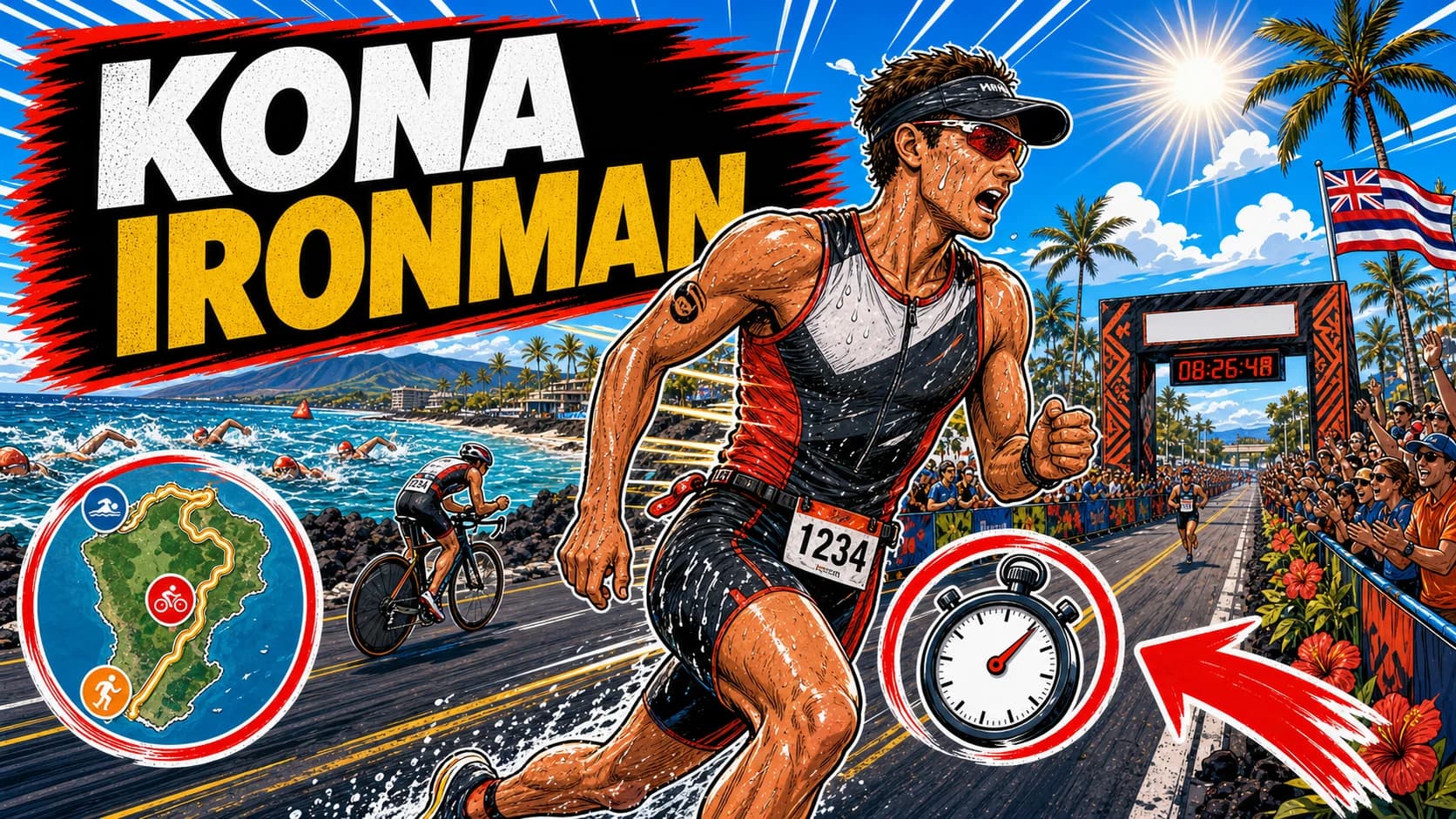
IRONMAN Kona is run on a single course that starts and finishes in Kailua-Kona. The swim is a rectangle in Kailua Bay (3.86 km, one lap), the bike is an out-and-back along the Queen Kaahumanu Highway to Hawi (180.25 km, ~1,700 m elevation gain), and the marathon covers Ali'i Drive first and then Queen Kaahumanu out to the Energy Lab (42.195 km, ~250 m gain). The race isn't decided in any single one of the three segments: it's decided by how you manage the sum.
Official 3D map of the IRONMAN Kona course with the three segments highlighted — the bay, the highway out to Hawi, and the marathon to the Energy Lab.
The swim start is right in front of Kailua Pier, in the heart of Kailua-Kona. It's a mass start by gender (men and women going off in separate groups a few minutes apart) directly into the Pacific. The course is a single rectangle marked by big yellow buoys: 1.9 km north, right turn, ~150 m crossing, 1.9 km south back to the pier — the postcard of the sport.
What makes the Kona swim unique:
Target swim time: 55:00–1:05:00 for strong swimmers (sub-1:00 marks the front pack); 1:05:00–1:15:00 for the middle pack; 1:15:00–1:25:00 for comfortable but not fast swimmers. Swim cutoff: 2 hours 20 minutes from the start.
Transition 1 (T1) is at Kailua Pier, 50 metres from the swim exit. You come out of the water, quick towel, helmet, bike shoes, and head north on the Queen Kaahumanu Highway (the "Queen K"). It's a single out-and-back with the turnaround at Hawi at km 90 — the northernmost point of the course.
Triathlete in aero position riding the Queen Kaahumanu Highway with black lava fields on both sides — the iconic image of the Kona bike.
The profile:
Total elevation: ~1,700 m gain — moderate for a 180 km bike, but the combination with wind and heat multiplies it. Average speed for an amateur ranges from 28–32 km/h (5h45–6h30); pros roll at 40–43 km/h (4h10–4h25).
🚨 Where the Kona bike breaks
T2 is back at Kailua Pier. Bike on the rack, run shoes, hat, handheld bottle, and head south on Ali'i Drive. It's a marathon in three clearly different blocks: 16 km along the coast, 12 km up the Queen K to the Energy Lab, and 14 km through the lava fields + back to the finish.
Block 1 — Ali'i Drive (km 0–16):
This is the "easy" stretch — in quotes. You leave Kailua Pier heading south, parallel to the ocean along Ali'i Drive (Kona's residential coastal walk), with crowds on both sides, palm trees, partial shade and ocean breeze. Turnaround at km 8 (Lyman Street) and back to the pier to head north on the Queen K. Pace runs higher here than the rest of the marathon because the temperature is the most manageable, the sea breeze cools you, and your body still has glycogen.
Block 2 — Climb to the Queen K and Energy Lab (km 16–32):
This is where it all changes. You leave the coastal walk, climb a short 4 % ramp to the Queen Kaahumanu Highway and head north. The asphalt soaks up the sun like an oven (radiant surface temperature at 14:00 tops 50 °C), there is no shade, the sea breeze ends and humidity stays at 70 %.
Km 25–32 — the Energy Lab. The course leaves the Queen K to the left, drops a deceptive descent to the Natural Energy Laboratory of Hawaii Authority (the "Energy Lab"), a research compound surrounded by black lava fields. It's the lowest point of the course, down to sea level, in a wind-blocked basin where radiant temperature peaks. This is where the marathon meets you.
Block 3 — Energy Lab back to the finish (km 32–42):
You leave the Energy Lab, climb the same deceptive descent in reverse (now a 4 % climb) and rejoin the Queen K. 10 km of Queen K heading south with headwind or crosswind, low sun on the horizon if you're in a late amateur group, and the final descent into Kailua-Kona via Palani Road. The last 1.5 km is a loop on Ali'i Drive with the crowd on its feet.
Marathon target time in Kona: 3h00–3h15 for the front age-group pack; 3h30–3h50 for the middle pack; 4h00–4h30 for the mid-late pack. Add 20 to 40 minutes to your best stand-alone marathon — that's the cost of Kona.
Total cutoff for IRONMAN Kona: 17 hours from the swim start (typically midnight). Intermediate cutoff T1: 2h20. Intermediate cutoff T2: 10h30 after the start.
The IRONMAN World Championship has been raced since 1978. The original idea came out of an O'ahu argument among swimmers, cyclists and runners about who was the most complete athlete. Gordon Haller won the first edition (15 entrants) in 11h46. The race moved to Kailua-Kona in 1981 and has been the continuous home of the World Championship ever since, with two exceptions: 2020 cancelled by the pandemic, and 2021 raced in St. George (Utah) in May 2022 as an alternate venue.
Iconic image of a finisher crossing the line in Kailua-Kona at sunset, with the "You Are An Ironman" banner — the postcard of the sport.
Key data for the IRONMAN World Championship:
| Item | Value |
|---|---|
| First edition | 1978 (O'ahu, 15 athletes) |
| First edition in Kailua-Kona | 1981 |
| Editions raced | 45+ (through 2025) |
| Distances | 3.86 km swim · 180.25 km bike · 42.195 km run = 226 km |
| Participants (Kona, typical year) | ~3,500 |
| Countries represented | 90+ |
| Absolute Kona record men | 7:35:53 (Patrick Lange, GER, 2024) |
| Absolute Kona record women | 8:24:31 (Lucy Charles-Barclay, GBR, 2023) |
Verified winners and times for the 5 most recent editions (2021 raced in St. George; 2023 with split Kona/Nice format; 2024–2025 both genders in Kona):
| Year | Venue | 🥇 Men | Country | Time | 🥇 Women | Country | Time |
|---|---|---|---|---|---|---|---|
| 2025 | Kailua-Kona | Casper Stornes | 🇳🇴 NOR | 7:51:39 | Solveig Løvseth | 🇳🇴 NOR | 8:28:27 |
| 2024 | Kailua-Kona | Patrick Lange | 🇩🇪 GER | 7:35:53 (CR) | Laura Philipp | 🇩🇪 GER | 8:45:15 |
| 2023 | Nice (M) / Kona (W) | Sam Laidlow | 🇫🇷 FRA | 8:06:22 | Lucy Charles-Barclay | 🇬🇧 GBR | 8:24:31 (CR) |
| 2022 | Kailua-Kona | Gustav Iden | 🇳🇴 NOR | 7:40:24 | Chelsea Sodaro | 🇺🇸 USA | 8:33:46 |
| 2021 | St. George (UT) | Kristian Blummenfelt | 🇳🇴 NOR | 7:49:16 | Daniela Ryf | 🇨🇭 SUI | 8:34:59 |
Data verified against the public archive at Ironman World Championship (Wikipedia EN). 2020 was cancelled due to COVID. The 2023 format split the two competitions by gender: men in Nice (France) and women in Kona. For 2026 both are back to Kailua-Kona.
Unlike any other IRONMAN on the calendar, Kona doesn't get registered — it gets earned. The official qualification system works like this: every regional IRONMAN on the circuit (Frankfurt, Lanzarote, Hamburg, Nice, Cozumel, Cairns, etc.) hands out a fixed number of Kona slots to age-groupers, in proportion to the size of each category. If you finish inside your age-group slot count and claim the slot at the Roll-Down ceremony the next day, you've qualified. If you decline, the slot rolls down to the next athlete.
Athlete standing up to claim their Kona slot at a regional IRONMAN Roll-Down ceremony — the moment that changes the next 12 months of their life.
Official routes to Kona 2026:
These are the approximate times that have historically qualified in each age band. They are not official times — slot count changes every year depending on category size and field strength:
| Age group | Men (qualifying threshold) | Women (qualifying threshold) |
|---|---|---|
| 18–24 | ~9h45 | ~10h45 |
| 25–29 | ~9h30 | ~10h45 |
| 30–34 | ~9h25 | ~10h35 |
| 35–39 | ~9h25 | ~10h35 |
| 40–44 | ~9h35 | ~10h45 |
| 45–49 | ~9h45 | ~11h00 |
| 50–54 | ~10h10 | ~11h30 |
| 55–59 | ~10h45 | ~12h15 |
| 60–64 | ~11h30 | ~13h15 |
| 65–69 | ~12h30 | ~14h00 |
Reference times based on recent roll-down counts at IRONMAN Hamburg, Frankfurt and Lanzarote. Confirm the actual slot count published by the organizer of whichever IRONMAN you're targeting.
An IRONMAN Kona 2026 from Europe runs between €6,000 and €12,000 all-in. Typical breakdown:
| Item | Estimated cost (EUR) |
|---|---|
| IRONMAN Kona bib | $1,300 ≈ €1,250 |
| USAT federation license | $50 ≈ €48 |
| Regional IRONMAN qualifier (previous bib) | €700–900 |
| Direct Europe → KOA flights (10 days early, 2 people) | €2,500–4,000 |
| Lodging in Kailua-Kona (10 nights, double) | €3,000–6,000 |
| Rental car for 10 days (mandatory) | €600–900 |
| Bike air transport | €200–400 |
| Food + supplements on island | €500–800 |
| Travel + cancellation insurance | €100–200 |
| Total | ~€9,000–14,500 |
Kailua-Kona is on the western coast of the Big Island of Hawaii. The reference airport is Kona International Airport (KOA), located about 12 km north of the town of Kailua-Kona. Direct flights into KOA come mostly from San Francisco (SFO), Los Angeles (LAX), Seattle (SEA), Vancouver (YVR), Tokyo (NRT/HND), Sydney (SYD) and Honolulu (HNL). There are no direct flights from Europe — the standard combination is a flight to Los Angeles or San Francisco + a domestic connection to KOA (8 + 5 hours + 4–6 h of layover).
Arrival at Kona International Airport — open-air Hawaiian-style terminal with palm trees and ocean view. The first heat + humidity slap for the European athlete.
Common routes from Europe:
What to keep in mind:
Rental car — mandatory:
Kailua-Kona has no functional public transport for an athlete. The distance between the airport and downtown (12 km), between downtown and the hotels in Keauhou (10 km south) or Waikoloa (45 min north), between your hotel and the supermarket to grab breakfast — all of it is done by car. Book an SUV or crossover with room for a bagged bike or bike box, or a minivan if you're travelling as a couple with two sets of luggage.
Race-day parking:
For an IRONMAN in Kona, staying less than 2 km from Kailua Pier isn't luxury — it's pure logistics. On race morning you leave the hotel at 04:30, drop your transition bag, head back to finish prepping, grab cold bottles from the fridge and walk to the pier at T-90 minutes. Any lodging that forces you into a car or shuttle that day adds unnecessary stress to the most important day of your year.
View of Kailua Pier at sunrise with the bay lit up, the village in the background, and the main hotels (Royal Kona, King Kamehameha) in view — the "must-have" lodging zone.
| Hotel | Cat. | USD/night* | To Kailua Pier | Triathlete edge |
|---|---|---|---|---|
| Royal Kona Resort | 4* | 350–550 | 600 m · 7 min | Bathtub, AC, bay view |
| Marriott Courtyard King Kamehameha's Kona Beach | 4* | 380–600 | 100 m · 1 min | Next to the pier, transition 50 m away |
| Outrigger Kona Resort & Spa | 4* | 320–500 | 800 m · 10 min | Temperate pool, gym |
| Kona Tiki Hotel | 3* boutique | 200–320 | 700 m · 9 min | Equipped kitchen, ocean balcony |
| Kona Seaside Hotel | 3* | 180–280 | 200 m · 3 min | Budget-friendly, next to the pier |
| Hotel | Cat. | USD/night* | To Kailua Pier | Triathlete edge |
|---|---|---|---|---|
| Sheraton Kona Resort & Spa at Keauhou Bay | 4* | 350–500 | 10 km · 15 min | Big pool, manta ray night view |
| Outrigger Keauhou Beach Resort | 4* | 300–450 | 9 km · 14 min | Snorkel, gym, early restaurant |
| Kona Coast Resort (apartments) | 3*+ | 250–400 | 11 km · 16 min | Apartment with full kitchen, ideal for couples |
| Hotel | Cat. | USD/night* | To Kailua Pier | Triathlete edge |
|---|---|---|---|---|
| Waikoloa Beach Marriott Resort & Spa | 4* | 250–400 | 50 km · 45 min | Pool, golf, AC, gym |
| Hilton Waikoloa Village | 4*+ | 280–500 | 50 km · 45 min | Mega resort, mantas, dolphins, all in-house |
| Mauna Lani Auberge Resorts | 5* | 600–1,000 | 55 km · 50 min | Full luxury if budget allows |
*Reference rate for IRONMAN World Championship weekend (second week of October). Rates jump 40–60 % above normal Kona pricing. Book 12 months ahead if your qualification looks likely — Kailua-Kona village hotels sell out by March of race year.
Kailua-Kona's weather in October averages 28–32 °C highs with 70–90 % relative humidity and water at 26–28 °C. It's the combination of all three variables — not any of them alone — that makes Kona the toughest race on the IRONMAN calendar. For a European athlete who's trained March through October at average temperatures of 18–24 °C, the physiological cost shows up on the very first ride.
Triathlete pouring water over their head in T1 with radiant sun, sweat and brutal heat appearance — the image that defines nutrition in Kona.
Kona's October heat map:
| Variable | Typical value | Implication |
|---|---|---|
| Ambient temperature at sunrise (06:00) | 23–25 °C | Comfortable swim start |
| Ambient temperature midday (12:00) | 30–32 °C | Bike under radiant sun |
| Ambient temperature afternoon (15:00) | 31–33 °C | Marathon at peak heat |
| Average relative humidity | 70–90 % | Sweat doesn't cool you — critical |
| Sea water temperature | 26–28 °C | No wetsuit most years |
| Asphalt temperature midday | 50–55 °C | Feet burn through running shoes |
| Average bike wind (Mumuku zone) | 30–50 km/h | Crosswind, not headwind |
| Rain probability | 20–30 % | Short showers possible, not sustained |
Why humidity is worse than heat:
At 32 °C with 30 % humidity (a dry day in Spain in July) your sweating works — sweat evaporates, cools you, you keep regulating temperature. At 32 °C with 80 % humidity (Kona in October) sweat doesn't evaporate — it pours off. You lose salts and water without getting the cooling effect. Core temperature climbs from the usual 37 °C to 38.5–39.5 °C — heat-stroke territory.
Heat acclimatization plan (minimum 14 days before the race):
Pre-race hydration: in the 3 days before the race drink 3–4 litres/day with extra sodium (1–2 g of salt per litre). Your body needs to be over-hydrated by the time you hit the start line. Weigh yourself every morning when you wake up — overnight you sweat off weight; rebuild it with sports drink at breakfast.
The recommended plan to prepare for IRONMAN Kona is a 40+ week macrocycle split into four blocks: aerobic base (weeks 1–16), specific strength (weeks 17–24), specific IRONMAN build (weeks 25–36) and taper + heat acclimatization (weeks 37–40+). The difference compared to a regional IRONMAN is the heat + wind acclimatization and the total weekly bike load (12–18 h/week on the bike during the build block).
Triathlete in aero position riding a long session on open coastal terrain similar to the Queen Kaahumanu — real Kona-prep training.
These are the peak-week volumes during the build block (weeks 28–34). The macrocycle average will be roughly 60–70 % of these numbers:
| Final goal | Swim/week | Bike/week | Run/week | Total hours/week |
|---|---|---|---|---|
| sub-9h00 | 12–16 km | 350–450 km | 75–90 km | 24–28 h |
| 9h00–10h00 | 10–14 km | 300–400 km | 65–80 km | 20–25 h |
| 10h00–11h00 | 8–12 km | 250–350 km | 55–70 km | 17–22 h |
| 11h00–12h00 | 7–10 km | 220–300 km | 50–65 km | 15–19 h |
| 12h00–13h00 | 6–8 km | 180–250 km | 45–55 km | 13–17 h |
| Finish (>13h00) | 5–8 km | 150–220 km | 40–50 km | 11–14 h |
Macrocycle principles:
| Weeks out | Action |
|---|---|
| -4 | 3 sessions/week sauna 20 min post-training · winter clothing on Z2 rides |
| -3 | 4 sessions/week sauna 25 min · long bike at the hottest hour of the day |
| -2 | Fly to Kailua-Kona (8–14 days early) · short Z2 rides at sunrise · sauna no longer needed |
| -1 | Short sessions on the Queen K · reinforced rest · 3–4 L/day with sodium loading |
The taper is three weeks, not two. Week -3 at 70 % of volume, week -2 at 50 %, week -1 at 30 % keeping intensity in short pills. The two peak long sessions (weeks -7 and -5) are the ones that fill the cup.
Once you have your final IRONMAN marathon goal (after 3.86 km of swim + 180.25 km of bike, with 7–10 hours of racing already in the legs), this calculator gives you the average required pace (in min/km and min/mi) and the cumulative splits at 5K, 10K, 15K, half marathon, 30K and finish. Change the goal time in the field below and the table updates instantly:
| Punto | Tiempo acumulado | Parcial |
|---|---|---|
| 5 km | 24:53 | 24:53 |
| 10 km | 49:46 | 24:53 |
| 15 km | 1:14:39 | 24:53 |
| Media (21,1 km) | 1:45:00 | 30:21 |
| 30 km | 2:29:18 | 44:18 |
| Meta | 3:30:00 | 1:00:42 |
Splits asumen ritmo constante. En carreras con desnivel real (IRONMAN Kona Marathon) — banca 5–8 s/km en bajadas y pierde el mismo margen en subidas; el ritmo medio se mantiene.
Important: this calculator is for the final marathon (the last 42.2 km of the IRONMAN), not for the full 226 km. To set your Kona marathon target split, use this rule: your best stand-alone marathon + 30–45 minutes. A sub-3h00 in a stand-alone marathon turns into a 3h30–3h45 in Kona after 7+ hours of prior racing.
The calculator above gives you the marathon pace. But a real IRONMAN plan answers more questions: what target power on the bike? how do you swim the first 200 m? how many bottles do you carry? how much sodium per hour on the bike? when does the caffeine come in?
Set your goal, strategy and fueling plan. The planner generates a personalized plan by section (with paces, HR zones, bike power, mental cues and minute-by-minute fueling), a race-morning checklist, and a Plan B for the unexpected. Download it as a PDF to take with you on race day.
PDF A4, optimizado para imprimir y llevar el día de carrera.
An IRONMAN race plan isn't a plan — it's three sequential plans. The swim start, the transition to the bike, and T2 + marathon are three separate races with three different logics, connected by nutrition and thermoregulation.
What decides the swim: positioning in the first 200 m, sighting every 6–8 strokes, not torching your upper body before getting on the bike.
What decides the bike: pacing by power/HR — not by speed, hydration every 15 minutes without fail, and controlled technique in Mumuku winds.
| Goal | Target power (% FTP) | Target HR | Expected average speed |
|---|---|---|---|
| sub-4h30 bike | 70–75 % FTP | High Z2 → Low Z3 | 40+ km/h |
| 4h30–5h00 bike | 65–72 % FTP | High Z2 | 36–40 km/h |
| 5h00–5h30 bike | 60–68 % FTP | Mid-high Z2 | 32–36 km/h |
| 5h30–6h00 bike | 55–65 % FTP | Mid Z2 | 30–32 km/h |
| 6h00+ bike | 50–60 % FTP | High Z1 → Low Z2 | 28–30 km/h |
Tactical rules for the Kona bike:
What decides the marathon: patience in the first 16 km on Ali'i Drive, ruthless management of core temperature in the Energy Lab, push or hold from km 32 to the end depending on how you arrive.
| Marathon goal | Target pace | Kona-specific tactical note |
|---|---|---|
| sub-3h00 | 4:16 min/km | Bank 5–10 s/km in km 0–10 (Ali'i Drive). Hold pace km 10–25. Survive the Energy Lab. |
| sub-3h30 | 4:58 min/km | Don't go out at 4:50. Hold 5:05 the first 10 km. Gel every 4 km, salts every 30 min. |
| sub-4h00 | 5:41 min/km | Splits very even at 5:40–5:45. Walk 30 s at every aid station. Don't lose the pace at the Energy Lab — earn it back km 35–42. |
| sub-4h30 | 6:24 min/km | Walk-run from km 21 (walk 30 s every km). Hydration mandatory at every aid station. |
| sub-5h00 | 7:06 min/km | Walk-run from km 1: 8 run / 1 walk. Ice on the head from km 10. |
| Finish | 7:30+ | No watch. Enjoy Ali'i Drive at night, the spectator signs, the lit-up finish line. |
Specific tactics for the Kona marathon:
The nutrition strategy for IRONMAN Kona pivots on 70–90 g of carbs per hour on the bike, 50–70 g/h on the marathon, 1.5–2 g of sodium per hour (key in Hawaii) and 800–1,000 ml of fluid per hour on the bike (more than at any other IRONMAN on the calendar). Nutrition starts the Tuesday before the race with carb-loading and doesn't end until the Monday after with recovery.
Triathlete laying out gels, salts, sports-drink mix bottles and bars on the hotel table the night before — nutrition is half the game in Kona.
| Bike goal | Carbs/hour | Bottles/hour | When to take them |
|---|---|---|---|
| sub-4h30 | 80–100 g/h | 2 bottles + aero bottle | Every 15 min — gel + sports drink |
| 4h30–5h00 | 70–90 g/h | 2 bottles + aero bottle | Every 15 min — gel + sports drink |
| 5h00–5h30 | 70–85 g/h | 2 bottles + aero bottle | Every 15–20 min |
| 5h30–6h00 | 60–80 g/h | 2 bottles | Every 20 min |
| 6h00+ | 50–70 g/h | 2 bottles | Every 20–25 min |
Bike aid stations (IRONMAN Kona organization):
| Marathon goal | Carbs/hour | When to take them |
|---|---|---|
| sub-3h00 | 70–80 g/h | Gel every 4 km + cola at aid stations |
| sub-3h30 | 60–75 g/h | Gel every 5 km + cola at aid stations |
| sub-4h00 | 50–65 g/h | Gel every 6 km + cola at aid stations |
| sub-4h30 | 45–60 g/h | Gel every 8 km + cola |
| 5h00+ | 35–50 g/h | Gel every 10 km + cola + occasional solid |
Marathon aid stations:
Unlike a European IRONMAN (where 800–1,200 mg/h of sodium is enough), in Kona you need 1,500–2,000 mg/h because of the heat + humidity combo. How you stack it:
| Source | Typical sodium | Quantity |
|---|---|---|
| Sports gel (Maurten Drink Mix 320) | 250 mg | 1 every 30 min |
| Gatorade Endurance (600 ml bottle) | 500 mg | 1 bottle every 30 min |
| Salt capsule (Salt Stick) | 215 mg | 1 every 30–45 min |
| Chicken broth (cup) | 800 mg | 1 every 60 min from km 30+ |
Total target: ~1,500–2,000 mg/h on the bike, 2,000+ mg/h on the marathon.
Hyponatremia warning sign: if at km 100 of the bike you feel nausea + headache + finger swelling, DO NOT drink more water — take 2 salt capsules with the next sports drink. Hyponatremia (low sodium) takes 50–100 athletes/year out of Kona.
Gear for IRONMAN Kona is complex and expensive. A well-spec'd TT bike runs €5,000–10,000, the aero helmet €300–600, the full transition with official bags €150–250, and supplements for 10 days on island €300–500. What's critical isn't expensive — it's tested. Debuting new gear in Kona is the recipe for a DNF.
Time-trial bike with short aero helmet, mid-profile wheels and aero bottle in the frame, racked on Kailua Pier the day before the race.
| Bag | Typical contents |
|---|---|
| Morning Clothes Bag | Clothes you arrive at the pier in (flip-flops, t-shirt, hat) — collected at the end |
| Bike Bag (blue) | Helmet, sunglasses, socks, bike shoes, pre-bike gel, vaseline |
| Run Bag (red) | Run shoes, cap, race number, dry sunglasses, gels, salts |
| Special Needs Bike (km 90 Hawi) | Extra bottle, special gel, spare aero gel |
| Special Needs Run (km 21 marathon) | Extra gels, extra salts, change of socks if you plan it |
You need to finish a regional IRONMAN (Frankfurt, Hamburg, Lanzarote, Nice, Barcelona, Cozumel, Cairns, etc.) during the qualifying cycle (August 2025 → July 2026) inside the slot count for your age group. Each regional IRONMAN hands out a fixed number of Kona slots in proportion to the size of each category. If you finish inside the slot count and claim it at the Roll-Down ceremony the day after your IRONMAN, you've qualified. If you decline, it rolls down to the next athlete.
Alternative routes: Foundation slots ($5,000–10,000 donation), Janus Charity Challenge (raise ~$2,000), Kona Inspired (8 slots a year for inspirational stories), age-group lottery (1/30 ratio among qualifiers without a slot).
Between €6,000 and €14,500 all in. Typical breakdown: Kona bib €1,250 + IRONMAN qualifier €700–900 + flights €2,500–4,000 + 10-night lodging €3,000–6,000 + rental car €600–900 + bike transport €200–400 + food and supplements €500–800 + travel insurance €100–200. A couple pushes the total to €12,000–18,000. It's the most expensive race on the global triathlon calendar — but also the only cathedral of the sport.
Yes, more than the average European IRONMAN. The risks are:
The organizer has medical aid stations every 5 km on the bike and every mile on the marathon. Historical IRONMAN World Championship mortality is similar to other IRONMAN races (~1 in 75,000 finishers), not higher.
Depends on your strength. The IRONMAN World Championship rotates the men's venue between Kona (even years: 2024, 2026, 2028) and Nice (odd years: 2023, 2025, 2027). Women race in Kona from 2024 onward. Each venue rewards different profiles:
If you weigh <70 kg and have a climbing background, Nice fits you better. If you weigh >75 kg and perform on flat + heat, Kona. Decide by physiology, not by prestige (Kona has the history; Nice is building its own).
Minimum 7 days, optimal 10–14 days early. Reasons:
Pro tip: arrive on the Saturday before race week (8 days early), train easy 3–4 days, rest 4 days, prep gear 2 days out, race day. Your supporter can fly in 2–3 days later to save costs.
The organizer keeps the race on unless gusts top 80 km/h sustained or waves in Kailua Bay prevent the swim start (historical case: 2003, 2.5 m sea, 30-minute delay). The most common scenario is gusts of 40–60 km/h in the Mumuku zone — challenging but rideable with the right gear.
Athlete Plan B: if you have any doubt about your crosswind technique in extreme gusts, drop your power target by 5–10 W in km 75–95 and keep hands close to the brakes. You give up 90 seconds but you arrive at the marathon in one piece. The athlete who insists on holding power target in extreme Mumuku winds is the athlete who hits the deck at 50 km/h.
Hawaii is GMT-10 (11 hours behind peninsular Spain). Tested strategy:
Almost never. The IRONMAN rule is: water >24.5 °C → wetsuit not allowed for any athlete who wants to qualify for anything afterwards (in Kona, everyone). Kailua Bay water in October usually sits at 26–28 °C, clearly above the limit. Historically only two editions (2010, 2014) saw water cold enough for wetsuit.
What you can use: a swimskin — non-buoyant textile suit that reduces drag without adding flotation. Brands: Roka SR1, HUUB Lurz X, blueseventy PZ4TX. Worth 30–60 seconds across 3.86 km — pays off if budget allows.
Heat is the real adversary in Kona and it has to be trained. Tested plan:
Acclimatized athletes finish 20–40 minutes ahead of unacclimatized athletes in Kona. That's the difference between an age-group podium and being outside the top 30.
Kona vs Lanzarote: Lanzarote is the toughest IRONMAN in Europe (2,500 m elevation gain on the bike, extreme wind). Physiological cost similar to Kona but for different reasons (Lanzarote elevation + wind; Kona heat + humidity + wind).
Kona vs Roth (Challenge Roth, not official IRONMAN): Roth covers 226 km in Germany on a fast profile (1,300 m gain). 40–60 minutes faster than Kona because of the lack of extreme heat. It's where world records get broken (Iden 7:18 in 2022).
Kona vs Nice: Nice has 2,500 m gain on the bike on French alpine terrain, fresher Mediterranean water. Rewards lean climbers. Marathon along a cool seafront, not lava. Times similar to Kona but a different athlete profile.
Kona vs Cozumel: Cozumel (Mexico, November) is the fastest race on the IRONMAN calendar — flat island bike, Caribbean water, mild November heat. 30–60 minutes faster than Kona because of less extreme heat.
Kona vs Cairns: Cairns (Australia, June) is Kona but with a more relaxed town, similar wind but less radiant heat. 15–25 minutes faster than Kona.
| Race | Place | Bike gain | Heat | Physiological cost vs Kona |
|---|---|---|---|---|
| Kona (this guide) | Hawaii | 1,700 m | ★★★★★ | Reference 100 % |
| Lanzarote | Spain | 2,500 m | ★★★ | 95 % (different profile) |
| Nice | France | 2,500 m | ★★★ | 92 % |
| Roth | Germany | 1,300 m | ★★ | 75 % |
| Frankfurt | Germany | 1,200 m | ★★★ | 80 % |
| Cozumel | Mexico | <500 m | ★★★ | 75 % |
| Cairns | Australia | 1,500 m | ★★★★ | 90 % |
| Barcelona | Spain | 800 m | ★★★ | 78 % |
The IRONMAN World Championship Kona is the World Championship — it doesn't compare to a regional IRONMAN, it's the level above that you only access via qualification. But understanding how the big IRONMAN races on the calendar position themselves helps you plan the path: which race to pick as a qualifier, which to pick as a "post-Kona" goal, and which to pick if Kona doesn't fit your physiology.
All these races are IRONMAN-distance (3.86 + 180.25 + 42.195 km), so the choice depends on month, profile, heat and prestige:
| Race | Month | Bike gain | Typical heat | Best for |
|---|---|---|---|---|
| IRONMAN Kona (this guide) | October | ~1,700 m | 28–32 °C / 80% RH | World Championship · qualification mandatory |
| IRONMAN Nice | September | ~2,500 m | 22–28 °C | World Championship M (odd years) · climbers |
| IRONMAN Lanzarote | May | ~2,500 m | 20–28 °C / wind | "Tough" European qualifier · wind |
| Challenge Roth | July | ~1,300 m | 18–28 °C | Personal records · not official IRONMAN |
| IRONMAN Frankfurt | June/July | ~1,200 m | 22–32 °C | Main European qualifier · atmosphere |
| IRONMAN Hamburg | June | ~500 m | 18–24 °C | Flat European qualifier · fast |
| IRONMAN Barcelona | October | ~800 m | 22–26 °C | End-of-cycle qualifier · Mediterranean |
| IRONMAN Cozumel | November | <500 m | 26–30 °C | Personal record · end-of-calendar |
| IRONMAN Cairns | June | ~1,500 m | 22–28 °C | Australasian qualifier · scenic |
| IRONMAN Western Australia (Busselton) | December | <300 m | 20–28 °C | End-of-year qualifier · flat |
Did this guide help? If you're racing Kona 2026, save the event in SportPlan to get weather forecast alerts, logistics reminders, and later, log your finish time. And if you're still qualifying, explore the upcoming IRONMAN calendar to find your qualifier.
Sigue planificando
Usa SportPlan para comparar fechas, guardar eventos objetivo y montar una temporada que encaje con tus fines de semana.