52 min de lecturarunningmaraton
Complete Guide to the TCS New York City Marathon 2026 — Course, 5 Boroughs, Logistics and How to Train for It
Complete Guide to the TCS New York City Marathon 2026
Complete Guide to the TCS New York City Marathon 2026
On November 1, 2026 New York hosts the largest single-day marathon in the world — ~55,000 finishers crossing the city's five boroughs from Fort Wadsworth (Staten Island) to Central Park. It's the most iconic event on the North American calendar and, alongside Boston, Chicago, Berlin, London and Tokyo, one of the six World Marathon Majors. It's not the fastest — the five bridges, the rolling false flats and the ~250 m of cumulative elevation gain take their toll — but it has the best atmosphere by far, with two million spectators lining every meter of the course. This guide covers what the official NYRR site doesn't quite spell out: how to get in (lottery, 9+1, charity, time qualifier), how to manage the two hours at Fort Wadsworth before your wave, where most runners break on the Queensboro Bridge at km 24, how to avoid burning yourself on First Avenue at km 26, and how to close the last 5K in Central Park without collapsing.
| Item | Information |
|---|---|
| Date | November 1, 2026 (Sunday) |
| Distance | 42.195 km (marathon) |
| Elevation gain | ~250 m (5 bridges) |
| City | New York City (5 boroughs) |
| Start | Fort Wadsworth, Staten Island |
| Finish | Central Park · Tavern on the Green |
| Start time | Waves between 8:30 and 11:30 (depending on assignment) |
| Organizer | NYRR (New York Road Runners) · Sponsor: TCS |
| Registration | nyrr.org/tcsnycmarathon — lottery, 9+1, charity, time qualifier |
The TCS New York City Marathon is the largest single-day marathon in the world, organized by NYRR (New York Road Runners) since 1970. It draws ~55,000 finishers, attracts runners from 130+ countries and closes the autumn World Marathon Majors season alongside Berlin, Chicago and London. It's the only marathon on the international calendar that crosses all five boroughs of one city — Staten Island, Brooklyn, Queens, the Bronx and Manhattan — crossing five bridges and finishing in Central Park in front of the Tavern on the Green. It's not a PB track; it's the definitive "experience" marathon.
Pack crossing the Verrazzano-Narrows Bridge at the start with the Manhattan skyline in the background — the postcard that defines the New York City Marathon.
NYC is not a flat marathon for chasing times. The city is rolling, the five bridges add up to ~250 m of cumulative elevation gain, and the false flats of Brooklyn (km 5–20) and Manhattan (km 26–30) charge a silent tax on anyone who goes out hard. What you lose in fast geometry you gain in atmosphere: 2 million spectators lining every meter of the course, the Brooklyn bands (~150 live performances along the route), the Queensboro ramp into absolute silence before exploding into First Avenue, and the final 5K in Central Park with crowds packed on every side. The elevation + atmosphere + late waves combo typically costs 3 to 8 minutes versus your time on a flat marathon like Berlin or Valencia.
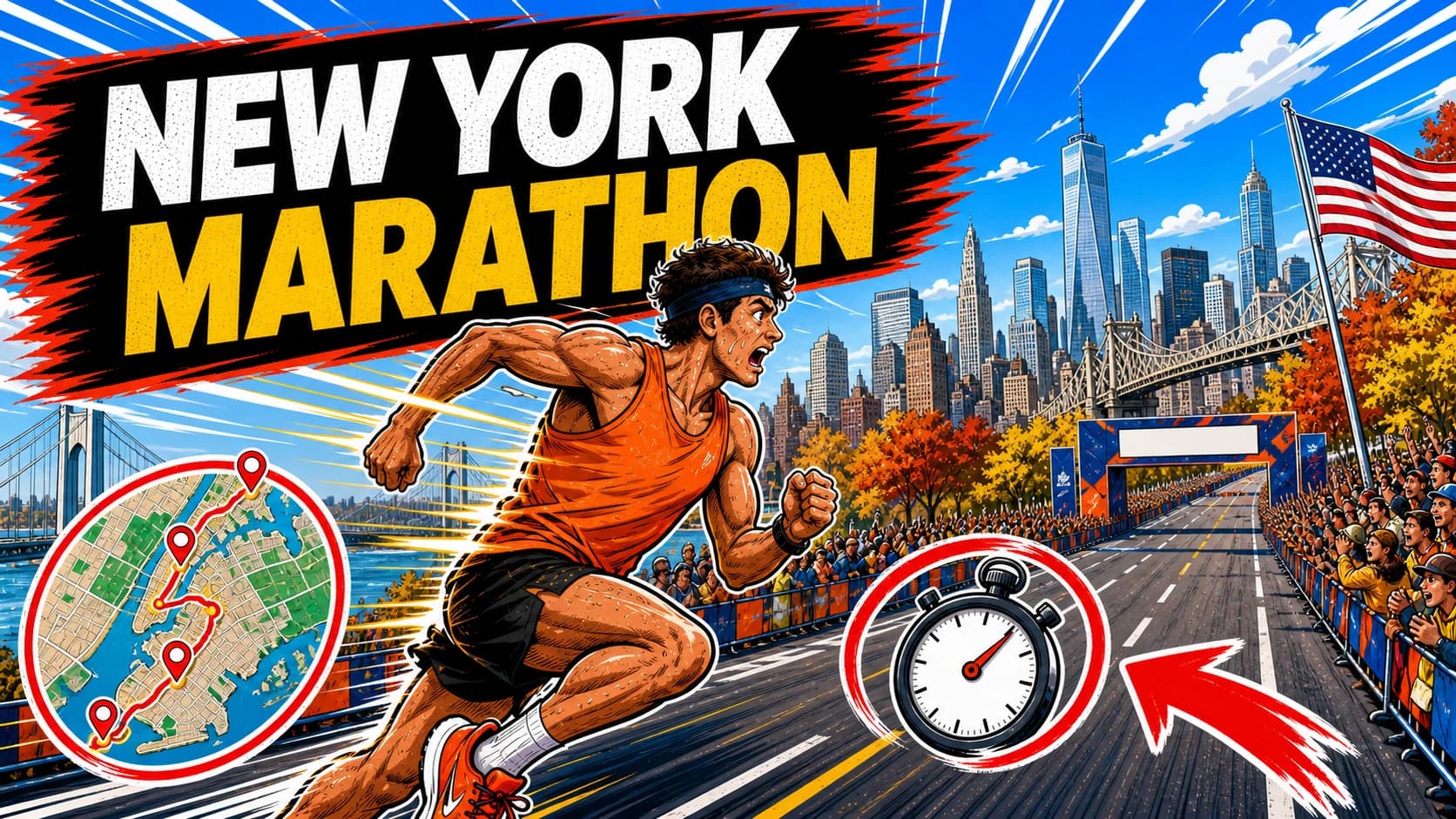
The TCS New York City Marathon course is a point-to-point route of 42.195 km that crosses the five boroughs of New York with ~250 m of cumulative elevation gain, distributed mainly across the five bridges. It starts on the Verrazzano-Narrows Bridge at Fort Wadsworth (Staten Island), runs through Brooklyn for 18 km (km 3–21), crosses the Pulaski Bridge into Queens (km 21.5), heads up the Queensboro Bridge into Manhattan at km 24, climbs First Avenue to the Willis Avenue Bridge into the Bronx (km 32), returns over the Madison Avenue Bridge to Manhattan, descends down Fifth Avenue and closes the last 4 km inside Central Park to the finish next to the Tavern on the Green.
Official 3D map of the full TCS NYC Marathon course (published by NYRR), with the 5 boroughs and the 5 bridges clearly visible.
The start at Fort Wadsworth puts you at the foot of the Verrazzano-Narrows Bridge, the longest bridge on the course (~2.1 km) and the most iconic ramp: you climb 60 m to the center of the bridge (km 1) with a view of the Statue of Liberty and the Manhattan skyline ahead. The Verrazzano descent (km 1–3) drops the pack into Brooklyn, where you'll run Fourth Avenue and Bedford Avenue for a long 18 km (km 3–21) — the longest, most festive section with the most live bands of any marathon in the world. The Pulaski Bridge (km 21.5) marks the crossing into Queens, and the next 2.5 km are rolling false flat to the Queensboro Bridge ramp (km 24) — the moment that changes the race.
The Queensboro Bridge is the second key bridge: 1.5 km of sustained climb at 2–3 % gradient, with no spectators or bands (it's a bridge closed to pedestrians), in absolute silence. You exit the Queensboro into Manhattan, on the off-ramp toward 60th Street, where the roar of 50,000+ spectators packed onto First Avenue hits you. The next 6 km (km 26–32) are rolling flat along First Avenue to the Willis Avenue Bridge that crosses you into the Bronx for 1.5 km (km 32–34). You return to Manhattan via the Madison Avenue Bridge (km 34), descend Fifth Avenue with a moderate technical descent, enter Central Park at 90th Street (km 39), run East Drive through the park and turn onto Central Park South (59th Street) to close with the last 800 m on West Drive to the Tavern on the Green.
Asphalt is the dominant surface throughout the course. Liquid aid stations (water + Gatorade Endurance) sit roughly every mile (1.6 km) from km 5 to the finish, with GU gel stations at km 30 and km 35 (mile 18 and mile 22). Crowd density is extreme on First Avenue (km 26–30), all of Brooklyn (km 3–21), and the last 5K in Central Park — thinner on the Verrazzano (no spectators), the Queensboro (closed) and the Willis and Madison bridges.
Forget the "NYC is flat" myth. Cumulative elevation gain runs about ~250 m spread across five structural ramps:
The descents on Verrazzano (km 2–3), Queensboro (km 25–26) and Fifth Avenue (km 36–38) are the only three time-recovery sections on the course — but don't expect gifts in the last 5K inside Central Park: the small ramps on West Drive and Cat Hill charge one final tax when you're already empty.
🚨 Where the race breaks
Course data for Strava / Garmin: NYRR publishes the official GPX a few weeks out at nyrr.org/tcsnycmarathon. To preview the Queensboro + First Avenue section, search Strava for the segments "Queensboro Bridge Inbound (Marathon)" and "First Avenue Mile 17–20" — they're the same profiles you'll suffer on race day.
The New York City Marathon has been run since 1970, when Fred Lebow organized the first edition with 127 runners doing laps of Central Park. The transformation came in 1976, when NYRR expanded the course to all five boroughs to mark the United States bicentennial — and the race exploded in participation, prestige and atmosphere. The TCS (Tata Consultancy Services) brand has been the title sponsor since 2014, and NYRR has held the first Sunday in November date as its calling card. The 1992 race in honor of Fred Lebow (who had passed away) and the 2001 edition (seven weeks after 9/11) are the two most symbolic in the event's history.
Winner of the most recent edition crossing the finish line in Central Park in front of the Tavern on the Green — iconic image that anchors the roll of honour section.
Roll of honour and race stats (recent editions):
| Item | Value |
|---|---|
| First edition | 1970 (Central Park) — 1976 (5 boroughs) |
| Editions held | 54 (through 2025; 1 cancellation in 2012 due to Hurricane Sandy, 1 in 2020 due to Covid) |
| Current distance | Marathon (42.195 km) |
| Finishers (recent editions) | ~55,000 |
| Lottery applicants | ~600,000 (draw in March) |
| Countries represented | 130+ |
| Spectators | ~2,000,000 |
| Men's course record | 2:04:58 (Tamirat Tola, ETH, 2023) |
| Women's course record | 2:19:51 (Hellen Obiri, KEN, 2025) |
Verified winners and times for the 5 most recent editions:
| Year | 🥇 Men's | Country | Time | 🥇 Women's | Country | Time |
|---|---|---|---|---|---|---|
| 2025 | Benson Kipruto | 🇰🇪 KEN | 2:08:09 | Hellen Obiri | 🇰🇪 KEN | 2:19:51 (CR) |
| 2024 | Abdi Nageeye | 🇳🇱 NED | 2:07:39 | Sheila Chepkirui | 🇰🇪 KEN | 2:24:35 |
| 2023 | Tamirat Tola | 🇪🇹 ETH | 2:04:58 (CR) | Hellen Obiri | 🇰🇪 KEN | 2:27:23 |
| 2022 | Evans Chebet | 🇰🇪 KEN | 2:08:41 | Sharon Lokedi | 🇰🇪 KEN | 2:23:23 |
| 2021 | Albert Korir | 🇰🇪 KEN | 2:08:22 | Peres Jepchirchir | 🇰🇪 KEN | 2:22:39 |
Data verified against the public archive at New York City Marathon (Wikipedia EN). 2020 cancelled due to Covid; in 2025 Hellen Obiri broke the women's course record with 2:19:51, the first sub-2:20 mark in NYC history.
Registration for the TCS New York City Marathon does not work first-come, first-served. NYC is the most in-demand marathon in the world with ~600,000 applicants for ~55,000 spots, so there are five entry paths and they all have different deadlines, requirements and prices. The most popular is the lottery (drawing): you sign up in January–February, pay an 11 USD non-refundable fee, and the draw is in mid-March. The probability of getting in via lottery is around 8–10 % for US residents and 15–20 % for international runners (NYRR reserves a more generous quota for non-US). If you don't get in via lottery, the four alternative paths are NYRR 9+1, charity bib, time qualifier and tour operator package.
Aerial view of the massive pack crossing Fourth Avenue in Brooklyn, ideal for reinforcing the "55,000 runners every year, spots are lottery" message.
The five entry paths to the NYC Marathon 2026:
NYRR uses a flat price by category (not tiered) — the bib costs the same whether you get in via lottery in March or charity in June. The official prices for the 2025 edition were:
| Category | Bib price | Notes |
|---|---|---|
| 🇺🇸 US residents — NYRR members | 295 USD | Requires NYRR membership (~50 USD/year) |
| 🇺🇸 US residents — non-members | 355 USD | No membership discount |
| 🌍 International — NYRR members | 365 USD | Optional NYRR international membership |
| 🌍 International — non-members | 425 USD | Standard for European runners without NYRR |
| ❤️ Charity bib | 295 USD + fundraising | 5,000–10,000 USD additional fundraising |
| 🎫 Tour operator package | 3,500–6,500 USD total | Includes flight + hotel + bib + transport |
Indicative prices based on the 2025 edition's structure. Always check on the official NYRR site — amounts and deadlines are updated there every year.
| Included in the price | NOT included (optional extra) |
|---|---|
| ✅ Bib with timing chip | ❌ Official professional photo (~50 USD MarathonFoto) |
| ✅ New Balance technical shirt | ❌ Bag check service at the start (free but limited) |
| ✅ Tiffany & Co finisher medal | ❌ Saturday pasta dinner (~50 USD separately) |
| ✅ Transport to the start (ferry or bus) | ❌ NYRR membership (~50 USD if you want it) |
| ✅ Aid stations every mile | ❌ Cancellation insurance (~30 USD separately) |
| ✅ Post-finish bag (foil blanket, food) | |
| ✅ Digital diploma with certified time |
What you need to factor in beyond the bib price:
Runners at the Health & Fitness Expo at Javits Center, with the bib pickup counter and New Balance / TCS stands visible.
Bib pickup happens at the TCS New York City Marathon Health & Fitness Expo, normally held on the three days before the race (Thursday, Friday and Saturday) at the Jacob K. Javits Convention Center (655 W 34th St, Manhattan). Bibs are not handed out on race day: you have to pick yours up in person before the expo closes on Saturday, which historically is around 5:00 pm.
You'll need:
Third parties cannot pick up your bib. Unlike Madrid or Boston, NYRR requires the runner themselves to pick up their bib in person. This is strict — international tourists get turned away every year for trying. Plan to arrive in NYC by Thursday or Friday at the latest.
The race kit usually includes the New Balance technical shirt, the bib with chip, a tag for bag check, a paper course map and the GU gel samples used at the aid stations. The Tiffany & Co finisher medals are handed out in the post-finish area in Central Park after you cross the line.
The NYC Marathon logistics are the most complex of any World Marathon Major. The start is at Fort Wadsworth (Staten Island), an island reachable only by ferry (from Manhattan or Brooklyn) or by NYRR charter bus from the New York Public Library (Bryant Park, Midtown Manhattan). Reaching the start requires leaving the hotel 3 to 4 hours before your wave, queueing for the ferry or bus, crossing the water, 2–4 hours of waiting at Fort Wadsworth, and entering your corral 30 minutes before the gun. There is no private car option: the Fort Wadsworth area is closed to traffic, there is no parking, and the Verrazzano and Hugh L. Carey bridges are closed or restricted by the race.
Staten Island Ferry at dawn with runners carrying bibs and throwaway clothing — the iconic 5:30 am image of the NYC Marathon.
The three transport options to the start:
Race morning, the typical plan (wave 2, start 9:10):
For the expo at Javits Center, the closest subway is 34th Street–Hudson Yards (line 7) or 34th Street–Penn Station (lines 1, 2, 3, A, C, E). From Times Square it's ~10 minutes on foot to Javits.
If you're coming from Europe, the most practical airport is JFK (direct flights from Madrid, Barcelona, Paris, London, Frankfurt land there). The AirTrain JFK + LIRR (Long Island Rail Road) drops you at Penn Station (Midtown Manhattan) in ~50 minutes for around 15 USD. Newark (EWR) and LaGuardia (LGA) are alternatives but more expensive or less direct.
For an NYC Marathon runner, staying less than 30 minutes on foot from the finish in Central Park or close to the Whitehall ferry is the priority. The finish drops you in Central Park (Tavern on the Green) around 11:30–14:30 depending on wave and goal — you head back to the hotel sweaty, hungry, with cramps starting. The difference between sleeping well with an early breakfast and walking 15 minutes to the hotel from Central Park, versus catching the subway at 11:30 with two transfers, can decide the rest of the weekend's mood.
View of Times Square or Central Park South showing hotel density and proximity to the finish area and the Whitehall ferry.
| Hotel | Tier | USD/night* | To ferry | To finish | Runner-friendly point |
|---|---|---|---|---|---|
| Marriott Marquis Times Square | 4* | 350–550 USD | 6 km · 22 min subway | 2 km · 25 min on foot | Late check-out 14:00, 24h gym, near Javits |
| Hilton Times Square | 4* | 280–420 USD | 6 km · 22 min subway | 2 km · 25 min on foot | Early breakfast bag for runners |
| The NoMad Hotel | 5* boutique | 450–680 USD | 5 km · 18 min subway | 2.5 km · 30 min on foot | Bathtub, strong AC, restaurant with pasta dinner |
| The Knickerbocker | 5* | 380–550 USD | 6 km · 22 min subway | 2 km · 25 min on foot | Large room, terrace with Central Park view |
| Hotel Edison Times Square | 3* | 220–340 USD | 6 km · 22 min subway | 2 km · 25 min on foot | Historic, mid-range, unbeatable location |
| Hotel | Tier | USD/night* | To ferry | To finish | Runner-friendly point |
|---|---|---|---|---|---|
| Hotel Beacon | 4* | 280–420 USD | 9 km · 30 min subway | 800 m · 10 min on foot | 2 blocks from Central Park, kitchenette to prep food |
| The Lucerne Hotel | 4* | 260–380 USD | 9 km · 30 min subway | 1.2 km · 15 min on foot | Classic boutique, early breakfast on request |
| NYLO New York City | 4* | 220–340 USD | 9 km · 30 min subway | 1.5 km · 18 min on foot | Modern, mid-range, decent gym |
| The Empire Hotel | 4* | 240–360 USD | 9 km · 30 min subway | 600 m · 8 min on foot | Lincoln Center / Central Park West, PB-tier finish location |
| Mandarin Oriental New York | 5* | 750–1,200 USD | 8 km · 28 min subway | 200 m · 3 min on foot | 200 m from the finish, full luxury, bathtub, spa |
| Hotel | Tier | USD/night* | To ferry | To finish | Runner-friendly point |
|---|---|---|---|---|---|
| Wythe Hotel (Williamsburg) | 4* boutique | 280–420 USD | 4 km · 15 min subway | 13 km · 40 min subway | Trendy boutique with Manhattan views, in-house restaurant |
| Pointe Plaza Hotel (DUMBO) | 4* | 220–340 USD | 1 km · 12 min on foot | 13 km · 40 min subway | 12 min walk to the ferry — the most practical option |
| 1 Hotel Brooklyn Bridge | 5* | 480–680 USD | 0.8 km · 10 min on foot | 12 km · 35 min subway | Sustainable, Manhattan skyline views, bathtub |
| The William Vale (Williamsburg) | 4* | 320–480 USD | 4 km · 15 min subway | 14 km · 45 min subway | Rooftop pool, strong AC, Equinox gym |
| Holiday Inn Express Brooklyn | 3* | 160–240 USD | 2 km · 15 min subway | 13 km · 40 min subway | Budget, free breakfast at 6:00 am |
*Indicative weekend rate for NYC Marathon weekend (last weekend in October / first Sunday in November). Prices rise 30–60 % versus a normal weekend — book 6+ months in advance for competitive rates.
The weather in NYC on the first Sunday of November is the best on the international calendar for a marathon. It averages 4 °C minimum and 12 °C maximum with sunny conditions on around 65 % of days, according to historical National Weather Service data. Rain is uncommon (a race-day Sunday with rain every 5 editions), humidity is low (~50–60 %), and wind is the only unstable variable: the Verrazzano and Queensboro bridges can have 25–35 km/h gusts with no shelter, while the avenues of Manhattan and Brooklyn are more sheltered.
Finishers from a recent edition with their Tiffany medals on a sunny November day with autumn leaves in Central Park — the typical race weekend pattern.
The variable to watch is wind on the bridges. For a marathon, the difference versus a fully urban race is critical: the Verrazzano-Narrows Bridge (km 1–3) is exposed to the Atlantic Ocean; the Queensboro Bridge (km 24–26) is exposed to the East River; and the Madison Avenue Bridge (km 34) can have crosswinds. The cold at Fort Wadsworth (waiting area) can drop to 0–4 °C between 5:30 and 9:00 am — you need plenty of throwaway clothing.
Plan by forecast:
Bring plenty of throwaway clothing for the 2–4 hours of waiting at Fort Wadsworth: thick jacket, sweatpants, hat, gloves — all "old, throw away". NYRR donates all clothing left at the start to charity (Goodwill). Average wind on the bridges runs 10–20 km/h — annoying but rarely race-defining. Only in extreme conditions (gusts >40 km/h on Verrazzano) does the organization slow the start pace or briefly close the bridge.
The recommended plan to prepare for the TCS NYC Marathon is a 16-week block with peak volume in weeks 11–13 (between 50 km and 130+ km weekly depending on goal), one long run a week and a three-week taper. The key for NYC: train on rolling terrain with long false flats and at least two long runs with bridge-style ramps (1.5–2 km at 2–3 % gradient) to acclimate to the Queensboro and the final Cathedral Hill.
Runner training on rolling terrain with a bridge in the background — aspirational image that anchors the 16-week plan for NYC.
Approach NYC as a marathon with a budget of ~250 m elevation gain + 5 bridges, not as a flat marathon. Pick your goal and follow the table — these are peak volumes (weeks 11–13), not block-cycle averages.
| Goal | Average pace | Peak weekly vol. | Peak long run |
|---|---|---|---|
| 5h00 | 7:06 min/km | 35–45 km | 25–28 km |
| 4h30 | 6:24 min/km | 45–55 km | 28–30 km |
| 4h00 | 5:41 min/km | 55–70 km | 30–32 km |
| 3h30 | 4:58 min/km | 70–85 km | 32–35 km |
| 3h00 | 4:16 min/km | 90–110 km | 32–36 km |
| ≤2h45 | 3:54 min/km | 110–130+ km | 32–38 km |
How to read the table and build the cycle:
Three sessions worth their weight in gold for NYC:
The taper is three weeks, not two. Week 14 at 80 %, week 15 at 60 %, week 16 at 40 % keeping race pace in short pickups. The two final long runs (in weeks 11 and 12) are the ones that fill the cup.
Don't know what realistic goal time you have for NYC? Cross your best recent half marathon with the "NYC Marathon" factor (which discounts the bridges, false flats and start-line cold):
| Your best recent half | Flat equivalent (marathon) | NYC realistic |
|---|---|---|
| 1:25 | sub-3:00 flat | 3:03–3:08 |
| 1:35 | sub-3:20 flat | 3:23–3:32 |
| 1:45 | sub-3:42 flat | 3:46–3:55 |
| 1:55 | sub-4:05 flat | 4:10–4:20 |
| 2:05 | sub-4:25 flat | 4:30–4:42 |
| 2:15 | sub-4:48 flat | 4:53–5:05 |
How to read it: the "flat" column is the unadjusted Riegel conversion (your half × ~2.11). NYC loses an extra 2–4 % from the sum of five bridges + false flats + the emotional effort of First Avenue — that gives you the realistic range. If you've run long with ramps and your form holds, aim for the low end of the range. If the last hour falls apart on you, the high end.
Once you have your goal time, this calculator gives you the required average pace (in min/km and min/mi) and the cumulative splits at 5K, 10K, 15K, half marathon, 30K and finish. Change the goal time in the field below and the table updates instantly:
| Punto | Tiempo acumulado | Parcial |
|---|---|---|
| 5 km | 24:53 | 24:53 |
| 10 km | 49:46 | 24:53 |
| 15 km | 1:14:39 | 24:53 |
| Media (21,1 km) | 1:45:00 | 30:21 |
| 30 km | 2:29:18 | 44:18 |
| Meta | 3:30:00 | 1:00:42 |
Splits asumen ritmo constante. En carreras con desnivel real (New York City Marathon) — banca 5–8 s/km en bajadas y pierde el mismo margen en subidas; el ritmo medio se mantiene.
The calculator above gives you the pace. But a real race plan answers more questions: what strategy do I run on the Verrazzano? how many gels do I carry? when do I hit the caffeine? what do I do if I'm 30 seconds over goal on First Avenue?
Set up your goal, strategy and fueling plan. The planner generates a personalized plan by segment (with paces, HR zones, mental cues and fueling minute by minute), a race morning checklist specific to Fort Wadsworth, and a Plan B for surprises. Download it as a PDF to bring on race day.
PDF A4, optimizado para imprimir y llevar el día de carrera.
You're at the corral in Fort Wadsworth. You've done the 16-week plan. What separates good training from a good time is what you do over the next 4–5 hours.
The race plan for NYC has to combine conservative pacing in km 1–3 (Verrazzano ramp + start-line adrenaline), goal pace between km 3–24 (Brooklyn + Queens), grit from km 24–32 (Queensboro + First Avenue + Bronx), and push or close from km 32 to 42 depending on how you arrive at Cathedral Hill. Each goal time (sub-2:45 to finish) has a specific split pattern.
| Goal | Target splits | NYC-specific tactical note |
|---|---|---|
| sub-2:45 | 3:54 min/km | Bank 5 s/km on the descents of the Verrazzano (km 2–3) and Queensboro (km 25–26). Hold by effort on km 1–2 (Verrazzano climb) and km 24–25.5 (Queensboro); lose 5–8 s/km max. Don't accelerate on First Avenue at km 26 — hold the pace. |
| sub-3:00 | 4:16 min/km | Cross the half at 1:30:30 over the Pulaski Bridge. Hold Queensboro at 4:25; attack Manhattan at km 27 if you arrive with legs. The classic mistake is breaking to 4:08 on First Avenue. |
| sub-3:30 | 4:58 min/km | No rush km 1–3 (Verrazzano + crowding). Cross the half at 1:45:30 on the Pulaski. Walk 15 s at every aid station from km 15. |
| sub-4:00 | 5:41 min/km | The classic mistake is going out at 5:30 on the Verrazzano descent. Hold 5:45 for the first 10 km in Brooklyn. Walk 20 s at every aid station. |
| sub-4:30 | 6:24 min/km | Very even splits: 6:20–6:30 the whole way. Walk-run strategy from km 30 (Bronx) if you need it. |
| sub-5:00 | 7:06 min/km | Plan B walk-run from km 1: 8 run / 1 walk. Gives you margin to finish Central Park in shape. |
| Finish | 7:00–7:30 | No watch. Empty the tank. Enjoy closed-off Brooklyn, the live bands, First Avenue, the spectator signs and the arrival in Central Park. |
First Avenue is where the marathon is decided. Three anchors:
The nutrition strategy for NYC pivots on 60–100 g of carbs per hour by goal, with 5–8 gels spaced every 25–30 minutes from km 8. Carb loading over the 3 days before should be 8–10 g/kg/day, and Saturday dinner should be light and familiar (pasta or rice). Extra sodium only if the forecast goes above 14 °C (rare in November).
Volunteer at an NYC Marathon aid station serving Gatorade Endurance — the iconic Brooklyn atmosphere.
Saturday dinner is light, familiar and on the early side (eat before 8:00 pm). Italian pasta in Little Italy or in your hotel neighborhood works better than a tourist restaurant in Times Square (mass kitchens, variable quality). Pasta with tomato or pesto + grilled chicken or fish, bread, fruit. Zero experiments.
Race-morning breakfast depends on when you board the ferry. For a 9:10 am wave, you eat at 6:00 am at the hotel (3 h before). The safe choice: toast with peanut butter + banana + coffee. 80–100 g of carbs, eaten at the hotel. Bring a second portion for Fort Wadsworth (30–40 g of carbs: energy bar + banana) that you eat 30–45 minutes before entering the corral. If your stomach shuts down with nerves, swap for a sports drink with 80 g of carbs.
What NYRR puts on the course:
Carb plan by goal:
| Goal | Carbs / hour | Gels to bring | When to take them |
|---|---|---|---|
| 5h00 | 30–45 g/h | 3–4 gels | km 8, km 18, km 28, km 36 |
| 4h00 | 45–60 g/h | 5 gels | km 8, km 16, km 22, km 30, km 36 |
| 3h30 | 60–75 g/h | 6 gels | km 6, km 12, km 18, km 24 (before Queensboro), km 30, km 36 |
| 3h00 | 75–90 g/h | 7 gels + flask | km 5, every 5 km up to km 35 |
| ≤2h45 | 90–100 g/h | 8 gels + flask | km 4, every 4–5 km |
Three mistakes you see every year at the NYC Marathon:
Hydration and sodium by forecast (November NYC):
Post-finish recovery — the first hour matters more than at the half:
The best shoes for the TCS NYC Marathon are carbon-plate race for sub-3:30, carbon plate or super-trainer between 3:30–4:00 (Saucony Endorphin Speed, Hoka Mach X), and protective daily trainer for over 4:00 (Nike Pegasus, ASICS Cumulus, Brooks Ghost). The critical thing is not the brand but that they're already broken in and don't have more than 250–350 km of use.
Close-up of race shoes at the NYC Marathon start line, with the Verrazzano-Narrows Bridge skyline in the background.
Unlike the half, in the marathon the muscular endurance factor matters more than weight. An ultralight carbon plate can save you 4 % of energy but leaves your quads trashed from km 30. For non-elite runners, a plate with good protection (Vaporfly 4, Adios Pro Evo, Metaspeed Sky) or a protective super-trainer is better than the lightest option. For NYC add a detail: November can have light rain, so consider a shoe with good wet traction (Vaporfly Next% 4, ASICS Metaspeed Sky+).
Recommendations by goal:
| Goal | Category | Common models |
|---|---|---|
| ≤2h45 | Light "race" carbon plate | Nike Alphafly 3 · adidas Adios Pro Evo · ASICS Metaspeed Sky · Saucony Endorphin Elite |
| 2h45–3h30 | Protective carbon plate | Nike Vaporfly 4 · adidas Adios Pro 4 · ASICS Metaspeed Sky · Saucony Endorphin Pro |
| 3h30–4h00 | Carbon plate or super-trainer | Saucony Endorphin Speed · Hoka Mach X · Puma Deviate Nitro Elite · ASICS Magic Speed |
| 4h00+ | Protective daily trainer | Nike Pegasus · ASICS Cumulus / Nimbus · Brooks Ghost · Hoka Clifton |
Look at this before leaving the house:
Mandatory and NYC-specific:
NYRR donates all clothing left at Fort Wadsworth to Goodwill — don't feel guilty for leaving it. Experienced runners arrive with two layers of throwaway and keep the last one until 5 minutes before the gun.
The drawing for the lottery opens in January–February 2026 at nyrr.org. You pay a non-refundable 11 USD fee when applying and the draw is in mid-March. Historical probability: ~8–10 % for US residents, ~15–20 % for international. If you get in, you have to pay the full bib (295–425 USD by category) within the next month. If you don't get in, the 11 USD fee is non-refundable, but you accumulate a "lottery credit" for future editions. There is no official waiting list — if you don't get in, the alternatives are 9+1, charity, time qualifier or tour operator.
The 9+1 is NYRR's system for NYC residents: if you complete 9 NYRR-certified races + 1 day of volunteering during the previous calendar year, you get a guaranteed spot at the NYC Marathon the following year. Only accessible if you live in NYC (or are willing to travel 9 times during the year for NYRR races). The qualifying year ends on December 31, so for the 2026 edition you need to complete the 9+1 during 2025. It's the most-used path by New Yorkers and the cheapest if you live in NY.
The official NYRR charity organizations (~80 orgs) offer bibs in exchange for a fundraising commitment of 5,000–10,000 USD (depending on the org — Team for Kids is the most popular, with ~5,000 USD minimum). You apply in May–June of the race year, get assigned to an organization, and have until mid-October to raise the minimum. It's the only non-lottery, non-9+1, non-qualifying guaranteed path. Realistic total cost: 295 USD bib + 5,000–10,000 USD fundraising + travel. For Europeans without BQ or 9+1 it's the most-used path.
Yes, the official cutoff is at 6 hours and 30 minutes from the last wave (~11:30 am), which works out to about 9:15 min/km. NYRR allows walking and the organization is very lenient — the cutoff closes zone by zone, not aggressively. "No-time-limit" runners can finish in up to 8 hours, but some aid stations and parts of the course start being dismantled from 5h30 after your wave. For most runners over 5 hours the experience is complete.
No. Pickup is restricted to the Thursday, Friday and Saturday expo at Javits Center. Bibs are not handed out on race day under any circumstance, and third parties are not allowed to pick up your bib — NYRR requires the runner themselves to pick up in person with ID/passport. It's strict. Plan your arrival in NYC to allow at least one expo visit on Thursday or Friday.
Two options:
Yes, headphones are allowed at the NYC Marathon. That said, the urban entertainment of the course is one of the biggest draws of the race — ~150 live bands, 2 million spectators, PA system on First Avenue and Central Park. Most experienced finishers run without headphones because the atmosphere of the course is the experience. If you wear them, keep volume low to hear announcements and other runners.
NYRR turns Fort Wadsworth into a decent "athlete village": heated tents, free coffee, Dunkin' donuts, water, plenty of porta-potties (still queues), seating areas with Dunkin bags as "seats". Bring a book or headphones, a thick foil blanket, light food 30-45 min before the corral (energy bar + banana), plenty of throwaway clothing (jacket + sweatshirt + sweatpants + hat), and stay warm and dry. Experienced runners arrive with a large garbage bag to sit on and conserve heat. Leave the corral toward the start line 30 minutes before your wave gun (NYRR closes corrals 20 min before).
For sub-3:30, a protective carbon plate (Nike Vaporfly, Adidas Adios Pro, ASICS Metaspeed Sky). For 3:30–4:00, a carbon plate or super-trainer (Saucony Endorphin Speed, Hoka Mach X). For over 4:00, a protective daily trainer (Nike Pegasus, ASICS Cumulus, Brooks Ghost). The most important thing is not the brand but that they're broken in and don't exceed 250–350 km of use. For November NYC add the factor of wet traction — if the forecast includes rain, avoid the slipperier plates (some Adios Pro have less grip than Vaporfly in the wet).
NYC is the biggest (55,000 finishers, versus 50,000 Berlin, 40,000 Chicago, 30,000 Boston), the most festive (2 million spectators, ~150 live bands) and the slowest of the four in the USA/EU. Berlin (September) is flat at sea level — the fastest marathon in the world (record <2:00). Chicago (October) is flat and compact — the fastest in the USA. Boston (April) is point-to-point with a net descent but the Newton Hills make it demanding — and it's the only one with mandatory BQ qualifying. NYC is for running the experience and atmosphere, not for a specific time.
The NYC Marathon is the best urban marathon in the world for atmosphere and the largest single-day marathon in the world, but not the fastest. If you want a pure PB, Berlin or Valencia are significantly faster; if you want the most prestigious marathon with BQ qualifying, Boston is the choice. NYC is for living the experience, the World Marathon Majors "Six Stars" and two million spectators.
All are marathons (42.195 km), so the choice depends on month, elevation, prestige and what you want:
| Race | Month | Elevation | Best for | Registration |
|---|---|---|---|---|
| TCS NYC (this guide) | November | ~250 m (5 bridges) | Atmosphere · experience · "Six Stars" | Lottery + 9+1 + charity |
| Boston Marathon | April | ~140 m net descent + 4 hills | Prestige · BQ runners | BQ qualifying or charity |
| BMW Berlin Marathon | September | <50 m | PB · world records | Lottery + tour operator |
| Bank of America Chicago | October | <30 m | Flat PB · USA records | Lottery + tour operator |
| London Marathon | April | <50 m | Iconic atmosphere | Lottery + charity |
| Tokyo Marathon | March | ~70 m | "Six Stars" · culture | Lottery + tour operator |
| EDP Madrid | April | ~600 m | Spanish atmosphere · experience | First-come |
| Valencia Marathon | December | <50 m | Pure PB · Spain record | First-come (fast) |
The World Marathon Majors ("Six Stars") are: Boston, London, Berlin, Chicago, NYC, Tokyo. Completing all six earns you the "Six Star Finisher" medal and entry to the WMM Hall of Fame.
Did this guide help? If you're running NYC 2026, save the event in SportPlan to get lottery draw alerts, expo reminders and, afterwards, log your result.
Sigue planificando
Usa SportPlan para comparar fechas, guardar eventos objetivo y montar una temporada que encaje con tus fines de semana.