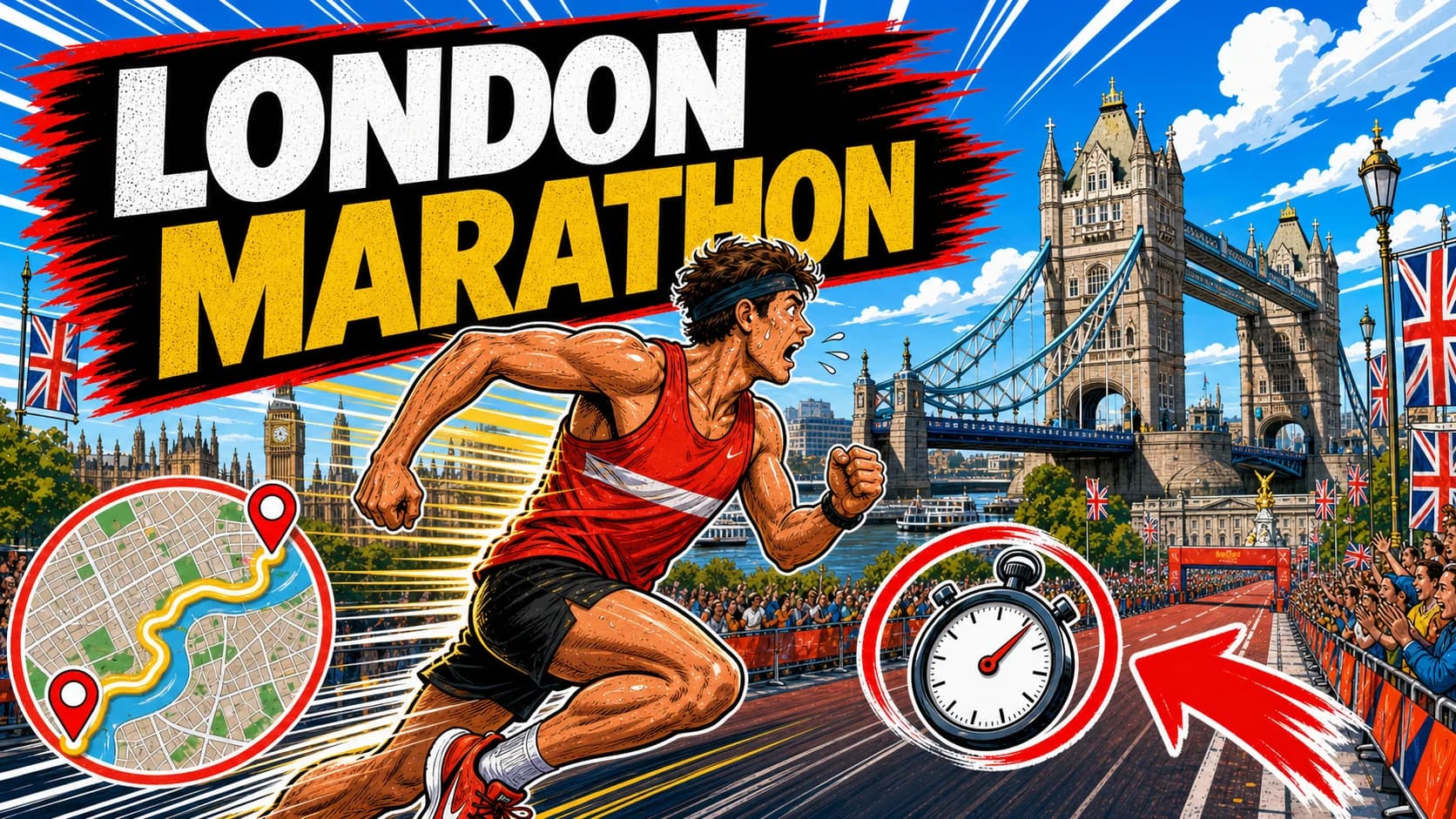
46 min de lecturerunningmaraton
TCS London Marathon 2027 Complete Guide — Course, Tower Bridge, Logistics and How to Train For It
📖 15 min read 📝 3,500 words 🎯 Skim friendly
TCS London Marathon 2027 Complete Guide
By · Updated 2026-05-06
📖 15 min read 📝 3,500 words 🎯 Skim friendly
By · Updated 2026-05-06
On April 25, 2027 London hosts the 47th edition of the TCS London Marathon — one of the six World Marathon Majors, the most charity-driven marathon in the world (over £1.4 billion raised for good causes since 1981) and the event that every year draws 600,000+ applications for just 50,000 bibs. Nearly flat, festive, urban from start to finish: from Greenwich Park to the "right onto The Mall" in front of Buckingham Palace, with Tower Bridge at the halfway point as the definitive postcard of road running. This guide covers what the official site doesn't quite spell out: how to get in (ballot, Good for Age, Charity, Championship), how not to blow up on the Embankment between km 35 and 40 when the Thames headwind hits you square on, what to do during the two hours before in Blackheath, and how to manage the final stretch down Birdcage Walk and onto the red carpet finish.
| Data | Information |
|---|---|
| Date | Sunday, April 25, 2027 |
| Distance | 42.195 km (marathon) |
| Elevation gain | ~50 m (essentially flat) |
| City | London |
| Start | Greenwich Park / Blackheath (three starts: Red, Green, Blue) |
| Finish | The Mall, in front of Buckingham Palace |
| Start time | Elite 09:00–09:40 · Mass 10:00 (in waves) |
| Organiser | London Marathon Events Ltd |
| Title sponsor | TCS (Tata Consultancy Services) |
| Entry | tcslondonmarathon.com |
The TCS London Marathon is one of the six World Marathon Majors (alongside Boston, NYC, Berlin, Chicago and Tokyo), the most charity-driven marathon in the world and the most photogenic event on the international calendar thanks to its route through the heart of London. It gathers ~50,000 finishers each year, attracts 600,000+ ballot applications to share just 50,000 bibs, and combines a nearly flat profile (~50 m net descent) with iconic sections — Cutty Sark, Tower Bridge, Canary Wharf, Embankment, The Mall — that make it one of the most complete experiences an amateur marathoner can live.
Lead pack of the marathon crossing Tower Bridge with the lead motorcycle ahead — the postcard that defines the London race.
London is a marathon to run hard. The nearly flat course, 50,000 runners pushing forward, mass atmosphere and the world's best marathon organisation create favourable conditions for a PB as long as you don't make the classic mistake: getting carried away by the Tower Bridge euphoria at km 19 and paying for it on the Embankment between km 35 and 40. The difference between London and Berlin or Valencia (the world's two fastest flat marathons) lies in the turns, the small undulations in the first half and, above all, the Thames headwind on the final stretch.
The TCS London Marathon course is point-to-point from Greenwich Park (Blackheath) to The Mall, in front of Buckingham Palace. The net elevation drop is just ~50 m (you start about 35 m above sea level and finish near Thames level), which makes it one of the fastest marathons on the global calendar. But "almost flat" doesn't mean "monotonous": there are three different starts that merge at km 4, a short climb to Cutty Sark, the crossing of Tower Bridge at km 19, an incursion into Canary Wharf between km 22 and 25, and a final stretch along the Embankment that is where the marathon is won or lost.
Official 3D map of the full TCS London Marathon route, with the three starts (Red, Green, Blue), Tower Bridge marked at km 19 and the finish on The Mall.
The start happens from three different points in Blackheath, near Greenwich Park: the Red Start (men's elite + championship), the Green Start (women's elite + Good for Age + sub-elite) and the Blue Start (general public + ballot). The three starts merge around km 4, so for the first 4 km you're running tighter than it looks and the pace is dictated by the pack around you. Forget hitting 4:50/km in the first 2 km if you're in the Blue Start — you can't, even if you want to.
From the merge the route heads east along Woolwich Road before turning north toward the river. The first visual landmark is the Cutty Sark climb at km 9 — a short ramp (200 m) past the historic ship that is the day's first mental test. It's where the Greenwich crowd (dense, loud) reminds you the marathon has truly begun. After that the route runs through Surrey Quays and aims north through Bermondsey until reaching the icon of the race: Tower Bridge at km 19.
Tower Bridge km 19 — the marathon postcard. You cross the bridge with the crowd on both sides, the towers high to your right and the City ahead. Course health is measured at this point: if you arrive with legs and have paced the first half well, the second half marathon is gifted to you by the atmosphere. If you've gone out hard, this is the moment you'll feel it — because the climb up the bridge is short but real (3% over 300 m).
Crossing Tower Bridge you enter the north bank of the Thames and head along the Embankment axis to the east for 1 km, before turning left toward Canary Wharf at km 22. The Canary Wharf section (km 22–25) is the glass-and-silence zone of the marathon: tall skyscrapers, strange echoes, fewer spectators and the sense that the pace turns viscous. This is where runners who arrived strong start to feel their legs grow heavy.
From km 25 the course turns west back through the City — Tower of London on your left at km 33 — and lines up the most symbolic and dangerous stretch: Embankment km 35–40, the long straight along the Thames that ends at Big Ben and Westminster before the final turn down Birdcage Walk to The Mall. This section is where the marathon is won or lost because (a) you already have 35 km in your legs, (b) there's usually a NE headwind whipping along the river and (c) the geometry is deceptively flat — it looks easy, but seconds per km bleed away without you noticing.
🚨 Where the race breaks
The final 1,500 m are ceremonial: leaving the Embankment, passing under Big Ben, turning down Birdcage Walk, seeing Buckingham Palace at the end, right onto Spur Road, left onto The Mall, the final 400 m on the red carpet with crowds wall to wall, the finish line. It's one of the most cinematic finishes in world road running.
Course data for Strava / Garmin: the organisers publish the official GPX a few weeks before the race on their website. To recce the Embankment, search Strava for the segment "Embankment Westbound" — it's the same profile you'll suffer on race day.
The London Marathon has been run since 1981, founded by Chris Brasher (Olympic gold medallist in the 3000 m steeplechase at Melbourne 1956) and John Disley after running the New York City Marathon in 1979. Their founding mission was simple: bring a popular marathon experience with charity spirit to London. Forty-six editions later, the race has raised over £1.4 billion for charitable causes, making it the most charity-driven single-day sporting event in the world. TCS (Tata Consultancy Services) has been title sponsor since 2022, replacing Virgin Money.
Most recent men's or women's winner crossing the finish line on The Mall — the iconic image that anchors the roll-of-honour section.
Roll of honour and race data (recent editions):
| Data | Value |
|---|---|
| First edition | 1981 |
| Editions held | 46 (as of 2026) |
| Distance | Marathon (42.195 km) |
| Finishers (recent editions) | ~50,000 |
| Ballot applications | 600,000+ per year |
| Men's course record | 1:59:30 (Sabastian Sawe, KEN, 2026) — the first sub-2-hour marathon in official race conditions |
| Women's course record | 2:15:25 (Paula Radcliffe, GBR, 2003) |
| Women's "women-only" record | 2:15:41 (Tigst Assefa, ETH, 2026) |
| Cumulative charity total | £1.4 B+ since 1981 |
Verified winners and times for the 5 most recent editions:
| Year | 🥇 Men | Country | Time | 🥇 Women | Country | Time |
|---|---|---|---|---|---|---|
| 2026 | Sabastian Sawe | 🇰🇪 KEN | 1:59:30 (CR) | Tigst Assefa | 🇪🇹 ETH | 2:15:41 |
| 2025 | Sabastian Sawe | 🇰🇪 KEN | 2:02:27 | Tigst Assefa | 🇪🇹 ETH | 2:15:50 |
| 2024 | Alexander Mutiso | 🇰🇪 KEN | 2:04:01 | Peres Jepchirchir | 🇰🇪 KEN | 2:16:16 |
| 2023 | Kelvin Kiptum | 🇰🇪 KEN | 2:01:25 | Sifan Hassan | 🇳🇱 NED | 2:18:33 |
| 2022 | Amos Kipruto | 🇰🇪 KEN | 2:04:39 | Yalemzerf Yehualaw | 🇪🇹 ETH | 2:17:26 |
Data verified against the public archive of London Marathon (Wikipedia EN).
The TCS London Marathon is the hardest Major to get into: ~600,000 people apply for the public ballot each year for just ~17,000 spots (~3% success rate), which has led the organisers to design six different entry routes depending on runner profile, personal best and willingness to fundraise. Entry for the 2027 edition opened in late April 2026 (public ballot), with results notified in July 2026.
Aerial view of 50,000 runners crossing Tower Bridge — reinforces the message "the most coveted mass-participation event in the world".
| Route | Probability | Price | When it opens | Who it's for |
|---|---|---|---|---|
| 🎟️ Public ballot (UK) | ~3% | £79.99 (rejected get refund) | Late April 2026 | UK residents |
| 🌍 Public ballot (international) | ~3% | £160 | Late April 2026 | Rest of world |
| 🏆 Championship | Direct entry if you meet the standard | £79.99 | Autumn 2026 | sub-2:45 (M) / sub-3:15 (W) |
| ⏱️ Good for Age | Direct entry if you meet the standard | £79.99 | Autumn 2026 | Age- and gender-graded standards |
| 🤝 Charity Gold Bond | Guaranteed with fundraising commitment | £500–2,000+ raised | Summer–autumn 2026 | Anyone fundraising for a registered charity |
| 🏃 Club Place | Via UKA-affiliated clubs | Variable | Autumn 2026 | Members of affiliated athletics clubs |
| ✈️ Travel Partners | Bib included in travel package | Full package £1,500–3,500+ | Year-round | International runners with budget |
Indicative info based on the 2026 edition. Always confirm on the official entry site — fees and standards are updated there each year.
If you have a recent verifiable marathon time, the Good for Age route is the most cost-effective. The (indicative) standards are:
| Age | Men | Women |
|---|---|---|
| 18–39 | sub-3:00 | sub-3:45 |
| 40–44 | sub-3:05 | sub-3:50 |
| 45–49 | sub-3:15 | sub-4:00 |
| 50–54 | sub-3:20 | sub-4:05 |
| 55–59 | sub-3:30 | sub-4:15 |
| 60–64 | sub-3:45 | sub-4:30 |
| 65–69 | sub-4:00 | sub-4:45 |
| 70+ | sub-5:00 | sub-5:30 |
Standards are confirmed at tcslondonmarathon.com/enter/good-for-age. The qualifying time has to be from a certified marathon within the previous 26 months.
If you don't get in via the ballot and don't meet Good for Age, the charity route is essentially guaranteed in exchange for committing to raise between £500 and £2,500+ for a registered charity. The big charities (British Heart Foundation, Macmillan, Cancer Research UK, MIND, Alzheimer's Society) hold guaranteed Gold Bond places each year; smaller ones distribute theirs by lottery among applicants.
The reality of fundraising: raising £2,000 from outside the UK isn't trivial. Most people combine (a) donations from family and friends, (b) JustGiving online shared via LinkedIn / social media, (c) local events (charity dinner, raffle, charity coffee morning) and (d) employer match (some companies double what you raise). The commitment is signed by contract and monitored — if you don't reach the target, you may be forced to top up the difference out of pocket.
| Included in the price | NOT included (optional extra) |
|---|---|
| ✅ Bib with timing chip | ❌ Travel package to London (flights, hotel) |
| ✅ Technical finisher T-shirt | ❌ Official professional photo (~£15–25) |
| ✅ Finisher medal (exclusive design each year) | ❌ Premium race backpack (£20+) |
| ✅ On-course aid stations | ❌ Saturday pasta party (official extra) |
| ✅ Finisher bag with drink + snack bar | ❌ Access to the Charity Lounge after the finish |
| ✅ Digital diploma with certified time | ❌ Pre-race kit porter |
| ✅ Official app with live tracking |
Runners and family at the Running Show at ExCeL London, with stalls or the bib pickup desk visible.
Bib pickup happens at the TCS London Marathon Running Show held at ExCeL London (Royal Victoria Dock, east London) from Wednesday to Saturday of race week. No bibs are handed out on race day: you have to pick yours up in person before the Running Show closes on Saturday at 18:00.
You'll need:
Nobody else can collect on your behalf except in very exceptional cases with official authorisation — this is stricter than Madrid or Valencia. Allow at least 90 minutes for the visit: ExCeL is huge and queues at peak times (Saturday afternoon) are long.
The most practical way to reach the start of the TCS London Marathon is by surface train + Tube. The three starts (Red, Green, Blue) are in Blackheath, next to Greenwich Park, in southeast London. Useful stations are Blackheath (National Rail from London Bridge), Greenwich (DLR + National Rail) and Maze Hill (National Rail) — none have public parking on race day.
Big Ben with a red bus or a train pulling out of a central station — visual reference for the reader arriving in London for the first time.
To get to the start (Blackheath / Greenwich) on race morning:
Special services on race day: TfL (Transport for London) boosts train frequency to Blackheath, Greenwich and Maze Hill from early morning. Check your race confirmation magazine — it includes a map with your assigned start (Red, Green or Blue) and the recommended station for each.
To get back from the finish (The Mall / Westminster): the closest stations are Charing Cross, Embankment and Westminster. But after crossing the line, the finisher flow is massive and queues to access the Tube run 20–30 minutes. Consider walking 15 minutes toward Trafalgar Square or Piccadilly before heading underground.
Bag drop / kit check: the organisers transport your bag from Blackheath to The Mall in trucks identified by bib number. Tag your bag with the kit sticker, drop it 30–45 minutes before your wave, and pick it up in the finishers' zone after crossing the line. Don't put valuables in — there's staff but no ID check at pickup.
Don't drive in. London has the Congestion Charge (£15/day), the ULEZ (Ultra Low Emission Zone, £12.50/day for non-compliant vehicles) and essentially zero free parking in zones 1–2. Streets in the centre are closed all Sunday morning. If you're coming from elsewhere in the UK, leave the car at a National Rail station on the outskirts (Bromley, Sevenoaks, Orpington) and come in by train.
For a marathon runner in London, staying within 20 minutes by public transport from the start or the finish isn't luxury: it's logistics. The marathon dumps you at The Mall around 12:00–15:00 depending on goal — you go back to the hotel sweaty, hungry, with cramps building. The difference between sleeping well with an early breakfast and walking 5 minutes to the Tube to Charing Cross versus making two transfers to Hammersmith can cost you 1–2 minutes on the clock and twice that in mental stress.
View of Buckingham Palace or Westminster Bridge showing the finish area — visual reference for readers booking accommodation.
| Hotel | Cat. | £/night* | To finish | Runner highlight |
|---|---|---|---|---|
| London Marriott Hotel County Hall | 5* | 280–450 £ | 1.4 km · 17 min | Bathtub, Big Ben views, strong AC |
| Park Plaza Westminster Bridge | 4* | 220–340 £ | 1.3 km · 16 min | Runner-friendly early breakfast |
| Premier Inn London County Hall | 3* | 140–220 £ | 1.4 km · 17 min | Unbeatable value, opposite Westminster |
| Hilton London Bankside | 5* | 240–360 £ | 2.2 km · 26 min · direct Tube | Spa with bathtub, well-equipped gym |
| The Z Hotel Victoria | 3* boutique | 110–170 £ | 1.5 km · 18 min | Compact but central, good for solo travellers |
| Hotel | Cat. | £/night* | To finish | Runner highlight |
|---|---|---|---|---|
| The Stafford London | 5* | 380–600 £ | 0.5 km · 6 min | 5 min walk from The Mall — the premium pick |
| The Connaught | 5* | 600–950 £ | 1.2 km · 14 min | Pure luxury, bathtub, 24h gym |
| Park Plaza Westminster Bridge | 4* | 220–340 £ | 1.3 km · 16 min | Same hotel listed in Westminster — dual access |
| The Cavendish London | 4* | 220–320 £ | 0.8 km · 10 min | Off Piccadilly, walking distance to The Mall |
| Citizen M Tower of London | 4* | 180–260 £ | 4.5 km · direct Tube | Modern, km 33 passes the front door |
| Hotel | Cat. | £/night* | To start | Runner highlight |
|---|---|---|---|---|
| InterContinental London – The O2 | 5* | 280–420 £ | 4 km · DLR 12 min | Thames views, bathtub, premium gym |
| Hilton London Greenwich | 4* | 180–280 £ | 1.5 km · 18 min walking | Walking distance to Blackheath, working AC |
| Premier Inn London Greenwich | 3* | 110–160 £ | 2.0 km · 24 min | Value pick, good for runners with family |
| Devonport House (Greenwich Hotel) | 4* boutique | 160–240 £ | 1.2 km · 14 min | Historic, garden, walking distance to Cutty Sark |
| Novotel London Greenwich | 4* | 160–240 £ | 1.8 km · 22 min | Modern, AC, near DLR Greenwich |
*Indicative weekend rate for race weekend (last Sunday of April). Varies depending on booking lead time, availability and current promotions. Booking before November of the prior year saves 30–50% versus April.
The weather in London in late April averages 6 °C low and 14 °C high with variable conditions — race week can swing from continuous rain to spring sun depending on the dominant system. The probability of measurable precipitation on a given day is 35–40%, average wind is 15–20 km/h (variable), and relative humidity rarely drops below 60%. It's ideal weather to run hard — cool, no thermal stress — as long as the NE wind doesn't show up at the wrong moment.
Recent-edition finishers crossing the line under the typical overcast London sky in April — the usual race-weekend pattern.
The variable to watch is the wind. For the marathon, the risk isn't heat (rarely >18 °C in April) but the NE wind that hits you head-on along the Embankment for the final 7 km. A calm start and a 25 km/h NE wind on the Embankment can cost you 30–60 seconds per km in the final section. Check the wind forecast for Saturday night and Sunday at 12:00 specifically — that's what defines your plan B.
Plan by forecast:
Bring a throwaway layer (old T-shirt or disposable poncho) for the 90 minutes in Blackheath before your wave — it breaks the cold and the organisers collect the abandoned clothing for charity. Disposable arm sleeves are London's most useful accessory: if it gets warm by km 5, you push them down; if it cools again at km 35, you pull them back up.
The recommended training block for the TCS London Marathon is a 16-week cycle with peak volume in weeks 11–13 (between 50 km and 130+ km per week depending on goal), one long run per week and a three-week taper. The key for London: train goal pace under pack conditions (because you'll be running surrounded by 200 runners for the first 10 km), and at least two long runs into a real headwind to get used to the Embankment feel.
Runner crossing an urban zone at sunrise or training along a canal in the wind — aspirational image that anchors the 16-week plan.
Treat London as a fast marathon with a budget of ~50 m of net elevation, not as a rolling marathon. Pick your goal and follow the table — these are peak volumes (weeks 11–13), not averages across the whole cycle.
| Goal | Average pace | Peak weekly vol. | Peak long run |
|---|---|---|---|
| 5h00 | 7:06 min/km | 35–45 km | 25–28 km |
| 4h30 | 6:24 min/km | 45–55 km | 28–30 km |
| 4h00 | 5:41 min/km | 55–70 km | 30–32 km |
| 3h30 | 4:58 min/km | 70–85 km | 32–35 km |
| 3h00 | 4:16 min/km | 90–110 km | 32–36 km |
| ≤2h45 | 3:54 min/km | 110–130+ km | 32–38 km |
How to read the table and build the cycle:
Three sessions worth gold for London:
The taper is three weeks, not two. Week 14 at 80%, week 15 at 60%, week 16 at 40% maintaining race pace in short pickups. The two final long runs (in weeks 11 and 12) are the ones that fill the cup.
Don't know what realistic goal time you have for London? Cross your best recent half marathon with the "London marathon" factor (which assumes the nearly flat profile and a moderately windy day):
| Your best recent half | Flat marathon equivalent | Realistic London |
|---|---|---|
| 1:25 | sub-3:00 flat | 3:00–3:05 |
| 1:35 | sub-3:20 flat | 3:18–3:25 |
| 1:45 | sub-3:42 flat | 3:42–3:50 |
| 1:55 | sub-4:05 flat | 4:05–4:15 |
| 2:05 | sub-4:25 flat | 4:25–4:35 |
| 2:15 | sub-4:48 flat | 4:48–5:00 |
How to read it: the "flat" column is the unadjusted Riegel conversion (your half × ~2.11). London adds a 1–3% adjustment for possible wind and turns — that gives you the realistic range. If you've done long runs into the wind and your form holds, aim for the lower end of the range. If your last hour falls apart, the upper end.
Once you have your goal time, this calculator gives you the required average pace (in min/km and min/mi) and the cumulative splits at 5K, 10K, 15K, half marathon, 30K and finish. Change the goal time in the field below and the table updates instantly:
| Punto | Tiempo acumulado | Parcial |
|---|---|---|
| 5 km | 21:20 | 21:20 |
| 10 km | 42:40 | 21:20 |
| 15 km | 1:03:59 | 21:20 |
| Media (21,1 km) | 1:30:00 | 26:01 |
| 30 km | 2:07:59 | 37:59 |
| Meta | 3:00:00 | 52:01 |
Splits asumen ritmo constante. En carreras con desnivel real (London Marathon) — banca 5–8 s/km en bajadas y pierde el mismo margen en subidas; el ritmo medio se mantiene.
The calculator above gives you the pace. But a real race plan answers more questions: what strategy do I start with? How many gels do I carry? When do I take the caffeine? What do I do if at Tower Bridge I'm 30 seconds over goal?
Set up your goal, strategy and fuelling plan. The planner generates a personalised plan by segment (with paces, HR zones, mental cues and fuelling minute by minute), a race-morning checklist, and a Plan B for surprises. Download it as a PDF to take with you on race day.
PDF A4, optimizado para imprimir y llevar el día de carrera.
You're at the corral. You did the 16-week plan. What separates a good training block from a good time is what you do over the next 4–5 hours.
The race plan for London should combine conservative pacing in km 1–10 (3 starts merging + Cutty Sark km 9), goal pace between km 10–30, and push or hold from km 30 to 42 depending on how you arrive at the Embankment. Each goal time (sub-2:45 to finish) has a specific split pattern.
| Goal | Split pace | London-specific tactical note |
|---|---|---|
| sub-2:45 | 3:54 min/km | Hold back the first 4 km until the merge (don't fight for space). Bank 3 s/km on the descents; goal pace between km 10–30; defend on the Embankment. |
| sub-3:00 | 4:16 min/km | Cross halfway at 1:30:00 on Tower Bridge. Hold pace through Canary Wharf (treacherous zone). If you arrive at km 35 with legs, gain 5 s/km in the final 5K. |
| sub-3:30 | 4:58 min/km | No rush km 1–8 (crowding + Cutty Sark). Cross halfway at 1:45:00. Walk 10 s at every aid station if it's warm. |
| sub-4:00 | 5:41 min/km | The classic mistake is going out at 5:30 carried away by the crowd. Hold 5:45 for the first 10 km. Walk 20 s at every aid station. |
| sub-4:30 | 6:24 min/km | Very even splits: 6:20–6:30 the whole way. Walk-run strategy from km 30 if you need it. |
| sub-5:00 | 7:06 min/km | Plan B walk-run from km 1: 9 run / 1 walk. It gives you margin to finish enjoying it. |
| Finish | 7:00–7:30 | No watch. Enjoy Tower Bridge, Cutty Sark, the crowd signs and the arrival on The Mall. |
It's where the marathon is decided. Three anchors:
The nutrition strategy for a London marathon pivots on 60–100 g of carbs per hour depending on goal, with 5–8 gels spread every 25–30 minutes from km 8 onwards. Carb loading in the 3 days before should be 8–10 g/kg/day, and Saturday dinner light and familiar (pasta or rice). Extra sodium if the forecast goes above 16 °C or the wind picks up.
Volunteer at a TCS London Marathon aid station serving Lucozade Sport, the official drink of the race.
Saturday dinner is light, familiar and on the early side (eaten before 21:00). Pasta or white rice with grilled chicken or fish, bread, fruit. Zero experiments. London tempts you with pubs and curries — leave them for Sunday night, not race eve.
Race-morning breakfast depends on whether you wake up hungry. The safe option: toast with honey/jam + banana + coffee (if you drink it normally). 80–100 g of carbs, eaten 3 hours before the gun. If your stomach closes up with nerves, swap for a sports drink with 80 g of carbs. Ask the hotel to serve you breakfast at 06:00 or pack a bag the night before.
What the organisers put on the course:
Carb plan by goal:
| Goal | Carbs / hour | Gels to carry | When to take them |
|---|---|---|---|
| 5h00 | 30–45 g/h | 3–4 gels | km 8, km 18, km 28, km 36 |
| 4h00 | 45–60 g/h | 5 gels | km 8, km 16, km 22, km 30, km 36 |
| 3h30 | 60–75 g/h | 6 gels | km 6, km 12, km 18, km 24, km 30, km 36 |
| 3h00 | 75–90 g/h | 7 gels + flask | km 5, every 5 km until km 35 |
| ≤2h45 | 90–100 g/h | 8 gels + flask | km 4, every 4–5 km |
Three mistakes you see every year at the London Marathon:
Hydration and sodium by forecast:
Post-finish recovery — the first hour counts more than in a half:
The best shoes for the TCS London Marathon are carbon-plated race for sub-3:30 (Vaporfly 4, Adios Pro Evo, Metaspeed Sky), carbon plate or super-trainer between 3:30–4:00 (Saucony Endorphin Speed, Hoka Mach X), and protective daily trainer for slower than 4:00 (Nike Pegasus, ASICS Cumulus, Brooks Ghost). What's critical isn't the brand but that they're already broken in and don't exceed 250–350 km of use.
Tight shot of race shoes on the Blackheath start line — several brands visible, possibly with wet soles if it rained.
Unlike Madrid or Boston, in London the pure speed factor weighs as much as muscular endurance. The nearly flat course rewards light, fast carbon plates; but if it rains, the same model can slip on some Embankment paving stones. Weigh up the weekend weather before choosing.
Recommendations by goal:
| Goal | Category | Common models |
|---|---|---|
| ≤2h45 | Light "race" carbon plate | Nike Alphafly 3 · adidas Adios Pro Evo · ASICS Metaspeed Sky · Saucony Endorphin Elite |
| 2h45–3h30 | Protective carbon plate | Nike Vaporfly 4 · adidas Adios Pro 4 · ASICS Metaspeed Sky · Saucony Endorphin Pro |
| 3h30–4h00 | Carbon plate or super-trainer | Saucony Endorphin Speed · Hoka Mach X · Puma Deviate Nitro Elite · ASICS Magic Speed |
| 4h00+ | Protective daily trainer | Nike Pegasus · ASICS Cumulus / Nimbus · Brooks Ghost · Hoka Clifton |
Check this before leaving the house:
Just 50 m of net descent over 42.2 km — it's one of the flattest marathons on the international calendar. There are three short ramps (Cutty Sark climb at km 9, Tower Bridge climb at km 19, Tower Hill pass at km 33), but none exceeds 300 metres in length or 3% in gradient. The course is essentially flat: what counts is the NE wind on the Embankment, not the geometry.
You have five alternative routes: (1) Good for Age if you have a recent certified time that meets your age standard; (2) Championship if you've run sub-2:45 (M) or sub-3:15 (W) on a certified marathon in the previous 36 months; (3) Charity Gold Bond by committing to fundraise £500–2,500+ for a registered charity; (4) Club Place if you're a member of a UKA-affiliated club with allocation; (5) Travel Partners by buying an international travel package with bib included (£1,500–3,500+). The most likely route for an international without an elite mark is Charity — if you react quickly after the ballot rejection in July.
Recent editions close the marathon at 8 hours from the last wave, equivalent to about 11:00 min/km. Walking is allowed; the course has rolling partial closures (streets reopen to traffic after the last runner of each zone passes). London Marathon is one of the few Majors with such a generous cut-off — the organisers are very patient with anyone walking the whole course.
No. Pickup is restricted to the Wednesday-to-Saturday Running Show at ExCeL London. No bibs are handed out on race day under any circumstances, and nobody else can collect on your behalf except in very exceptional cases with official authorisation. Plan your arrival to allow at least one ExCeL visit before Saturday at 18:00.
The organisers transport your bag from Blackheath to The Mall in trucks identified by bib number. Tag your bag with the kit sticker, drop it 30–45 minutes before your wave, and pick it up in the finishers' zone after crossing the line. Only clear bags issued by the organisers (at the Running Show) are accepted — opaque or personal bags are not. Don't put valuables in.
Yes, headphones are allowed at the TCS London Marathon. That said, the urban atmosphere of the course is one of the appeals of the race — bands, the Tower Bridge crowd, PA systems in Canary Wharf, the "come on!" shouts every km — so many runners prefer to run without headphones. The most useful section for music is Canary Wharf (km 22–25), where the crowd thins out and the skyscrapers create a strange echo.
The NE wind on the Embankment (km 35–40) is the most volatile variable of the day. In calm editions, you don't notice it. In editions with NE winds of 20–25 km/h, it can cost you 30–60 seconds per km in the final 7 km. The trick is to tuck into a pack — 3–5 runners ahead save you 10–15% of the aerodynamic effort, according to studies from Eindhoven University. If you're running solo and there's wind, look around: if you find a runner just slightly faster than you, slip into their draft for 1–2 km and rest.
Train from London Bridge → Blackheath (15 min) or DLR to Greenwich + 15 min walking. Trains start running around 06:30 with frequency boosted by TfL for marathon day. Check your race confirmation magazine — it includes a map with your assigned start (Red, Green or Blue) and the recommended station for each. Leave the hotel 2 hours before your wave, no exceptions.
For sub-3:30, a protective carbon plate (Nike Vaporfly, Adidas Adios Pro, ASICS Metaspeed Sky). For 3:30–4:00, a carbon plate or super-trainer (Saucony Endorphin Speed, Hoka Mach X). For slower than 4:00, a protective daily trainer (Nike Pegasus, ASICS Cumulus, Brooks Ghost). What matters most isn't the brand but that they're already broken in and don't exceed 250–350 km of use — and that you've tested them at least once in the rain if the forecast is classic British.
London is the most festive and most charity-driven of the Majors, and the second fastest after Berlin. Berlin (September, flat) is 1–2 minutes faster than London given equal fitness — it's the world-record marathon. Boston (April) is point-to-point downhill with Heartbreak Hill — unique atmosphere but slower because of the climbs. NYC (November) is 5 bridges and 5 boroughs — the most diverse marathon but also the slowest of the Majors. Valencia (December, not a Major) is flat like Berlin and the fastest marathon in Spain. For a first Major, London is the best combination of "fast + festive + entry is hard but possible".
The TCS London Marathon is the best combination of speed + atmosphere + status among the World Marathon Majors. If you're chasing a pure PB without wind, Berlin is 1–2 minutes faster; if you want the most symbolic marathon of any race, Boston is the bet; if you want a first Major, London is the ideal ramp.
All are marathons (42.195 km), so the choice depends on month, course profile, entry difficulty and what you're looking for:
| Race | Month | Elevation | Best for | Atmosphere |
|---|---|---|---|---|
| TCS London (this guide) | April | ~50 m | Major + atmosphere + ballot | ⭐⭐⭐⭐⭐ |
| Boston Marathon | April | -140 m net, +250 m climb | BQ + history + Heartbreak Hill | ⭐⭐⭐⭐⭐ |
| BMW Berlin Marathon | September | <50 m | Pure PB · world record | ⭐⭐⭐⭐ |
| Bank of America Chicago | October | <30 m | PB + urban atmosphere | ⭐⭐⭐⭐ |
| TCS NYC Marathon | November | ~250 m (5 bridges) | Experience + 5 boroughs | ⭐⭐⭐⭐⭐ |
| Tokyo Marathon | March | ~80 m | Asian Major + organisation | ⭐⭐⭐⭐ |
| EDP Madrid Marathon | April | ~600 m | Spanish atmosphere + experience | ⭐⭐⭐⭐⭐ |
| Valencia Marathon | December | <50 m | Pure PB · no Major status | ⭐⭐⭐⭐ |
Did this guide help? If you're running London 2027, save the event on SportPlan to get ballot deadline alerts, Running Show reminders, and later log your result.
Continuer à planifier
Utilisez SportPlan pour comparer les dates, sauvegarder des événements et construire une saison adaptée à vos week-ends.