47 min de leiturarunningmaraton
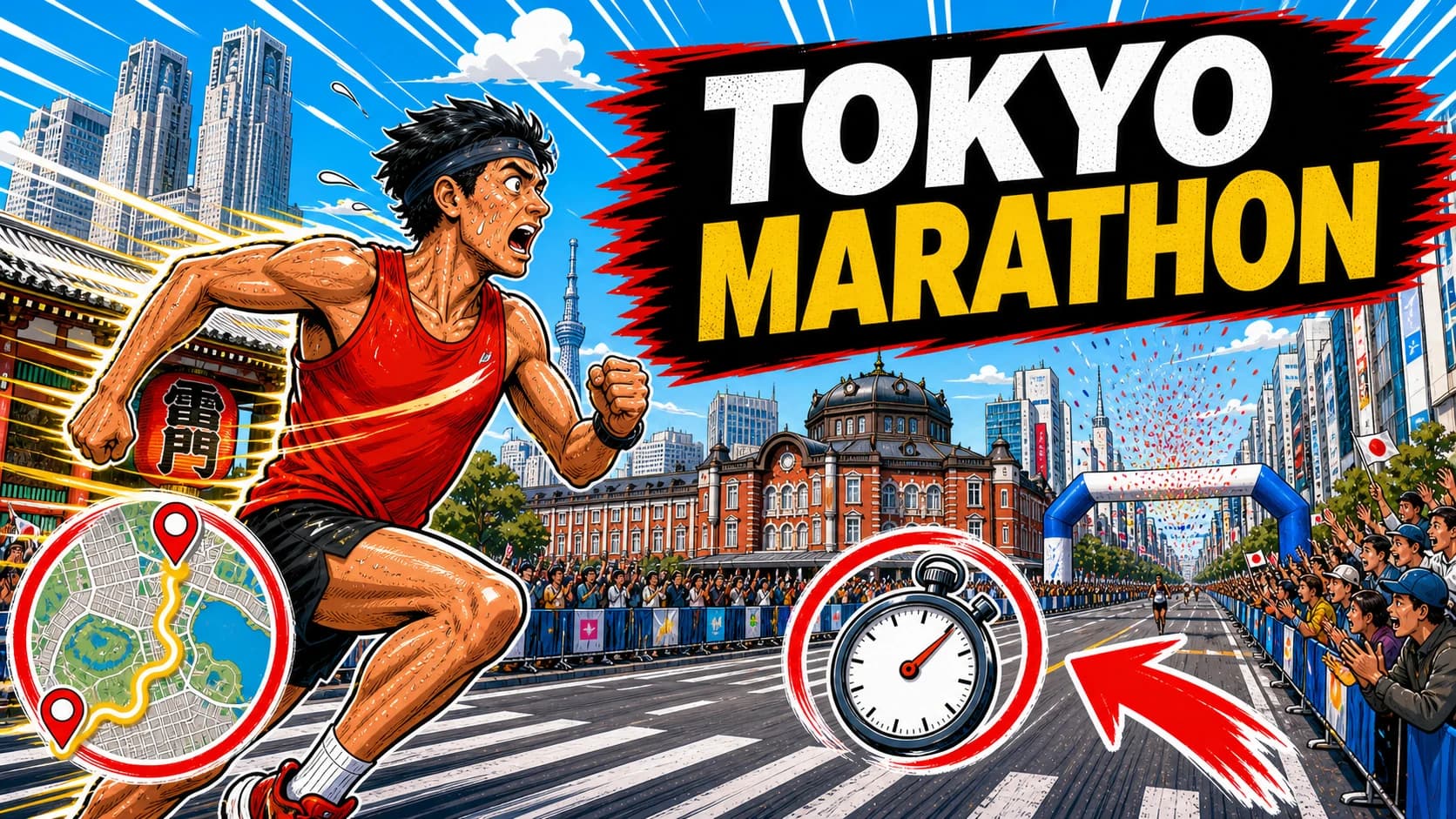
Tokyo Marathon 2027 Complete Guide — Course, Sensoji, Logistics and How to Train For It
📖 16 min read 📝 9,000 words 🎯 Skim friendly
Tokyo Marathon 2027 Complete Guide
By Ramon Curto · Updated 2026-05-06
📖 16 min read 📝 9,000 words 🎯 Skim friendly
By Ramon Curto · Updated 2026-05-06
On Sunday, March 7, 2027 Tokyo hosts the most exclusive marathon on the planet. The Tokyo Marathon is the smallest of the six World Marathon Majors by field size (~38,000 finishers) and, at the same time, the most selective: the world's most exclusive marathon lottery accepts only 8% of applicants. If you're lucky enough to land a bib, you'll run 42.195 km perfectly timed, perfectly organized and perfectly urban through the heart of the Japanese capital: Shinjuku → Iidabashi → Asakusa (Sensoji) → Tsukiji → Ginza → Tokyo Station / Marunouchi. This guide covers what the official site doesn't quite spell out: what the course is really like, where the race breaks, how to train for a track that rewards consistency, what realistic time to target, and how to put together a Japan trip that doesn't sabotage your marathon.
| Item | Info |
|---|---|
| Date | Sunday, March 7, 2027 |
| Distance | 42.195 km (marathon) |
| Net elevation gain | ~50 m (essentially flat profile with gentle rolls) |
| City | Tokyo, Japan (~10 m above sea level) |
| Start | Tokyo Metropolitan Government Building (Tokyo Tochō), Shinjuku |
| Finish | Tokyo Station / Marunouchi |
| Start time | 09:10 (elite); waves 09:10–09:40 |
| Organizer | Tokyo Marathon Foundation |
| Registration | marathon.tokyo (lottery + charity) |
| Category | Abbott World Marathon Major (1 of 6) |
| Lottery acceptance | ~8% |
The Tokyo Marathon is one of the six Abbott World Marathon Majors (alongside Boston, London, Berlin, Chicago and New York) and the only one in Asia. It's been run since 2007, making it the youngest WMM, but also one of the most in-demand: the 2026 lottery received nearly 380,000 applications for ~38,000 spots, putting acceptance close to 8%. For many international runners, Tokyo is the final star of the Six Stars Abbott — completing all six WMMs earns you the Six Star Medal, and Tokyo is usually the last to enter the trophy cabinet precisely because of how hard it is to land a bib.
Aerial view of the mass start in Shinjuku, with the Tokyo Metropolitan Government Building (Tokyo Tochō) in the background and the skyscrapers of Nishi-Shinjuku — the postcard that defines the event.
Tokyo is a fast marathon. The course was redesigned in 2017 to cut elevation and reduce turns, and times have dropped year after year since. The men's record belongs to Benson Kipruto (KEN) at 2:02:16 (2024) and the women's to Brigid Kosgei (KEN) at 2:14:29 (2022) — numbers that put Tokyo among the fastest tracks in the world, alongside Berlin and Valencia. Altitude is marginal (~10 m above sea level), March weather is cool and stable, and the Japanese organization is literally perfect: full road closures, aid stations every 1.4–2.9 km, massive volunteer crews, and zero improvisation.
What sets Tokyo apart from the other WMMs isn't the clock — Berlin is slightly faster — it's the cultural experience. You'll run next to Sensoji Temple in Asakusa (km 12), past the old Tsukiji market, through the lights of Ginza (km 30), and finish in the shadow of the Imperial Palace and Tokyo Station. The atmosphere is respectful, quiet compared to NYC or Boston, and the Japanese crowd applauds with an almost reverent tone: every corner has a sign reading "頑張って" (gambatte — "you can do it").
The Tokyo Marathon course is a point-to-point layout of 42.195 km that starts at Shinjuku (Tokyo Metropolitan Government Building), drops south-east through central Tokyo, reaches Asakusa (Sensoji-ji) at km 12, swings back via Tsukiji, crosses Ginza (km 30) and finishes near Tokyo Station / Marunouchi, opposite the Imperial Palace. Net cumulative elevation is barely ~50 m, with gentle rolls and two longer descents at the start (km 1–4) and in the middle stretch. Since the 2017 redesign, it's one of the fastest courses on the WMM calendar.
Official 3D map of the full Tokyo Marathon course (published by the Tokyo Marathon Foundation), with the point-to-point Shinjuku → Asakusa → Ginza → Tokyo Station layout clearly visible.
Km 0–4 · Shinjuku → Iidabashi (gentle descent). The start is on the west block of the Tokyo Metropolitan Government Building (Tokyo Tochō), in the heart of Nishi-Shinjuku. The first 4 km drop gently (about 30 m down) toward the Iidabashi neighborhood. This is where most runners fall into the trap of going out 10–15 seconds per km faster than goal pace: the free downhill fools the body and the watch. Hold goal pace and bank no more than 5 sec/km tops.
Km 4–12 · Iidabashi → Asakusa (Sensoji). The course turns east and threads through Kanda and then Asakusa, crossing wide, mostly flat avenues. Km 12 lands you at the gates of Sensoji-ji Temple — Sensoji km 12, the postcard. A gentle U-turn sends you back south. The Japanese crowd makes its first big appearance here: respectful, sign-waving, no hysterics.
Km 12–21 · Asakusa → Nihonbashi (mid-race). A descent into Tokyo's financial heart: Nihonbashi and zones near Akihabara. False flats, perfect asphalt, gentle 90° turns. You cross the half-marathon split near km 21 — that's where your watch sets the tone: if you're on goal pace and feel comfortable, the second half is yours. If you're already on the edge, you went out too fast.
Km 21–30 · Nihonbashi → Ginza (where it breaks). The decisive stretch. Through the historic Tsukiji district (the old wholesale fish market, now redeveloped) and on to Ginza. This is where focus drops: gentle turns chip away, aid stations stay perfect but start to weigh on your head, and the body enters the danger zone. Ginza km 30 — where the mind decides the marathon: if your pacing has been honest, the Ginza neon lights will push you forward; if you went out hard, they'll hammer you.
Km 30–35 · Ginza → Shibakoen (the start of the home straight). Continues through the southern downtown, passing close to the Tokyo Tower (km 33) and Shibakoen. The organization stages solid extra aid here (banana, gels, traditional Japanese sweets) — exactly where recreational runners need it most.
Km 35–42 · Shibakoen → Tokyo Station / Marunouchi (the cover shot). The last 5K is a cover-shot finish: you cross Hibiya, hit the avenue facing the Imperial Palace, swing left on the final straight and enter Marunouchi, alongside the iconic red brick façade of Tokyo Station — peak Japanese precision. The finish line sits literally between skyscrapers and the most iconic train station in Asia. No other WMM has a finish this photogenic.
🚨 Where the race breaks
Course data for Strava / Garmin: the organization releases the official GPX a few weeks before the race on its site. To recon the final stretch midweek, search the "Marunouchi finish straight" segment on Strava — it lines up with the last straight before the line, opposite Tokyo Station.
The Tokyo Marathon has been run since 2007, making it the youngest of the six World Marathon Majors. It replaced several smaller marathons that used to be held in Tokyo (including the Tokyo International Marathon) and was designed from day one to be a marathon of world-class elite + controlled mass field: roughly 38,000 bibs split between lottery, charity and guaranteed entries.
Winner of the latest edition crossing the finish line next to Tokyo Station — the iconic shot that anchors the past-winners section.
Key data and recent edition stats:
| Item | Value |
|---|---|
| First edition | 2007 |
| Editions held (through 2026) | 18 (2021 was canceled due to COVID) |
| Single distance | Marathon (42.195 km) — used to have a 10K sibling, now marathon-only |
| Participants | ~38,000 (smallest WMM by field size) |
| Countries represented | 130+ |
| Finisher rate | ~96% (highest of the WMMs) |
| Men's elite record | 2:02:16 (Benson Kipruto, KEN, 2024) |
| Women's elite record | 2:14:29 (Brigid Kosgei, KEN, 2022) |
Verified winners and times from the 5 most recent editions:
| Year | 🥇 Men | Country | Time | 🥇 Women | Country | Time |
|---|---|---|---|---|---|---|
| 2025 | Tadese Takele | 🇪🇹 ETH | 2:03:23 | Sutume Kebede | 🇪🇹 ETH | 2:16:31 |
| 2024 | Benson Kipruto | 🇰🇪 KEN | 2:02:16 CR | Sutume Kebede | 🇪🇹 ETH | 2:15:55 |
| 2023 | Deso Gelmisa | 🇪🇹 ETH | 2:05:22 | Rosemary Wanjiru | 🇰🇪 KEN | 2:16:28 |
| 2022 | Eliud Kipchoge | 🇰🇪 KEN | 2:02:40 | Brigid Kosgei | 🇰🇪 KEN | 2:14:29 CR |
| 2020 | Birhanu Legese | 🇪🇹 ETH | 2:04:15 | Lonah Salpeter | 🇮🇱 ISR | 2:17:45 |
Data verified against the public archive at Tokyo Marathon (Wikipedia EN). The 2021 edition was canceled due to COVID-19 — the event returned in March 2022 with a limited international field.
The Tokyo Marathon lottery system is the most restrictive of the WMMs and, arguably, of global road running. The numbers:
For international runners chasing the Six Stars, the reality is: plan on 3 consecutive lotteries or go straight to charity. The cumulative odds of getting in over three years are ~75% — significantly better than betting on one shot.
Registration for the 2027 Tokyo Marathon opens August–October 2026 via the official site marathon.tokyo. There are four entry routes: the general lottery (8% acceptance), charity (¥150,000+ donation to a social cause), Run as One (community bib), and semi-elite slots (with verified time). Most international runners stick to the first two, and many opt for charity precisely because of the lottery's low odds.
Aerial view of the mass field starting from Shinjuku — perfect to drive home the scale of the event.
| Category | Price | Notes |
|---|---|---|
| 🟢 Lottery — Japan resident | ¥16,500 (~€95) | After being accepted into the lottery |
| 🟡 Lottery — international | ¥23,300 (~€135) | After being accepted into the lottery |
| 🔴 Charity (Run with Heart) | ¥150,000+ (~€870+) | Guaranteed bib. ~¥100,000 is tax-deductible donation in Japan |
| 🟣 Run as One — solidarity team | ¥30,000+ (~€175) | Limited spots, via partner organizations |
| 🟠 Semi-Elite men | ¥16,500 | Verified sub-2:35 official within last 24 months |
| 🟠 Semi-Elite women | ¥16,500 | Verified sub-3:00 official within last 24 months |
| ⚫ Official tours (Marathon Tours, etc.) | €1,500–4,000 | Guarantees bib + lodging + transfers |
Approximate prices as of the update date. Always confirm on the official site — amounts are quoted in yen and exchange rates fluctuate.
Exact dates are confirmed in July of the prior year, but the historical pattern is:
| Milestone | Approximate date |
|---|---|
| Lottery opens | Mid-August 2026 |
| Lottery closes | Mid-September 2026 |
| Lottery results | Late October 2026 |
| Payment for accepted entries | Before mid-November 2026 |
| Charity opens | September–October 2026 (limited spots) |
| Bib pickup (Expo) | Thursday March 4, Friday March 5 and Saturday March 6, 2027 |
| Race day | Sunday March 7, 2027 |
| Included with the bib | NOT included (optional add-on) |
|---|---|
| ✅ Bib with timing chip | ❌ Official pre-race t-shirt (~¥4,000 at Expo) |
| ✅ Official backpack / finisher bag | ❌ Official professional photo (~¥3,000–6,000) |
| ✅ Finisher medal | ❌ Pasta party / carbo dinner |
| ✅ Perfect on-course aid stations | ❌ Official hotel package |
| ✅ Post-finish bag (water, banana, sweets) | ❌ Cancellation insurance (NO refunds) |
| ✅ Digital diploma with certified time | ❌ Six Star Medal (at the finish, only if your previous 5 majors are certified) |
Things to factor in beyond the bib price:
View of the Tokyo Marathon Expo at Tokyo Big Sight, with Asics, Adidas booths and the bib pickup zone clearly visible.
Bib pickup happens at the Tokyo Marathon Expo, held at Tokyo Big Sight (Odaiba) during the 3 days before the race (Thursday, Friday and Saturday). No bibs are handed out on race day: you must pick yours up in person before Saturday's closing time (~21:00).
You'll need:
Japanese attention: the bib clerks at Tokyo Big Sight check the match between passport, number and bib one by one. Pickup by a third party is not allowed under any circumstances (unlike Madrid or Boston). If you're not at the Expo in person, you lose the bib.
The race kit usually includes:
The Expo itself is an experience: Asics booths (title sponsor), Adidas, On, Nike, Hoka, local Japanese brands (Mizuno, Yonex), talks with elites and an official souvenir zone. Block at least 2 hours to visit at a relaxed pace and, if you want the official t-shirt, buy it on Thursday — medium sizes are gone by Saturday.
The most practical way to reach Tokyo for the marathon is international flight + JR train. Tokyo has two airports: Narita (NRT), 60–90 minutes from downtown, and Haneda (HND), 30–45 minutes. Once in the city, the JR Yamanote line (Tokyo's loop line) connects all the marathon's key points: Shinjuku (start), Ginza, Tokyo Station (finish) and the main hotel hubs. Forget the car: the central streets are fully or partly closed from early Sunday morning.
Crowded JR Yamanote platform at Shinjuku Station — the busiest station in the world and the key hub to reach the start.
| Feature | Narita (NRT) | Haneda (HND) |
|---|---|---|
| Distance to downtown | 60 km | 14 km |
| Train time to downtown | 60–90 min | 30–45 min |
| Express train | Narita Express (N'EX) | Haneda Express / Tokyo Monorail |
| Train cost | ¥3,020 (~€17) | ¥500–1,000 (~€3–6) |
| Direct European flights | Iberia, Air Europa, KLM, AF, Lufthansa | British Airways, ANA, JAL |
| Recommended for the marathon | OK but farther out | Yes — ideal, faster to the city center |
If you have the option, fly into Haneda. Saving 30–45 minutes matters when you arrive jet-lagged on Thursday or Friday and need to settle in and sleep.
The start is in the west block of the Tokyo Metropolitan Government Building, about 8–10 minutes on foot from the west exit of Shinjuku Station (the busiest station in the world, ~3.5 million people/day). Lines that reach Shinjuku:
Tokyo's metro starts running before 05:00 on Sundays (earlier than Madrid's). The Tokyo Marathon coordinates with JR so that Yamanote line trains run at extra frequency from 06:00 to 08:30 toward Shinjuku.
Recommended plan:
The finish is in Marunouchi, 2 minutes on foot from Tokyo Station. From Tokyo Station you can:
Driving in is not recommended. Like Madrid, central streets are closed from the early hours of Sunday, restrictions apply, and parking in Tokyo is absurdly expensive (¥3,000–5,000 per hour near Shinjuku). The metro and JR network solve absolutely everything.
For a Tokyo Marathon runner, staying less than 10 minutes on foot from the start (Shinjuku) or the finish (Tokyo Station) is the difference between arriving relaxed and starting the race with cortisol through the roof. The marathon will release you at the finish between 11:30 and 14:30 depending on your goal — you walk back to the hotel sweaty, hungry, with cramps creeping in. The advantage in Tokyo is that the rail system is so dense and punctual that even "far" in Tokyo = 15 minutes on the train, opening up almost any well-connected central neighborhood.
Panoramic view of the Shinjuku skyline with the Park Hyatt Tokyo and the Nishi-Shinjuku skyscrapers — the top hotel zone near the start.
| Hotel | Tier | €/night* | To start | Runner edge |
|---|---|---|---|---|
| Park Hyatt Tokyo | 5* luxury | €700–1,200 | 800 m · 10 min | Onsen tub, Fuji views, late check-out |
| Hyatt Regency Tokyo | 5* | €250–400 | 500 m · 6 min | Glued to the start, early breakfast |
| Keio Plaza Hotel | 4*+ | €200–350 | 400 m · 5 min | Official WMM hotel, runner packages |
| Hilton Tokyo | 5* | €280–450 | 700 m · 9 min | Big tub, 24h gym |
| Shangri-La Tokyo | 5* luxury | €600–900 | 1,500 m · 18 min (Marunouchi) | Onsen spa, but closer to finish |
| Hotel | Tier | €/night* | To finish | Runner edge |
|---|---|---|---|---|
| The Tokyo Station Hotel | 5* heritage | €400–700 | 100 m · 1 min | Inside the station building, legendary |
| Palace Hotel Tokyo | 5* luxury | €700–1,100 | 400 m · 5 min | Imperial Palace views, onsen spa |
| Marunouchi Hotel | 4* | €250–380 | 300 m · 4 min | Price-location balance |
| Four Seasons Tokyo Marunouchi | 5* luxury | €800–1,200 | 500 m · 6 min | Quiet luxury, top Japanese restaurant |
| Aman Tokyo | 5* extreme luxury | €1,200–2,500 | 700 m · 9 min | For celebrating in style |
| Hotel | Tier | €/night* | To start | Runner edge |
|---|---|---|---|---|
| Imperial Hotel Tokyo (Ginza) | 5* heritage | €400–650 | 4 km · 12 min metro | Historic hotel, classic Japanese |
| Mitsui Garden Hotel Ginza Premier | 4* | €220–350 | 4.5 km · 14 min metro | High-floor onsen tub, value pick |
| Asakusa Tobu Hotel | 4* | €150–250 | 7 km · 20 min metro | Sensoji views, old-town feel |
| Park Hotel Tokyo (Shiodome) | 4*+ | €250–400 | 6 km · 15 min metro | On the course, Tokyo Tower views |
| Hotel Gracery Shinjuku | 3*+ | €130–220 | 200 m · 3 min | Budget option near the start (Shinjuku alternative) |
*Indicative weekend race-rate (first week of March). Tokyo bumps prices 30–50% the week of the marathon. Book 6 months out for the best rates.
Weather in Tokyo on the first Sunday of March averages 4 °C low and 12 °C high with dry conditions on around 80% of historical days, per the Japan Meteorological Agency. Rain is rare (one wet edition every 4–5 years), humidity is low (40–55%) and wind is usually light (5–12 km/h). It's one of the most predictable and runner-friendly climates on the WMM calendar.
Runners in the start corral wearing thermal blankets before the gun, on a cold sunny March morning in Shinjuku.
The variable to watch is the cold at the start. At 09:10, just before the gun, temperature can sit between 2 and 6 °C. You'll be standing in the corral for 20–40 minutes before moving and your body cools down. The organization hands out thermal blankets and the basic rule is: wear an old throwaway shirt that you'll toss right at the start line (volunteers collect and donate it).
Plan by forecast:
Rain in Tokyo is usually light (drizzle). If the forecast calls for precipitation, pack a visor cap (keeps the face dry) and consider water-resistant technical socks (Showers Pass, Sealskinz). Cold hands are the number-one issue in Tokyo for runners not used to the cold — investing in technical gloves and thermal arm sleeves is worth more than a new shirt.
Mind the jet-lag. Tokyo is +8 hours ahead of Madrid (+9 in winter time). Arriving at least 3–4 days early is essential to let your body adjust to the Japanese circadian rhythm. Arriving 2 days out is sub-optimal: your body thinks it's running at 1:00 AM when it's the marathon start at 9:10 AM Tokyo time.
The recommended block to prepare for the Tokyo Marathon is 16 weeks with peak volume in weeks 11–13 (between 50 km and 130+ km per week depending on goal), one weekly long run, and a three-week taper. The key for Tokyo: the course rewards consistency and discipline. You won't be using strength to climb hills; you'll be using your head to hold the same pace for 42 km.
Runner crossing the Tokyo Marathon finish line next to Tokyo Station — the aspirational shot that anchors the 16-week plan.
Approach Tokyo as a flat-course elite-style marathon: the challenge isn't the geography, it's your own ability to hold an identical pace when the body is asking you to slow down. Pick your goal and use the table — these are peak volumes (weeks 11–13), not averages across the full cycle.
| Goal | Average pace | Peak weekly vol. | Peak long run |
|---|---|---|---|
| 5h00 | 7:06 min/km | 35–45 km | 25–28 km |
| 4h30 | 6:24 min/km | 45–55 km | 28–30 km |
| 4h00 | 5:41 min/km | 55–70 km | 30–32 km |
| 3h30 | 4:58 min/km | 70–85 km | 32–35 km |
| 3h00 | 4:16 min/km | 90–110 km | 32–36 km |
| ≤2h45 | 3:54 min/km | 110–130+ km | 32–38 km |
How to read the table and build the cycle:
Three sessions worth gold for Tokyo:
The taper is three weeks, not two. Week 14 at 80%, week 15 at 60%, week 16 at 40% while keeping race pace alive in short pickups. The two final long runs (in weeks 11 and 12) are the ones that fill the cup.
Jet-lag adaptation (weeks 15–16): international runners flying into Tokyo carry an extra factor: the +8/+9-hour time shift. Start moving your bedtime 30–45 minutes earlier from week 15 onward. Arrive in Tokyo on the Tuesday or Wednesday before (ideally 4 days out) and do an easy shakeout the first day to reset the body clock.
Not sure what realistic goal time you have for Tokyo? Cross your most recent best half-marathon with the "Tokyo" factor (which slightly rewards runners vs a hilly marathon):
| Recent best half | Flat marathon equivalent | Tokyo realistic |
|---|---|---|
| 1:25 | sub-3:00 flat | 2:58–3:02 |
| 1:35 | sub-3:20 flat | 3:18–3:23 |
| 1:45 | sub-3:42 flat | 3:38–3:45 |
| 1:55 | sub-4:05 flat | 4:00–4:08 |
| 2:05 | sub-4:25 flat | 4:20–4:30 |
| 2:15 | sub-4:48 flat | 4:42–4:53 |
How to read it: the "flat" column is the Riegel conversion with no adjustments (your half × ~2.11). Tokyo runs slightly faster than the average thanks to flat profile + stable weather + perfect organization — that gives you the realistic range. If you've nailed progressive long runs and your pacing is disciplined, target the low end. If your last hour tends to fall apart, the high end.
Once you have your goal time, this calculator gives you the required average pace (in min/km and min/mi) and the cumulative splits at 5K, 10K, 15K, half-marathon, 30K and finish. Change the goal time in the field below and the table updates instantly:
| Punto | Tiempo acumulado | Parcial |
|---|---|---|
| 5 km | 21:20 | 21:20 |
| 10 km | 42:40 | 21:20 |
| 15 km | 1:03:59 | 21:20 |
| Media (21,1 km) | 1:30:00 | 26:01 |
| 30 km | 2:07:59 | 37:59 |
| Meta | 3:00:00 | 52:01 |
Splits asumen ritmo constante. En carreras con desnivel real (Tokyo Marathon) — banca 5–8 s/km en bajadas y pierde el mismo margen en subidas; el ritmo medio se mantiene.
The calculator above gives you the pace. But a real race plan answers more questions: what strategy do I open with? How many gels do I carry? When do I take the caffeine? What do I do if at km 21 I'm 30 seconds behind goal?
Set your goal, strategy and fueling plan. The planner generates a personalized plan by segment (with paces, HR zones, mental cues and minute-by-minute fueling), a race-morning checklist, and a Plan B for the unexpected. Download as PDF and bring it on race day.
PDF A4, optimizado para imprimir y llevar el día de carrera.
You're at the corral. You've done the 16-week plan. You arrived in Tokyo on Tuesday and you've reset your body clock. What separates a good training block from a good time is what you do in the next 3–5 hours.
The Tokyo race plan should combine pacing identical from start to finish. The course rewards consistency, not heroics. Don't skip aid stations to "save time" — Tokyo is the most polite marathon in the world and the Japanese organization spaces them every 1.4–2.9 km for a reason. Each goal time (sub-2:45 to finish) has its own split pattern.
| Goal | Goal splits | Tokyo-specific tactical note |
|---|---|---|
| sub-2:45 | 3:54 min/km | Bank max 3 sec/km on the Shinjuku descent (km 1–4). The drop fools the GPS. Hold pace through Asakusa (km 12) and push from Ginza (km 30). |
| sub-3:00 | 4:16 min/km | Cross the half at 1:30:00 dead — Tokyo is for nailing times, not improvising. The gentle turns between km 21–30 drain you, don't accelerate. |
| sub-3:30 | 4:58 min/km | No rushing km 1–4 (descent fools you). Cross the half at 1:45:00. Walk 10 sec at every aid station (shorter than at other WMMs). |
| sub-4:00 | 5:41 min/km | The classic mistake is opening at 5:30 on the Shinjuku descent. Hold 5:45 the first 5 km. Walk 15 sec at each aid station. |
| sub-4:30 | 6:24 min/km | Very even splits: 6:20–6:30 throughout. Walk-run from km 30 if needed. |
| sub-5:00 | 7:06 min/km | Plan B walk-run from km 1: run 8 / walk 1. Buys margin to finish in shape. |
| Finish | 7:00–7:30 | No watch. Soak in Sensoji, the Japanese crowd and the finish next to Tokyo Station. |
This is where the marathon is decided. Three Tokyo-specific anchors:
The Tokyo Marathon nutrition strategy pivots on 60–100 g of carbs per hour depending on goal, with 5–8 gels spaced every 25–30 minutes from km 8 onward. The carb load over the 3 prior days should be 8–10 g/kg/day, and Saturday's dinner should be light and familiar. Mind the food shift: you're in Japan, not at home, and experimenting with Japanese food the night before is the biggest mistake European runners make in Tokyo.
Japanese volunteer at a Tokyo Marathon aid station serving Pocari Sweat — the official sports drink.
Saturday's dinner is the most delicate nutrition decision of the trip. The protocol:
Dinner time: before 20:00. Tokyo eats early and reputable restaurants fill up by 19:00. Reserve in advance.
The safe play: toast with honey/jam + banana + coffee (if you drink it daily). 80–100 g of carbs, eaten 3 hours before the gun (06:10–06:30 if start is 09:10). If your international hotel doesn't open breakfast until 7:00, request a to-go bag or bring instant oats from home.
If you're comfortable with Japanese breakfast: white rice + boiled egg + banana + green tea works if you've practiced it. Skip natto (fermented soybeans — very high fiber) and grilled fish on race morning (slow protein).
If your stomach shuts down with nerves, swap for an 80 g sports drink or a banana + honey smoothie.
| Goal | Carbs / hour | Gels to carry | When to take them |
|---|---|---|---|
| 5h00 | 30–45 g/h | 3–4 gels | km 8, km 18, km 28, km 36 |
| 4h00 | 45–60 g/h | 5 gels | km 8, km 16, km 22, km 30, km 36 |
| 3h30 | 60–75 g/h | 6 gels | km 6, km 12, km 18, km 24, km 30, km 36 |
| 3h00 | 75–90 g/h | 7 gels + flask | km 5, every 5 km until km 35 |
| ≤2h45 | 90–100 g/h | 8 gels + flask | km 4, every 4–5 km |
Three mistakes seen every year at the Tokyo Marathon:
The best shoes for the Tokyo Marathon are carbon-plate race shoes for sub-3:30, carbon-plate or super-trainer between 3:30–4:00 (Saucony Endorphin Speed, Hoka Mach X), and protective daily trainer for over 4:00 (Nike Pegasus, ASICS Cumulus, Brooks Ghost). What's critical isn't the brand but that they're already broken in with under 250–350 km of use. Tokyo is a flat course — the most aggressive carbon plates work better here than in Madrid or Boston.
Tight shot of race shoes at the Tokyo Marathon start line — Asics, Nike, Adidas, Mizuno visible.
Tokyo is the WMM where the most aggressive carbon plate performs best: flat course, perfect asphalt, gentle turns. If your goal is a PB, this is the event where it makes sense to invest in a maximum-response race shoe (Vaporfly 4, Adios Pro Evo, Metaspeed Sky).
Cultural note: Asics is the title sponsor of the Tokyo Marathon. The Expo is dominated by their models. If you want the Asics MetaSpeed Sky/Edge Tokyo Marathon limited edition, buy on Thursday — by Saturday they're out in your size.
Recommendations by goal:
| Goal | Category | Common models |
|---|---|---|
| ≤2h45 | Lightweight carbon-plate "race" | Nike Alphafly 3 · adidas Adios Pro Evo · ASICS Metaspeed Sky · Saucony Endorphin Elite |
| 2h45–3h30 | Protective carbon-plate | Nike Vaporfly 4 · adidas Adios Pro 4 · ASICS Metaspeed Sky · Saucony Endorphin Pro |
| 3h30–4h00 | Carbon-plate or super-trainer | Saucony Endorphin Speed · Hoka Mach X · Puma Deviate Nitro Elite · ASICS Magic Speed |
| 4h00+ | Protective daily trainer | Nike Pegasus · ASICS Cumulus / Nimbus · Brooks Ghost · Hoka Clifton |
Check this before leaving home:
About 8% in any single application. It's the most exclusive WMM — ~380,000 applications for ~25,000–28,000 lottery slots. The cumulative odds of getting in across 3 consecutive lotteries are ~75%, which is why most international runners plan three straight attempts. If you're in a hurry, charity (¥150,000+) guarantees a bib.
Yes, at the key touch-points. The Expo, bib pickup, volunteers in the start and finish areas all have at least one English-speaking volunteer. The official site is fully in English and so is all email communication. Outside the event (taxis, local restaurants, transport) English drops off: download Google Translate offline for Japanese before the trip and learn 10 basic phrases (thank you = arigatou, sorry = sumimasen, water = mizu, bathroom = toire).
Bring everything you'll use in the race: 5–8 gels of your usual brand (SiS, Maurten, GU), energy bars for the days before, at least 2 servings of instant oats or breakfast cereals for hotel mornings, and electrolyte salts. Don't experiment with Japanese brands the week of the race. Dry pasta or rice you can buy in any Japanese supermarket (Italian pasta is widely available).
It's the most polite marathon in the world. The Japanese crowd applauds in a respectful, almost reverent way, with no hysterics or blasting music. Signs reading "頑張って" (gambatte — "you can do it"), sustained but measured clapping, zero rowdiness. It's a different mental experience: if you're coming from NYC's euphoria expecting roars, Tokyo's respectful silence may surprise you. Use it to your advantage: the lack of external stimulus forces you into your own head and into holding the plan.
Very significantly if you arrive late. Tokyo is +8 h from Madrid (+9 h in winter time). Practical rule: one day of adjustment per hour of difference, so at least 4–5 days before the marathon. Arriving Tuesday for a Sunday race is the bare minimum; arriving Friday is sub-optimal and will cost 5–15 minutes on the clock. Move your bedtime 30–45 minutes earlier from week 15 of the plan, and do an easy shakeout your first day in Tokyo to reset the body clock.
Yes, 7 hours from the last corral, which works out to about 9:55 min/km — more generous than most WMMs. Walking is allowed and the organization keeps aid stations open until cutoff. There are staggered partial cutoffs: each checkpoint has its own window, so if you're going for a finish-without-time, ask the organization on Saturday and learn the intermediate cutoffs.
No, under any circumstances. Pickup is restricted to the Tokyo Marathon Expo on Thursday, Friday and Saturday at Tokyo Big Sight (Odaiba). No bibs are issued on race day, and third-party pickup isn't allowed (unlike Madrid or Boston). If you're not physically at the Expo with your passport, you lose the bib and the entry.
The organization runs truck-based gear check in the start area. Tag your bag with the kit sticker, drop it 30–45 minutes before the start, and pick it up in the finish area (not the start — it's point-to-point). The trucks transport it during the race. Don't bring valuables — the organization isn't liable for losses, though Japanese reliability makes loss almost impossible.
Yes, headphones are allowed at the Tokyo Marathon. That said, the cultural experience of the course (Sensoji, Ginza, Tokyo Station) and the respectful Japanese applause are part of the event's value. Many runners prefer to run at least the first 30 km without headphones to soak in the atmosphere. The loneliest section (Tsukiji, km 25–28) can benefit from music.
Tokyo vs Berlin: Berlin is slightly faster (record 2:01:09 vs 2:02:16) and better known for PBs. Tokyo wins on organization + cultural experience. Tokyo vs Boston: Boston has hills (Newton Hills) and is more demanding; Tokyo is flat and fast. If you're chasing a time, Tokyo. If you're chasing the mystique, Boston. Tokyo vs NYC: NYC has 5 bridges and big elevation; Tokyo is flat. NYC has hysterical crowds, Tokyo is polite and quiet. Opposite philosophies. Tokyo vs Chicago: both are flat and fast. Chicago is warmer (October); Tokyo is cooler (March). Technical tie for PB; Tokyo wins on exotic factor. Tokyo vs London: London is more European-urban with massive crowds; Tokyo is the unique Asian WMM. If you're chasing the Six Stars, both are mandatory.
The Tokyo Marathon is the Asian WMM, the most exclusive lottery (8%) and the youngest (2007). Its flat course + stable weather + Japanese organization make it one of the best PB options on the WMM calendar, alongside Berlin and Chicago. If you want a pure PB, Tokyo or Berlin are your bet; if you want a massive crowd atmosphere, NYC or London win; if you want historic mystique, Boston.
All are marathons (42.195 km), so the choice depends on month, bib difficulty and the experience you want:
| Race | Month | Elevation | Bib | Best for | Atmosphere |
|---|---|---|---|---|---|
| Tokyo Marathon (this guide) | March | ~50 m | Lottery 8% / Charity ¥150k | PB · cultural · WMM final | ⭐⭐⭐⭐⭐ |
| Boston Marathon | April | ~150 m net desc. | BQ qualifying | Mystique · historic | ⭐⭐⭐⭐⭐ |
| London Marathon | April | <30 m | Lottery / charity | Massive crowds · UK | ⭐⭐⭐⭐⭐ |
| Berlin Marathon | September | <50 m | Lottery / Travel | Pure PB · world record | ⭐⭐⭐⭐ |
| Chicago Marathon | October | <40 m | Lottery / Travel | PB · flat · USA | ⭐⭐⭐⭐ |
| NYC Marathon | November | ~250 m | Lottery 15% / charity | Epic atmosphere · 5 boroughs | ⭐⭐⭐⭐⭐ |
| EDP Madrid | April | ~600 m | Open | Atmosphere · experience | ⭐⭐⭐⭐ |
| Valencia Marathon | December | <50 m | Open / lottery | Pure PB Spain | ⭐⭐⭐⭐ |
Did this guide help? If you're running Tokyo Marathon 2027, save the event on SportPlan to get lottery deadline alerts, Expo reminders, and later log your result.
Continuar a planear
Usa o SportPlan para comparar datas, guardar eventos e construir uma época que se adapte aos teus fins de semana.