Hoppa till huvudinnehåll
SPORTPLAN
UtforskaTribeBloggCalculators
Logga in
SPORTPLAN

Ett tydligare sätt att hitta evenemang, bygga din säsong och samla resultat på ett ställe.

UtforskaOm ossKontaktIntegritetspolicy
Email us

© 2026 SportPlan. Alla rättigheter förbehållna.

by Dockia Labs

SPORTPLAN

Ett tydligare sätt att hitta evenemang, bygga din säsong och samla resultat på ett ställe.

Email us

Product

  • Utforska
  • Tribe
  • Blogg
  • Calculators

Sports

  • Running
  • Trail Running
  • Triathlon
  • Gravel
  • Road Cycling
  • HYROX
  • OCR / Spartan
  • Swimming

Cities

  • Barcelona
  • Madrid
  • Valencia
  • Sevilla
  • Bilbao
  • Málaga
  • Girona
  • Zaragoza

Company

  • Om oss
  • Kontakt
  • Integritetspolicy
  • Användarvillkor
  • Cookiepolicy

© 2026 SportPlan. Alla rättigheter förbehållna.

by Dockia Labs

UtforskaTribeLogga in
Complete Marathon des Sables 2027 Guide — The World's Toughest Footrace (250K Sahara) | SportPlan
Complete Marathon des Sables 2027 Guide — The World's Toughest Footrace (250K Sahara)
🌐

Visar den engelska versionen

Den här guiden är inte översatt till ditt språk ännu — vi visar den engelska versionen. Översättningar kommer snart.

31 min läsning·runningultra

Complete Marathon des Sables 2027 Guide — The World's Toughest Footrace (250K Sahara)

📖 32 min read 📝 9,000 words 🎯 Skim friendly

Complete Marathon des Sables 2027 Guide

By Ramon Curto · Updated 2026-05-06

På denna sida

Key dataAbout the raceThe course — 6 stagesHistory and roll of honourRegistration and pricesGetting thereWhere to stayWeatherHow to train — 40-week planPace calculatorPersonalised race planRace planNutritionKitFAQsComparison with other ultras

Relaterade artiklar

📖 32 min read 📝 ~9,000 words 🎯 Skim friendly

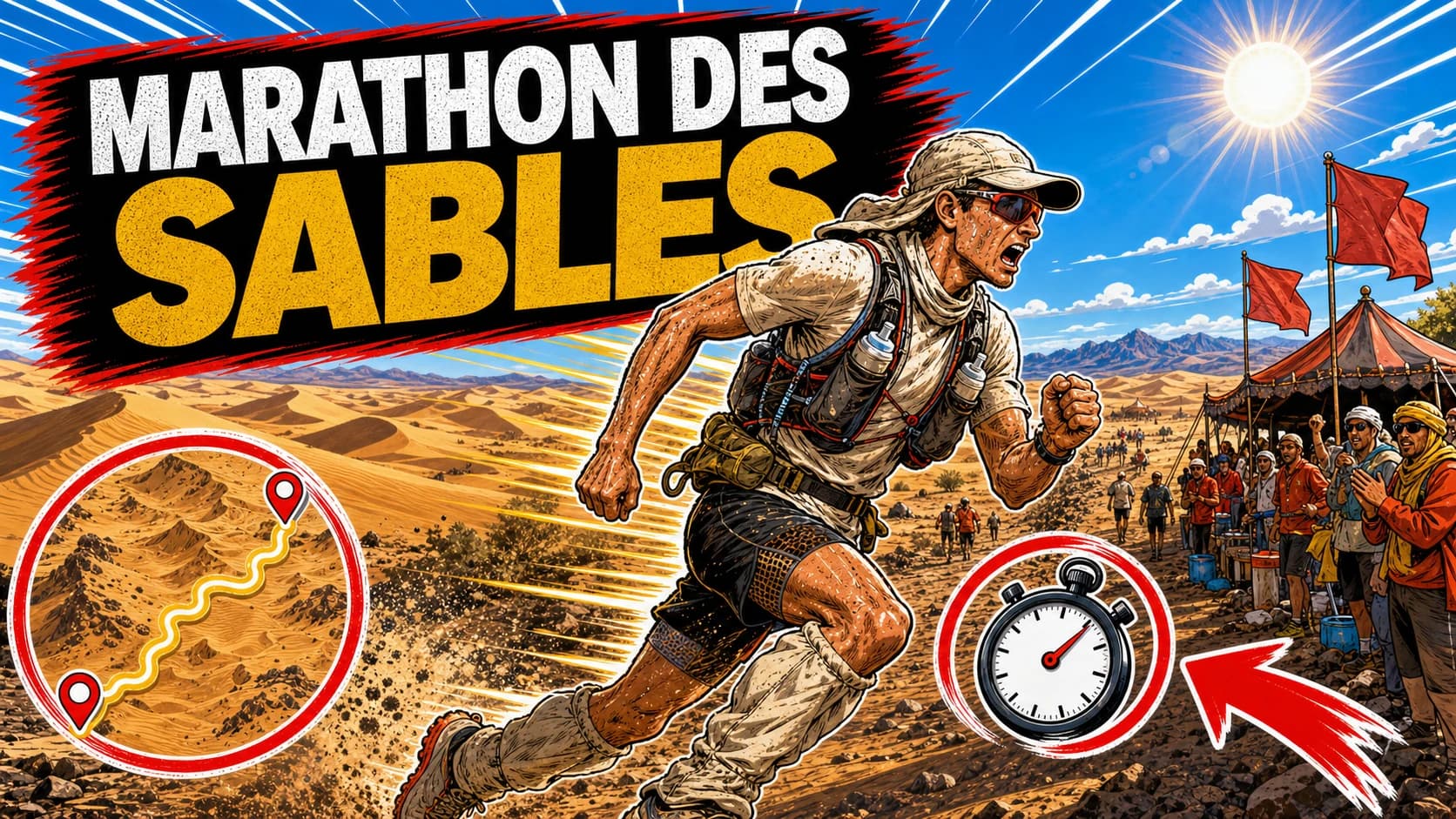
On March 19, 2027, the 41st edition of the Marathon des Sables (MdS) kicks off in the Moroccan Sahara — 250 km in 6 stages over 7 days, while you carry every gram of food, kit and sleeping bag yourself. No solid aid stations. No hotels. No shortcuts. It's "the world's toughest footrace" — a label that gets thrown around a lot, but at MdS it's earned: 30–45 °C by day, 5–15 °C at night, dunes that swallow your calves with every step, and a day 4 long stage of ~85 km that takes 18 to 36 hours. This guide covers what neither the official site nor the finishers' blogs lay out in full: how the race breaks down, what to pack, how to train for 40 weeks for an event you can't simulate, and what really happens when the thermometer crosses 42 °C in the middle of an erg.

⚡ Quick verdict
  • One line: the world's toughest footrace — 250 km self-sufficient in the Sahara, not for first-timers.
  • Best for: ultra-runners with 2+ years of long runs, capable of managing a heavy pack, extreme heat and broken sleep.
  • Skip it if: you've been running less than 2 years, can't tolerate heat, or expect European-style trail support.
  • Key data: ~250 km · 6 stages in 7 days · self-sufficient (you carry ~14,000 calories) · ~1,400 athletes · 30–45 °C · day 4 long stage ~85 km.
  • Registration: opens 12–18 months out; €4,000–5,500 entry. Charity bib via fundraising.
📑 Table of contents
  1. Key data
  2. About the race
  3. The course — 6 stages
  4. History and roll of honour
  5. Registration and prices
  6. Getting there
  7. Where to stay
  8. Weather
  9. How to train — 40-week plan
  10. Pace calculator
  11. Personalised race plan
  12. Race plan
  13. Nutrition
  14. Kit
  15. FAQs
  16. Comparison with other ultras

Key data#

The essentials in one table: dates, format, ~250 km total split across 6 stages, 1,400 bibs and prices.
DataInformation
Start dateFriday March 19, 2027
Duration7 days (6 stages + rest/finish day)
Total distance~250 km
StagesDay 1 ~30 km · Day 2 ~35 km · Day 3 ~38 km · Day 4 long stage ~85 km · Day 5 marathon stage ~42 km · Day 6 charity stage ~7 km
LocationSouthern Morocco · Sahara · Erfoud / Merzouga / Erg Chigaga / Erg Chebbi area
FormatStage race in food self-sufficiency
Field size~1,400 athletes
Minimum age18 (with medical certificate)
OrganiserAtlantide Organisation Internationale (Patrick Bauer)
Registrationmarathondessables.com

About the race#

What Marathon des Sables really is, what "self-sufficient" means, and how to honestly decide if this race is for you today.

The Marathon des Sables is not a trail race, not a classic ultramarathon and not a tourist challenge. It's a stage race in food self-sufficiency in the heart of the Sahara desert — for one week you literally carry everything you'll eat (~14,000 calories), your sleeping bag, the mandatory safety kit, spare clothing and electronics. The organisation only provides two things: a shared tent (the "bivouac") and rationed water (between 9 and 14 litres a day depending on the stage). Everything else comes out of your pack.

Is this race for you?

MdS is not for ultra debutants. The race assumes you arrive with:

  • 2+ years running long distances (at least a couple of marathons or 50K+ ultras).
  • Ability to manage an 8–10 kg pack for 8–12 straight hours.
  • Proven heat tolerance (not in a one-week test, but in real training blocks).
  • Financial bandwidth: between bib, flights, kit and training you're looking at €7,000–10,000 total.
  • Mental stability: sleeping 5 to a tent open to the desert, with little privacy and a day 4 that lasts 30 hours, is not for everyone.

If you've been running 6 months or you're on your first marathon, MdS is not your race yet. Come back in 2 years with more kilometres in your legs.

What MdS IS:

  • A brutal human experience — you'll see sunrises over the Erg Chebbi that justify the bib on their own.
  • A very strong community: the bivouac creates bonds that last decades.
  • The chance to discover how far your body and mind go when comfort vanishes.
  • A personal mark on your runner CV that very few people carry.

What MdS is NOT:

  • A European trail with aid stations every 10 km (here it's water only, no food).
  • A race to chase a PB (the difficulty is in finishing, not in the clock).
  • A luxury experience (the tent is a rug and five people; the shower comes on day six).
  • A cheap event.

The course — 6 stages#

The terrain shifts every day: soft dunes, stony regs, dry oueds, rocky jbels. And in the middle, the day 4 long stage that decides the race.

The MdS course changes every year — Patrick Bauer and his scout team draw new routes to keep the surprise, but the overall structure (~250 km in 6 stages) and the terrain types repeat edition after edition. What follows is the typical pattern of a modern edition in the Erfoud–Merzouga–Zagora area.

Day 1 · Approach stage (~30 km)#

The first stage is the "friendliest" in distance — but not in feel. You set off with the pack at maximum weight (8–10 kg with the entire week's food) and the body is not yet acclimatised to the heat. The terrain typically combines regs (flat hard stone plains), the odd oued (sandy dry riverbed) and a first taste of small dunes at the end.

  • Distance: ~30 km
  • Terrain: reg + oued + soft dunes
  • Average time: 5–7 h (top: ~3 h)
  • Key: don't go out fast. The pack weighs 9 kg on day 1 and 5 kg on day 5. Managing that gradient is 80 % of the race.

Day 2 · Entering the dunes (~35 km)#

Day two raises the stakes. It usually includes a first crossing of a small erg (dune field) and a jbel (rocky mountain) climbed and descended steeply. Feet start complaining — the first blisters appear here, especially if sand has begun to creep through the gaiters.

  • Distance: ~35 km
  • Terrain: reg + small erg + jbel
  • Average time: 6–8 h (top: ~3:30 h)
  • Key: foot check at the bivouac on arrival. If you don't treat the small blisters today, day 4 they explode.

Day 3 · The grinder (~38 km)#

Day 3 is the "long" stage before the real long one, and it usually drops you into hard ground: medium dunes for several kilometres, sun-baked regs, possibly a technical jbel section with a fixed rope. This is where many runners realise they packed too much kit or didn't drink enough on day 1.

  • Distance: ~38 km
  • Terrain: dunes + reg + technical jbel
  • Average time: 7–9 h
  • Key: manage the water. They give you ~9 L for the stage, but midday heat makes you drink an extra litre that's missing later.

Day 4 · THE long stage (~85 km) — where the race breaks#

This is the day. The MdS long stage runs about 80–90 km and you do it in one go, only stopping at Check Points (CP) every ~12 km to receive your water ration. You start Friday morning and finish Saturday — elites in 8–10 hours, the bulk between 18 and 30 hours, and the slowest in 35 hours.

  • Distance: ~80–90 km (can hit 91 km in some editions)
  • Terrain: all combined — long dunes, endless regs, night-time erg, jbel, oued
  • Average time: 18–30 h (top: ~7:30 h · cut-off: 36 h)
  • Rest day after: yes, runners get the entire next day to recover at the bivouac.

Why the race breaks here:

  • Sleep. If you finish at midnight, you've slept 0 h in 24 h. If the second sunrise catches you still moving, you're approaching 36 h without sleep.
  • The night. Pre-dawn cold (5–10 °C) after 12 hours of 40 °C heat confuses the body: shivering while dehydrated is a dangerous mix.
  • Dunes at night. Walking soft sand by headlamp with only chemical glow-stick markers is mentally exhausting.
  • Pack decay. You carry 7 kg of food and by the end of day 4 you've burned through it: weight drops, but feet are already wrecked.

How to manage day 4:

  • Mandatory pacing plan: plan to stop 5 minutes at each CP, eat hot at one of them, and sleep 1–2 h after km 60 if you'll finish past midnight.
  • Serious headlamp (>300 lumens and battery for 8 h).
  • Poles: legal and very useful, especially in night dunes.
  • Don't start fast: day 4 ego kills more MdS runs than the heat does.

Day 5 · Marathon stage (~42 km)#

After the rest day, day 5 is the marathon — 42.195 km. On paper it's "only" a marathon distance, but you do it with 300 km in your legs, wrecked feet and the leftover-pack weight from the previous days. Elites run it in 3:00–3:30 h; most take 5–7 hours.

  • Distance: 42.195 km
  • Terrain: the last big crossing — often includes a spectacular final erg
  • Average time: 5–7 h (top: ~3:00 h)
  • Key: finish on your feet, with your head intact. Not a stage to push — the podium is decided here only if you're top-20.

Day 6 · Charity stage (~7 km)#

The last day is the charity stage — 7 celebratory kilometres, everyone in a UNICEF shirt, in a group. It's the day of applause, photos and closure. Some editions run it as a walk; others as a mini-race. Nobody is chasing a clock here.

  • Distance: ~7 km
  • Terrain: flat into the final camp
  • Key: enjoy it.

History and roll of honour#

From a crazy idea by Patrick Bauer in 1986 to 40+ editions and 25,000 finishers — and Rachid El Morabity's absolute reign.

Marathon des Sables was born in 1986 out of a personal expedition by Patrick Bauer, a Frenchman who in 1984 crossed 350 km of the Algerian Sahara alone on foot, carrying everything. The experience marked him so deeply that two years later he organised the first MdS edition with 23 runners. Four decades on, MdS is the oldest and most prestigious desert stage race, with over 40 editions and a central role in defining the modern "self-sufficient stage race" concept.

Milestones:

  • 1986: first edition. 23 runners. Patrick Bauer directs the race personally.
  • 1994: the famous edition where Mauro Prosperi, an Italian athlete, gets disoriented in a sandstorm, ends up in Algerian territory and survives 9 days drinking his own urine and bat blood. The episode enters MdS mythology.
  • 2010: first victory of Rachid El Morabity, a Moroccan from the Zagora region, who dominates the race from that year onwards.
  • 2021: post-pandemic edition, run in October. Two deaths during the race make it the toughest edition in history.
  • 2024–2026: Rachid El Morabity passes 10 victories and becomes the most dominant figure in stage ultra-running.

Recent men's roll of honour:

YearWinnerCountryTotal time
2026Rachid El MorabityMAR~20:15 h
2025Rachid El MorabityMAR~20:25 h
2024Rachid El MorabityMAR~20:38 h
2023Mohamed El MorabityMAR~21:02 h
2022Rachid El MorabityMAR~20:52 h

Historic record: the dominance of the El Morabity brothers (Rachid and Mohamed) over the last decade is comparable to Kilian Jornet in European trail: same lineage, same heat genetics, terrain knowledge from childhood.

In the women's category the podium is dominated by European runners with prior ultra experience (Aziza Raji, Audrey Tanguy, Elisabet Barnes in recent years), with typical podium times of 23–25 hours total.


Registration and prices#

How to get a bib, what's included and what isn't, and the charity option if you can't reach the standard entry price.

MdS registration is first-come-first-served and opens 12–18 months out from the edition. For MdS 2027 (March 2027), the opening window is expected between July and November 2025. The race closes well before the theoretical deadline — the 1,400-bib quota typically sells out in weeks.

Entry types:

TypeApprox. priceIncludesDoesn't include
Standard entry€4,200–4,800Bib, charter flight Paris–Errachidia, desert transfers, water and tent, organisation feeFood (you carry it), kit, flight to Paris, pre/post hotel, insurance
Entry from Spain (Mama Sahara or local operator)€4,800–5,500Above + travel package from Madrid/BarcelonaFood, kit, insurance
Charity bib€5,500–7,500Bib + obligation to fundraise for an NGOThe rest
Resale bibs (officially not allowed)VariableTotal riskAny guarantee

What the bib actually includes:

  • Charter flight Paris Orly → Errachidia (return) — only if you book the official package.
  • Bus transfers from Errachidia to the start bivouac.
  • A spot in a shared tent (5 people) for the whole week.
  • Daily water: 9 to 14 litres depending on the stage, distributed at CPs.
  • Medical assistance from Doc Trotters (mobile medical team).
  • Bib bag with basic kit (survival blanket, beacon, salts).
  • Dinner the night before the start and the night after the last stage.
  • Finisher T-shirt.

What it does NOT include:

  • Food for the 7 days — €150–300 if you buy freeze-dried meals.
  • Mandatory kit: pack, sleeping bag, headlamp, GPS, gaiters, etc. Between €1,500 and €3,000 if starting from scratch.
  • International flight to Paris (if you don't live there).
  • Pre-race hotel in Paris Orly (1 night).
  • Evacuation insurance specific for desert zones (~€200).
  • Post-race hotel in Marrakech / Ouarzazate (recommended: 2 nights).

Charity bib: if you don't want to pay the standard entry, several NGOs (in Spain: Fundación Sergio García-Ramírez, Manos Unidas, Fundación Amigos de Mauthausen, among others) offer bibs in exchange for fundraising between €8,000 and €12,000, which you have to raise yourself from sponsors and donors. It's an option for people with a corporate network but no personal budget.


Getting there#

There's an "official" way (charter flight from Paris) and two alternatives if you're coming from Spain. Watch the airport.

Reaching the Sahara from Europe goes through Morocco, and MdS organises the final leg. Your options:

Option 1: Official package (recommended for first-timers)#

The bib includes a charter flight Paris Orly → Errachidia (ERH) direct. From Errachidia it's 2–3 hours by bus to the start bivouac, organised by MdS. You only need to land in Paris Orly on the assigned day (typically the Thursday before the race) with all your kit.

  • Pros: zero logistics. You arrive with your pack, they put you on the bus, and the following Monday you're back in Paris.
  • Cons: mandatory night in Paris (€100–180 hotel near Orly). International flight cost on top.

Option 2: Flight to Marrakech (RAK) + local operator package#

Some Spanish operators (Mama Sahara, Yumping, Trotamundos) organise packages from Madrid/Barcelona with a flight to Marrakech (RAK) + bus transfer to the bivouac.

  • Pros: no Paris stopover, departure from Spain, Spanish on the bus.
  • Cons: 8–12 hour bus transfer from Marrakech to the desert. If buses make you sick, this isn't your option.

Option 3: Flight to Ouarzazate (OZZ)#

Ouarzazate is the closest airport to the desert, but has very few international connections. Some editions arrange direct charters from Paris to OZZ. If you find a regular Madrid–OZZ flight via Casablanca (Royal Air Maroc), you save 3 hours of bus.

Relevant airports:

AirportCodeDistance to bivouacConnections from Spain
ErrachidiaERH~150 kmMdS charter only
OuarzazateOZZ~250 kmCasablanca → OZZ (Royal Air Maroc)
MarrakechRAK~500 kmDirect flights from Madrid, Barcelona, Bilbao, Málaga
CasablancaCMN~700 kmRoyal Air Maroc hub, daily connections

Recommendation: if it's your first MdS, pay for the official package. The day before the race is not the moment for your luggage to go missing or to land 30 hours late from a cancelled connection.


Where to stay#

Spoiler: during the race you sleep in a tent with four strangers. But there's a before and after that does need a hotel.

You need to think about three moments: pre-race, during the race and post-race.

During the race: the bivouac#

There are no hotels on the course. You sleep all 7 days in a Berber tent (goat-hair tent open on the sides) shared with 4 other runners. The organisation sets up and tears down the bivouac each night at a new location, following the route. You only carry your sleeping bag and a thin mat (optional). The floor is sand.

  • Tents are assigned in groups of 8 people, usually by language or affinity (you can request to share with friends).
  • There are showers at the start and the finish, but between stages there are none. People clean up with wet wipes.
  • Bathroom: designated trenches by the organisation. The less detail, the better.

Pre-race: 1–2 nights in Paris, Marrakech or Ouarzazate#

If you go with the official package:

  • Paris Orly the night before the charter flight. Hotels near the airport: Ibis Orly Aéroport, Mercure Paris Orly, NH Paris Orly Aéroport. Price €100–180.

If you go with an operator package from Spain:

  • Marrakech or Ouarzazate the night before the desert transfer. Recommended: one extra night to see the Marrakech souk or the ksar of Aït Benhaddou.

Post-race: the reward#

When the race ends, MdS transfers you to a 4-star hotel in Ouarzazate or back to Errachidia for the charter flight to Paris. Most runners stay 2–3 extra nights in Marrakech to recover before flying home.

Recommended Marrakech hotels post-MdS:

  • La Mamounia (5★, historic luxury, €400+/night): the expensive celebration.
  • Riad Yasmine (small riad in the medina, €150–250): the cultural option.
  • Es Saadi Marrakech Resort (5★ with huge pool, €250+): the "I need a pool NOW" option.
  • Hotel Atlas Asni (3★, €70–100): decent low-cost.

Recommendation: book the Marrakech hotel before leaving for the race — when you finish you won't have the head to do it from the desert.


Weather#

The factor that defines MdS. 30–45 °C by day, 5–15 °C at night, possible sandstorms. And acclimatising is not optional.

The Sahara in March is in winter–spring transition: daytime temps milder than in summer (when it hits 50 °C), but still brutal for an unacclimatised European.

Typical March temperatures (Erfoud–Merzouga zone):#

Time of dayRange
Sunrise (~6:00)5–10 °C
Mid-morning (~10:00)20–28 °C
Midday (~13:00)35–42 °C
Afternoon (~16:00)35–45 °C (peak)
Sunset (~19:00)18–25 °C
Night (~3:00)5–12 °C

Sahara sun is not European sun. At 40 °C in Madrid you sweat; at 40 °C in the Sahara with humidity <15 % and a vertical sun, you dehydrate without feeling thirst. CPs weigh you (scales): if you lose >5 % body weight, they stop you and force rehydration. If you lose >10 %, you're out.

Climate risks:#

  • Heatstroke. Main risk. Symptoms: stop sweating, confusion, body temp >40 °C. It's a medical emergency.
  • Hyponatraemia (water intoxication). Drinking too much water without salts also kills. That's why electrolyte salts are mandatory in the kit.
  • Sandstorms. Visibility can drop to <10 metres. The organisation halts the race if it's severe, but if it catches you mid-stage: cover head, goggles, wait it out.
  • Night cold. Runners finishing the long stage at 3 AM at 8 °C after 12 hours of heat slip into hypothermia fast if they don't have dry warm clothing.

Heat acclimatisation (not optional):#

The 15 days before the trip are critical. Typical plan:

  • 2–3 heat sessions per week: sauna 20–30 min post-training, hot baths 40 °C × 30 min, or training in multiple layers.
  • Hot yoga / Bikram: 1–2 weekly sessions if you have access.
  • Arrive in Marrakech 3–4 days early: walks and easy training under midday sun.

Heat acclimatisation isn't improvised in race week. Start 6 weeks out.


How to train — 40-week plan#

It's not a marathon plan or a "European" ultra plan. MdS is 40 weeks of pack work, heat, back-to-backs and sand simulation. Here's the skeleton.

MdS takes 40 weeks (10 months) of training. The 16- or 24-week plans that work for a marathon or UTMB don't prepare you for this. The accumulated load you'll absorb on day 5 with 300 km in your legs is built over a year of honest training. We assume you arrive with a base of 60+ km/week and at least one 50K ultra completed.

General plan structure (40 weeks):#

BlockWeeksFocus
Aerobic base1–8Volume 60→80 km/wk, long runs without pack, muscle base
Specific strength9–16Gym 2x/wk (squats, deadlifts, core), runs with light pack (3–4 kg)
Volume + back-to-backs17–28Progressive long runs: 30 → 40 → 50 km. Saturday-Sunday back-to-backs
Desert specific29–36Heavy pack (8–10 kg), sand simulation (beach or fields), heat acclimatisation
Tapering37–40Volume drop, intensity maintenance, logistics prep

Sample week of block 17–28 (volume + back-to-backs):#

  • Monday: 60–90 min easy Z2.
  • Tuesday: rest or 30 min mobility.
  • Wednesday: 90 min with Z3 blocks (30 min warm-up + 6×5 min Z3 + 15 min cool-down).
  • Thursday: 60 min easy + gym (squat, deadlift, pull-ups, core).
  • Friday: rest or 45 min very easy.
  • Saturday: long run 1: 4–6 hours progressive with 5 kg pack.
  • Sunday: long run 2 (back-to-back): 2–3 hours with 5 kg pack on tired legs.

The weekend back-to-back is the session closest to MdS. It teaches you to run day 4 with day 3's legs.

Sample sessions of block 29–36 (desert specific):#

  • Full pack: start training with 8–10 kg (everything you'll actually carry).
  • Sand: if you live near a beach, one weekly run on dry sand (not firm sand near the water). Otherwise, find urban dunes or, failing that, incline treadmill with weight.
  • Heat: sauna 30 min post-training × 3 sessions/wk, hot baths 40 °C × 30 min × 2/wk, training in multiple layers.
  • 24 h simulation: one session, once in the entire plan, of long stage simulation: 8–12 hours with 8 kg pack, mixed terrain, eating only what you'll eat at MdS. Ideally overlapping a sunrise.

Common preparation mistakes:#

  • Training without a pack. 40 % of debutants make this mistake. Biomechanics with 9 kg on your back are radically different.
  • Training only in the cold. You arrive in March in Morocco having not sweated seriously in months.
  • Trying new food on day 1. Whatever you carry, you should have eaten it at least 5 times in training.
  • Not testing shoes with gaiters. Gaiters modify your stride — train with them.
  • Too much volume, too little rest. The body absorbs training during sleep. If you sleep 5 hours, you're not training, you're breaking yourself.

Pace calculator#

The day 5 marathon stage — 42.195 km after 4 stages and 200+ km in your legs. Calculate your realistic pace for the day that will hurt most.

Unlike a standard marathon, in MdS per-km splits aren't useful — pace shifts radically between dunes (you walk at ~10 min/km), hard regs (you run at 6 min/km) and oueds (5–6 min/km). The only day that makes sense for a marathon calculator is day 5, the marathon stage, where you already know your legs, the terrain tends to be more rolling and you can set a realistic time goal.

This calculator gives you the average required pace for the day 5 marathon stage, assuming reasonable mixed terrain, and the control splits at 5K, 10K, 15K, half marathon, 30K and finish. Change the target time and the table updates instantly:

🎯 Calculadora de ritmo y splitsEscribe tu tiempo objetivo para MdS Marathon Stage
Ritmo medio requerido7:07 min/km
Equivalente en millas11:27 min/mi
PuntoTiempo acumuladoParcial
5 km35:3335:33
10 km1:11:0635:33
15 km1:46:3935:33
Media (21,1 km)2:30:0043:21
30 km3:33:181:03:18
Meta5:00:001:26:42

Splits asumen ritmo constante. En carreras con desnivel real (MdS Marathon Stage) — banca 5–8 s/km en bajadas y pierde el mismo margen en subidas; el ritmo medio se mantiene.

How to use it for MdS:

  • Add 30–40 % to your road marathon time. If your PB is 3:30, don't expect to run 3:30 on day 5 — aim for 4:30–5:00.
  • Dunes can add 90 minutes. If the day 5 marathon stage includes a long final erg, plan 70 extra minutes for those 5 km alone.
  • Average pace is misleading. In MdS it pays more to plan by terrain block (10 min/km in dunes, 6 min/km in reg) than by flat kilometre.

Personalised race plan#

The planner generates your stage-by-stage plan: terrain pacing, pack management, daily food, foot care and a Plan B for day 4.

Configure your goal, heat acclimatisation strategy and aid plan (which in MdS means what you put in the pack). The planner gives you a personalised plan per stage (with paces, heat management, daily food, foot plan and mental cues), a morning checklist for each stage, and a Plan B for the unexpected (sandstorm, massive blisters, GI issues). Download as a PDF to take in your pack.

📋 Plan de carrera personalizadoConfigura objetivo, estrategia y avituallamiento. Genera tu plan paso a paso y descárgalo en PDF para llevártelo el día de carrera.
Estrategia de pacing
Ritmo medio7:07/km
Tiempo previsto5:00:00
Geles totales9
  • 📊 Ritmo por tramo con FC y cues mentales
  • ⏱️ Avituallamiento minuto a minuto (33 eventos)
  • ✅ Checklist de la mañana de carrera
  • 🆘 Plan B para los imprevistos

PDF A4, optimizado para imprimir y llevar el día de carrera.


Race plan#

Day-by-day strategy: day 1 conservative, day 4 THE race, day 5 marathon, day 6 charity. And the principle ruling everything: the pack lightens, the feet break.

The MdS race plan is not measured in splits, but in stage management. The master rule is simple: finish day 4 in one piece. Everything you do on days 1–3 serves arriving at day 4 with legs, feet and head. And everything you do on day 4 dictates whether you'll run or walk days 5 and 6.

Day 1 — conservative mode#

  • Target pace: 75–80 % of your "comfortable" ultra pace.
  • Pack: full (8–10 kg). Adapting to load.
  • Focus: kit check, gaiter adjustment, first hydration test with salts.
  • Typical mistakes: running fast on adrenaline, not stopping to treat the first km-20 blister.

Day 2 — keep discipline#

  • Target pace: same as day 1, don't accelerate even if you feel better.
  • Pack: already 1 kg lighter (day 1 food gone).
  • Focus: arrive at the bivouac with energy to treat feet and cook.
  • Typical mistakes: getting cocky and pushing the last hour.

Day 3 — the penultimate step#

  • Target pace: slight intensity drop. Day 4 is tomorrow.
  • Pack: 2 kg lighter.
  • Focus: save feet on technical descents, no heroics on jbel.
  • Typical mistakes: "I've held 100 km, I can push". Kills you.

Day 4 — THE race#

This is the day. The decisions of the next 24–30 hours define your MdS.

  • Start: very conservative. The first 3 hours you go slower than you think you need to.
  • CPs (every ~12 km): mandatory 5–10 min stop. Eat hot at at least one (ideally CP3 or CP4). Feet checked at CP2 and CP4.
  • Nightfall: headlamp on, thermal layer ready, shorter stride.
  • Sleep plan: decided before. If you'll arrive past midnight, plan a 1–2 h sleep at CP4 or CP5.
  • The second sunrise: if it catches you moving, eat something hot, change underwear if you can, and push to the bivouac.
  • Finish: what matters isn't the time, it's finishing intact. Feet, legs, head.

Day 5 — marathon#

  • Target pace: pure marathon but +30–40 % over your PB.
  • Pack: almost empty (4–5 kg).
  • Focus: finish on your feet, with your head intact. If you raise the pace, accept that the podium was decided on day 4.
  • Typical mistakes: trying to "claw back" time from day 4 — feet won't take it.

Day 6 — charity#

  • Target pace: walk, enjoy, photo.
  • Focus: the finish line. UNICEF shirt, hug, tears.

Nutrition#

~14,000 total calories in your pack over 7 days. MdS nutritional planning is half the race. Fail here and you fail everything.

In MdS there are no solid aid stations. You carry in your pack all the food you'll eat over 7 days (~14,000 kcal total). The organisation only gives water. That makes nutritional planning one of the race's pillars, and probably the most underestimated by debutants.

Mandatory rules from the regulations#

  • Minimum 2,000 kcal/day documented in the pre-race bag check. If you carry less, you don't start.
  • Visible calorie labels on every product (freeze-dried meals carry them; bars and gels too).
  • If you run out of food at any CP, you're out (rare, but it's the rule).

MdS calorie balance#

You'll burn 5,000–7,000 kcal/day between stage, active recovery and thermoregulation. You'll eat 2,500–3,500 kcal/day. That means a real deficit of 2,500–3,500 kcal/day for 7 days. You'll arrive at the finish 3–6 kg lighter, mostly muscle and water. It's inevitable. Nutritional planning minimises that loss without overweighting the pack.

Typical daily calorie split (~2,000 kcal minimum)#

MomentExampleCalories
Breakfast (5:30 AM)1 freeze-dried oats with chocolate sachet (Real Turmat Granola) + instant coffee500
During stage4 gels + 2 bars + nuts800
Bivouac arrivalRecovery shake (protein + carbs)250
Dinner (19:00)1 freeze-dried main meal (Lyofood Quinoa, Trek'n Eat Pasta) + 2 squares dark chocolate600
Before sleepNuts + bar250
TOTAL~2,400 kcal

Key products#

  • Freeze-dried meals: the base. Real Turmat (NOR), Trek'n Eat (DE), Lyofood (PL), Travellunch (DE). 500–700 kcal per sachet, weight 100–130 g, need hot water (you cook with your stove + Esbit fuel tablets). Reserve 2/day (breakfast + dinner).
  • Gels: Maurten 100, SiS, Gu, Spring Energy. 5–6 a day during stage. Tested in training.
  • Bars: Cliff Bar, Trek (good weight/cal ratio), homemade date/almond. 2–3 a day.
  • Nuts: pistachios, cashews, almonds. 30–50 g/day = 200 kcal at almost no weight cost.
  • Electrolyte salts: SaltStick, Hammer Endurolytes, S!Caps. 3–6 a day depending on heat.
  • Dark chocolate: 70 %+. 2 squares a day as a "ritual". Calorie-dense, psychological boost.
  • Instant coffee/tea: morning and evening ritual.

What does NOT work#

  • Real food (sandwich, fresh fruit): weighs too much and doesn't survive heat.
  • Cans/preserves: too heavy.
  • Untested products: the exotic bar that looks great at home can give you diarrhoea on day 3 in the desert. Guaranteed disaster.
  • Unfamiliar caffeine: if you've never used caffeine pills, don't debut them at MdS.

Hydration and salts#

The organisation hands out 9 to 14 litres of water per day depending on the stage. CPs are every ~12 km. Rules:

  • Drink BEFORE feeling thirst. In the Sahara, thirst = already dehydrated.
  • Salts in every flask. Without sodium, you drink the water and pee it out instantly, retaining nothing.
  • 150–200 ml every 15–20 min during a hot stage.
  • Never finish a CP with empty flasks — always keep reserve for the ~12 km to the next CP.

Kit#

25–30 L pack, -5 °C down sleeping bag, headlamp, stove, gaiters and mandatory kit. Here are the models actually used in the field.

Kit at MdS is 30 % of your final score. A badly fitted pack sinks you on day 2. A too-thin sleeping bag wakes you every hour from day 3 to day 6. Shoes badly protected against sand leave your toes raw on day 4.

Mandatory kit (checked pre-race)#

The organisation publishes an official mandatory list that's checked at the pre-race pack inspection. Without any item, you don't start.

  • Pack with your bib stitched to the front.
  • Sleeping bag.
  • Headlamp with spare batteries.
  • 10 safety pins.
  • Compass (yes, real compass, not an app).
  • Lighter.
  • Whistle.
  • Signal mirror.
  • Survival blanket.
  • Knife with metal blade.
  • Topical antiseptic.
  • Electrolyte salts.
  • Rubbish bag for your kit during the stage.
  • Snake antivenom (provided by the organisation at the bivouac, but you must collect it).

Without any of these: 2-hour penalty per item. Without sleeping bag or headlamp: out of race.

Pack#

Capacity: 25–30 litres to carry 7 days of food + sleeping bag + clothing + mandatory kit. Much less doesn't fit; much more is dead weight.

Popular models in the field:

  • WAA Ultrabag 25L (~€280): the most-used at MdS. Designed for the race.
  • Raidlight Revolutiv 24L (~€220): French, fine adjustment, ultralight materials.
  • OMM Phantom 25L (~€180): British, light, very tested.
  • Salomon Out Day 20+4 (~€140): more urban option, fine for runners with little kit.

The critical thing isn't the brand: that it fits you and that you've trained with the actual load for at least 200 km.

Sleeping bag#

Sahara nights in March drop to 5–10 °C (sometimes less). You need a bag that's warm but light.

Recommendation: 800-cuin goose down sleeping bag, comfort temperature 0 °C or slightly below, weight <700 g.

Models:

  • Western Mountaineering Ultralite (~€500, 800 g, -7 °C comfort): expensive but the reference.
  • PHD Minim 400 (~€450, 600 g, 0 °C comfort): the most-used at MdS for weight/warmth ratio.
  • Cumulus Lite Line 300 (~€280, 600 g, 0 °C comfort): more affordable European option.

Not recommended: synthetic bag (double the weight), generic adventure bag (triple the weight).

Shoes#

Protective trail running shoes, one full size larger than your street size (feet swell in the desert with the pack).

Common MdS models:

  • Hoka Speedgoat 5: the most seen at the bivouac. Cushioning + protection.
  • Salomon Sense Ride 5: balance, grip on moderate sand.
  • La Sportiva Bushido III: if you come with trail technique.
  • Topo Athletic Ultraventure 3: wide toe box, fine for wide feet.
  • Altra Olympus 5: zero drop, very wide toe box — only if you're already adapted.

Gaiters#

Essential. Without gaiters, on day 1 you already have sand inside the sock, and on day 3 blisters are systematic.

Recommendation: gaiters sewn or glued to the shoe with perimeter velcro (not generic boot-style gaiters).

Models: Raidlight Desert Gaiters, MyRaceKit Gaiters (UK, very tested at MdS), Sandbaggers (USA). €60–100.

Critical: carry the gaiters already sewn to the shoe from home, and train with them at least 100 km. Sewing them at the bivouac in the heat is a nightmare.

Hydration#

  • 2 flexible flasks of 750 ml–1 L each (Hydrapak Softflask, Salomon Soft Flask). 1.5 L total capacity.
  • Hydration tube: optional. Some runners prefer to carry the soft flasks directly on the shoulders to drain them.

Headlamp#

Powerful headlamp for day 4 (long stage, 8–12 hours of night). Essential: 300+ lumens and 8+ hours of battery.

Models: Petzl Nao+, Silva Trail Speed 5XT, Ledlenser NEO9R. €100–250.

Poles (optional but very useful)#

Allowed and very useful in dunes and on the day 4 long stage. Foldable, ultralight.

Models: Black Diamond Carbon Z, Leki Cross Trail FX Carbon, Naturehike Z.

Stove and fuel#

To boil water for the freeze-dried meals.

  • Esbit stove (solid alcohol tablets) — the bivouac standard. €20.
  • Esbit tablets: 1 tablet = 1 boiled meal. Carry 14–16 tablets for the 7 days.
  • 500 ml titanium pot: Toaks, MSR. €40–80.

Clothing#

What you wear + 1 spare set. No more.

Minimum list:

  • Light running shirt (worn) + 1 second underwear set (spare).
  • Light shorts with pockets.
  • Socks: 2–3 thin technical pairs.
  • Buff or neck cover: sun and dust protection.
  • Cap with neck cover (legionnaire style) (Salomon XA Cap, Buff Pack Run Cap).
  • Sunglasses with side protection.
  • UV sleeves: optional but useful for intense sun.
  • Light fleece for the night (~200 g, good weight/warmth).
  • Dry socks for sleeping (feet need to breathe).

Foot kit (decisive)#

70 % of MdS abandons are due to feet. Carry a serious kit.

  • Leukotape or Strappal (rolls, not pre-cut).
  • Small scissors.
  • Needle and thread to drain large blisters.
  • NOK / vaseline anti-chafing cream.
  • Antibacterial powder.
  • Gauze and antiseptic.
  • Compeed: for emergencies, not as prevention.

Doc Trotters (medical team) treats feet at the bivouac, but with a 2-hour queue. Treat them yourself first.


FAQs#

10 honest answers to the real questions: difficulty, risk, comparison with UTMB and Western, age, beginners, vegetarians, women, language and dropping out.
Is Marathon des Sables really "the world's toughest race"?

It's one of the 4 or 5 toughest, and the toughest in the self-sufficient stage format. Compared to Badwater 135 (hotter, but with support), Western States 100 (faster but not self-sufficient), Bigfoot 200 (longer but less extreme on climate) or La Diagonale des Fous (more vertical), MdS wins on combination of variables: distance + heat + self-sufficiency + 7 days + broken sleep. Patrick Bauer's marketing label ("the toughest footrace on Earth") is debatable, but the difficulty is real.

How much do I train for MdS if I've never done an ultra?

Don't sign up for MdS if you've never done an ultra. The theoretical plan for someone without a base is 24–30 months: year 1 marathon + 50K + 80K, year 2 specific 40-week MdS plan. People who try without that base end up in a helicopter on day 3. If your base is pure marathon, consider UTMB CCC or a 100K before MdS.

Is there real risk of death? How many finishers are there?

Yes, there is risk. There have been deaths in MdS history — 2 in 2021, sporadic cases in other editions, almost always from heatstroke or cardiac complications. The finisher rate is ~85–90 % (high for an ultra of this level) thanks to CP density and the medical team. But it is NOT a "safe" race — it's a well-organised race with managed risk, not eliminated.

MdS or UTMB? Which one first?

Different races. UTMB is vertical European trail, supported, not self-sufficient, in 1 stage. MdS is a self-sufficient stage race in flat desert. UTMB takes 6 months to train; MdS, 10. UTMB costs €350; MdS €4,500+. If you come from road, do UTMB first. If you come from adventure/trekking, MdS fits earlier. They're not alternatives: they're different.

Is there a minimum or maximum age?

Minimum: 18 with medical certificate. Maximum: not official, but the organisation requires a reinforced medical certificate and a stress ECG from age 60. There are 70+ year-old finishers every edition. The average pack age is 40–50 years — it's a race for mature runners, not kids.

Can you eat vegetarian / vegan / gluten-free at MdS?

Yes, but with extra planning. Freeze-dried meals have vegan versions (Real Turmat Vegan, Lyofood Vegan). Gluten-free also exists. The hard part is finding vegan freeze-dried with 600+ kcal per sachet without losing weight/calories. Plan B: use more dense nuts (cashews, Brazil nuts, almond butter sachets) to reach minimum kcal.

What's MdS specifically like for women?

Women make up ~25 % of the field and tend to have better long-distance heat management than men at MdS. The specifics:

  • Period: bring your usual option (menstrual cup + wipes, tampons). Some runners shift their cycle with the pill to avoid the race.
  • Intimate hygiene: alcohol-free perineal wipes + barrier cream (Sudocrem, NOK).
  • Sports bra: high support, already tested in pack runs.

There are top female finishers near the absolute podium (top 30 overall). No technical barrier.

Is Spanish spoken at MdS? And in the bivouac?

The official language is French, briefings in French + English. There are ~100 Spanish runners every edition and they typically request a Spanish-speaking tent. The organisation (Atlantide) is French, so basic French helps. If not, English always works.

What happens if I drop out?

If you drop out, they take you to the next stage's bivouac and you stay the rest of the week there (you can't return to Marrakech early, there's no logistics for it). You stay in a "non-finisher" tent and ride the official bus at the end. The bib isn't refunded. Many people who drop continue accompanying their group to the finish.

Is it worth doing MdS just once?

Yes, brutally so. The vast majority of finishers describe MdS as "the most intense experience of their sporting life". It's expensive, painful, takes forever to prepare for, but transforms how you understand your body and mind. People who do it twice (~10 % of the field) confirm it: the first to discover it, the second to race it.


Comparison with other ultras#

How MdS fits against other iconic world ultras — so you know exactly what kind of extreme you're choosing.

MdS is the world's best-known stage ultra, but other "extreme" races compare to it in marketing. None are really equivalent:

RaceDistanceDaysFormatType of extreme
Marathon des Sables (this guide)~250 km7Stage, self-sufficientHeat + sand + self-sufficiency
Badwater 135 (USA)217 km1 (non-stop)Supported, non-stopExtreme heat (50 °C)
Western States 100 (USA)161 km1 (24–30 h)Supported, non-stopSpeed + heat + mountain
UTMB (FR/IT/CH)171 km1 (20–46 h)Supported, non-stopVertical (10,000 m D+) + altitude
Bigfoot 200 (USA)322 km1 (~80–100 h)Supported, sleep on the moveDistance + broken sleep
Comrades (RSA)89 km1SupportedSpeed + atmosphere
Two Oceans (RSA)56 km1SupportedAtmosphere + scenery
TransLagorai (IT)~250 km5–6Stage, semi-supportedAlpine vertical

MdS is unique for:

  • Real self-sufficiency (no food provided).
  • 7 straight days of accumulated load.
  • Extreme heat + sand (the dunes are the differential factor).
  • Communal bivouac for a week.

If your priority is...

  • Heat: Badwater (more extreme peak temperature).
  • Speed: Western States or Comrades.
  • Mountain: UTMB or Hardrock 100.
  • Pure distance: Bigfoot 200.
  • The complete adventure: MdS remains the reference.

See more ultras on SportPlan →


Did this guide help? If you're racing Marathon des Sables 2027, save the event on SportPlan to receive registration window alerts, medical check reminders, kit submission deadlines and, after the race, log your finish.

Fortsätt planera

Använd SportPlan för att jämföra datum, spara målevenemang och bygga en säsong som passar dina helger istället för ännu en ostrukturerad lista.

Bläddra bland evenemang

På denna sida

  • Key data
  • About the race
  • The course — 6 stages
  • History and roll of honour
  • Registration and prices
  • Getting there
  • Where to stay
  • Weather
  • How to train — 40-week plan
  • Pace calculator
  • Personalised race plan
  • Race plan
  • Nutrition
  • Kit
  • FAQs
  • Comparison with other ultras
Home
Blog
← Tillbaka till bloggen
runningultra
28 min läsning

Complete Comrades Marathon 2026 Guide — World's Oldest Ultramarathon (87.7 km, Up Run)

📖 14 min read 📝 3,000 words 🎯 Skim friendly

runningmaraton
54 min läsning

Complete Guide to the Two Oceans Marathon 2027 — The World's Most Beautiful Ultra (56K Cape Town)

Complete Guide to the Two Oceans Marathon 2027

runningmaraton
16 min läsning

Zurich Seville Marathon 2027 Complete Guide — Spain's Fastest Flat Course, Cathedral, Triana and How to Train For It

Zurich Seville Marathon 2027 Complete Guide

R

Blog.writtenBy

Ramon Curto· Founder & editor

Fundador de SportPlan. Lleva una década corriendo carreras populares en España. Autor de las guías de Madrid, Valencia y Zegama-Aizkorri en SportPlan.