IRONMAN 70.3 World Championship 2026 Marbella Complete Guide — The Half-Ironman Pinnacle, Costa del Sol and How to Train For It
IRONMAN 70.3 World Championship 2026 Marbella Complete Guide
By Ramon Curto · Updated 2026-05-08
On Saturday March 28 (women) and Sunday March 29 (men), 2026 the Costa del Sol stages the IRONMAN 70.3 World Championship for the very first time on Spanish soil. The pinnacle of half-iron racing, after a decade of Anglo and Central-European hosts, lands in Marbella: 113.1 km split between the Mediterranean off Bonita Beach, a 90 km bike west to Estepona/Manilva that loops inland through the Sierra Bermeja foothills, and a 21.1 km finish along the Marbella seafront promenade. This is not an open-entry race: it is qualifier-only from a regional 70.3 within the previous 12 months, with race entry around $695–795 USD before flights to Málaga (AGP) or rooms at Marbella Club. This guide covers what the official site doesn't quite explain: how you qualify, what each segment really feels like, where the race breaks, how to plan 24+ weeks of training, and how to handle logistics from elsewhere in Europe or globally.
📑 Table of contents
| Field | Information |
|---|---|
| Dates | Saturday 28 March (women) · Sunday 29 March (men) 2026 |
| Total distance | 113.1 km (1.9 km swim + 90.1 km bike + 21.1 km run) |
| Bike elevation | ~700 m |
| Run elevation | <50 m (flat seafront) |
| Location | Marbella, Costa del Sol, Andalucía, Spain |
| Swim start | Bonita Beach / Playa de la Bajadilla, Marbella |
| Start time | 07:30 CET — first swim wave |
| Cutoff | 8 h 30 min |
| Organiser | The IRONMAN Group (Wanda Sports) |
| Entry | Qualifier-only · ironman.com/im703-world-championship |
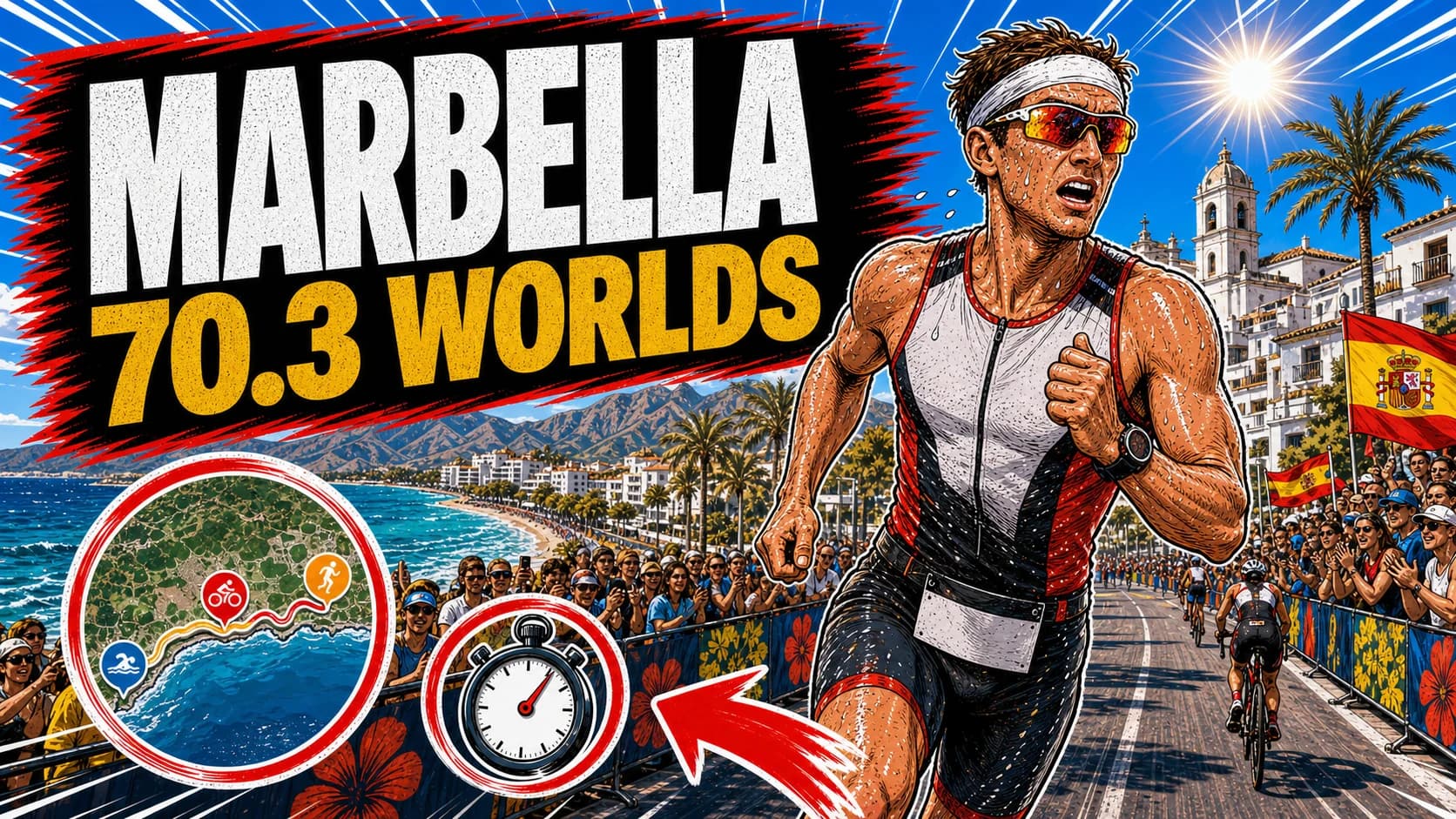
The Marbella 70.3 difficulty triangle: 16 °C sea forcing wetsuits + Sierra Bermeja rolling at km 60–80 + strong March sun on the closing promenade. As a qualifier-only race there are no weak rivals: even the deepest age groups bring elite times, and the day is decided by power management on the bike, not peak watts.
The IRONMAN 70.3 World Championship is the closing event of the global half-iron circuit: ~50 regional 70.3 races each year hand out age-group slots, and the qualifiers converge on a rotating venue. From its first edition in Clearwater, Florida (2006) the race has cycled through Las Vegas, Mont-Tremblant, Nelson Mandela Bay, Chattanooga, Nice, St. George, Lahti and Taupō. 2026 is the first time it has ever been held in Spain, after Marbella won the host bid in 2024.
Three traits separate it from a normal 70.3:
- 100% qualified field. Each athlete has earned a slot at a regional 70.3 within the previous 12 months. Outcome: finisher rate ~96%, almost no DNFs from underpreparation.
- Two-day format. Saturday women + Sunday men has been standard since 2017 — full media coverage of each category without overlap.
- Rotating venue. Marbella was chosen for its mild March climate, Costa del Sol tourism infrastructure and a bike script that mixes flat coast with a short but technical inland loop.
Note: 70.3 refers to the 70.3 miles that the three distances add up to (≈113.1 km). It's the exact half of a full IRONMAN (140.6 miles / 226 km).
Start at Bonita Beach / Playa de la Bajadilla, in central Marbella. Format: rolling start by cap colour, waves every 5 seconds based on declared target time. The course is a single-loop trapezoid marked with large yellow buoys every 250 m: 750 m parallel to the shore eastbound, turn, 400 m offshore, turn, 750 m back to the start chute.
Real Mediterranean conditions in March:
- Water temperature: 15–17 °C. Wetsuit mandatory — IRONMAN enforces it below 24.5 °C; below 16 °C the swim may be shortened or "long-sleeve full" wetsuits made compulsory.
- Swell: typically 0.3–0.8 m, mild unless an easterly Levante wind picks up. The bigger risk isn't waves but occasional jellyfish and face/hand cold in the first 200 m.
- Sighting: La Concha mountain to the north-east is visible from the water and serves as the natural reference point.
Out of T1 at Bonita Beach, west on the N-340 and the closed A-7 motorway. Course structure:
- Km 0–30: flat coastal Marbella → San Pedro Alcántara → Estepona. High average speed (38–42 km/h with packs). No drafting.
- Km 30–55: Estepona → Manilva → inland turn onto the MA-8300 and back roads heading into the Sierra Bermeja foothills. Here come 4–7% short ramps — no long climbs, just a steady drip of pitches that breaks rhythm.
- Km 55–80: inland loop with two ~3 km segments at average 5%. This is where the race breaks: if you spent in the coastal section, you lose 2–3 min per km versus split target.
- Km 80–90: technical descent back to Estepona and flat finish into T2 at Marbella centre.
Roads and traffic: A-7 fully closed during the race, secondary roads with rolling closures. Asphalt is generally good; watch for speed bumps in town sections (Estepona, San Pedro).
Two laps of 10.5 km along the Marbella seafront promenade, from T2 (centre) out to the Marbella Lighthouse and back, repeated. Flat: <50 m total elevation across the whole half-marathon. Surface is mostly tile and boardwalk (not asphalt) — slightly tougher on the joints but kinder on the calves.
Aid stations every ~2 km with water, sports drink (Maurten Drink Mix is the official partner), Maurten gels, fruit, Coca-Cola and sponges. Finish line on Avenida del Mar, the official IRONMAN arch facing the Salvador Dalí sculptures.
Where the half-marathon breaks: km 14–18. This is where overpacing the bike is paid back: if you rode above 75% FTP through the inland loop, here pace falls 30–45 s/km. Athletes who hit km 10 in 42 min walk into the finish at 1:35 — wondering what happened.
- 2006 — Clearwater, FL. First edition. Andy Potts (USA) and Samantha Warriner (NZL) open the record book.
- 2011 — Las Vegas, NV. First year out of Florida; brutal desert heat.
- 2014 — Mont-Tremblant, QC. First edition outside the US (Canada).
- 2018 — Nelson Mandela Bay, RSA. First African host.
- 2019 — Nice, FR. First time on continental Europe.
- 2022 — St. George, UT (women) + 2023 — Lahti, FIN (women) / Taupō, NZL (men). The two-day, two-venue format is consolidated.
- 2025 — Marbella confirmed. The IRONMAN Group announces Marbella as the 2026 host (the 21st edition).
- 2026 — Marbella, ESP. First time in Spain.
Course records: each venue has its own record. Historical 70.3 World Championship results are searchable on the official IRONMAN archive. Elite winning times typically range 3:35–3:55 (men) and 3:55–4:15 (women) depending on course profile.
- Regional 70.3 qualifier. Each year ~50 events allocate slots by age group. Your placing within your age group (not overall) determines whether you receive a slot. Slot count varies with field size (rule of thumb: "1 slot per ~75 athletes in the age group").
- Roll-down. If a qualified athlete declines, the slot rolls down to the next eligible.
- Legacy / Foundation slots. Small charity quota (~$1,500–2,500 USD donation to the IRONMAN Foundation).
- Pro qualification. PTO/IRONMAN Pro Series points system — outside age-group scope.
- Race entry: ~$695–795 USD (±$100 depending on payment window).
- Active assets: annual IRONMAN licence + qualifier-race verification.
- Real total cost (flights to AGP + 4 nights Marbella + bike transport): €2,200–3,500 from elsewhere in Europe.
- IRONMAN Athlete Village in central Marbella, Wednesday to Saturday before the race.
- Required documents: passport / ID + qualifier-race confirmation + national federation licence (USAT, BTF, FETRI…).
- Bike check-in: mandatory the day before the race (Saturday for men, Friday for women) between 10:00 and 16:00.
- Málaga Airport (AGP) — 60 km north-east. Main hub: direct flights from Madrid, Barcelona, London, Paris, Frankfurt, Zürich, Amsterdam. Rental car 45 min on the A-7. Direct Avanza bus AGP–Marbella ~€13 / 50 min.
- Gibraltar Airport (GIB) — 70 km south-east. Limited connections (London, Manchester) but useful from the UK.
- AVE Madrid–Málaga — 2 h 30 min to Málaga María Zambrano + 1 h transfer to Marbella.
- Driving from Madrid: A-4 + A-44 + A-7, ~5 h 30 min. From Barcelona: AP-7 along the Mediterranean, ~9 h.
Bike: airline transport runs €60–150 per leg depending on carrier. Iberia, Vueling and Ryanair are the most-used Spanish options. Book early — special-baggage capacity saturates in March.
Race-day parking: Marbella offers public parking at La Bajadilla, Plaza de la Patera and Avenida Ricardo Soriano. Arrive before 06:00 — central Marbella closes to traffic from 06:30.
The optimal pick if you want zero pre-race transfer headaches. Walk 5–10 min to the swim pier.
- Marbella Club Hotel (5*) — the city icon, beachfront. ~€450–700/night.
- Don Pepe Gran Meliá (5*) — seafront, Mediterranean views. ~€350–550/night.
- El Fuerte Marbella (4*) — classic, next to the old town. ~€180–280/night.
- H10 Andalucía Plaza (4*) — strong value. ~€140–220/night.
- AC Hotel Marbella (4*) — modern, on-site parking. ~€160–240/night.
Marina vibe, restaurants, easy by car. 12 min to the start.
- Hotel Puente Romano (5*) — one of the best on the Costa del Sol. ~€600–900/night.
- H10 Estepona Palace (4*) — slightly further west, balance price/quality. ~€150–230/night.
- Senator Banús Spa (4*) — well connected. ~€130–200/night.
Quieter, recommended if you bring family. 30 min by car to Marbella.
- Kempinski Hotel Bahía (5*) — beach, premium standard. ~€400–650/night.
- Elba Estepona Gran Hotel (4*) — all-inclusive option. ~€180–270/night.
- Iberostar Marbella Coral Beach (4*) — on the Marbella/Estepona border. ~€170–260/night.
Recommendation: if it's your first time on the Costa del Sol, prioritise Marbella centre — pre-race logistics (bike check-in, briefing, swim start) save you 60–90 min of driving every day.
- Air temperature: 14–22 °C during the day, 10–14 °C at dawn.
- Sea temperature: 15–17 °C — wetsuit mandatory.
- Rain probability: ~12% (March is one of the driest months on the Costa del Sol).
- Wind: occasional Levante 10–25 km/h; generally light in the morning, building on the bike from midday.
- Sun: UV 5–7 in March (medium-high). The midday 21.1 km run is aggressive for fair skin — sunscreen mandatory.
Kit per segment:
- Swim: long-sleeve wetsuit (5/3 mm), thermal cap optional under the official one.
- Bike: tri-suit + thin arm warmers until km 30, then suit only.
- Run: no arm warmers. Visor + sunglasses. Sunscreen before T2.
We assume an athlete who qualified the previous autumn, with a base of 2 half-iron finishes and confirmed cycling FTP.
- Weekly volume: 12–15 h.
- Focus: aerobic development — swim 3×/week (technique + 3,000–4,000 m), bike 4×/week (1 long ride 80–100 km in Z2), run 4×/week (1 long run 18–22 km).
- Strength: 2 sessions/week (squat, deadlift, pull-ups).
- Weekly volume: 14–18 h.
- Focus: intensity introduction — swim with CSS sets (400 m + 200 m tests), bike with sweet-spot blocks (88–94% FTP) on simulated Sierra Bermeja terrain (rolling rides), run with tempo and target-pace work.
- Key sessions: 70.3 simulation every 3 weeks (1 km swim + 60 km bike + 12 km run).
- Weekly volume: 15–20 h.
- Focus: course specificity — bike with rolling 80–90 km loops at 75% FTP, T2 brick sessions every 2 weeks, run on softer surface (board/tile) to mimic the seafront.
- Test: full 113.1 km (bike at 75% FTP + 21 km at target pace) 6 weeks out.
- Volume: -40% week 23, -60% week 24.
- Maintain frequency, cut duration. 2 short, sharp sessions to keep the engine awake.
- Travel: arrive in Marbella by Wednesday minimum. Day before: 30 min easy spin + 10 min run + 800 m swim with race kit.
| Punto | Tiempo acumulado | Parcial |
|---|---|---|
| 5 km | 14:35 | 14:35 |
| 10 km | 29:11 | 14:35 |
| 15 km | 43:46 | 14:35 |
| Media (21,1 km) | 1:01:33 | 17:47 |
| 30 km | 1:27:32 | 25:59 |
| Meta | 5:30:00 | 4:02:28 |
Splits asumen ritmo constante. En carreras con desnivel real (IRONMAN 70.3 World Championship Marbella) — banca 5–8 s/km en bajadas y pierde el mismo margen en subidas; el ritmo medio se mantiene.
Official distance: 113.1 km. The calculator estimates per-segment pacing assuming a balanced split (swim 5%, bike 55%, run 35%, transitions 5%).
- Swim: 26–28 min. Aggressive lead-pack start, sight every 6 strokes.
- T1: 3 min. Wetsuit off with stripper, aero helmet on.
- Bike: 2:25 at 75–82% FTP. No drafting — watch the 12 m rule.
- T2: 2 min. Quick shoe swap, cap, sunglasses.
- Run: 1:32 at 4:20–4:25/km. Controlled first 5 km, sustained to km 16, push to finish.
- Swim: 30–32 min. Comfortable CSS, avoid buoy contact.
- T1: 4 min.
- Bike: 2:40 at 70–75% FTP. Conserve in Sierra Bermeja, recover in descents.
- T2: 3 min.
- Run: 1:43 at 4:55/km. Open 5–10 s/km slower than goal, balance by km 8.
- Swim: 33–35 min.
- Bike: 2:55 at 68–72% FTP. Hold cadence 85–90 rpm on climbs.
- Run: 1:55 at 5:30/km. Take full aid stations.
- Swim: 36–40 min.
- Bike: 3:10 at 65% FTP.
- Run: 2:10 at 6:10/km. Walking 30 s through aid stations is legitimate.
- Plan: finish under the 8 h 30 cutoff. Conservative bike (60–65% FTP) and run-walk (4 min run, 1 min walk) if needed.
- Mindset: finishing the 70.3 World Championship is itself a career achievement.
Sierra Bermeja golden rule: in the inland loop km 60–80, keep power <75% FTP even if you drop 2 km/h below target speed. You'll recover on the descent and the first 8 km of the run. This is the #1 mistake of World Championship debutants.
- Pre-race (90 min before): 100 g carbs (oats + banana + honey) + 500 ml sports drink.
- Bike: 90 g/h carbs (Maurten 100 gel every 25 min + 500 ml/h Maurten Drink Mix). Sodium 700–900 mg/h.
- Run: 60–70 g/h. Maurten Caffeine gel at km 7 and 14. Coca-Cola at late aid stations.
- Total fluid target: 750 ml/h on the bike, 500 ml/h on the run.
Common trap: underestimating bike carbs "because it's not hot." Glycogen cost on 90 km at 75% FTP is similar to Kona — duration, not temperature, drives the burn. Train your gut at 90 g/h during the specific block, don't improvise on race day.
- Bike: TT/triathlon bike with aerobars. Wheel depth 60–80 mm is optimal (low crosswind). Cassette 11-30 for Sierra Bermeja.
- Helmet: aero-road style (Specialized Evade / Giro Aerohead).
- Wetsuit: 5/3 mm minimum (sea at 16 °C). Verify thickness per regulation — IRONMAN allows up to 5 mm.
- Bike shoes: BOA closure, thin socks optional.
- Run shoes: fast carbon-plate shoe (Nike Vaporfly, Adidas Adios Pro, Asics Metaspeed). Soft promenade surface forgives slightly.
- Visor + sunglasses: UV protection mandatory on the run from March radiation on the coast.
- Hydration: 2 aero bottles between aerobars + 1 behind saddle (BTA + behind-saddle).
- GPS: Garmin 1050 / Edge 1040 or Wahoo Bolt 3 with the official course GPX preloaded.
You need to finish in a slot position within your age group at one of ~50 regional IRONMAN 70.3s held between March 2025 and February 2026. Slot count by age group depends on field size ("1 slot per ~75 athletes" rule). If a qualified athlete declines, the slot rolls down to the next.
Base entry runs $695–795 USD depending on the payment window. Adding flights to Málaga, 4 nights of accommodation in Marbella, and bike transport, total cost from elsewhere in Europe usually lands at €2,200–3,500.
Between 15 and 17 °C in late March. Wetsuit mandatory (IRONMAN enforces below 24.5 °C). If the thermometer drops below 16 °C, the organisation may shorten the swim or require a "long-sleeve full" wetsuit.
Fast in absolute terms (flat run, no long climbs on the bike), but the Sierra Bermeja loop at km 60–80 breaks rhythm. Estimated elite winning times: 3:35–3:55 (men) / 3:55–4:15 (women).
Entry only opens after qualification — the same day of the qualifier 70.3, at the post-race roll-down desk. There is no public open registration.
Yes: central Marbella allows free pedestrian access. Elite zones and T1/T2 are restricted, but the rest of the promenade is fully accessible to spectators. Avenida del Mar (finish) is prime cheering territory.
Marbella has spas in many hotels (Marbella Club, Puente Romano, Don Pepe). We recommend 10 min cold immersion, next-day massage, and a 30 min sunrise walk. Schedule your return flight Tuesday — not the same Monday.
IRONMAN has a contingency protocol: if swell tops 1 m or there's an electrical storm, the swim can be shortened or replaced by a duathlon format. In 20 years of 70.3 World Championship history this has happened only twice.
| Race | Distance | Venue | Month | Character |
|---|---|---|---|---|
| IRONMAN 70.3 World Championship Marbella | 113.1 km | Spain | March | Qualified 70.3 Worlds, flat-rolling |
| IRONMAN World Championship Kona | 226 km | Hawaii | October | Full Worlds, heat + wind |
| Challenge Roth | 226 km | Germany | July | Iron-distance, fast, festival vibe |
| Embrunman | 230 km+ | France | August | Iron-distance extreme, Alpine |
| Norseman Xtreme | 226 km | Norway | August | Iron-distance extreme, fjords |
If you come from Kona 2025: Marbella is ~50% of the physiological stress (half the distance) but a similar competitive level since it's qualifier-only. If you come from a regional 70.3: it's a step up in race management, not in distance.
- IRONMAN 70.3 World Championship — official site
- Wikipedia — IRONMAN 70.3 World Championship
- Spanish Triathlon Federation
- Marbella Tourism — official guide
- 2026 70.3 qualifier calendar
- Event on SportPlan
- Spain triathlon calendar 2026
Last updated: 2026-05-08. Spotted a fact to revise? Drop me a line.
Keep planning
Use SportPlan to compare dates, save target events, and build a season that fits your weekends instead of another unstructured list.