
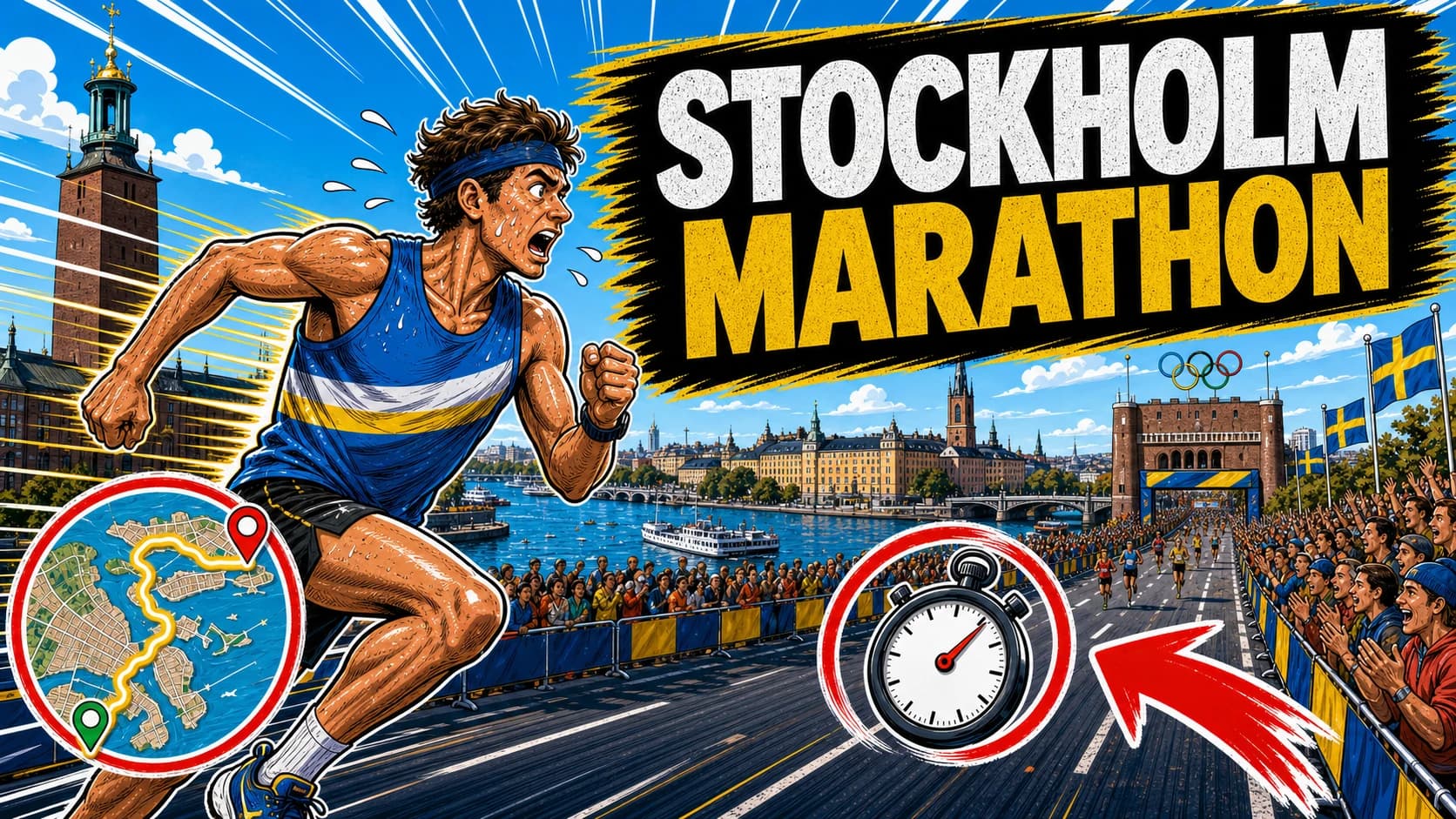
Stockholm Marathon 2027 Complete Guide — Scandinavia's Most Beautiful Marathon
Everything you need to run the 2027 Stockholm Marathon: 42.2 km hopping between the 14 islands of the "Venice of the North", real course breakdown, finishing on the original 1912 Olympic track at Stockholm Stadium,...
By Ramon Curto · Updated 2026-05-06
On Saturday, May 29, 2027 Stockholm hosts the oldest and biggest marathon in Scandinavia. Marathongruppen has run this race since 1979, combining the most beautiful course in the Nordic calendar — 42.2 km hopping between the 14 islands of the "Venice of the North" — with a finish that no other marathon on Earth can match: Stockholm Stadium, the 1912 Olympic track that's still active today, making this the only way to finish a marathon running on historic Olympic ground. This guide covers what the official site doesn't quite spell out: what the course really feels like between bridges and water, where the race breaks, how to manage Nordic midday sun, what realistic time to expect, and how to put the weekend together in an expensive, compact city.
📑 Table of contents
| Data | Info |
|---|---|
| Date | Saturday, May 29, 2027 |
| Distance | 42.195 km (marathon) |
| Elevation gain | ~80 m (relatively flat, with short bridges) |
| City | Stockholm (Sweden, sea level) |
| Start and finish | Stockholm Stadium (1912 Olympic stadium) |
| Start time | around midday (confirm with official communication) |
| Organiser | Marathongruppen |
| Registration | stockholmmarathon.se |
The Stockholm Marathon is the biggest marathon in Scandinavia and one of the oldest in Europe: it's been run since 1979 and pulls roughly 15,000 finishers in the main race. Marathongruppen organises it, and the race keeps a feature no other marathon worldwide has: it starts and finishes inside Stockholm Stadium, the Olympic stadium built for the 1912 Games — still operational, still with its track — turning the last 200 metres into a lap of the original Olympic track with packed grandstands.
Stockholm isn't a pure PB track, but it isn't a hill-grinder either. The course is relatively flat (only ~80 m total elevation gain) split across short bridge crossings — Slussen, Skeppsholmen, the bridges connecting the city's 14 islands. What costs you isn't the climb: it's the Nordic midday sun (start time is mid-day, not first thing) and the subtle monotony of running long between canals with a similar visual profile for hours. Most runners reach km 30 with legs left but a head already tired of so many bridges.
- If you've recently run sub-3:30 in another marathon: target 3:30–3:35 here. Terrain is forgiving; the sun factor and late start cost you 2–5 minutes.
- If you come from half marathons but have never done 42K: Stockholm is a reasonable first marathon if you go in without a time goal. Finishing at the Stadium makes the experience unforgettable.
- If you want your first marathon with a unique stage: yes, yes and yes. Medieval postcard at Gamla Stan km 8, green island Djurgården km 25, Olympic track km 42. No other European marathon offers this visual menu.
- If you're chasing a pure PB: go to Berlin, Valencia or Seville. Stockholm isn't the track for your fastest time of the year.
- If you're training for Boston, NYC, Berlin: use it as a test 4 months out — the combination of flat, relative cool and an iconic finish teaches you to manage afternoon racing.
See other marathons in Europe →
The Stockholm Marathon course is a single 42.195 km loop through the heart of the "Venice of the North" with ~80 m elevation gain. It starts at Stockholm Stadium, drops down Strandvägen (the city's most expensive street), crosses Norrmalm, passes through Gamla Stan (the medieval old town), jumps to Skeppsholmen, loops through several islands, runs across Djurgården (the green museum island), comes back via Östermalm and finishes inside Stockholm Stadium with a lap on the Olympic track.
The start is at Stockholm Stadium, in front of the red-brick facade of the 1912 Olympic stadium — an art nouveau design by Torben Grut that, 115 years on, is still the oldest Olympic stadium in the world still operating. The first kilometres drop down Strandvägen, the tree-lined waterfront boulevard with Stockholm's priciest addresses, looking out over yachts moored along the quay. From there the course crosses into Norrmalm (the commercial and administrative centre), turns south and hits Gamla Stan at km 8: medieval city, cobbled alleys, ochre facades and the silhouette of the Royal Palace in the background. It's the postcard of the course.
The route then jumps onto Slussen bridge and enters Skeppsholmen, a small central island with military museums. From there the course loops through several islands — Stockholm's geography, with 14 islands connected by bridges, means runners change visual frame every 3–5 km — and reaches Djurgården around km 25: the city's "green island", a huge urban park with museums (Vasa, ABBA, Skansen), low forests and a countryside feel even though you're 2 km from downtown. The return is via Östermalm, the elegant northern district, with its cafés, shops and the "rich Stockholm" vibe runners already know from Strandvägen.
The last 500 metres are the entry into Stockholm Stadium through the south tunnel, one full lap of the original Olympic track (400 m exactly) and the finish line under the wooden grandstands of 1912. It's the only marathon in the world that finishes on an active historic Olympic track.
Asphalt is the dominant surface (with short cobble sections in Gamla Stan). Water and sports drink stations come roughly every 5 km, with solid aid stations (gels, fruit, banana) at km 21.1 and km 32. Crowd density peaks on Strandvägen, Gamla Stan and the Stadium entrance — thinner on the bridges and central islands, where you'll run kilometres with little outside support.
Forget the "it's flat, it flies" myth: Stockholm climbs little but the profile is deceiving. The bridge crossings are short ramps (300–500 m) at 3–5% gradient that show up 6–8 times along the course — Slussen, Skeppsholmen, the bridges to Djurgården, the crossings into Östermalm. They won't break you, but they fragment your rhythm and, added up, cost you 1–2 minutes versus a truly flat marathon like Berlin.
🚨 Where the race breaks
Course data for Strava / Garmin: Marathongruppen publishes the official GPX a few weeks before race day on their site. To recce the final segment from Östermalm into the Stadium, search Strava for "Stockholm Stadium last km" — same profile you'll suffer on race day, including the tunnel entry into the stadium.
The Stockholm Marathon has been run since 1979, making it one of the oldest marathons in Europe and, without question, the oldest in the Nordic countries. Marathongruppen has organised it from the very first edition, and the race keeps a unique feature: it starts and finishes inside Stockholm Stadium, the 1912 Olympic track that's still operational — the stadium where Hannes Kolehmainen won the 5,000 m and 10,000 m, where modern multi-discipline athletics was inaugurated, and where, 47 years later, amateur marathoners close out their 42.2 km every last Saturday of May.
Roll of honour and race data (recent editions):
| Data | Value |
|---|---|
| First edition | 1979 |
| Editions held | ~46 (as of 2026) |
| Current distances | Marathon · 10K · shorter races on the same weekend |
| Marathon finishers (recent editions) | ~15,000 |
| Men's course record | 2:10:10 (Nigussie Sahlesilassie, ETH, 2019) |
| Women's course record | 2:28:24 (Grete Waitz, NOR, 1988) |
| Finish | Stockholm Stadium (1912 Olympic track) |
Verified winners and times for the 5 most recent editions (source: Stockholm Marathon — Wikipedia EN):
| Year | 🥇 Men | Country | Time | 🥇 Women | Country | Time |
|---|---|---|---|---|---|---|
| 2025 | Onemus Kiplagat Kiplimo | 🇰🇪 KEN | 2:11:34 | Shewarge Alene | 🇪🇹 ETH | 2:30:38 |
| 2024 | Fredrick Kibii | 🇰🇪 KEN | 2:14:17 | Marion Kibor | 🇰🇪 KEN | 2:31:46 |
| 2023 | Ashenafi Moges | 🇪🇹 ETH | 2:10:32 | Sifan Melaku | 🇪🇹 ETH | 2:30:44 |
| 2022 | Felix Kirwa | 🇰🇪 KEN | 2:11:08 | Tsige Haileslase | 🇪🇹 ETH | 2:31:48 |
| 2021 | Fikadu Teferi | 🇪🇹 ETH | 2:12:23 | Atalel Anmut | 🇪🇹 ETH | 2:29:03 |
Data verified against the public archive at Stockholm Marathon (Wikipedia EN).
Registration for the Stockholm Marathon 2027 opens late autumn 2026 (typically October–November) on a first-come-first-served basis: no lottery, just buy a bib until the ~15,000-spot cap is gone. The race sells slowly — most recent editions stayed open for months — but anyone leaving it until April of race year either misses out or pays the top price.
Reference from the 2026 edition at close:
- Marathon: sold out (closed in April).
- 10K: last spots through May.
- Weekend short races: closed by late April.
Thinking Stockholm always has last-minute bibs is a mistake: although sales are slower than London or Berlin, the 15,000 cap fills up between February and April of race year.
Stockholm Marathon uses a tiered pricing system in SEK (Swedish krona) — the bib price climbs as deadlines approach. If you can afford it and you know you're racing, register in the first tier: savings versus the last spots are 600–800 SEK (~€55–75) per bib in the marathon.
| Tier | Approx. open | Approx. close | Marathon (SEK) | Marathon (~EUR) | 10K (SEK) | 10K (~EUR) |
|---|---|---|---|---|---|---|
| 🟢 Early-bird | Oct 2026 | Dec 2026 | 2,500–2,700 | €220–235 | 500–600 | €45–55 |
| 🟡 Standard | Jan 2027 | Apr 2027 | 2,900–3,200 | €255–285 | 650–750 | €60–70 |
| 🔴 Last spots | May 2027 | until close | 3,300–3,500 | €290–320 | 800–900 | €75–85 |
Indicative SEK prices based on the 2026 edition structure. Always confirm on the official registration page. The mid-2026 SEK/EUR rate sits around 11.5 SEK per euro; use the day's rate for actual conversion.
| Included in the price | NOT included (optional extra) |
|---|---|
| ✅ Bib with timing chip | ❌ High-resolution professional photos (~250 SEK) |
| ✅ Official technical shirt | ❌ Friday pasta party (sometimes extra) |
| ✅ Finisher medal | ❌ Premium bag drop service |
| ✅ Aid stations on course | ❌ Cancellation insurance (recommended: international flight) |
| ✅ Post-finish bag inside the Stadium | |
| ✅ Digital diploma with certified time | |
| ✅ Stadium access for supporters (designated area) |
Things to factor in beyond the bib price:
- Refund policy: terms typically allow a partial refund with a medical certificate before April 30, 2027, minus an admin fee. Registrations are non-transferable to another edition or another race; in some cases there's an internal resale market.
- Total event cancellation: registration carries over to the next edition; no money is refunded.
- Travel insurance: strongly recommended if you're coming from outside the EU — Stockholm in May is an expensive destination and direct flights aren't refundable.
Bib pickup happens at the race expo, normally held the two days before the race (Thursday and Friday) at a complex near Stockholm Stadium. No bibs are handed out on race day: you must collect in person before the expo closes on Friday, historically around 19:00.
You'll need:
- Your registration confirmation (printed or on your phone)
- A valid photo ID (passport if coming from outside the EU)
Family or friends can pick up for you with a signed authorisation and a copy of your ID. The race kit normally includes the official technical shirt, the bib with chip, a bag tag and a course map. Finisher medals are handed out inside the Stadium after you cross the line.
The most practical way to reach Stockholm from Spain is a direct flight to Arlanda (ARN) from Madrid or Barcelona (3.5–4 hours). Once in town, start and finish are at Stockholm Stadium, next to Stadion station (red Tunnelbana line). Stockholm's metro network is dense and efficient, distances downtown are short, and forget the car: the centre is closed for the race and parking inside the ring is prohibitively expensive.
- Arlanda (ARN) — the big one. 40 km north of downtown. Direct flights from Madrid (Iberia, SAS, Norwegian) and Barcelona (Vueling, SAS). City connection: Arlanda Express (fast train, 20 minutes to Stockholm Central, ~320 SEK / €28) or bus 583 + Tunnelbana (cheaper, ~60 minutes, ~90 SEK / €8).
- Bromma (BMA) — the small one. Just 8 km from downtown. Some European flights (typically not direct from Spain). If you connect via Copenhagen or Helsinki you might land at BMA. Bus to centre: 15 minutes.
- Skavsta (NYO) — Ryanair. 100 km south of Stockholm. Avoid if you can: the bus to downtown takes 1h20 and "low-cost" pricing is offset by lost time.
- Red line (T13/T14) — the key line. Connects T-Centralen (central station) with Stadion station, 200 metres from the marathon start and finish. 4 minutes by metro from downtown.
- Green line (T17/T18/T19) — useful for Östermalm and the north. Transfer at T-Centralen.
- Blue line (T10/T11) — for the south (Norrmalm towards Skeppsholmen). Useful if you stay further south.
- Transit pass (SL Access): 24 h costs ~165 SEK (€15) and gives unlimited access to metro, bus and urban rail. Recommended for the weekend.
The start is at midday (approximate — confirm with the organisers), not first thing in the morning. This is very different from most European marathons: you have the whole morning to have breakfast, warm up and arrive relaxed. Plan to be in your corral 45–60 minutes before the gun. The marathon goes off in waves from the Stadium.
Driving in is not recommended. Downtown is closed from early morning until late afternoon, and central Stockholm parking costs 60–80 SEK per hour (€5–7). If you're driving from outside, park near a Tunnelbana station on the outskirts (Bromma, Sundbyberg) and ride in.
For a marathoner, staying within 15 minutes' walk of the start/finish isn't luxury: it's logistics. Stockholm is an expensive city — the average hotel in May runs 1,500–2,500 SEK (€135–225) a night — and the difference between sleeping well with an early breakfast and walking 8 minutes to the Stadium versus catching the metro at 11:00 with two transfers can cost you 1–2 minutes on the clock and twice that in mental stress.
- Breakfast before 9:30 a.m. (or grab-bag the night before). Eating 2:30–3 h before the gun is key; the midday start gives you flexibility but demands planning.
- Late check-out until 16:00–17:00. You finish the marathon between 14:30 and 17:00 depending on goal — you need margin for shower, food, rest.
- Bathtub for ice baths / contrast post-race. More useful after 42K than after a half. Filter on Booking ("bath with bathtub") — not all modern hotels have one.
- Air conditioning or ventilation. May isn't very hot, but a good ventilation system helps recovery on Saturday afternoon.
- Quiet room. Saturday night in Östermalm is calm; in Norrmalm it can be noisy with bars.
- Real distance in metres, not advertising minutes. <1,000 m: you walk easy. 1,000–2,000 m: Tunnelbana or a long walk. >2,000 m: pass.
- Distance to start/finish: 0.5–1.5 km on foot (6–18 min). The most comfortable option for Sunday at 11:00 a.m.
- Pros: unbeatable logistics. Restaurants, cafés, technical stores (Stadium store at Hötorget is nearby). Elegant, quiet neighbourhood.
- Cons: expensive. Östermalm hotels sit at the high end of the market.
| Hotel | Cat. | SEK/night* | To start | Runner highlight |
|---|---|---|---|---|
| Hotel Diplomat | 5* | 2,800–4,200 | 1.2 km · 15 min | Bathtub, AC, Strandvägen views |
| Lydmar Hotel | 5* boutique | 3,200–4,800 | 1.5 km · 18 min | Large bathtub, late check-out negotiable |
| Scandic Park | 4* | 1,700–2,500 | 1.0 km · 12 min | Near the Stadium, mid-high range |
| Elite Hotel Marina Tower | 4* | 1,500–2,200 | 1.5 km · 18 min | Spa, cold plunges for recovery |
| Hotel Birger Jarl | 4* | 1,400–2,100 | 1.3 km · 16 min | Scandinavian design, early breakfast |
- Distance to start: 1.5–2.5 km on foot (18–28 min) or 1–2 Tunnelbana stops.
- Pros: everything at hand, varied dining, direct connection to Arlanda Express at T-Centralen.
- Cons: Saturday night can be noisy with bars; transport mandatory on Sunday.
| Hotel | Cat. | SEK/night* | To start | Runner highlight |
|---|---|---|---|---|
| Grand Hôtel Stockholm | 5* | 4,500–7,000 | 2.2 km · 25 min | Historic luxury, bathtub, late check-out |
| Scandic Anglais | 4* | 1,600–2,400 | 1.8 km · 22 min | Well connected, mid-range |
| Berns Hotel | 4* boutique | 2,200–3,200 | 2.0 km · 25 min | Design, 24h restaurant for post-race |
| Story Hotel Riddargatan | 4* | 1,700–2,500 | 1.5 km · 18 min | Boutique, young vibe |
| Nobis Hotel | 5* boutique | 3,500–5,000 | 2.3 km · 27 min | Top Scandinavian design, bathtub |
- Distance to start: 2.5–3.5 km on foot (30–42 min) or 2 Tunnelbana stops.
- Pros: sleeping in the medieval centre, postcard every morning, charming restaurants. The marathon route passes here at km 8 — perfect for your supporter to spot you.
- Cons: transport mandatory for the start; cobbled streets that punish legs on Friday/Saturday pre-race.
| Hotel | Cat. | SEK/night* | To start | Runner highlight |
|---|---|---|---|---|
| Hotel Skeppsholmen | 4* | 2,000–3,000 | 3.0 km · 35 min | Historic building, quiet island |
| Hotel Reisen | 5* | 3,200–4,500 | 2.8 km · 33 min | Waterfront, bathtub, spa |
| Royal Vasa | 4* | 1,900–2,700 | 3.2 km · 38 min | Views over Gamla Stan |
| Lord Nelson Hotel | 3* | 1,400–1,900 | 3.0 km · 35 min | Medieval location, mid-range |
| Victory Hotel | 4* boutique | 2,100–3,000 | 3.1 km · 36 min | 17th-century building, charming |
*Indicative weekend rate for the last Saturday of May. Varies by booking lead time, availability and current promotions. Approximate exchange 11.5 SEK / EUR.
Stockholm weather in late May averages 9 °C low and 19 °C high, with sunny or partly sunny conditions around 65% of the days, according to historical data from SMHI (the Swedish weather service). Rain shows up in roughly one in four editions (brief showers more than a downpour), but the factor that matters most for the marathon is the almost-midnight light: in May the sun rises at 4 a.m. and sets at 11 p.m. — 19 hours of daylight a day — and the midday sun hits harder than the air temperature suggests.
The variable to watch is the midday sun. Stockholm Marathon's start time is mid-day, not first thing — this is unusual for a European marathon. It helps because you eat breakfast calmly and sleep well the night before, but it punishes you because you race under peak Nordic sun (latitude 59° N + 50–55° solar angle at midday + reflection off canal water = more radiation than you'd expect for 18–20 °C).
Plan by forecast:
- <14 °C high: "European standard" marathon in fresh conditions, no extra heat stress. Most personal Stockholm PBs happen here.
- 14–20 °C: optimal conditions with an asterisk — the Nordic sun still costs you even at moderate temps. Bring a cap/visor and sunglasses.
- 20–24 °C: watch the pace from km 1. Dehydration arrives at km 25, not km 35. Drink at every aid station and use electrolyte salts every 45 min.
- >24 °C: unusual but not impossible. Drop your goal pace 5–10 seconds per km. Carry your own hydration bottle if you're going more than 4 h.
Bring your own water if you're running slow (>4h30) and the forecast tops 22 °C — on-course aid is enough but the central islands have lower density of points. Stockholm's wind in May is usually light (10–15 km/h) but bridge crossings expose you to stronger gusts than the rest of the route — not a critical factor, but bear in mind that bridges can be 2–3 degrees colder.
The recommended plan for Stockholm Marathon is a 16-week block with peak volume in weeks 11–13 (between 50 km and 130+ km per week depending on goal), one weekly long run and a three-week taper. The key for Stockholm: train to hold pace on long flat sections (the islands section is visually repetitive) and at least two long runs in heat or direct sun to acclimate to the unique midday-start pattern.
Approach Stockholm as a relatively flat marathon with a thermal asterisk, not a hilly marathon. Pick your goal and use the table — peak volumes (weeks 11–13), not whole-cycle averages.
| Goal | Average pace | Peak weekly vol. | Peak long run |
|---|---|---|---|
| 5h00 | 7:06 min/km | 35–45 km | 25–28 km |
| 4h30 | 6:24 min/km | 45–55 km | 28–30 km |
| 4h00 | 5:41 min/km | 55–70 km | 30–32 km |
| 3h30 | 4:58 min/km | 70–85 km | 32–35 km |
| 3h00 | 4:16 min/km | 90–110 km | 32–36 km |
| ≤2h45 | 3:54 min/km | 110–130+ km | 32–38 km |
How to read the table and structure the cycle:
- These are peak volumes (weeks 11–13). The 16-week block average is roughly 65% of the row you pick.
- One long run per week, no more. It's the session that builds the most aerobic fitness. The two final peak long runs (weeks 11 and 12) are 32–36 km.
- The rest of the volume is easy conversational running.
- Standard split: 80% easy / 20% hard, measured in total time.
- One quality session per week is enough up to a 4h00 goal; from there, two.
Three sessions worth gold for Stockholm:
- Long flat tempo (weeks 4–10). 10–15 km at goal pace on the flattest terrain you can find (cycle path along a river, park). Learn to hold pace when the scene is repetitive — key for the bridges and the central islands.
- Midday / sun long run (weeks 8–13). At least 2 of your block's long runs should be done at 12:00–14:00 in direct sun. Stockholm is the only big European marathon that starts at midday: your body needs to learn to eat, drink and run at that hour.
- Bridge crossings: 3–5% gradient reps (weeks 6–13). 8–12 × 400 m at moderate-strong pace. Get used to "popping" short ramps without trashing your average pace — exactly what you'll do 6–8 times in Stockholm.
The taper is three weeks, not two. Week 14 at 80%, week 15 at 60%, week 16 at 40% holding race pace in short pickups. The two final long runs (in weeks 11 and 12) load the cup.
Don't know what realistic time goal you have for Stockholm? Cross your best recent half marathon with the "Stockholm" factor (which adjusts for the relatively flat terrain and midday sun):
| Your best recent half | Flat equivalent (marathon) | Realistic Stockholm |
|---|---|---|
| 1:25 | sub-3:00 flat | 3:00–3:05 |
| 1:35 | sub-3:20 flat | 3:20–3:28 |
| 1:45 | sub-3:42 flat | 3:42–3:52 |
| 1:55 | sub-4:05 flat | 4:05–4:15 |
| 2:05 | sub-4:25 flat | 4:25–4:38 |
| 2:15 | sub-4:48 flat | 4:48–5:00 |
How to read it: the "flat" column is the unadjusted Riegel conversion (your half × ~2.11). Stockholm loses an extra 1–3% to the midday sun and the bridges — that gives you the realistic range. If you've done midday long runs and hydrated well in training, aim for the low end. If your last hour falls apart in the sun, the high end.
Find another marathon near you →
Once you have your goal time, this calculator gives you the required average pace (in min/km and min/mi) and cumulative splits at 5K, 10K, 15K, half marathon, 30K and finish. Change the goal time in the field below and the table updates instantly:
| Punto | Tiempo acumulado | Parcial |
|---|---|---|
| 5 km | 24:53 | 24:53 |
| 10 km | 49:46 | 24:53 |
| 15 km | 1:14:39 | 24:53 |
| Media (21,1 km) | 1:45:00 | 30:21 |
| 30 km | 2:29:18 | 44:18 |
| Meta | 3:30:00 | 1:00:42 |
Los parciales suponen un ritmo constante y no incluyen paradas. En Stockholm Marathon, adapta el esfuerzo al terreno y a las condiciones; no fuerces las bajadas para recuperar segundos.
The calculator above gives you the pace. But a real race plan answers more questions: what strategy do I open with? How many gels do I carry? When do I take caffeine? What do I do at km 21 if I'm 30 seconds over goal? What if the midday sun hits harder than forecast?
Set your goal, strategy and aid plan. The planner generates a personalised plan by segment (with paces, HR zones, mental cues and minute-by-minute aid), a race-morning checklist and a Plan B for the unexpected. Download as PDF to take race day.
- 📊 Ritmo por tramo con FC y cues mentales
- ⏱️ Avituallamiento minuto a minuto (24 eventos)
- ✅ Checklist de la mañana de carrera
- 🆘 Plan B para los imprevistos
PDF A4, optimizado para imprimir y llevar el día de carrera.
You're at the corral. You've done the 16-week plan. What separates good training from a good time is what you do over the next 4–5 hours — and in Stockholm, what you do the morning before the midday gun.
The Stockholm race plan should combine conservative, sun-aware pacing in km 1–10, goal pace between km 10–25 (the islands section, where the head matters more than the legs), and push or hold from km 25 to 42 depending on how you arrive at the turn back to Östermalm. Each goal time (sub-2:45 to finish) has a specific split pattern.
| Goal | Target splits | Stockholm-specific tactical note |
|---|---|---|
| sub-2:45 | 3:54 min/km | Hold pace on the bridge crossings (don't accelerate). Bank 3–5 s/km on the fresh start down Strandvägen. Push final entering the Stadium (the last 400 m on track reward you). |
| sub-3:00 | 4:16 min/km | Cross half at 1:30:30. Hold pace through the islands section (km 15–25); this is where plans break from mental monotony. |
| sub-3:30 | 4:58 min/km | No rush km 1–8 (sun hits less in the morning). Cross half at 1:45:30. Walk 15 s at every aid station. |
| sub-4:00 | 5:41 min/km | Classic mistake: opening at 5:30 enjoying Strandvägen. Hold 5:45 the first 10 km. Walk 20 s at every aid station. |
| sub-4:30 | 6:24 min/km | Very even splits: 6:20–6:30 throughout. Walk-run from km 30 if needed. |
| sub-5:00 | 7:06 min/km | Plan B walk-run from km 1: 8 run / 1 walk. Gives you margin to enter the Stadium with legs. |
| Finish | 7:00–7:30 | No watch. Enjoy Gamla Stan at km 8, Djurgården at km 25 and the Stadium entry at km 42. |
- Wake up: 3.5 hours before the gun (08:30 if start is at midday). Watch out: a late start tempts you to relax too much — keep the routine like an early start.
- Breakfast: 3 h before the gun. What you tested in long runs, no experiments. 80–100 g of carbs. If you've never run at midday, simulate the routine at least twice before the marathon.
- Mid-morning meal: 90 min before a light snack (banana + small bar, ~30 g extra carbs). This is different from a morning marathon: with a midday start you need two carb loads.
- Hotel exit: 75–90 minutes before. Stadion (Tunnelbana) is 4 minutes from T-Centralen.
- Warm-up: light. 5–10 min jog + 4 × 50 m strides. If you're going faster than sub-3:30, add 10 minutes extra.
- Corral: enter 45–60 minutes before the gun. The marathon goes off in waves from the Stadium.
- Km 1–10 (conservative, grateful): start out of the Stadium, drop down Strandvägen along the water. It's the prettiest and freshest stretch — the temptation to push is real. Allow yourself 3–5 seconds per km, no more. If your watch reads 3:50/km at 5 km and you're going for sub-2:45, that's already too fast.
- Km 10–25 (cruise through the islands): goal pace at a heart rate you can hold while talking in short sentences. Drink at every aid station, gel at your cadence. The Skeppsholmen section and the island loops (km 15–22) are the most isolated and visually repetitive zone — use the head, not the ego.
- Km 25–32 (push or hold — Djurgården and return): the key segment. If you reach km 30 with legs, hold pace on the return towards Östermalm. If you arrive on the edge, hold the effort. The midday sun hits harder at this hour — hydrate even if you're not thirsty.
- Km 32–42 (resist or close): the last 10 km are rolling with residual bridge crossings. If you arrive with energy, splits hold. If you arrive empty, you'll lose 30–60 seconds per km in the last 5 km. Paint it all on the Stadium entry: the last 400 m are a lap of an Olympic track with grandstands — no other marathon ends like this.
- Km 5: drink even if you're not thirsty. The most underrated aid station — especially with a midday start.
- Km 21.1 (gels): carry your own, don't rely solely on the organisers.
- Km 30: the critical aid station. If you're struggling, walk 30 seconds and rehydrate; you lose less than collapsing at km 35 in the sun.
- Km 35–40: the last ones. If you have glycogen, skip. If not, drink + a fast gel.
This is where the marathon is decided. In Stockholm there are three specific anchors:
- Name the next three points: km 35, km 40, the Stadium tunnel. As long as you have a next point, you keep going. The last anchor — the tunnel — is physically recognisable.
- Count down kilometres from km 35: "seven km, six km, last 5K". The brain accepts small numbers better than big distances.
- Foot rhythm, not watch rhythm: hold your cadence (170–185 spm). The watch can lie between buildings; cadence won't.
Stockholm-specific mental bonus: the last 400 metres are a lap of the 1912 Olympic track. It's literally the only marathon worldwide that finishes on an active historic Olympic track. When you enter the Stadium's south tunnel, know you're closing the most photogenic marathon in Europe. That's worth 30 extra seconds in anyone's legs.
- Don't stop. Keep walking 10–15 minutes. Stopping cold is the recipe for dizziness + cramps.
- Hydrate before eating. Sports drink + water in the first 10 minutes.
- Mylar blanket: use it. Body temperature drops fast after a marathon, especially with the Nordic afternoon breeze.
- Very light stretching: hamstrings, calves, quads. 30 seconds each, no bouncing. Better to walk easy than stretch hard.
- Stop your watch when you cross the finishers' zone (inside the Stadium), not before. Your official time is by chip.
Save this event in SportPlan →
The nutrition strategy for a marathon pivots on 60–100 g of carbs per hour by goal, with 5–8 gels spread every 25–30 minutes from km 8. Carb loading over the previous 3 days should run 8–10 g/kg/day, and Friday dinner should be light and familiar — forget the smörgåsbord and the pickled herring the night before, however tempting: the digestive system isn't there for experiments. Extra sodium if the forecast tops 20 °C.
Friday dinner is light, familiar and early (eat before 21:00). Pasta with grilled salmon is the local option that works best — lean protein, slow carb, easy to digest. Zero pickled herring, zero gravlax, zero smörgåsbord the night before; save them for Sunday's celebration. If your hotel offers a Scandinavian breakfast, you can sample it Saturday morning (cheese, deli, whole-grain bread, fruit) — but not the night before.
Race-morning breakfast depends on whether you wake up hungry. The safe bet: toast with honey/jam + banana + coffee (if you drink it regularly). 80–100 g of carbs, eaten 3 hours before the gun (i.e. around 09:00 if start is at midday). The mid-morning snack at 90 min (banana + small bar, ~30 g) is what separates Stockholm from a marathon with an early start — the late start demands a second carb point.
What Marathongruppen puts on course:
- Liquid aid stations every ~5 km (km 5, 10, 15, 20, 25, 30, 35, 40). Water and sports drink.
- Solid aid stations at km 21.1 and km 32 — gels, banana, bars.
- Cold-water sponges at least at one point if the forecast is warm.
- Solid aid at the finish inside the Stadium: fruit, bars, sports drink, water, mylar blanket.
Carb plan by goal:
| Goal | Carbs / hour | Gels to carry | When to take them |
|---|---|---|---|
| 5h00 | 30–45 g/h | 3–4 gels | km 8, km 18, km 28, km 36 |
| 4h00 | 45–60 g/h | 5 gels | km 8, km 16, km 22, km 30, km 36 |
| 3h30 | 60–75 g/h | 6 gels | km 6, km 12, km 18, km 24, km 30, km 36 |
| 3h00 | 75–90 g/h | 7 gels + flask | km 5, every 5 km until km 35 |
| ≤2h45 | 90–100 g/h | 8 gels + flask | km 4, every 4–5 km |
Three mistakes you see every year at Stockholm Marathon:
- Trying new gels on race day. Carbs are tested on at least 3 prior long runs; gut dysbiosis arrives at km 30, not km 5.
- Skipping the km 5 aid station because "it's not hot yet". Stockholm can start at 12 °C and rise to 22 °C in four hours, with the sun hitting from the zenith. Drinking early avoids the km 25–32 funnel.
- Relying only on solid aid at km 21 and 32. That's two points in 42 km. Carry your own: 5 gels for sub-4h, 7 for sub-3h.
Hydration and sodium by forecast:
- Cold (<14 °C high): water + sports drink at aid stations every 5 km. Optional extra sodium from km 25.
- Mild (14–20 °C): sports drink at every aid station. Electrolyte salts every hour from km 15.
- Hot (>20 °C): electrolyte salts every 45 minutes. Carry a 250 ml handheld bottle if you're going more than 4h and the forecast is over 24 °C. Critical with a midday start: the thermal peak hits exactly at your km 25–35.
Post-finish recovery — the first hour matters more than in a half:
- First 5 minutes: sports drink at the finish + water inside the Stadium.
- 0–30 minutes: mylar blanket + easy walk + second sports drink.
- 30–60 minutes: real food with protein + carbs. Aim for 30 g protein and 80 g carbs in this window.
- 2–4 hours later: full normal meal. This is when the smörgåsbord and the celebration beer come in.
The best shoes for Stockholm Marathon are carbon-plate race for sub-3:30, carbon-plate or super-trainer between 3:30–4:00 (Saucony Endorphin Speed, Hoka Mach X), and a protective daily trainer for over 4:00 (Nike Pegasus, ASICS Cumulus, Brooks Ghost). What's critical isn't the brand but that they're already broken in and not over 250–350 km of use. Stockholm's relatively flat terrain lets you go more aggressive than on a hilly marathon like Madrid.
Unlike Madrid or Boston, in Stockholm muscular endurance matters less than in a hilly marathon — but the bridge crossings and the midday start still demand a shoe with good protection. An ultralight carbon plate works very well here; daily trainers are reasonable from 4h.
Recommendations by goal:
| Goal | Category | Common models |
|---|---|---|
| ≤2h45 | Light "race" carbon plate | Nike Alphafly 3 · adidas Adios Pro Evo · ASICS Metaspeed Sky · Saucony Endorphin Elite |
| 2h45–3h30 | "Race" carbon plate | Nike Vaporfly 4 · adidas Adios Pro 4 · ASICS Metaspeed Sky · Saucony Endorphin Pro |
| 3h30–4h00 | Carbon plate or super-trainer | Saucony Endorphin Speed · Hoka Mach X · Puma Deviate Nitro Elite · ASICS Magic Speed |
| 4h00+ | Protective daily trainer | Nike Pegasus · ASICS Cumulus / Nimbus · Brooks Ghost · Hoka Clifton |
Look at this before leaving home:
- Mileage on your shoes. A carbon plate loses return after 250–350 km. If you used them for your March half and have done long runs in them, they arrive at Stockholm cooked.
- Drop and footstrike style. Don't drop below your usual drop "to gain 30 seconds" — the soleus and Achilles will charge you from km 25 onwards.
- Tested in at least two long runs of >25 km. Debuting shoes on a marathon is an expensive mistake.
- Traction for the bridges. If it rains race morning (1 in 4 editions), bridges can have slippery patches. A shoe with good grip wins over the pure ultralight.
- Singlet: technical singlet if forecast >18 °C, normal short sleeve if 12–18 °C. Materials: polyester or fine merino, never cotton.
- Throwaway layer (key in Stockholm): an old shirt for the 60 minutes before the gun. Stockholm morning can be 8–12 °C — you need something on top until the corral.
- Bottoms: 5–7" shorts with gel pockets. 3/4 tights if start is <10 °C.
- Socks: thin technical, no toe seams, already tested in at least 5 long runs. Cotton socks are the source of half of all blisters.
- Sports bra: high support, already tested on a long run.
- Anti-chafing: Vaseline or BodyGlide on nipples, armpits, groin, sports-bra zone. More marathoners finish with bloody nipples than with cramps.
- GPS watch with >5 h battery. Models with barometric altimeter (Garmin Forerunner 265+, Coros Apex, Apple Watch Ultra) are useful to confirm real elevation.
- Pin goal pace + total time on the main screen. GPS distance can come out +1–2% in central Stockholm (between buildings and water, the signal sometimes bounces).
- Hydration belt / vest: strongly recommended for marathon if you're going more than 4 h or forecast tops 22 °C. Especially with a midday start.
- Phone: optional. If you carry it, in an arm sleeve or belt pocket.
- Sunglasses: yes, almost always. Nordic May sun at midday is intense; reflection off canal water amplifies it.
- Cap or visor: strongly recommended — the midday start means the sun beats on your head for 4 hours straight.
- Throwaway layer: an old shirt for the chilly morning. Critical in Stockholm.
- Gel belt: to carry 5–7 of your own gels. Don't underestimate the space you need.
- Electrolyte salts: capsules or tablets to take every 45–60 min in warm conditions. Especially with a late start.
- SPF 50 sunscreen: yes, for a marathon. Stockholm latitude (59° N) and 4 hours under the sun burn you. Apply 30 min before the gun.
Compare with other European marathons →
Is it good for a PB?
Yes, with an asterisk. Terrain is relatively flat (~80 m elevation) and typical May temperatures (15–20 °C) are reasonable, but two factors punish you versus Berlin or Valencia: the midday start (sun hitting in km 25–35) and the 6–8 short bridge crossings that fragment rhythm. Expect 1–3 minutes slower than on a truly flat, cool marathon.
What's the atmosphere like?
Excellent at the key points (Strandvägen, Gamla Stan, Stadium entry), thinner on the central islands (Skeppsholmen, the canal-loop section) where you'll run kilometres with little crowd. Finishing inside the Stadium with packed grandstands is the most photogenic moment of any European marathon: worth running just for those last 400 metres.
What to wear for the morning chill?
Throwaway layer mandatory. Stockholm morning can be 8–12 °C before the gun, and you'll be waiting 60 minutes in the corral before midday. An old shirt, an old hoodie or a disposable mylar blanket are the answer. The organisers collect them for recycling after the start.
Why is the start at midday and not early morning?
It's a historic Marathongruppen decision: the late start lets runners eat breakfast calmly, arrive at the start without stress and use the full Saturday for the race and celebration. For spectators it also makes it easier to watch the whole marathon (start, Strandvägen, Stadium finish) without an early wake-up. The trade-off is racing under midday sun — something your race plan has to factor in.
Is there a cut-off time?
Recent editions close the marathon at 6 hours from the last corral, equivalent to about 8:30 min/km. Walking is allowed; the course has staggered partial closures. If you're a finish-without-time-limit runner, ask Marathongruppen first — some editions allow up to 7 h on the sidewalk.
Can I pick up my bib on race day?
No. Pickup is restricted to the Thursday and Friday race expo at the complex near Stockholm Stadium. No bibs are handed out on race day under any circumstances, so plan your arrival to leave at least one window for the expo.
How do I get to the start on race morning?
The Tunnelbana is the most practical option. Stadion station (red line T13/T14) is 200 metres from the start and finish, and trains start running at 05:00 on Saturdays. From T-Centralen (central station) it's 4 minutes by metro. Walking from Östermalm or Norrmalm is doable (15–25 minutes).
What are the best shoes for Stockholm Marathon?
For sub-3:30, a carbon plate (Nike Vaporfly, Adidas Adios Pro, ASICS Metaspeed Sky). For 3:30–4:00, a carbon plate or super-trainer (Saucony Endorphin Speed, Hoka Mach X). For over 4:00, a protective daily trainer (Nike Pegasus, ASICS Cumulus, Brooks Ghost). Most important isn't the brand but that they're already broken in and not over 250–350 km of use. Stockholm is flat — you can pick something more aggressive than at Madrid or Boston.
How does Stockholm compare with Helsinki, Copenhagen, Berlin or Reykjavik?
Stockholm is the most beautiful in Scandinavia (course between islands, Olympic-track finish), Helsinki is the coldest, Copenhagen is the flattest in the region, Berlin is clearly the fastest and biggest in Europe, and Reykjavik is the most exotic with volcanic scenery. For a pure PB: Berlin. For a unique experience: Stockholm. See the detailed comparison below.
Is it good for a first marathon?
Yes. Atmosphere, organisation, aid stations, relatively flat terrain and finishing inside Stockholm Stadium make the experience memorable, especially for a debut. The midday start lets you sleep well the night before (no early wake-up) and the mild May temperatures are kind. If you go in without a specific time goal, Stockholm is an excellent first marathon. If your goal is a specific stopwatch number, consider a flat, cool marathon first (Valencia, Seville, Berlin).
Stockholm Marathon is the best urban marathon in Scandinavia for scenery and an iconic finish, but not the fastest. If you want a pure PB, Berlin or Valencia are significantly faster; if you want a massive crowd atmosphere, Berlin or London are the better bet. If you want a "unique" marathon (course + finish), Stockholm has no European competition.
All are marathons (42.195 km), so the choice depends on month, scenery, elevation and what you're after:
| Race | Month | Elevation | Best for | Atmosphere |
|---|---|---|---|---|
| Stockholm (this guide) | May | ~80 m | Scenery · Olympic finish · first marathon | ⭐⭐⭐⭐ |
| Helsinki City Marathon | August | <50 m | Cool Nordic marathon | ⭐⭐⭐ |
| Copenhagen Marathon | May | <30 m | Nordic PB · flat | ⭐⭐⭐⭐ |
| TCS Amsterdam Marathon | October | <50 m | Urban PB · atmosphere | ⭐⭐⭐⭐ |
| BMW Berlin Marathon | September | <50 m | Pure PB · World Major | ⭐⭐⭐⭐⭐ |
| Reykjavik Marathon | August | ~150 m | Unique landscape · small marathon | ⭐⭐⭐ |
Indicative comparison — elevations are approximate and atmosphere is a qualitative assessment based on crowd presence and urban animation. Exact data for each race is in its own guide.
Did this guide help? If you're running Stockholm 2027, save the event on SportPlan to get registration deadline alerts, expo reminders, and afterwards, log your result.
Keep planning
Use SportPlan to compare dates, save target events, and build a season that fits your weekends instead of another unstructured list.