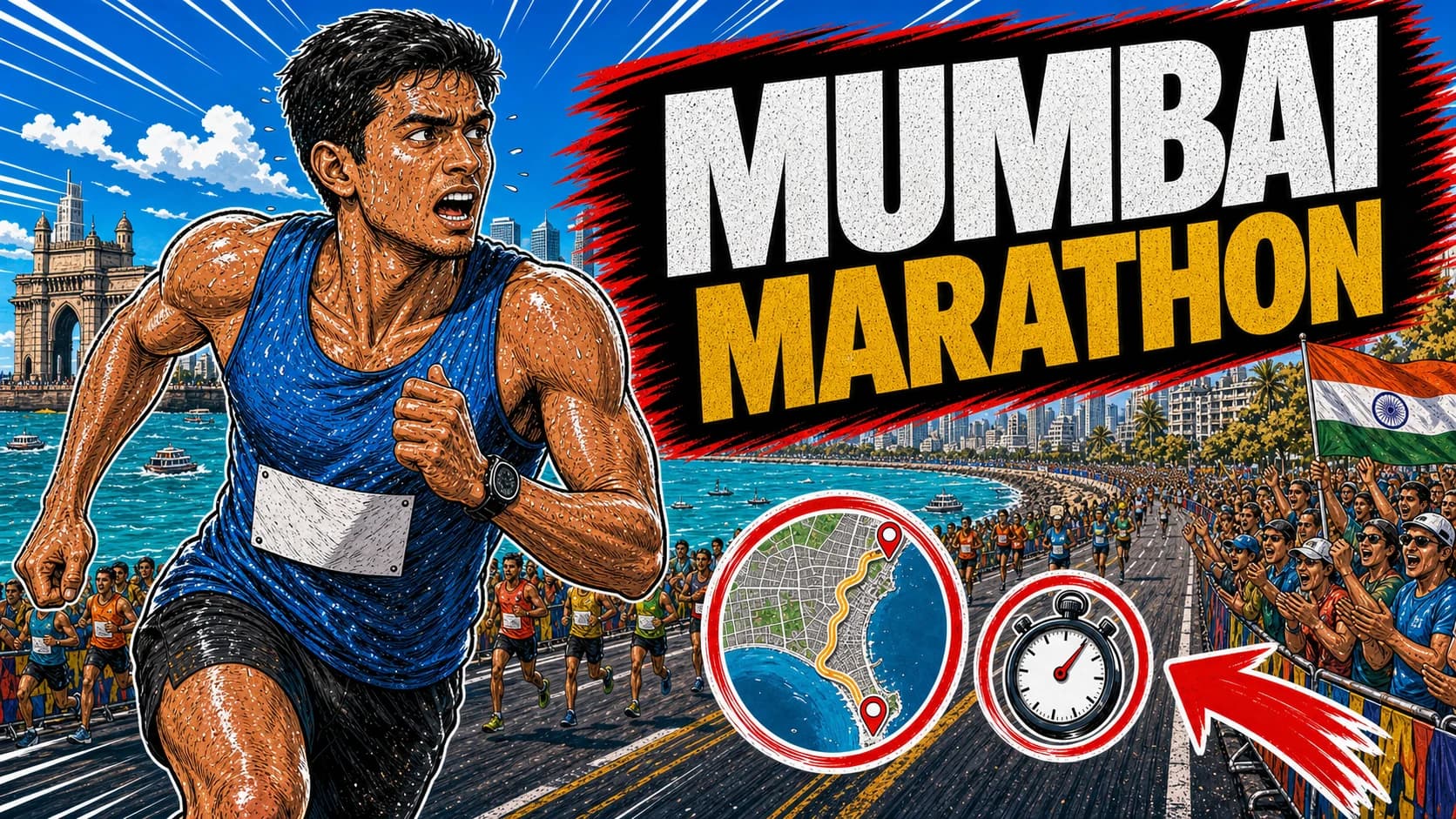
Tata Mumbai Marathon 2027 Complete Guide — Asia's Biggest Marathon, Marine Drive, Sea Link and How to Train For It
Everything you need to run the 2027 Tata Mumbai Marathon: Asia's biggest marathon by participation (~55,000 runners), Marine Drive and the iconic Bandra-Worli Sea Link, 05:40 IST pre-dawn start, tropical January heat,...
The race in this guide
Tata Mumbai Marathon
Jan 17, 2027 · Mumbai
By Ramon Curto · Updated 2026-05-08
On Sunday, January 17, 2027 Mumbai holds Asia's biggest marathon by participation (~55,000 runners across all distances) and India's most prestigious running race. Loop course from Chhatrapati Shivaji Maharaj Terminus (CSMT) along Marine Drive (the iconic "Queen's Necklace"), crossing the Bandra-Worli Sea Link over the Arabian Sea and back to central Mumbai. World Athletics Gold Label since 2009, with a 05:40 IST pre-dawn start to beat the tropical heat. This guide covers what the official Procam site doesn't quite spell out: how to manage the heat (24 °C at start, 30 °C at finish), how to hydrate without overdoing it, what to do about jet lag from Europe (4h30 ahead), and how to run Mumbai as a Western runner without the city eating you.
📑 Table of contents
| Item | Information |
|---|---|
| Date | Sunday January 17, 2027 |
| Distance | 42.195 km (marathon) |
| Other distances | Half-Marathon (21.1 km) · Open 10K · Dream Run (~5.9 km) · Senior Citizens' Run (~4.2 km) · Champions With Disability (1.3 km) |
| Elevation gain | ~110 m (mostly Sea Link + Peddar Road) |
| City | Mumbai (Maharashtra), India |
| Start & finish | Chhatrapati Shivaji Maharaj Terminus (CSMT) / Azad Maidan, Fort District |
| Start time | ~05:40 IST (pre-dawn to beat heat) |
| Organizer | Procam International |
| Sponsor | Tata Group (since 2018) |
| Category | World Athletics Gold Label (since 2009) |
| Participants | ~55,000–60,000 (all distances) |
| Registration | tatamumbaimarathon.procam.in |
The Tata Mumbai Marathon is Asia's biggest marathon by participation and India's most prestigious running event. Organized by Procam International since 2004 (Standard Chartered title sponsor until 2017, Tata Group since 2018), it holds World Athletics Gold Label and gathers ~55,000 runners across the marathon, half-marathon, 10K, and the iconic Dream Run charity event with Bollywood celebrities. The race is held on the third Sunday of January — the most pleasant time of year in Mumbai: 18–32 °C, lower humidity than monsoon season, clear skies.
Mumbai is the opposite of a cool-weather European marathon. Where Berlin or Valencia offer 8 °C start and a flat track, Mumbai offers 22 °C pre-dawn start and a flat course with a Sea Link over the Arabian Sea. The organizer adapts the start to 05:40 AM so the bulk of marathoners finish before the sun gets brutal (10–11 AM). The average amateur runner from a cool climate gives up between 5 and 15 minutes versus their best mark — Mumbai is NOT a PB course. It's an experience course.
- If you've run sub-3:30 recently in cool European weather: target 3:35–3:45 here. Heat + humidity cost 5–15 minutes. Be realistic.
- If you're moving from halves to your first marathon: Mumbai is not the best first marathon for Europeans — punitive heat punishes debut. Consider Valencia or Sevilla first.
- If you want a massive Asian experience with international prestige: fits perfectly. Gold Label + philanthropy + Mumbai culture.
- If you live in warm climate (southern Spain, Latin America, Africa): relative advantage — your body is acclimatized. Safe bet for a personal best in Asia.
- If you're collecting international marathons: Mumbai is the Asian marathon that does NOT require Tokyo's impossible lottery. Open registration + Gold Label + unique culture.
The Tata Mumbai Marathon course is a single 42.195 km loop from Chhatrapati Shivaji Maharaj Terminus (CSMT) with ~110 m of total positive elevation — essentially flat. It starts at Azad Maidan next to CSMT, runs along iconic Marine Drive (the "Queen's Necklace"), climbs Peddar Road (the only functional climb), crosses the Bandra-Worli Sea Link twice (the 5.6 km cable-stayed bridge over the Arabian Sea), and returns via Worli's seafront, Haji Ali, Marine Drive, and Marine Lines back to the CSMT finish.
The first 9 km descend gently from CSMT along Marine Drive — a 3.6 km curving seafront promenade with art-deco lighting that at sunrise looks like a necklace of lights (hence "Queen's Necklace"). The route passes Chowpatty Beach (around km 6), takes the Peddar Road climb (km 8–10, ~30 m of ascent — the only real climb of the course), crosses Worli Naka, and enters the Bandra-Worli Sea Link (km 18–24).
The Sea Link is the iconic stretch: 5.6 km of cable-stayed bridge over the Arabian Sea, designed by Seshadri Srinivasan and opened in 2009. The race crosses it twice (out to Bandra Reclamation and back to Worli). The views of the Mumbai skyline from the middle of the bridge at sunrise are among the most recognizable in Asian road racing.
From km 30 the course returns via Worli Sea Face, Haji Ali Dargah, Marine Drive again, and finishes at CSMT. The asphalt is uniform and smooth throughout. Aid stations are every 2.5 km with water + electrolyte, with solid stations (gels, banana, biscuits) at km 21, 30, and 36.
Strava data: popular segments are "Marine Drive Mumbai" (km 0–8, Queen's Necklace view) and "Bandra-Worli Sea Link" (km 18–24, the iconic crossing). Procam publishes the official GPX a few weeks before the race.
The Tata Mumbai Marathon was first run in 2004 as the Standard Chartered Mumbai Marathon, conceived by brothers Vivek and Anil Singh of Procam International to create India's first international marathon. In 2009 it earned World Athletics Silver Label, upgraded to Gold Label in 2017. In 2018 the title sponsor switched to Tata Group (hence the current name) and the race consolidated its position as Asia's largest marathon by participation (~55,000 across distances). 2027 will be edition 21 of the race.
Race data and palmarés (recent editions):
| Item | Value |
|---|---|
| First edition | 2004 |
| Annual edition since | 2004 |
| World Athletics category | Gold Label (since 2017) |
| Current distances | Marathon · Half · 10K · Dream Run · Senior Citizens' · CWD |
| Participants (all distances) | ~55,000 |
| Marathon cap | ~14,000 (lottery if oversubscribed) |
| Countries represented | 80+ |
| Men's course record | 2:07:32 (Hailemaryam Kiros, ETH, 2017) |
| Women's course record | 2:24:23 (Worknesh Degefa, ETH, 2018) |
Recent winners are published on the official Procam archive and on Wikipedia: Mumbai Marathon. Hailemaryam Kiros's men's record (2:07:32, 2017) and Worknesh Degefa's women's record (2:24:23, 2018) remain the international references for the race.
The Tata Mumbai Marathon 2027 entry opens in July 2026 and is managed via two channels: Indian portal (INR pricing for India residents) and international portal (USD pricing for foreign runners). The marathon has a cap of ~14,000 and typically goes into lottery when oversubscribed; shorter distances (Half, 10K) and the Dream Run charity have larger capacity. Marathon fees run ₹3,500–4,500 for residents (~€40–55) and $80–150 USD for international tier, depending on registration timing.
| Distance | India residents (INR) | International tier (USD) |
|---|---|---|
| Marathon | ₹3,500–4,500 | $80–150 |
| Half Marathon | ₹2,500–3,500 | $60–110 |
| Open 10K | ₹1,500–2,000 | $40–70 |
| Dream Run (5.9 km) | ₹600–1,200 | $20–40 |
Indicative pricing based on the 2026 edition. Always confirm at the official registration page — fees and the international tier update there.
| Included | NOT included (optional extra) |
|---|---|
| ✅ Bib with timing chip | ❌ Official professional photo |
| ✅ Tata finisher tech tee | ❌ Saturday pasta party |
| ✅ Finisher medal | ❌ Premium gear-check service |
| ✅ On-course aid stations | ❌ International cancellation insurance |
| ✅ Post-finish bag | ❌ Organized expo excursion |
| ✅ Get-Active Expo (BKC) access |
Refund policy: ~70 % refundable with medical certificate before late November. Entries are non-transferable between runners. Procam tightened this since the lottery cap introduced in 2018.
Bib pickup happens at the Get-Active Expo at the MMRDA Grounds in Bandra-Kurla Complex (BKC), typically held on Friday and Saturday before the race. Race-day pickup is not allowed: collect in person before the Saturday afternoon expo close.
You'll need:
- Registration confirmation (printed or on phone)
- Passport (international runners) or Indian photo ID
- e-Visa India (~$25 USD, online at indianvisaonline.gov.in, 4–5 day approval) — essential to enter the country
Family can collect on your behalf with a signed authorization and a copy of your passport. The kit includes the finisher tech tee, the chipped bib, and the course map.
The most practical way to reach Mumbai is via Chhatrapati Shivaji Maharaj International Airport (BOM), 25 km from CBD, with direct connections from Europe (Lufthansa, Air India, Emirates, Qatar) and East Asia. From Europe it's ~9 hours direct (Madrid–Mumbai with Air India) or ~12–14 hours with stop (Frankfurt, Doha, Dubai). The time gap with CET is +4h30, requiring 3 days minimum jet-lag adjustment.
On race day, get to the start by local train or pre-paid ride. Options from South Mumbai:
- Western Line train to Churchgate Station — 10 min walk to CSMT/Azad Maidan. Operates from 04:00.
- Central Line train to CSMT — terminus AT the start. Operates from 04:30.
- Pre-paid Uber/Ola from your hotel — viable for hotels >2 km away. Book with 30 min margin; Mumbai pre-dawn has light traffic but many drivers aren't operational until 04:30.
NEVER attempt to drive on race day. Roads around Marine Drive and CSMT are closed from 03:00 IST. Parking is impossible.
For European runners: direct flight Madrid–Mumbai with Air India (~9h, 1–2 weekly services) or via Doha/Dubai/Frankfurt (~12–14h with stop, daily frequency). Visa required: process the e-Visa India online at indianvisaonline.gov.in — ~$25 USD, valid 60 days, 4–5 day approval for Spanish, Portuguese, Italian, French, German, and other EU passports.
Jet-lag adjustment plan from Europe:
- Sunday before (T-7): start advancing your bedtime gradually.
- Wednesday (T-3): flight from Europe (~12h with stop).
- Thursday (T-2): arrive Mumbai in the morning, walk gently along Marine Drive in daylight. NO long run. Hydrate intensely.
- Friday (T-1): easy 30 min jog very early (06:00 IST), then to expo at BKC.
- Saturday: rest, light walk, carb-loading meal at noon, early dinner.
- Sunday: marathon, wake 03:30, leave hotel by 04:30.
For a Mumbai marathoner, sleeping less than 2 km from CSMT isn't luxury — it's strategy. The marathon drops you at the finish around 11:30–13:00 IST depending on goal — you head back to the hotel sweaty, hungry, dehydrated, with cramps starting. The difference between sleeping in South Mumbai (10 min walk to CSMT) and a hotel in Bandra 25 km away by transit can cost you 1–2 minutes on the clock and double in mental stress.
- Distance to start: 0.5–2 km on foot (5–25 min). The most convenient option Sunday at 04:30.
- Pros: unbeatable logistics. Walk to start, walk to finish. Top restaurants, elegant colonial atmosphere, museums, Gateway of India.
- Cons: more expensive tourist zone than the rest of Mumbai. Marine Drive can be loud Saturday night.
- Best for: PB-chasing runners who want to minimize logistics and maximize rest.
| Hotel | Cat. | $/night* | To start | Runner highlight |
|---|---|---|---|---|
| The Taj Mahal Palace | 5* | 350–550 | 1.5 km · 18 min | Iconic, opposite Gateway, luxury spa |
| Trident Nariman Point | 5* | 280–420 | 0.8 km · 10 min | Next to Marine Drive, strong AC |
| The Oberoi Mumbai | 5* | 380–520 | 1.2 km · 15 min | Marine Drive front, late check-out |
| The Gordon House Hotel | 4* | 130–180 | 1.8 km · 22 min | Boutique in Colaba, mid-range |
| Sea Palace Hotel | 3* | 80–130 | 1.5 km · 18 min | Budget, Colaba, decent AC |
- Distance to start: 18–25 km by taxi (40–70 min in traffic). NOT walkable.
- Pros: next to the expo at MMRDA Grounds. Modern restaurants, international corporate atmosphere. Near the middle of the course (~km 18 when crossing the Sea Link).
- Cons: transport mandatory Sunday 04:00. Isolated from tourist center. Early start = pre-paid Uber required.
- Best for: runners prioritizing expo + corporate atmosphere who accept the start-day taxi.
| Hotel | Cat. | $/night* | Runner highlight |
|---|---|---|---|
| Sofitel Mumbai BKC | 5* | 220–340 | Next to expo, spa, international luxury |
| Trident BKC | 5* | 200–300 | Next to expo, 24h gym |
| Vivanta by Taj BKC | 4* | 150–220 | Solid mid-range, next to expo |
- Distance to start: 8–15 km by taxi (25–45 min). Near km 30–35 of the course.
- Pros: mid-Mumbai restaurants, local + corporate atmosphere, sea view (Worli).
- Cons: transport mandatory Sunday. Far from expo. Far from historic CSMT.
| Hotel | Cat. | $/night* | Runner highlight |
|---|---|---|---|
| Four Seasons Mumbai | 5* | 280–420 | Sea view, spa, recovery pool |
| The St. Regis Mumbai | 5* | 260–380 | Luxury, Lower Parel, 24h gym |
| Hyatt Regency Lower Parel | 5* | 200–290 | Next to modern shopping centers |
*Indicative weekend-of-race rate (third Sunday of January) in USD. Varies with booking lead time, exchange rates, and rising demand since the Gold Label recognition.
Mumbai weather on the third Sunday of January averages 22 °C low at pre-dawn start and 30–32 °C high at finish with sunny or lightly hazy conditions on around 85 % of days, per India Meteorological Department (IMD) data. It's dry tropical winter — the coolest and most pleasant time of year in Mumbai. Rain is virtually nonexistent in January (monsoon is June–September), wind moderate from the east (10–15 km/h, sea breeze), and humidity relatively "low" (60–75 %, vs. 90 % in monsoon).
The critical factor is relative heat. For a European runner used to marathons at 8–14 °C, 22 °C at start in Mumbai is already heat, and 30 °C at finish is STRONG heat. Your body enters thermal stress above 16–18 °C, and that's exactly what you'll have between km 15 and finish. The 05:40 IST pre-dawn start is specifically designed to get most runners to the finish before the worst heat.
Plan by forecast:
- <22 °C at start + moderate wind: optimal Mumbai conditions. Target pace + 5 sec/km.
- 22–28 °C all day: typical conditions. Target pace + 10–15 sec/km.
- 28–32 °C at finish: tough conditions. Aggressive hydration from km 5; target pace + 15–20 sec/km.
- >32 °C at finish: infrequent but happens in atypical years. Procam may activate heat protocol (more aid stations, ice sponges). Drop target pace 20–25 sec/km.
The recommended Mumbai training plan is a 16-week block with peak volume in weeks 11–13 (between 50 km and 100+ km weekly depending on goal), specific heat-acclimatization block in the last 2 weeks (essential for European runners), and a 3-week taper. Key for Mumbai: train in heat conditions the last 14 days — Mumbai doesn't forgive runners arriving without 4–6 sessions at 25 °C+.
Peak weekly volume by goal:
| Mumbai goal | Peak volume | Max long run | Sessions/week |
|---|---|---|---|
| Sub-3:00 | 80–100 km | 32 km | 6 |
| Sub-3:30 | 65–80 km | 30 km | 5 |
| Sub-4:00 | 55–70 km | 28 km | 4–5 |
| Sub-4:30 | 45–60 km | 26 km | 4 |
| Finish (5:00+) | 35–50 km | 24 km | 3–4 |
Mumbai-specific sessions (weeks 14–16):
- Heat acclimatization: 6 sessions in sauna (15–25 min post-training) OR 4 noon training sessions in warm weather. Activates thermoregulatory adaptation.
- Sun-exposed long run: once a week in weeks 14–15, head out between 11:00 and 13:00 for 20–25 km. Practice hydration + sodium.
- Tempo in warm weather: 12 km at goal pace during the day's hottest hours.
Based on your best recent cool-weather marathon (Berlin, Valencia, Sevilla), here's your realistic Mumbai time applying the heat + humidity penalty (~5–15 minutes):
| Best in cool | Realistic Mumbai |
|---|---|
| 2:45 cool | 2:50–2:55 |
| 3:00 cool | 3:06–3:12 |
| 3:30 cool | 3:38–3:46 |
| 4:00 cool | 4:10–4:20 |
| 4:30 cool | 4:42–4:52 |
Once you have your realistic Mumbai goal (factoring heat + humidity), use the calculator for the splits you need to hit at each checkpoint:
| Punto | Tiempo acumulado | Parcial |
|---|---|---|
| 5 km | 26:40 | 26:40 |
| 10 km | 53:19 | 26:40 |
| 15 km | 1:19:59 | 26:40 |
| Media (21,1 km) | 1:52:30 | 32:31 |
| 30 km | 2:39:58 | 47:28 |
| Meta | 3:45:00 | 1:05:02 |
Los parciales suponen un ritmo constante y no incluyen paradas. En Tata Mumbai Marathon, adapta el esfuerzo al terreno y a las condiciones; no fuerces las bajadas para recuperar segundos.
The Mumbai race plan starts at the gun at CSMT at 05:40 IST. The first 15 km descend gently along Marine Drive — the feel is deceptively easy under pre-dawn light with sea breeze. Don't let it. That Marine Drive bank is what you'll need — all of it — between km 25 and 32 when the sun hits the Sea Link return.
| Goal | 5K split | Mumbai-specific tactical note |
|---|---|---|
| Sub-2:30 | 17:46 | Elite. Marine Drive 3:30/km. Sea Link 3:35/km. Return 3:38–3:42/km with aggressive sodium. |
| Sub-3:00 | 21:18 | Marine Drive 4:10/km. Sea Link 4:15/km. Return 4:20/km with hydration every 2.5 km. |
| Sub-3:30 | 24:53 | Marine Drive 4:55/km. Sea Link 5:00/km. Return 5:05/km. Conservation critical km 25–32. |
| Sub-4:00 | 28:25 | Marine Drive 5:35/km. Sea Link 5:40/km. Return 5:48/km. Don't chase pace if humidity >75%. |
| Sub-4:30 | 31:58 | Marine Drive 6:18/km. Run-walk on Sea Link OK if extreme heat. Enjoy the scenery. |
| Sub-5:00 | 35:30 | Marine Drive 7:00/km. Plan B: walk 30 sec at every aid station from km 25. |
| Finish | — | Comfortable pace. The medal and the Sea Link photo are worth any time. |
Race morning: wake 03:30 IST, coffee + light breakfast at 04:00 (white bread with honey + banana), leave hotel at 04:30 to reach corral by 05:00 (40 min before the gun). Old hoodie or poncho — morning temps can drop below 20 °C in January.
Aid stations: every 2.5 km with water + electrolyte + banana and biscuits at some points. Cadence is generous due to heat. Drink at every one from km 5 without exception.
Mental at km 32: after the Sea Link return, the next 10 km are the toughest of the course — high sun, accumulated heat, silent dehydration. Crowd support on Worli Sea Face and Marine Drive return is massive. The last km is the rise toward the iconic Victorian CSMT finish.
The Mumbai nutrition strategy is the standard for warm-climate marathons — adapted to the early start (05:40 IST) and to jet lag if coming from Europe. Carb loading starts Friday (3 days before), with emphasis on Saturday: 8–10 g/kg body weight spread across 4 meals. South Mumbai has excellent international cuisine (Italian, Chinese, Middle Eastern) plus regional Indian — all valid for loading if you tolerate the cuisine.
Saturday dinner: pasta or white rice with lean protein (grilled chicken, fish), cooked vegetables. AVOID Indian street food in the 48 hours pre-race — risk of traveler's gastroenteritis is real. Drink ONLY bottled water. Dinner by 19:30 IST at the latest — you're waking at 03:30.
Sunday breakfast (04:00 IST): 1:30–2 hours before gun. White bread with honey + banana + espresso coffee. Avoid full-fat dairy, fiber, and any spicy Indian food.
On course: one gel every 25–30 minutes from km 6, last at km 35. Total 5–6 gels = 250–300 g of carbs. Drink water + electrolyte at every aid station (every 2.5 km), alternating.
Mumbai-specific hydration (CRITICAL): 22–32 °C climate + 70 % humidity = 2x sweating rate vs. Berlin or Valencia. Plan: 300–400 ml per aid station (NEVER below 250). Sodium: 400–600 mg per hour (gel salts, electrolyte sticks, salt tablets). If you arrive at km 25 with very dry mouth or calf cramps, you're already late on hydration.
Post-finish recovery (first 60 minutes): banana + protein bar + water + DOUBLE electrolyte (you're severely dehydrated). Hotel shower at warm-cool temperature (NOT cold — thermal shock), lunch at 14:00 IST (protein + carbs + cooked vegetables), short nap. Sunday night is loud in South Mumbai — massive celebration in Colaba pubs.
Mumbai gear is the standard tropical-marathon kit — closer to Honolulu or Boston Hot than to Valencia or Berlin. Start temperature (~22 °C) calls for very light layer or direct race kit; finish temperature (~30 °C) means just singlet + light shorts. The differentiator is humidity: anti-chafe + sun protection + cap are non-negotiable.
Mumbai-specific gear:
- Very light layer or NOTHING in corral. 22 °C at CSMT at 05:00 — you don't need a hoodie. Tech singlet from the start.
- Light white cap or visor with adjustable Velcro. MANDATORY. Sun is strong from km 15 onward and reflects off the Sea Link.
- UV400 sunglasses. Arabian Sea reflection from the Sea Link can dazzle.
- Anti-chafe + nipple plasters. Heat + humidity multiplies friction 3x vs. cool weather. Apply generously to armpits, nipples, groin, feet.
- Electrolyte salts + sticks. Carry 5–6 electrolyte sticks (Maurten, SiS, GU) or salt tablets to take every 60–90 minutes.
- Light gel belt. Carry 5–6 of your own. Aid station gels are solid but may not match your training brand.
- Carbon-plate shoes. Vaporfly Next% 4, Adidas Adios Pro 4, Asics Metaspeed Sky+. With minimum 200 km broken in across 2 prior long runs — and ideally one in warm weather.
How do I manage jet lag from Europe?
Arrive 3–5 days early. Time difference is +4h30 (Spain → Mumbai). First 2 days you'll feel strong afternoon fatigue — no long run. Day 3: easy 30 min jog very early (06:00 IST) to activate legs. Day 4: rest or tourist walk. Day 5: marathon. Arriving Tuesday is optimal for maximum acclimatization.
What visa do I need from Spain?
e-Visa India — online at indianvisaonline.gov.in, ~$25 USD, valid 60 days, 4–5 day approval for Spanish, Portuguese, Italian, French, and other EU passports. Allows tourism + running the marathon (not paid work, so no other visa type needed).
Is Mumbai safe for Western runners?
Mumbai is generally safe for tourists in South Mumbai, BKC, and hotel zones. Standard rules apply: don't display money/jewelry in public, use pre-paid Uber/Ola instead of casual taxis, avoid non-tourist areas alone at night. Women running: South Mumbai is more comfortable than Bandra; better to train with a group for pre-race jogs.
Can I eat Indian food the weeks before?
Last 48 hours: NO. Indian cuisine is delicious but traveler's gastroenteritis risk is real, especially with spicy curries, raw salads, tap water. Weeks before in your country: eat what you train with. Days 1–4 in Mumbai: bland international food (Italian, Japanese, American in hotels). Pre-race Saturday: pasta or white rice with protein. Drink only bottled water the entire trip.
Why is the start at 05:40 IST?
Because of the heat. Mumbai in January dawns around 07:10 IST. Starting 90 min before sunrise lets the marathon bulk finish before 11:00 (when the sun hits hardest). If the start were 08:00 (like Madrid or Berlin), finish-line temps would be 32–35 °C — dangerously high. Pre-dawn start is THE Mumbai adaptation to tropical heat.
How is the heat on race day really?
Start 22–24 °C, humidity 70–80 %. Feel: comfortable pre-dawn with sea breeze. By km 15 (06:30 IST): 24–26 °C, sun rising. By km 30 (08:30–09:00 IST): 28–30 °C, strong sun, reflective asphalt. Finish (10:00–13:00 IST): 30–32 °C, full heat. For European runners this is HEAT. Drink + sodium aggressively from km 5; accept 5–15 minutes worse than your cool-weather mark.
Is there a lottery or direct registration?
Procam uses direct registration with cap. Shorter distances (Half, 10K, Dream Run) have ample capacity and register directly. The marathon (cap ~14,000) typically goes into lottery when oversubscribed — opens July 2026, drawn September if applicable. Charity bibs available continuously with fundraising commitment for one of 250 partner NGOs.
Can I pick up my bib on race day?
No. Pickup is at the Get-Active Expo at MMRDA Grounds (BKC) on Friday and Saturday before. Race-day pickup is not allowed. You need passport + registration confirmation. Family can collect on your behalf with a signed authorization and a copy of your passport.
What shoes are best for Mumbai?
For sub-3:30, a protective carbon plate (Vaporfly 4, Adios Pro 4, Metaspeed Sky+). Marine Drive and Sea Link's smooth asphalt is ideal for fast shoes. Most important: broken in across at least 2 long runs in warm weather — heat + humidity changes the feel. Bring a backup pair (daily trainer) in case international travel loses your bag.
How does Mumbai compare to Tokyo, Honolulu, Singapore?
Mumbai is the largest Asian marathon by participation (~55K). Tokyo is a WMM with impossible lottery (3 % win rate). Honolulu is tropical but has no time limit (relaxed). Singapore (Standard Chartered) is similar in heat with fewer participants (~30K). Mumbai combines scale + Gold Label + unique culture + accessible entry — the optimal Asian marathon if you don't have Tokyo's lottery.
Mumbai is the largest Asian marathon by participation, with tropical climate and unique urban experience. This table compares Mumbai with its peers in the international warm-marathon calendar:
| Race | Month | Climate | Best for | Entry |
|---|---|---|---|---|
| Mumbai (this guide) | January | 22–32 °C dry tropical | Asia, scale, culture | Direct entry / lottery if oversubscribed |
| Tokyo Marathon | March | 5–12 °C | Pure PB + culture | Lottery (3 %) |
| Honolulu Marathon | December | 22–28 °C tropical | No time limit, finish-friendly | Direct entry |
| Standard Chartered Singapore | December | 24–30 °C tropical humid | Asian alternative, urban | Direct entry |
| Boston Marathon | April | 5–18 °C variable | Prestige + BQ qualifying | BQ qualifying |
| Comrades Marathon (ZA) | June | 5–18 °C SA winter | Iconic 87 km ultra | Qualifier required |
Did this guide help? If you're running Mumbai 2027, save the event on SportPlan to get registration alerts, e-Visa deadlines, and later log your Asian Gold Label.
Keep planning
Use SportPlan to compare dates, save target events, and build a season that fits your weekends instead of another unstructured list.