
Complete Guide to the Zurich Marató Barcelona 2027 — The Mediterranean Marathon par Excellence
Everything you need to know to run the Zurich Marató Barcelona 2027: 42.2 km from Plaça d'Espanya to Port Vell, the real course, an honest elevation profile, bib pickup, transport, accommodation, March weather and a...
By Ramon Curto · Updated 2026-05-06
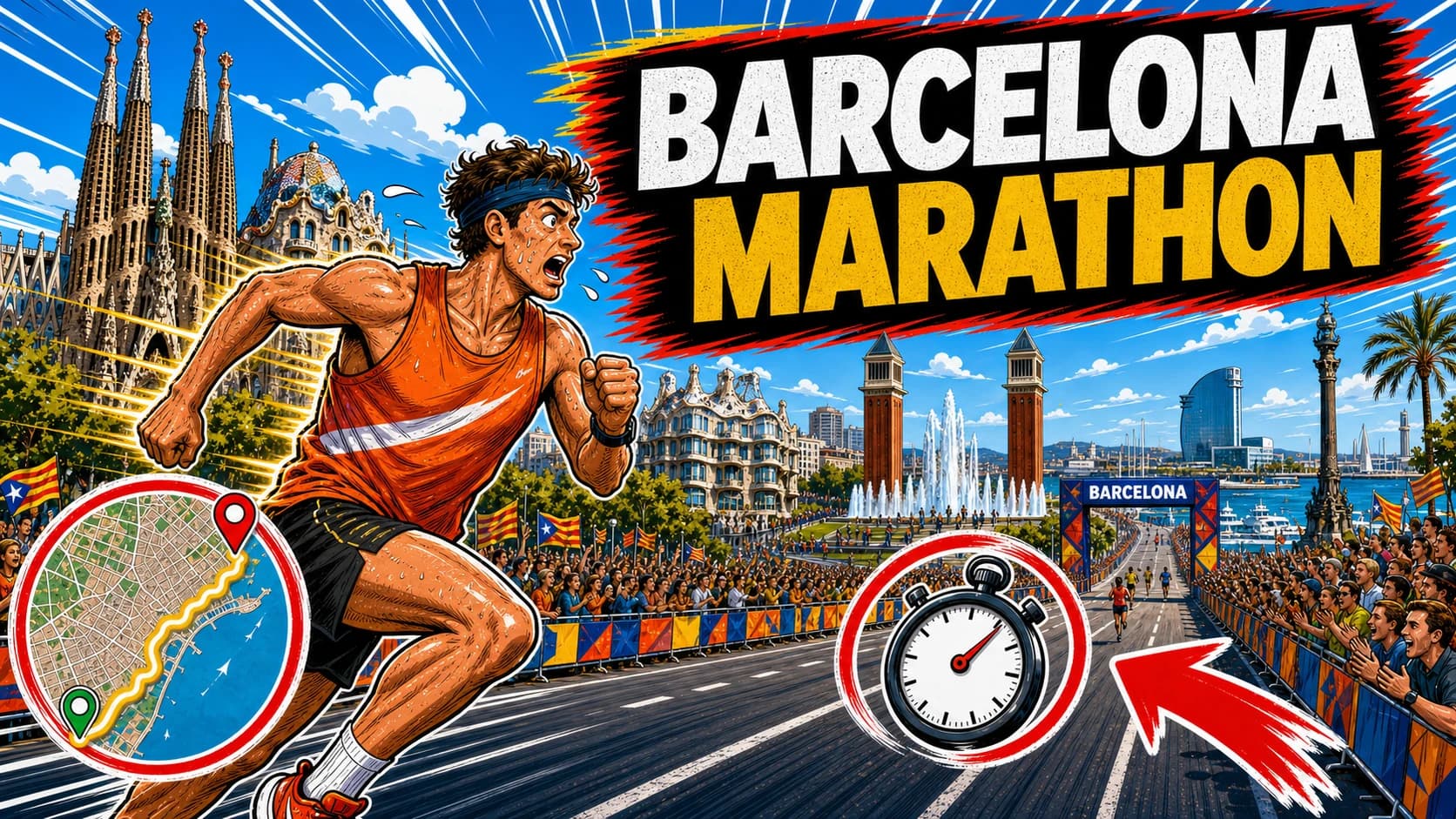
On 14 March 2027 Barcelona hosts the Mediterranean marathon par excellence: ~20,000 finishers, a Plaça d'Espanya start with the Magic Fountain backdrop, the Casa Batlló + La Pedrera Gaudí running tour at km 4 and a finish at Port Vell with paella and cava waiting. It is Spain's #2 marathon by participation (only Valencia moves more people) and pairs favourable spring weather with an undulating but fast course — a unique balance of urban experience and clock. This guide covers what the official site never quite spells out: what the course is really like, where most runners fall apart, how to train for the gentle Pedralbes-Sarrià climbs, what time is realistic and how to put together race-weekend logistics.
📑 Table of contents
| Item | Information |
|---|---|
| Date | 14 March 2027 (Sunday) |
| Distance | 42.195 km (marathon) |
| Elevation gain | ~150 m (moderately undulating) |
| City | Barcelona (sea level) |
| Start | Avinguda de la Reina Maria Cristina · Plaça d'Espanya |
| Finish | Avinguda de la Reina Maria Cristina · Plaça d'Espanya |
| Start time | ~8:30 (confirm with official communication) |
| Title sponsor | Zurich Seguros (since 2014) |
| Organiser | RPM Racing |
| Registration | zurichmaratobarcelona.es |
The Zurich Marató Barcelona is Spain's #2 marathon by participation and one of Europe's oldest marathons — first edition in 1978. It draws ~20,000 finishers each year, attracts runners from 100+ countries and combines Mediterranean March weather (8–16 °C) with an undulating but fast course that runs past the city's most recognisable postcards: Plaça d'Espanya, Casa Batlló, La Pedrera, Pedralbes, Sarrià and a finish next to the harbour.
Barcelona isn't flat like Valencia, but it doesn't punish you like Madrid either. The course adds ~150 m of cumulative elevation gain spread across gentle climbs (the rise toward Pedralbes-Sarrià between km 5 and km 10, and the return into the Eixample via Sants between km 25 and km 30). The differentiator is the Mediterranean March weather: 8–12 °C at the start, 14–16 °C peak around midday, low humidity and moderate sun — conditions often close to optimal for a PB.
- If you've recently run a sub-3:30 marathon elsewhere: target 3:25–3:32 here. The gap to Valencia is modest (1–3 minutes).
- If you're stepping up from halves but have never run 42K: Barcelona is a strong debut option with a real time — strong atmosphere, solid organisation, favourable weather. Better than Madrid if you want a time, better than Valencia if you want atmosphere.
- If you want your first marathon with an urban experience: yes, it fits perfectly. The Gaudí postcards at km 4 pull you through km 30 when you start to wobble.
- If you're chasing a hard, pure PB: Valencia is still 2–4 minutes faster on equal legs. Barcelona gives you a PB without suffering Valencia's "monotonous tunnel" feel.
- If you're training for Boston or Berlin: use it as a 6–8-month-out test — the mix of gentle climbs and undulation teaches you to manage pace under real pressure.
See other marathons in Spain →
The Zurich Marató Barcelona course is a single 42.195 km loop with start and finish at Plaça d'Espanya — Avinguda de la Reina Maria Cristina, right at the foot of Montjuïc, with the Font Màgica as the start-line postcard. It adds up to roughly ~150 m of cumulative elevation gain spread across gentle climbs between km 5–10 (the rise toward Pedralbes-Sarrià) and km 25–30 (the return into the Eixample via Sants).
The start fires from Avinguda de la Reina Maria Cristina facing the Font Màgica — one of the most photogenic openings on the European marathon calendar. The first kilometres roll gently downhill toward downtown: you pass Plaça de Catalunya around km 3, swing onto Passeig de Gràcia and between km 4 and km 5 you parade past Casa Batlló and La Pedrera — the Gaudí running tour express. It's a flat stretch with thick crowds and easy speed; the classic mistake is letting the legs go here.
From km 6 the course climbs along Avinguda Diagonal heading west, with a very gentle but sustained gradient. Between km 8 and km 12 you cross Pedralbes and Sarrià — Barcelona's upper neighbourhoods — where the cumulative elevation starts to bite: little ups and downs that reward the runner who respects target pace. Around km 15 the course starts coming back down toward the centre, passes Sagrada Família (Gaudí postcard #2) near km 18–19 and reaches the half-marathon mark with fresh legs if you've managed it well.
Between km 22 and km 30 comes the toughest stretch: the return through the Eixample, the long false flats and, above all, the gentle Sants climb (km 25–30). They're not dramatic hills — the gradient peaks at 1–2% — but they hit when glycogen is running low and the Mediterranean sun, which in March can climb from 12 °C to 18 °C in a few hours, starts to weigh. From km 30 to km 38 the course drops toward the sea: Old Port (Port Vell), Barceloneta and the seafront promenade carry you alongside the beach with the Mediterranean breeze. The last 4 km swing back toward Plaça d'Espanya, with the feeling of closing a perfect circle.
Tarmac is the dominant surface (with short cobblestone stretches in the Old Town near km 32). Aid stations with water and sports drink sit roughly every 2.5 km from km 5 — denser than the Spanish average. Solid aid stations (gels, fruit, banana) at km 17, km 25 and km 35. Crowd density peaks on Passeig de Gràcia, at Sagrada Família, in Barceloneta and at the finish — thinner up in Pedralbes-Sarrià.
🚨 Where the race breaks
Course data for Strava / Garmin: the organiser publishes the official GPX a few weeks before the race on its site. To recce the Pedralbes-Sarrià section midweek, look up the "Subida Diagonal Pedralbes" segment on Strava — it's the same profile you'll suffer on race day.
The Marató Barcelona has been run since 1978, first in Palafrugell and later in Barcelona itself. It is one of the five oldest marathons in Spain (alongside Madrid, San Sebastián, Seville and Zaragoza) and one of the oldest in Europe. Zurich Seguros has been title sponsor since 2014, and RPM Racing organises it in its modern format. The mid-March date and the Plaça d'Espanya start are its two unmovable trademarks.
Roll of honour and race data (recent editions):
| Item | Value |
|---|---|
| First edition | 1978 |
| Editions held | 48 (through 2026) |
| Title sponsor | Zurich Seguros (since 2014) |
| Organiser | RPM Racing |
| Single distance | Marathon (42.195 km) |
| Finishers (recent editions) | ~20,000 |
| Countries represented | 100+ |
| Men's record | 2:04:13 (Tesfaye Deriba, ETH, 2025) |
| Women's record | 2:10:51 (Fotyen Tesfay, ETH, 2026) |
Verified winners and times for the 5 most recent editions:
| Year | 🥇 Men | Country | Time | 🥇 Women | Country | Time |
|---|---|---|---|---|---|---|
| 2026 | Abel Chelangat | 🇺🇬 UGA | 2:04:57 | Fotyen Tesfay | 🇪🇹 ETH | 2:10:51 ⭐ |
| 2025 | Tesfaye Deriba | 🇪🇹 ETH | 2:04:13 ⭐ | Sharon Chelimo | 🇰🇪 KEN | 2:19:33 |
| 2024 | Tadesse Abraham | 🇨🇭 SUI | 2:05:01 | Degitu Azimeraw | 🇪🇹 ETH | 2:19:52 |
| 2023 | Marius Kimutai | 🇧🇭 BHR | 2:05:06 | Zeineba Yimer | 🇪🇹 ETH | 2:19:44 |
| 2022 | Yihunilign Adane | 🇪🇹 ETH | 2:05:53 | Meseret Gebre | 🇪🇹 ETH | 2:23:11 |
⭐ = course record. Data verified against the public archive of Barcelona Marathon (Wikipedia EN).
Registration for the Zurich Marató Barcelona 2027 opens early September 2026 in first-come-first-served format (no lottery). Historically the race sells out in 6–8 weeks — by October 2026 the international slots are usually gone, and by December the domestic cap. No lottery, no age-group quotas — first in, first to run.
2026 edition reference at close:
- Marathon: sold out (closed in November 2025).
- No secondary distances: the race only has the full marathon.
- Charity bibs: sold out by February 2026.
Assuming Barcelona always has last-minute bibs is a mistake: runners who wait until January end up on the official Marketplace or shut out. The race doesn't open extra slots at the last minute.
The Zurich Marató Barcelona uses a tiered pricing system — the bib price rises every time a tier closes. If you can afford it and you know you're running, register in the first tier: the saving versus the last slots is 20–30 € per bib.
| Tier | Approx. open | Approx. close | Price |
|---|---|---|---|
| 🟢 Early-bird | Sept 2026 | Oct 2026 | 60–70 € |
| 🟡 Standard | Nov 2026 | Jan 2027 | 75–85 € |
| 🔴 Last slots | Feb 2027 | until close | 90–95 € |
| 💎 Charity bib | Sept 2026 | Feb 2027 | 350 €+ (with NGO donation) |
Indicative prices based on the 2026 edition structure. Always confirm on the official registration page — amounts and tiers are updated there.
| Included in the price | NOT included (optional extras) |
|---|---|
| ✅ Bib with timing chip | ❌ RFEA federation licence (+5 €) |
| ✅ Technical finisher T-shirt | ❌ Official professional photo (~15–20 €) |
| ✅ Finisher medal | ❌ Saturday pasta party (10–15 € extra) |
| ✅ On-course aid stations | ❌ Premium bag drop |
| ✅ Post-finish bag (fruit, bars, sports drink) | ❌ Cancellation insurance |
| ✅ Digital diploma with certified time | ❌ Hotel transfer from finish |
What you need to factor in beyond the bib price:
- Refund policy: 80% refundable with a medical certificate before 15 February 2027. Registrations are non-transferable to another edition or another race.
- Official Marketplace: if you get injured or can't run, there's an internal market to resell the bib — open until late February. Organiser commission ~10 €.
- Full event cancellation: registration rolls over to the next edition with a discount; cash refunds aren't issued in full.
Bib pickup happens at the Expo Esportiva Barcelona, normally held the three days before the race (Thursday, Friday and Saturday) at Fira de Barcelona Montjuïc — next to Plaça d'Espanya, 5 minutes on foot from the start line. No bibs are handed out on race day: you have to pick yours up in person before the expo closes on Saturday, which historically closes at 20:00.
You'll need:
- Proof of registration (printed or on your phone)
- A valid photo ID
- Your RFEA federation licence (if you have one) — if not, it can be sorted on site
Family members and friends can pick yours up with a signed authorisation and a copy of your ID. The race kit includes the technical finisher T-shirt, the bib with chip, a bag tag and a course map. Finisher medals are handed out in the post-finish zone after you cross the line, next to Port Vell.
The most practical way to reach the Zurich Marató Barcelona start is by metro: the Espanya station (L1, L3, L8) is literally at the foot of the start line. The metro starts running at 05:00 on special race Sundays, and is often free for runners with a bib in some editions. The Low Emission Zone (ZBE Rondes) restricts downtown to unlabelled older vehicles.
Getting to Barcelona:
- El Prat Airport (BCN): the main airport, 15 km from downtown. Direct Aerobús to Plaça d'Espanya in 25–30 minutes (6.75 €). Metro L9 Sud to Torrassa + transfer to L1 to Espanya (~40 min, T-Casual). Taxi: 30–40 € to downtown.
- AVE / long-distance train: Estació Sants is the main station, 1.2 km from the start (15 min on foot or 1 stop on metro L3 to Espanya). AVE from Madrid in 2:30.
- Renfe Cercanías: R1, R2, R3, R4 stop at Sants and Passeig de Gràcia.
- FGC: the Ferrocarrils Generalitat de Catalunya connect Sarrià, Pedralbes and the upper city to Plaça Catalunya — useful if you stay in the upper part of town.
Barcelona has one of Europe's densest metro networks. On race morning the metro starts running at 05:00 on special timetable. Plan to be in your corral 45–60 minutes before the gun: the marathon goes off in waves and porta-loo queues spike in the last 30 minutes.
For the expo, the Espanya station (L1, L3, L8) drops you 5 minutes on foot from Fira de Barcelona Montjuïc.
Driving is not recommended. Most downtown streets are closed from early morning until afternoon, and central Barcelona is part of the ZBE Rondes, which restricts vehicles without an environmental label. If you must drive, park near a metro station on the outskirts (Cornellà, Hospitalet) and switch to public transport.
For a marathon runner, staying within a 15-minute walk of the start or the finish is not luxury: it's logistics. The marathon spits you out at the finish around 11:30–14:00 depending on goal — you walk back to the hotel sweaty, hungry, with cramps building. The difference between sleeping well with an early breakfast and a 5-minute walk to the corral versus catching the metro at 7:30 with two transfers can cost you 1–2 minutes on the clock and twice that in mental stress.
- Breakfast before 6:30 (or a bag the night before). Eating 2:30–3 h before the start is critical; buffets that open at 7:30 are too late.
- Late check-out until 15:00–16:00. In a marathon you finish later than in a half — you need margin for shower, food, rest.
- Bathtub for ice baths / contrast post-race. More useful after 42K than after 21K. Filter on Booking ("bath with bathtub").
- Independent, working air conditioning. To recover Sunday afternoon and sleep well the next night.
- Inner-courtyard or higher-floor room. Saturday night downtown Barcelona is loud — don't gamble with your pre-marathon sleep.
- Real distance in metres, not in marketing minutes. <1,000 m: walk relaxed. 1,000–2,000 m: metro required. >2,000 m: skip it.
- Distance to start: 1.8–2.5 km on foot (22–30 min) or 2 metro stops on L1/L3 to Espanya.
- Pros: restaurants for the pasta dinner, 24h pharmacies, direct connection to the course (you'll see runners pass by Passeig de Gràcia from your hotel).
- Cons: Saturday night is loud (Las Ramblas and Passeig de Gràcia until 02:00).
- Best for: runners travelling solo or with a runner partner who want atmosphere.
| Hotel | Cat. | €/night* | To start | Runner strength |
|---|---|---|---|---|
| Casa Fuster | 5* | 280–420 € | 2.2 km · 27 min | Bathtub, strong AC, terrace with views |
| Hotel Majestic | 5* | 240–380 € | 2.0 km · 25 min | Across from Casa Batlló, early breakfast |
| Mandarin Oriental Barcelona | 5* | 480–700 € | 1.8 km · 22 min | Spa, post-race recovery |
| Hotel Casa Bonay | 4* | 160–240 € | 2.5 km · 30 min | Boutique, excellent breakfast |
| Hotel Yurbban Trafalgar | 4* | 130–180 € | 2.8 km · 33 min | Gym for mobility, mid-range |
- Distance to finish: 400–1,200 m on foot (5–15 min). The most comfortable option on Sunday at 12:00.
- Distance to start: 4–5 km — metro L3 from Drassanes to Espanya in 10 minutes.
- Pros: 5 minutes' walk from the finish. Seafront promenade for a Saturday shakeout, paella in beach bars to celebrate Sunday.
- Cons: Sunday morning start needs metro or taxi. More tourist-heavy, less local.
- Best for: runners travelling with family who want to enjoy the beach post-race.
| Hotel | Cat. | €/night* | To finish | Runner strength |
|---|---|---|---|---|
| W Barcelona | 5* | 380–580 € | 600 m · 8 min | The icon, beachfront, strong spa |
| Hotel Arts | 5* | 350–540 € | 800 m · 10 min | Harbour view, big bathtub |
| Eurostars Grand Marina | 5* | 220–320 € | 500 m · 7 min | Across from World Trade Center, quiet streets |
| Pestana Arena Barcelona | 4* | 180–260 € | 1.2 km · 15 min | Next to Arc de Triomf, mid-to-upper range |
| H10 Marina Barcelona | 4* | 160–220 € | 1.0 km · 13 min | Modern, AC OK, generous breakfast |
- Distance to start: 800 m–1.5 km on foot (10–18 min) or 1 metro stop on L3 to Espanya.
- Pros: unbeatable logistics. Sants station next door for AVE / Cercanías. Quieter than the tourist core.
- Cons: less atmosphere and dining than Eixample.
- Best for: runners arriving by AVE who want to minimise transfer.
| Hotel | Cat. | €/night* | To start | Runner strength |
|---|---|---|---|---|
| Catalonia Barcelona Plaza | 4* | 130–180 € | 200 m · 3 min | Across from Plaça d'Espanya, almost on the start line |
| Hotel Barceló Sants | 4* | 140–200 € | 1.3 km · 16 min | On top of Sants AVE station |
| Onix Rambla | 3* | 95–130 € | 1.0 km · 12 min | Next to Plaça d'Espanya, mid-range |
| Expo Hotel Barcelona | 4* | 120–160 € | 600 m · 8 min | Across from Sants AVE, early breakfast |
| Hotel Catalonia Barcelona Golf | 4* | 110–150 € | 900 m · 11 min | Quiet, generous gym |
*Indicative race-weekend rates (second Sunday of March). Varies with booking lead time, availability and current promotions.
The weather in Barcelona in mid-March averages 8 °C low and 16 °C high with sunny conditions on around 75% of days, according to historical data from AEMET and Meteocat. Rain is uncommon in March (one wet day every 4–5 editions) and humidity is moderate-low (60–70%). The factor to watch is the Garbí breeze, a southwesterly wind that picks up around midday.
Barcelona's conditions are often close to optimal for a PB. The typical start temperature (8–12 °C) is ideal for running, and the rise to 14–16 °C around midday isn't a serious problem if you manage hydration. Compared to Valencia (December, 10–15 °C, similar) or Madrid (April, 12–22 °C, warmer), Barcelona offers the best combination of temperature + low humidity on the Spanish calendar.
Plan by forecast:
- <10 °C peak: standard European marathon, no thermal stress. Keep light gloves for the first 5 km.
- 10–16 °C: optimal conditions. Most personal records get set here. Short technical T-shirt, optional cap.
- 16–20 °C: watch the pace from km 1. Dehydration hits at km 25, not km 35. Drink at every aid station.
- >20 °C: drop goal pace 5–10 seconds per km. Carry your own bottle if you're going over 4h. Cap mandatory.
The Garbí breeze (southwesterly wind). It usually blows between 11:00 and 16:00 from the sea inland, with intensity of 10–25 km/h. It helps you between km 5 and km 15 (you climb toward Pedralbes with a tailwind) and hurts you between km 30 and km 38 (you come back from Barceloneta into a headwind). In mild conditions it doesn't affect the clock; in strong Garbí (>25 km/h, rare but possible) it can cost 30–60 seconds at the end.
Carry your own water if you're slow and the forecast is over 18 °C — on-course aid is generous but the back of the field reaches the final stations after several hours.
The recommended plan to prepare for the Zurich Marató Barcelona is a 16-week block with peak volume in weeks 11–13 (between 50 km and 130+ km per week depending on goal), one weekly long run and a three-week taper. The key for Barcelona: train with long continuous tempos and at least two long runs with 150 m+ of cumulative elevation to acclimatise to the gentle climbs of the course.
Approach Barcelona as a marathon with a budget of ~150 m of elevation and favourable spring weather, not as a pure flat marathon. Pick your goal and follow the table — these are peak volumes (weeks 11–13), not averages of the whole cycle.
| Goal | Average pace | Peak weekly vol. | Peak long run |
|---|---|---|---|
| 5h00 | 7:06 min/km | 35–45 km | 25–28 km |
| 4h30 | 6:24 min/km | 45–55 km | 28–30 km |
| 4h00 | 5:41 min/km | 55–70 km | 30–32 km |
| 3h30 | 4:58 min/km | 70–85 km | 32–35 km |
| 3h00 | 4:16 min/km | 90–110 km | 32–36 km |
| ≤2h45 | 3:54 min/km | 110–130+ km | 32–38 km |
How to read the table and build the cycle:
- These are peak volumes (weeks 11–13). The 16-week block average will be roughly 65% of the row you pick.
- One long run per week, no more. It's the session that builds the most aerobic fitness. The two longest peak long runs (weeks 11 and 12) hit 32–36 km.
- The rest of the volume is easy running at conversational pace.
- Standard distribution: 80% easy / 20% hard, measured in total time.
- One quality session per week is enough up to a 4h00 goal; from there it's two.
Three sessions worth gold for Barcelona:
- Long continuous tempo (weeks 4–12). 12–18 km at goal marathon pace on flat or mildly undulating terrain. Barcelona is a marathon of single pace more than intervals — train your goal pace over long stretches.
- Long run with gentle climbs. At least 2 of the long runs in the block should add 150+ m of cumulative elevation. The Pedralbes-Sarrià climb is low gradient but sustained; your legs need to recognise it.
- 2 km repeats at marathon pace (weeks 8–13). 5–6 × 2 km at goal pace with 90 seconds jog recovery. It teaches you to "find" goal pace under accumulated fatigue.
The taper is three weeks, not two. Week 14 at 80%, week 15 at 60%, week 16 at 40% maintaining race pace via short pickups. The two final long runs (in weeks 11 and 12) are what fill the cup.
Don't know what realistic goal time you have for Barcelona? Cross your best recent half marathon with the "Barcelona marathon" factor (moderately undulating + favourable weather):
| Your best recent half | Flat equivalent (marathon) | Realistic Barcelona |
|---|---|---|
| 1:25 | sub-3:00 flat | 3:00–3:05 |
| 1:35 | sub-3:20 flat | 3:20–3:28 |
| 1:45 | sub-3:42 flat | 3:42–3:50 |
| 1:55 | sub-4:05 flat | 4:05–4:15 |
| 2:05 | sub-4:25 flat | 4:25–4:38 |
| 2:15 | sub-4:48 flat | 4:48–5:02 |
How to read it: the "flat" column is the unadjusted Riegel conversion (your half × ~2.11). Barcelona loses an extra 1–2% to the gentle climbs — that gives you the realistic range. If you've done long runs with elevation and your form holds, aim at the lower end. If the last hour falls apart on you, the higher end.
Find another marathon near you →
Once you have your goal time, this calculator gives you the required average pace (in min/km and min/mi) and the cumulative splits at 5K, 10K, 15K, half marathon, 30K and finish. Change the goal time in the field below and the table updates instantly:
| Punto | Tiempo acumulado | Parcial |
|---|---|---|
| 5 km | 23:06 | 23:06 |
| 10 km | 46:13 | 23:06 |
| 15 km | 1:09:19 | 23:06 |
| Media (21,1 km) | 1:37:30 | 28:11 |
| 30 km | 2:18:39 | 41:09 |
| Meta | 3:15:00 | 56:21 |
Los parciales suponen un ritmo constante y no incluyen paradas. En Marató Barcelona, adapta el esfuerzo al terreno y a las condiciones; no fuerces las bajadas para recuperar segundos.
The calculator above gives you the pace. But a real race plan answers more questions: what strategy do I open with? How many gels? When do I hit caffeine? What do I do if at km 21 I'm 30 seconds over goal?
Set up your goal, strategy and fuelling plan. The planner generates a personalised plan by segment (paces, HR zones, mental cues and minute-by-minute fuelling), a race-morning checklist, and a Plan B for the unexpected. Download it as PDF for race day.
- 📊 Ritmo por tramo con FC y cues mentales
- ⏱️ Avituallamiento minuto a minuto (22 eventos)
- ✅ Checklist de la mañana de carrera
- 🆘 Plan B para los imprevistos
PDF A4, optimizado para imprimir y llevar el día de carrera.
You're at the corral. You did the 16-week plan. What separates good training from a good time is what you do over the next 4–5 hours.
The Barcelona race plan needs to combine patience in the first 8 km (the Eixample and Passeig de Gràcia tempt you to let go — don't), goal pace on the climb to Pedralbes-Sarrià (km 8–15) and push or hold on the return through Sants (km 25–30) depending on how you reach the critical zone. Each goal time (sub-2:30 down to finish) has a specific split pattern.
| Goal | Goal splits | Barcelona-specific tactical note |
|---|---|---|
| sub-2:30 | 3:33 min/km | Bank 3 s/km on the Diagonal-to-Sagrada Família drop (km 15–19). Hold effort at km 25–30; lose 4–6 s/km max. |
| sub-3:00 | 4:16 min/km | Cross the half at 1:30:00. Hold km 25–30 at 4:22; attack from km 32 if you arrive with legs — the last 10 km drop to the sea. |
| sub-3:30 | 4:58 min/km | No rush at km 1–8 (Casa Batlló and La Pedrera are traps). Cross the half at 1:45:00. Walk 10 s at every aid station if it's >16 °C. |
| sub-4:00 | 5:41 min/km | The classic mistake is opening at 5:30 with the Eixample's easy speed. Hold 5:45 through km 10. Walk 20 s at every aid station. |
| sub-4:30 | 6:24 min/km | Very even splits: 6:20–6:30 throughout. Walk-run from km 30 if you need it. |
| sub-5:00 | 7:06 min/km | Plan B walk-run from km 1: 8 run / 1 walk. Gives you margin to finish in shape. |
| Finish | 7:00–7:30 | No watch. Enjoy Passeig de Gràcia, the Gaudí postcards and the arrival at Port Vell. |
- Wake up: 3.5 hours before (05:00 if the start is at 08:30).
- Breakfast: 3 h before. What you've tested on long runs, no experiments. 80–100 g of carbs.
- Leave the hotel: 90–100 minutes before. The corrals fill from 60 minutes onward.
- Warm-up: light. A 5–10-minute jog + 4 × 50 m strides. If you're going under sub-3:30, add 10 minutes.
- Corral: in 45–60 minutes before the gun. The marathon goes off in waves.
- Km 1–8 (patience and postcards): keep it level, don't get tangled up with runners who accelerate when they spot Casa Batlló or La Pedrera. Passeig de Gràcia is slightly downhill and pace falls on its own — let yourself drop 3–5 seconds per km, no more. If your watch reads 4:10/km at 5 km and you're going for sub-3:00, it's already too much.
- Km 8–15 (Pedralbes-Sarrià climb): goal pace at a heart-rate effort you could hold while talking in short sentences. The Diagonal-Pedralbes climb is 1–2%, long but gentle. Hold effort, not pace — give up 5–8 s/km on the climb and recover them on the descent.
- Km 15–25 (cruise through Sagrada Família): single-pace stretch. Drink at every aid station, gel on your cadence. Half marathon lands right after Sagrada Família — perfect spot to revise the plan.
- Km 25–32 (push or hold — Sants and back into the Eixample): the key segment. If you reach km 25 with legs, hold pace on the gentle Sants climb. If you arrive on the edge, hold effort.
- Km 32–42 (Port Vell and finish): the last 10 km drop toward the sea. If you arrive with energy, splits hold or improve. If you arrive empty, you'll lose 30–60 seconds per km in the last 5 km. The Barceloneta seafront can have a Garbí headwind — don't fight it, drop your head and push.
- Km 5: drink even if you're not thirsty. It's the most underrated aid station.
- Km 17 (gels): carry your own, don't trust the organiser alone.
- Km 25: the critical aid station. If you're hurting, walk 30 seconds and rehydrate; you lose less than collapsing at km 32.
- Km 35 (Barceloneta): the last one. If you've got glycogen left, skip it. If not, drink + a fast gel.
That's where the Barcelona marathon decides itself (a bit earlier than Madrid or Valencia, because of where the Sants climb sits). Three anchors:
- Name the next three points: km 30, km 35 (Barceloneta), finish at Plaça d'Espanya. As long as you have a next point, you're moving.
- Count down kilometres from km 35: "seven km, six km, last 5K". The brain accepts small numbers better than big distances.
- Pace from the feet, not the watch: hold cadence (170–185 spm). The watch can lie; cadence doesn't.
- Don't stop. Keep walking 10–15 minutes. Stopping cold is the recipe for dizziness + cramps.
- Hydrate before you eat. Sports drink + water in the first 10 minutes.
- Thermal blanket: use it. Body temperature drops fast after a marathon, especially if there's wind.
- Very light stretching: hamstrings, calves, quads. 30 seconds each, no bouncing. Better to walk easy than to stretch hard.
- Stop your watch when you cross the finisher zone, not before. Your official time is by chip.
Save this event on SportPlan →
The nutrition strategy for a marathon pivots on 60–100 g of carbs per hour depending on goal, with 5–8 gels spread every 25–30 minutes from km 8. Carb loading over the 3 days before should be 8–10 g/kg/day, and Saturday's dinner light and familiar (pasta or rice). Extra sodium if the forecast is over 18 °C.
Saturday dinner in Barcelona is where many runners go wrong: it's very easy to fall into tapas + cava + paella + sangría. Hold the line:
- Mediterranean tapas with restraint: pa amb tomàquet, jamón ibérico (a little), tortilla, croquettes (2–3 pieces, not 8). Avoid pickled anchovies, mussels and raw seafood — digestive risk.
- Paella is OK, but measured portion (250–300 g, not a giant tourist plate) and based on rice/chicken or seafood that's well cooked. Skip the seafood version if your stomach doesn't know it.
- Pasta or plain rice with grilled chicken is still the safest option if you're coming from outside the Mediterranean.
- Zero cava the night before. Alcohol dehydrates and wrecks sleep. The celebration beer goes Sunday after the finish, not Saturday.
- Early dinner (before 21:00). In Barcelona people eat late — you don't.
Race-morning breakfast depends on whether you wake up hungry. The safe play: toast with honey/jam + banana + coffee (if you take it normally). 80–100 g of carbs, eaten 3 hours before the gun. If your stomach closes from nerves, swap for a sports drink with 80 g of carbs.
What the organiser provides on course:
- Liquid aid stations every ~2.5 km from km 5 (denser than the Spanish average). Water and sports drink.
- Solid aid stations at km 17, km 25 and km 35 — gels, fruit (banana, orange), energy bars.
- Cold-water sponges at at least one point if the forecast is warm (km 28 typically).
- Solid aid at the finish: fruit, bars, sports drink, water, soft drinks.
Carb plan by goal:
| Goal | Carbs / hour | Gels to carry | When to take them |
|---|---|---|---|
| 5h00 | 30–45 g/h | 3–4 gels | km 8, km 18, km 28, km 36 |
| 4h00 | 45–60 g/h | 5 gels | km 8, km 16, km 22, km 30, km 36 |
| 3h30 | 60–75 g/h | 6 gels | km 6, km 12, km 18, km 24, km 30, km 36 |
| 3h00 | 75–90 g/h | 7 gels + flask | km 5, every 5 km until km 35 |
| ≤2h45 | 90–100 g/h | 8 gels + flask | km 4, every 4–5 km |
Three mistakes you see every year at Barcelona marathon:
- Trying new gels on race day. Carbs get tested in at least 3 prior long runs; intestinal disbiosis hits at km 30, not km 5.
- Skipping the km 5 aid station because "I'm not thirsty". Barcelona can start at 8 °C and rise to 18 °C in three hours. Drinking early dodges the km 25–32 funnel.
- Trusting only the solid aid stations at km 17, 25 and 35. That's three points in 42 km. Carry your own: 5 gels for sub-4h, 7 for sub-3h.
Hydration and sodium by forecast:
- Cold (<12 °C high): water + sports drink at aid stations every 5 km. Optional extra sodium from km 25.
- Mild (12–18 °C): sports drink at every aid station. Electrolyte salt every hour from km 15.
- Warm (>18 °C): electrolyte salt every 45 minutes. Carry a 250 ml bottle in hand if you're going over 4h and the forecast is around 20 °C.
Post-finish recovery — the first hour matters more than after a half:
- First 5 minutes: sports drink at the finish + water.
- 0–30 minutes: thermal blanket + easy walking + second sports drink.
- 30–60 minutes: real food with protein + carbs. Aim for 30 g of protein and 80 g of carbs in this window.
- 2–4 hours later: full normal meal. Now yes: paella at a Barceloneta beach bar + celebration beer belong here, not in the first 60 minutes.
The best shoes for the Zurich Marató Barcelona are carbon-plated race for sub-3:30, carbon plate or super-trainer between 3:30 and 4:00 (Saucony Endorphin Speed, Hoka Mach X), and a protective daily trainer for over 4:00 (Nike Pegasus, ASICS Cumulus, Brooks Ghost). What's critical isn't the brand but that they're already broken in and don't exceed 250–350 km of use.
Unlike Madrid (more elevation) or Valencia (totally flat), Barcelona is moderately undulating — a light carbon plate works very well here. For non-elite runners, a plate with good protection (Vaporfly 4, Adios Pro Evo, Metaspeed Sky) is often the best option: the 4% energy saving shows up in the last 10 km when you come back from Barceloneta.
Recommendations by goal:
| Goal | Category | Common models |
|---|---|---|
| ≤2h45 | Light "race" carbon plate | Nike Alphafly 3 · adidas Adios Pro Evo · ASICS Metaspeed Sky · Saucony Endorphin Elite |
| 2h45–3h30 | Protective carbon plate | Nike Vaporfly 4 · adidas Adios Pro 4 · ASICS Metaspeed Sky · Saucony Endorphin Pro |
| 3h30–4h00 | Carbon plate or super-trainer | Saucony Endorphin Speed · Hoka Mach X · Puma Deviate Nitro Elite · ASICS Magic Speed |
| 4h00+ | Protective daily trainer | Nike Pegasus · ASICS Cumulus / Nimbus · Brooks Ghost · Hoka Clifton |
Check this before you leave home:
- Mileage on your shoe. A carbon plate loses return after 250–350 km. If you used it for your February half and did long runs in it, it shows up at Barcelona worn out.
- Drop and footstrike style. Don't drop below your usual drop "to gain 30 seconds" — the soleus and Achilles cash that in from km 25 onwards.
- Tested on at least two long runs of >25 km. Debuting shoes at a marathon is an expensive mistake.
- Top: technical singlet if forecast >16 °C, regular short sleeve at 10–16 °C, short sleeve + disposable arm sleeves if start <10 °C. Materials: polyester or fine merino, never cotton.
- Bottom: 5–7" shorts with gel pockets. 3/4 tights if start <8 °C.
- Socks: thin technical, no toe seams, already tested on at least 5 long runs. Cotton socks are the source of half of all blisters.
- Sports bra: high support, already tested on a long run.
- Anti-chafe: Vaseline or BodyGlide on nipples, armpits, inner thighs, bra band. More marathoners finish with bloody nipples than with cramps.
- GPS watch with >5h battery. Models with a barometric altimeter (Garmin Forerunner 265+, Coros Apex, Apple Watch Ultra) are useful for real elevation.
- Pin goal pace + total time on the main screen. GPS distance can run +1–2% in central Barcelona (the Eixample's tall, uniform buildings saturate the signal).
- Hydration belt / vest: strongly recommended for marathon if you're going over 4h or the forecast is over 20 °C.
- Phone: optional. If you carry it, in an arm sleeve or a belt with pocket.
- Sunglasses: yes, almost always. The March Mediterranean sun hits even at 12 °C.
- Cap or visor: strongly recommended for marathon if forecast is over 18 °C or the sky is clear.
- Throwaway layer: an old T-shirt for the 60 minutes in the corral. March mornings in Barcelona are crisp.
- Gel belt: to carry 5–7 of your own gels. Don't underestimate the space you need.
- Electrolyte salts: capsules or tablets every 45–60 min in warm conditions.
Compare with other European marathons →
How much does Barcelona Marathon really climb?
About 150 m of cumulative elevation gain over 42.2 km, spread across gentle climbs (km 5–15 going up toward Pedralbes-Sarrià via Diagonal, km 25–30 returning via Sants into the Eixample). It's a modest amount compared to Madrid (~600 m) or Boston (~150 m but more concentrated). Take it as a moderately undulating marathon, not flat like Valencia but not punishing either. The gap to a pure flat marathon is 1–2 minutes.
Is there a cut-off?
Recent editions close the marathon at 6 hours from the last corral, which works out to about 8:30 min/km. Walking is allowed; the course has staggered partial closures (streets reopen to traffic after the last runner of each section passes). If you're going for a finish-without-time-limit, the organiser is flexible up to 6h30 — past that, the final aid stations start being broken down.
Can I pick up my bib on race day?
No. Pickup is restricted to the Expo Esportiva on Thursday, Friday and Saturday at Fira de Barcelona Montjuïc (next to Plaça d'Espanya). No bibs are handed out on race day under any circumstances, so plan your arrival to fit at least one expo visit.
Where do I leave my bag during the race?
There's a bag drop at the start (at Fira de Barcelona Montjuïc, next to the start line). Tag your bag with the printed sticker that comes in the kit, drop it 30–45 minutes before the start and pick it up at the finish — they have a transport system that moves the bags from the start to Port Vell. There's staff but no ID check, so don't carry valuables.
Are headphones allowed?
Yes, headphones are allowed at the Zurich Marató Barcelona. That said, the on-course urban atmosphere is one of the race's draws — bands on Passeig de Gràcia, crowds at Sagrada Família, the PA at the Port Vell finish — so many runners prefer to run without them. The lonelier section (Pedralbes-Sarrià, km 8–15) can benefit from music if it helps you keep focus.
How does the Garbí breeze (SW wind) affect things?
The Garbí is the southwesterly sea breeze that usually blows between 11:00 and 16:00. It helps you between km 5 and km 15 (you climb toward Pedralbes with a tailwind) and hurts between km 30 and km 38 (you come back from Barceloneta into a headwind). In mild conditions (10–15 km/h) it doesn't affect the clock. In strong Garbí (>25 km/h, rare but possible) it can cost 30–60 seconds at the end. Check the 48h forecast on Meteocat and adjust the plan if it looks red.
How do I get to the start on race morning?
The metro is the most practical option. The Espanya station (L1, L3, L8) is literally at the foot of the start line. Trains start running at 05:00 on the special race timetable. If you're staying downtown (Eixample), you can walk — most hotels are 2–3 km out. If you're in Sants, 1 metro stop or 12 minutes on foot.
Which shoes are best for Barcelona marathon?
For sub-3:30, a protective carbon plate (Nike Vaporfly, Adidas Adios Pro, ASICS Metaspeed Sky). For 3:30–4:00, a carbon plate or a super-trainer (Saucony Endorphin Speed, Hoka Mach X). For over 4:00, a protective daily trainer (Nike Pegasus, ASICS Cumulus, Brooks Ghost). What matters most isn't the brand but that they're already broken in and don't exceed 250–350 km of use. Barcelona is moderately undulating — the carbon plate helps more here than at Madrid (more elevation) and gets you a time almost as fast as Valencia.
How does Barcelona compare to Valencia or Madrid?
Barcelona is the best experience + clock combination on the Spanish calendar. Valencia is flat and at sea level — Spain's fastest marathon (record <2:03), but the atmosphere is more industrial-monotonous than touristic. Madrid is the most festive (downtown closure, atmosphere, massive crowds on Gran Vía) but the slowest because of elevation + altitude (~600 m). Barcelona gives you 1–3 minutes slower than Valencia, 5–7 minutes faster than Madrid, and a better urban experience than both. If you want a PB with postcards, Barcelona is the choice.
Is it good for a first marathon?
Yes, especially if you want a respectable clock + a big urban experience. The atmosphere on Passeig de Gràcia, the generous aid stations (every 2.5 km) and the harbour-side finish make it a memorable experience. The March weather (8–16 °C) is often close to optimal, and the gentle climbs (~150 m total) are manageable. Versus Madrid (more demanding) or Valencia (more monotonous), Barcelona offers the perfect balance for a goal-time debut. If you're chasing a clean sub-2:30, Valencia is still faster; but for everything else, Barcelona wins.
The Zurich Marató Barcelona is the best urban experience + respectable clock combination on the Spanish calendar. If you're chasing a pure PB, Valencia is 1–3 minutes faster; if you want atmosphere with massive crowds, Madrid or Barcelona are the best bet. If you want a quiet winter clock, Seville is flat without thermal stress.
All are marathon (42.195 km), so the choice depends on month, elevation and what you're after:
| Race | Month | Elevation | Best for | Atmosphere |
|---|---|---|---|---|
| Zurich Marató Barcelona (this guide) | March | ~150 m | PB with atmosphere · Gaudí · weather | ⭐⭐⭐⭐⭐ |
| Valencia Marathon | December | <50 m | Pure PB · record | ⭐⭐⭐⭐ |
| Zurich Seville Marathon | February | <30 m | Winter PB · stable weather | ⭐⭐⭐ |
| EDP Madrid Marathon | April | ~600 m | Atmosphere · experience · downtown | ⭐⭐⭐⭐⭐ |
| Málaga Marathon | December | ~80 m | Southern coast · mild weather | ⭐⭐⭐ |
| Behobia–San Sebastián* | November | ~150 m | Northern atmosphere | ⭐⭐⭐⭐ |
*Behobia–San Sebastián is 20 km, not a full marathon, but competes for the same "urban experience" profile in Spain.
Did this guide help? If you're racing Barcelona 2027, save the event on SportPlan to receive registration-window alerts, expo reminders and, afterwards, log your result.
Keep planning
Use SportPlan to compare dates, save target events, and build a season that fits your weekends instead of another unstructured list.